
What Is Shift Left Testing? Complete Guide (2026)
Quick answer
Shift-left testing means moving quality validation earlier in the software lifecycle — running tests at design time, at commit time, and in pull requests rather than only after merge. Done well, it cuts defect cost dramatically because issues caught at design time are 100x cheaper to fix than the same issues caught in production, and it speeds delivery because every late defect creates rework downstream.
Reviewed by Sushant Joshi
.svg)
What Is Shift Left Testing? Complete Guide (2026)
Shift left testing is a software quality strategy that moves testing activities earlier in the development lifecycle — from late-stage QA into requirements, design, and development phases. It helps teams catch defects sooner, reduce remediation costs, and deliver higher-quality software faster through early automation and CI/CD integration.
Rather than asking "does this work?" at the end of a project, shift left teams ask "how do we verify this works?" at the very beginning.
The term comes from visualizing a software development timeline as a horizontal line: traditional testing sits on the right side (late). Shifting it left means integrating quality earlier. In 2026, with release cycles measured in hours and microservices architectures spanning hundreds of services, shifting left is no longer optional — it is the foundation of modern software quality.
Table of Contents
- What Is Shift Left Testing?
- Why Shift Left Testing Is Important
- Key Components of Shift Left Testing
- Shift Left Testing Architecture and Pipeline
- Tools for Shift Left Testing
- Real Implementation Example
- Common Challenges and Solutions
- Best Practices
- Shift Left Testing Checklist
- Frequently Asked Questions
- Conclusion
Introduction
For decades, software development teams followed a predictable rhythm: developers wrote code, handed it to QA, and testers reported defects. The cycle repeated until the product was ready to ship. This approach had a fatal flaw — defects discovered late are exponentially more expensive to fix than those caught early.
According to research referenced by IBM's engineering resources, the cost of fixing a bug found in production is six times higher than fixing the same bug during the design phase. That ratio climbs steeply when you factor in customer impact, incident response, rollback procedures, and reputational damage. For enterprises shipping hundreds of microservices, even a modest reduction in late-stage defect discovery can translate to millions of dollars saved annually.
Shift left testing addresses this directly by embedding quality into every phase of development. Instead of a distinct "testing phase," quality becomes a continuous, parallel concern. Developers write tests alongside code. Product teams define acceptance criteria before a ticket is picked up. API contracts are validated before services are integrated. The result is a development process that is simultaneously faster and more reliable — no longer a trade-off between speed and quality.
This guide covers everything engineering leaders, DevOps teams, and QA professionals need to know about shift left testing in 2026: what it is, why it matters, how to implement it, and which tools to use. If you are ready to dive into execution, see the shift left testing strategy implementation guide for a step-by-step framework.
What Is Shift Left Testing?
Shift left testing is the practice of integrating testing activities earlier in the software development lifecycle (SDLC). Instead of treating testing as a phase that happens after development, shift left teams treat testing as a continuous process that begins at the requirements stage and runs in parallel with all development activities.
The phrase "shift left" refers to moving testing to the left on a traditional SDLC timeline diagram:
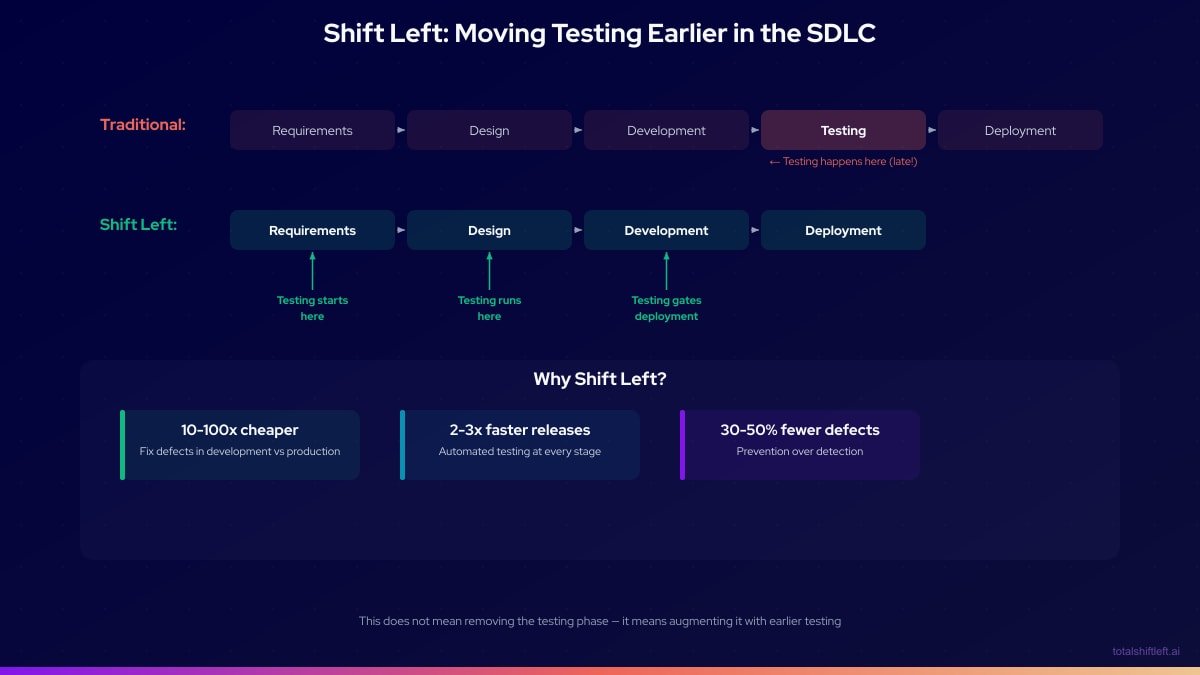
This does not mean removing the testing phase — it means augmenting it with earlier, continuous testing so that fewer defects survive to later stages.
Traditional Testing vs. Shift Left Testing
| Dimension | Traditional Testing | Shift Left Testing |
|---|---|---|
| When testing starts | After development completes | During requirements and design |
| Who tests | Dedicated QA team | Developers, QA, and automation together |
| Test types | Primarily manual functional testing | Unit, integration, contract, API, and e2e |
| Feedback speed | Days to weeks | Minutes to hours |
| Defect discovery cost | High (late-stage fixes) | Low (early-stage fixes) |
| CI/CD integration | Optional or bolted on | Core requirement |
| Test ownership | QA team | Shared across the team |
| Automation maturity | Often low | High — automation is central |
| Tooling | Testing tools separate from dev tools | Integrated into the development workflow |
| Cultural approach | Quality is QA's job | Quality is everyone's responsibility |
The shift left model aligns with modern software delivery practices: agile sprints, continuous integration, DevOps testing strategy, and microservices architectures all benefit from and reinforce shift left principles. For a detailed comparison of how shift left differs from shift right approaches, see Shift Left vs Shift Right Testing.
Martin Fowler, whose writing on software architecture and agile development has influenced an entire generation of engineering practice, frames this as the natural evolution of quality thinking — moving from inspection to prevention, from detection to design. You can explore his foundational writing at martinfowler.com.
IBM's technical resources on shift left testing (available at ibm.com/think/topics/shift-left-testing) provide a solid definitional baseline, but implementing shift left effectively requires going deeper into tooling, pipeline design, and cultural change — which is what the rest of this guide covers.
Why Shift Left Testing Is Important
The Cost of Late Defects
The economics of defect discovery are unambiguous. A bug caught in a code review costs a developer 15 minutes. The same bug caught in a QA regression cycle costs a day of investigation and a fix cycle. That same bug discovered in production costs incident response time, customer impact, escalation meetings, hotfix deployment, and potential SLA penalties. Shift left testing attacks the problem at its source.
Release Cadence Demands Earlier Quality
In 2026, high-performing engineering teams are shipping code multiple times per day. That cadence is only possible if quality is embedded in the development process rather than bolted on at the end. Teams that still rely on manual regression testing before each release find themselves bottlenecked, unable to match the pace of modern delivery expectations.
Microservices Multiply Integration Risk
Modern applications are not monoliths. They are composed of dozens or hundreds of independently deployed microservices, each with its own API contracts, deployment schedules, and ownership teams. When any one of those services breaks a contract, every dependent service is potentially affected. Without shift left practices like contract testing and API validation integrated early, integration failures cascade through the system and are discovered only after deployment — the worst possible time. For microservices teams, a dedicated API testing strategy for microservices is essential.
Developer Productivity and Feedback Loops
Short, tight feedback loops are a core principle of high-performing engineering teams. When developers receive test results within minutes of writing code, they can fix issues while context is fresh. When they receive feedback days later through a QA report, they must reconstruct mental context for code they may barely remember writing. Shift left testing shortens these loops dramatically. For a deeper look at the measurable impact, see Benefits of Shift Left Testing in Modern Software Development.
Regulatory and Compliance Requirements
For teams in regulated industries — financial services, healthcare, government — shift left testing provides auditable evidence that quality was considered from the start. This documentation is increasingly required for compliance frameworks like SOC 2, HIPAA, and PCI-DSS.
Key Components of Shift Left Testing
Unit Testing
Unit tests verify the smallest testable units of code — individual functions, methods, or components — in isolation. They are the fastest, cheapest tests to write and run. In a shift left approach, unit tests are written alongside the code they test, often following test-driven development (TDD) principles where tests are written before the implementation.
Ready to shift left with your API testing?
Try our no-code API test automation platform free. Generate tests from OpenAPI, run in CI/CD, and scale quality.
A robust unit test suite catches logical errors immediately, provides living documentation of expected behavior, and enables confident refactoring. Teams should aim for high unit test coverage (typically 80%+) for business-critical code paths.
Integration Testing
Integration tests verify that multiple components work together correctly. In a microservices architecture, this typically means verifying that service-to-service communications function as expected — that API calls return the right data, that message queue consumers process events correctly, and that database interactions behave as intended.
Integration tests are slower than unit tests but faster than end-to-end tests. They sit in the middle of the testing pyramid and are critical for catching issues that unit tests miss: timing issues, configuration problems, and contract violations between services.
Contract Testing
Contract testing is one of the most powerful components of shift left testing for microservices teams. It verifies that the interface contract between a service provider (an API) and its consumers is maintained independently, without requiring both services to be running simultaneously.
Tools like Pact allow teams to define consumer expectations as formal contracts, verify those contracts against the provider independently, and detect breaking changes before they reach a shared environment. This enables teams to deploy services independently with confidence. For a hands-on walkthrough, see Contract Testing for Microservices: A Practical Guide.
API Testing
API testing validates the behavior, performance, and security of HTTP APIs. In a shift left model, API tests are generated and run as early as possible — ideally through schema-aware generation from the API specification (OpenAPI/Swagger) before the implementation is even complete. This allows teams to validate contracts, test edge cases, and identify issues while there is still time to address them cheaply.
Shift-Left API automates this process by importing OpenAPI or Swagger specifications and automatically generating comprehensive API test suites. Tests cover happy paths, error conditions, boundary cases, and security scenarios — and run directly in CI/CD pipelines on every code change.
Static Analysis and Code Quality
Static analysis tools scan code without executing it, identifying potential bugs, security vulnerabilities, code style violations, and complexity issues. Tools like SonarQube, ESLint, and Checkmarx integrate directly into development workflows and provide feedback before code is even committed.
Static analysis is the earliest possible form of shift left testing — it catches issues before they become functional bugs. Security-focused static analysis (SAST) is increasingly required for compliance and is most effective when integrated at the development stage rather than applied as a post-hoc scan.
Test-Driven Development (TDD) and Behavior-Driven Development (BDD)
TDD and BDD are development methodologies that make testing the starting point rather than the afterthought. In TDD, developers write failing tests first, then implement the minimum code to make them pass, then refactor. In BDD, teams define expected behaviors in plain language before implementation, bridging the gap between business requirements and technical tests.
Both approaches ensure that tests are not an afterthought but a design artifact — they define what the system should do before the system is built.
Shift Left Testing Architecture and Pipeline
A well-designed shift left testing pipeline integrates quality checks at every stage of the development workflow. For a step-by-step walkthrough of building this pipeline from scratch, see our guide on how to build a CI/CD testing pipeline. The following architecture shows how testing layers map to CI/CD stages:
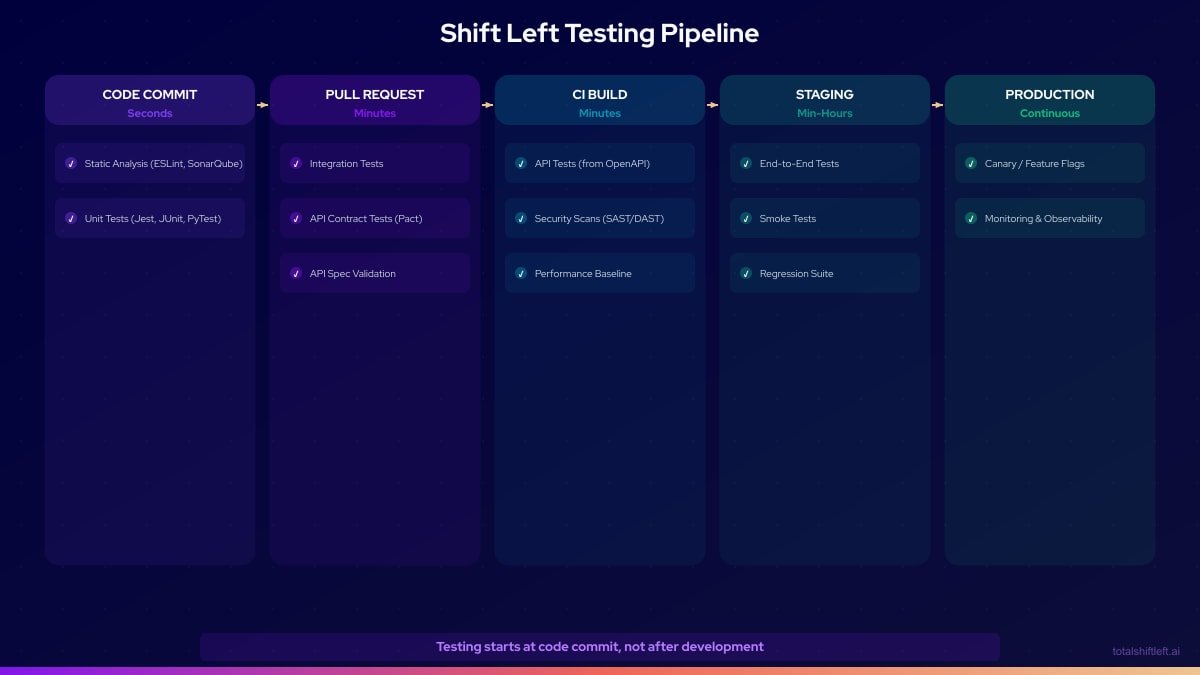
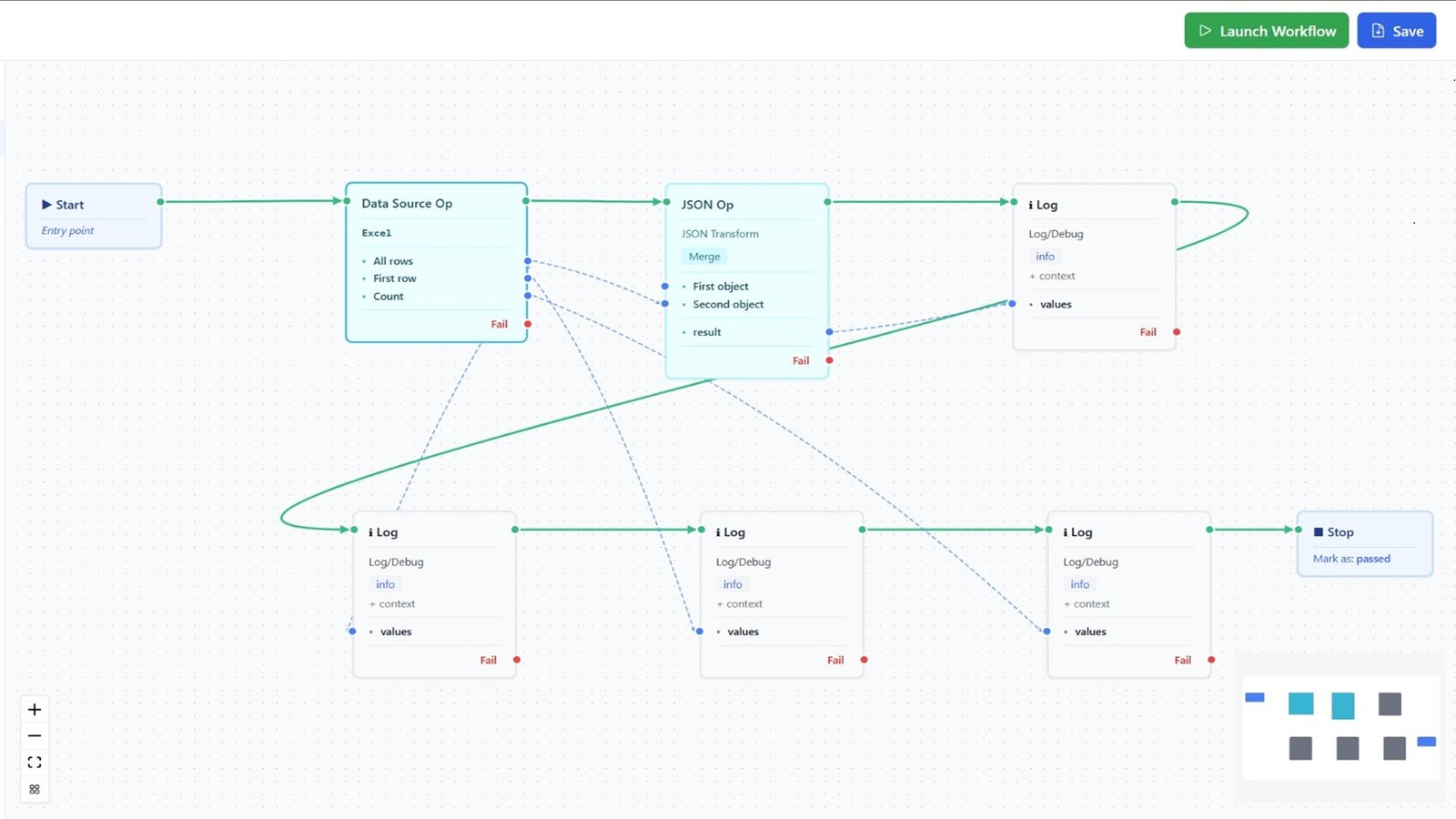
The diagram above illustrates how Shift-Left API integrates API testing into this pipeline architecture. API specs are imported, tests are generated automatically, and test suites execute at each CI/CD stage — providing fast, reliable feedback without requiring manual test authoring. For a comprehensive walkthrough, see our guide on automated testing in CI/CD.
The key principle is fail fast, fail early. Each stage acts as a quality gate. Code that fails static analysis never reaches integration testing. Code that fails contract tests never reaches staging. This ensures that only code meeting quality standards advances through the pipeline, and defects are caught at the earliest, cheapest point.
Tools for Shift Left Testing
| Category | Tools | Notes |
|---|---|---|
| Unit Testing | Jest, JUnit, PyTest, Mocha, NUnit | Choose based on language stack |
| API Testing | Shift-Left API, Postman, REST Assured, Karate | TSL auto-generates from OpenAPI specs |
| Contract Testing | Pact, Spring Cloud Contract | Pact is language-agnostic |
| Static Analysis | SonarQube, ESLint, Checkmarx, Semgrep | Integrate at commit/PR stage |
| Performance Testing | k6, Gatling, JMeter, Locust | Run baseline perf tests in CI |
| Security Testing | OWASP ZAP, Snyk, Dependabot, Burp Suite | SAST early, DAST in staging |
| CI/CD Integration | GitHub Actions, GitLab CI, Jenkins, CircleCI | Pipeline orchestration layer |
| Test Management | TestRail, Xray, Zephyr | Track coverage and results |
| Mock Servers | WireMock, MockServer, TSL Mocks | Isolate services for early testing |
| Code Coverage | Istanbul, JaCoCo, Coverage.py | Track and enforce coverage thresholds |
Why Shift-Left API Stands Out
Traditional API testing tools require developers and QA engineers to manually write test cases — a time-consuming process that often lags behind API development. Shift-Left API eliminates this bottleneck by automatically generating comprehensive API test suites from OpenAPI or Swagger specifications.
The workflow is straightforward:
- Upload your OpenAPI/Swagger spec to Shift-Left API
- The platform automatically generates test cases covering all endpoints, methods, parameters, and response codes
- Tests execute in your CI/CD pipeline on every code change
- Results and analytics are available in the dashboard

This approach ensures that API tests are always current with the spec, coverage is comprehensive by default, and teams do not need deep automation expertise to maintain a high-quality test suite. The no-code approach makes shift left testing accessible to the entire team, not just automation specialists.
Real Implementation Example
Problem
A mid-market SaaS company was shipping a platform built on 14 microservices. Each service had its own API, and the services communicated heavily with each other. The team's testing process was largely manual: QA engineers would receive builds, conduct exploratory testing, and report bugs. With 3-week sprint cycles and a QA team of 4 for a development team of 22, the bottleneck was severe.
Defects discovered in staging and production were common. One quarter, a breaking API change in the authentication service went undetected until it reached production, taking down customer sessions for 3 hours. The post-mortem identified the root cause: no automated contract tests, no API regression suite, and no systematic validation of service interfaces.
Solution
The team adopted a shift left testing strategy centered on three changes:
1. API Test Automation with Shift-Left API. The team imported all 14 OpenAPI specifications into Shift-Left API. Within a day, they had comprehensive test suites for every service, covering 200+ endpoints. Tests were integrated into their GitHub Actions CI/CD pipeline, executing on every pull request.
2. Contract Testing with Pact. For the service interfaces most prone to breaking changes, the team implemented consumer-driven contract tests using Pact. Contracts were verified as part of every CI build, so a breaking change in the auth service would fail the build immediately — before it ever reached staging.
3. Shift Left Culture. The team restructured their Definition of Done to require passing API tests and contract validation before a pull request could be merged. QA engineers shifted from manual testing to building and maintaining the test strategy, reviewing coverage gaps, and contributing to contract definitions.
Free PDF (10 pages)
Shift Left Testing Playbook
Move testing earlier in your SDLC with a proven adoption roadmap. Includes CI/CD architecture, tool stack recommendations, and metrics to track success.
Download FreeResults
Within two quarters:
- Defect escape rate to production dropped by 38%
- Average time-to-detect for API issues fell from 4 days to under 2 hours
- The quarterly production incident caused by an API breaking change became rare — the team went 6 months without a similar incident
- Developer confidence in merging cross-service changes increased measurably
- QA team capacity freed up for exploratory and user experience testing
Common Challenges and Solutions
Challenge 1: Cultural Resistance
Problem: Developers resist taking on testing responsibilities. QA teams worry about their role being eliminated. Leadership does not see immediate ROI.
Solution: Frame shift left as a quality investment, not an additional burden. Show early wins: demonstrate how a shift left pipeline caught a real bug before it reached production. Involve QA engineers as quality architects, not just test executors. Start with one team as a proof of concept.
Challenge 2: Lack of Automation Skills
Problem: The team wants to implement automated testing but lacks the expertise to write and maintain test code.
Solution: Use no-code tools like Shift-Left API that generate tests automatically from API specifications. This removes the need for deep automation expertise and makes shift left testing accessible to teams at any skill level. Pair skill-building with practical implementation — learn while doing.
Challenge 3: Slow Test Suites
Problem: As the test suite grows, CI pipelines slow down, creating frustrating feedback loops that push teams to skip tests.
Solution: Structure tests in layers. Run unit tests and static analysis on every commit (seconds). Run API and integration tests on pull requests (minutes). Run end-to-end tests only on merge to main or before staging deployment. Parallelize test execution. Set time limits for each layer to enforce performance standards.
Challenge 4: Test Environment Complexity
Problem: Integration tests require dependent services to be running, which is complex to manage in a CI environment.
Solution: Use mock servers to simulate dependencies. Shift-Left API includes built-in mock server capabilities that allow API tests to run against realistic service simulations without requiring live upstream dependencies. WireMock and MockServer are also strong options for custom mock implementations.
Challenge 5: Keeping Tests Synchronized with Code
Problem: As APIs evolve, manually maintained tests become stale and incorrect, creating false confidence.
Solution: Generate tests from the source of truth — the OpenAPI/Swagger spec. When the spec changes, regenerate or update the tests. Shift-Left API's spec-driven approach means tests always reflect the current API definition. Implement spec-first development so the contract is defined before implementation begins.
Best Practices
- Start with a testing pyramid mindset. Prioritize fast, cheap unit tests at the base, integration tests in the middle, and end-to-end tests at the top. Do not invert the pyramid.
- Define quality gates in your CI/CD pipeline. Make tests non-optional. A failing test should block a merge, not just trigger a notification.
- Generate API tests from your OpenAPI/Swagger spec. Spec-driven test generation ensures coverage is comprehensive and tests stay synchronized with the API definition.
- Implement contract testing for microservices. Consumer-driven contract tests catch breaking interface changes before they reach shared environments.
- Make tests fast. Aim for sub-5-minute feedback on every commit. Slow pipelines lead to skipped tests.
- Track and enforce coverage thresholds. Coverage metrics should be monitored and minimum thresholds enforced as part of the build process.
- Involve QA engineers as quality architects. QA's role in a shift left model is defining quality strategy, building test infrastructure, and identifying coverage gaps — not manual regression testing.
- Treat flaky tests as bugs. A flaky test is worse than no test. It creates noise, erodes trust in the pipeline, and causes teams to ignore failures. Fix or delete flaky tests immediately. For common adoption obstacles, see shift left testing challenges.
- Review testing at every sprint retrospective. Quality metrics, test coverage trends, and pipeline performance should be part of every team retrospective discussion. Apply DevOps testing best practices to maintain high testing standards across the team.
- Document your testing strategy. Teams should have a written test automation strategy that defines what types of tests exist, where they run, what they cover, and who owns them.
Shift Left Testing Checklist
Use this checklist to assess your team's shift left readiness:
- ✔ Unit tests are written alongside code and run on every commit
- ✔ API tests are generated from OpenAPI/Swagger specs and integrated into CI/CD
- ✔ Contract tests exist for inter-service interfaces in microservices architectures
- ✔ Static analysis and security scanning run at the pull request stage
- ✔ CI/CD pipeline has defined quality gates that block progression on test failure
- ✔ Mock servers are available for integration test isolation
- ✔ Test coverage is tracked and minimum thresholds are enforced
- ✔ The team's Definition of Done includes passing tests
See also: contract testing in our learn hub for the underlying concept.
Frequently Asked Questions
What is shift left testing?
Shift left testing is an approach to software quality that moves testing activities earlier in the development lifecycle — ideally starting during requirements and design — rather than waiting until after code is written. This reduces defect cost, accelerates feedback loops, and improves release quality.
What is the difference between shift left and traditional testing?
Traditional testing happens at the end of the development cycle, typically after code is complete. Shift left testing integrates testing from the very beginning — during requirements, design, and development — so defects are found and fixed before they become expensive to repair.
What tools are used for shift left testing?
Common shift left testing tools include automated test frameworks (Jest, JUnit, PyTest), API testing platforms (Shift-Left API, Postman), contract testing tools (Pact), static analysis tools (SonarQube), and CI/CD integrations (GitHub Actions, Jenkins, GitLab CI). No-code platforms like Shift-Left API make shift left accessible without requiring deep automation expertise. For a detailed comparison, see Best Shift Left Testing Tools for DevOps Teams.
How does shift left testing reduce costs?
IBM research shows that bugs fixed in production cost significantly more than bugs caught during design. By catching defects earlier — at the unit, integration, and API test layer rather than in production — shift left testing dramatically reduces the rework, escalation, and outage costs associated with late-stage defect discovery. Teams using shift left approaches consistently report 30-40% reductions in defect escape rates.
Conclusion
Shift left testing is the most effective strategy available to engineering teams in 2026 for delivering software that is both fast and reliable. By embedding testing from the earliest stages of development, organizations catch defects when they are cheapest to fix, shorten feedback loops for developers, and build the automation infrastructure necessary for sustainable high-velocity delivery.
The path to shift left maturity is incremental: start with unit tests, add API testing from your OpenAPI specs, implement contract testing for your most critical service interfaces, and enforce quality gates in your CI/CD pipeline. Each step compounds the benefits of the previous one. Shift-Left API accelerates this journey by automating API test generation from your existing API specifications — making comprehensive shift left testing accessible without requiring a large automation engineering investment. Start your free trial today.
Related: Shift Left Testing Strategy | Benefits of Shift Left Testing | Common Challenges in Shift Left Testing | Shift Left vs Shift Right Testing | How Shift Left Testing Works in CI/CD | Best Shift Left Testing Tools | Continuous Testing vs Shift Left Testing | API Testing Strategy for Microservices | Contract Testing for Microservices | API Testing for Microservices Platforms | Top API Testing Tools | REST API Testing Best Practices | API Testing vs UI Testing | How to Automate API Testing in CI/CD | Automated Testing in CI/CD | How to Build a CI/CD Testing Pipeline | Top Test Automation Tools for CI/CD | Test Automation Strategy | How to Build a Test Automation Framework | Best No-Code Test Automation Tools | Manual Testing vs Automation Testing | DevOps Testing Strategy | Testing in DevOps | Best Practices for Test Automation in DevOps | Best Testing Tools for Microservices | Unit Testing vs Integration Testing vs System Testing | Functional Testing vs Integration Testing | End-to-End Testing vs API Testing | Smoke Testing vs Regression Testing | Black Box Testing vs White Box Testing | No-code API testing platform | Start Free Trial
Ready to shift left with your API testing?
Try our no-code API test automation platform free.