
What Is API Contract Testing? Consumer-Driven Contracts, Pact, and Schema-First Microservices (2026)
Quick answer
API contract testing verifies that a service implementation matches the OpenAPI or Pact contract its consumers depend on, catching breaking changes before they reach production. It runs in CI on every change to either side of the contract, fails fast when the producer or consumer drifts, and is the single most effective practice for keeping microservices integrations stable.
Reviewed by Sushant Joshi
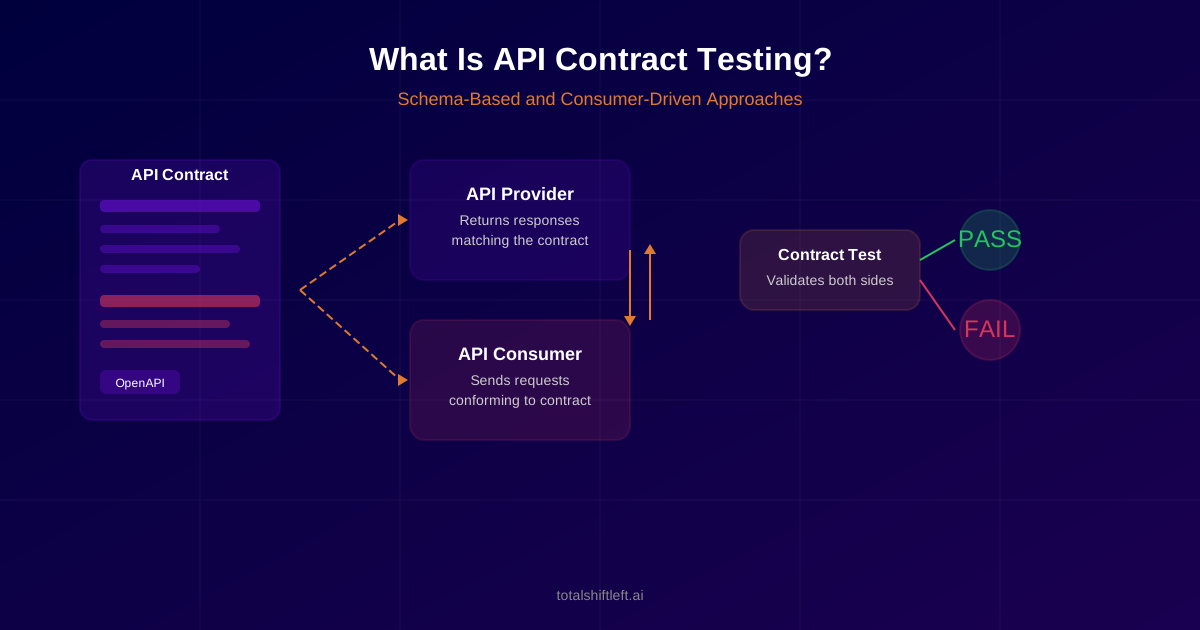
**API contract testing** is the discipline of verifying that an API provider and its consumers continue to honor a shared, machine-readable interface agreement — covering endpoints, request and response schemas, status codes, headers, authentication, and data types — on every commit. It is implemented either schema-first (against an OpenAPI, AsyncAPI, or Protobuf specification) or consumer-driven (against a Pact-style contract each consumer publishes), and it runs inside the pull request so breaking changes never reach staging, let alone production.
Contract testing is the safety net microservices architectures require. The World Quality Report 2025 found that 71% of organizations now run more than 100 internal APIs, and the DevOps Research and Assessment (DORA) team reports that elite performers — teams that deploy multiple times per day with change failure rates under 5% — are 2.6x more likely to practice systematic contract testing than low performers. The arithmetic is simple: without an automated boundary check, coordinated deploys become mandatory and the independent-deployment promise of microservices collapses.
Table of Contents
- Introduction
- What Is API Contract Testing?
- Why This Matters Now for Engineering Teams
- Key Components of API Contract Testing
- Reference Architecture
- Tools and Platforms
- Real-World Example
- Common Challenges
- Best Practices
- Implementation Checklist
- FAQ
- Conclusion
Introduction
Every distributed system hits the same wall. A backend engineer renames user_name to username in a response payload. The OpenAPI spec is not updated. The change passes unit tests and a green integration build, and ships. Forty minutes later a mobile app starts throwing parse errors in production and an incident channel lights up. The interface broke silently because nothing was watching the boundary.
Contract testing watches the boundary. Rather than relying on code review or slow end-to-end tests to catch interface drift, contract testing treats the interface as a first-class, machine-checked artifact that every commit must prove — in seconds, inside the pull request — still honors what every consumer depends on.
This guide explains API contract testing in 2026, how consumer-driven and schema-first approaches differ, how Pact and OpenAPI-driven tooling implement the pattern, and how teams adopting a shift-left AI-first API testing platform push contract coverage to 100% without hand-writing tests. For fundamentals see our API Learning Center — what is an API and request/response anatomy.
What Is API Contract Testing?
An API contract is the formal agreement between an API provider and every party that calls it. It specifies which endpoints exist, which HTTP methods they accept, what the request body and query parameters look like, what the response body and headers look like, which status codes are valid, how authentication is proved, and how errors are represented. The contract can be explicit — expressed as an OpenAPI 3.x document, a Protobuf .proto file, a GraphQL SDL, or a Pact JSON file — or implicit, living only in code and tribal knowledge. Contract testing requires the explicit form.
API contract testing is the automated practice of verifying, on every change, that both sides still honor that agreement. The provider must return responses that match the contract. Consumers must send requests that conform to it. When either side diverges, contract tests fail in CI and block the merge.
Contract testing is deliberately narrow. It is not functional testing — it does not verify that creating an order actually deducts inventory. It is not performance testing. It is not security testing. It answers one focused question: does the interface structurally conform to what was promised? That narrowness is the source of its leverage. Because contract tests only touch the interface layer, they are fast (milliseconds per test), deterministic, dependency-free, and trivially parallel. Because they run on every commit, they catch the full class of interface regressions before the code is merged.
The industry recognizes two canonical implementations. Schema-first contract testing uses a provider-owned specification — usually OpenAPI — as the single source of truth and validates the running implementation against it. Consumer-driven contract testing (CDCT) inverts the relationship: each consumer publishes a contract describing what it needs from the provider, and the provider must satisfy the union of those contracts. Pact is the dominant CDCT implementation. Mature organizations combine both. For a dedicated lesson, see contract testing in the learning center.
Why This Matters Now for Engineering Teams
Microservices removed the compiler
In a monolith, a renamed function signature breaks the build. That safety net disappears the moment a network hop appears between two components. Microservices teams effectively return to pre-type-safe development — unless they add contract testing to the commit path. This is why NIST and IBM defect-cost research has held up so consistently across decades: the cheapest place to catch an interface bug is the commit that introduced it, and the most expensive place is production.
Release cadence has compressed past coordinated releases
The DORA State of DevOps reports that elite teams deploy to production multiple times per day. That cadence is incompatible with the old contract-enforcement pattern of shared staging environments, cross-team release trains, and manual compatibility spreadsheets. Only automated contract testing run inside the pull request scales to daily or hourly deploys. See shift-left testing in CI/CD pipelines for pipeline patterns and API testing CI/CD integration for tooling.
Schema drift is a top incident driver
The World Quality Report 2025 identifies "undetected API schema drift" as a top-three cause of production incidents in distributed systems. Drift happens in both directions: the code changes without the spec being updated, or the spec changes without the code catching up. Schema-first contract tests catch the first direction; consumer-driven contracts catch the second. For deeper coverage, see API schema validation and catching drift and validation errors.
Consumer diversity is growing
Modern APIs serve mobile apps, partner integrations, internal microservices, and increasingly autonomous AI agents. Each consumer reads a different subset of the response. A field that looks optional from the provider's view may be load-bearing for one downstream team. Consumer-driven contracts make those hidden dependencies visible.
End-to-end tests do not scale to microservice fleets
IBM's engineering productivity studies show that end-to-end test suites grow super-linearly with service count and eventually consume more engineering time than they save. Contract tests are the escape hatch: they catch most interface-level regressions end-to-end tests find, in seconds, with no shared environment.
Key Components of API Contract Testing
The contract artifact itself
The contract must be explicit, versioned, and machine-readable. In practice this means an OpenAPI 3.x or Swagger 2.0 document for REST, an AsyncAPI document for event-driven APIs, a .proto file for gRPC, a GraphQL SDL for GraphQL, or a Pact JSON file for CDCT. The contract lives in source control alongside the service code, not in a wiki. Deeper material: OpenAPI test automation and how to generate API tests from OpenAPI.
Schema validation engine
The validation engine compares a live response — status code, headers, body, and content type — against the contract. It must verify required fields, type correctness, enum constraints, format rules (date-time, uuid, email), pattern regex, minimum/maximum numeric bounds, minLength/maxLength, and additionalProperties: false where declared. Shallow engines that only check status codes miss 80% of drift. See AI-assisted negative testing.
Test generation
Hand-writing contract tests for a 400-endpoint API is not viable. Modern schema-first tooling reads the spec and auto-generates the positive, negative, and boundary cases for each endpoint. AI-first platforms go further: they infer realistic request payloads, chain dependent calls (create → read → delete), and produce assertions a human would write. See generate tests from OpenAPI.
Consumer pact capture (for CDCT)
In Pact-style testing, the consumer's existing unit tests double as pact recorders — every call to a Pact mock produces a JSON interaction that, in aggregate, becomes the consumer's published contract. No separate authoring step exists. The Pact Broker stores these pacts, versions them, and exposes can-i-deploy APIs.
Provider verification
The provider's CI job fetches every published pact for its current version and replays each interaction against a running instance of the service. Every pact must pass before the provider can deploy. This is the step that makes CDCT asymmetric — consumers set expectations, the provider must honor them.
Ready to shift left with your API testing?
Try our no-code API test automation platform free. Generate tests from OpenAPI, run in CI/CD, and scale quality.
CI/CD integration and deployment gates
Contract tests deliver value only when they gate deployment. First-class integrations for GitHub Actions, GitLab CI, Azure DevOps, Jenkins, and CircleCI — plus JUnit XML, SARIF, and PR-annotation output — are non-negotiable. Guide: API test automation with CI/CD step-by-step.
Drift detection and observability
A dedicated layer continuously compares the running API's actual responses to the committed schema, flagging undocumented fields, type mismatches, and removed endpoints. Observability — diffs, historical trends, flakiness scoring, one-click local reproduction — determines whether developers trust the tool or bypass it. Analytics coverage: features/analytics-monitoring.
Governance: versioning, deprecation, breaking-change policy
Contracts need semantic versioning, deprecation windows, and a documented breaking-change policy. A platform that silently rewrites a consumer's contract on every deploy is worse than no testing at all. Policy guardrails belong in governance, not in individual pull requests.
Reference Architecture
A production-grade API contract testing architecture is a five-layer pipeline connecting source artifacts to deployment gates.
The source layer holds the contract artifacts. For schema-first, this is the OpenAPI or Protobuf file committed alongside the service code, with Spectral or a similar linter enforcing quality on every PR. For CDCT, this is the Pact Broker, which stores published consumer pacts and exposes them via an HTTP API. Both are the system of record; no test, mock, or SDK should derive from anything else.
The generation layer converts contracts into executable tests. In schema-first flows, an AI or template engine reads the OpenAPI document and emits positive, negative, and boundary cases per endpoint, versioned against the spec hash. In CDCT flows, the generation step is implicit — consumer unit tests produce pacts as a side effect, and provider verification tests are generated by the Pact library at runtime.
The execution layer runs tests against the target service. It resolves authentication (OAuth2, JWT, API keys, mTLS), sends requests, captures responses, and evaluates assertions against both the contract and any learned baselines. Execution is headless, parallel across endpoints, and deterministic. This layer is wired into CI/CD so every pull request runs the full contract suite.
The feedback layer surfaces results where developers work: inline PR annotations showing exactly which field drifted, diff views of expected-vs-actual responses, Slack or Microsoft Teams alerts for breaks, and dashboards tracking contract coverage over time. Without a polished feedback layer, adoption stalls regardless of how good generation is.
The governance layer cross-cuts everything: secrets management, role-based access control, multi-environment configuration, audit logs for regulated industries, versioning policy, and breaking-change workflows. This mirrors the patterns in our API testing strategy for microservices — decoupled services, cross-cutting concerns centralized.
Tools and Platforms
| Tool | Approach | Contract Format | CI/CD Integration | Best For |
|---|---|---|---|---|
| Total Shift Left | AI-first schema + consumer-driven | OpenAPI 3.x, Swagger 2.0, AsyncAPI | GitHub Actions, GitLab, Azure DevOps, Jenkins, CircleCI | Auto-generated contract suites with self-healing and drift detection |
| Pact | Consumer-driven (CDCT) | Pact JSON (language DSL) | All major CI platforms via CLI and Broker | Multi-team internal microservices with shared provider |
| Schemathesis | Schema-first property-based | OpenAPI 3.x, GraphQL | CLI-based, any CI | Fuzzing and automatic edge-case generation from spec |
| Dredd | Schema-first | OpenAPI 2.0/3.0, API Blueprint | CLI-based, any CI | Simple spec-compliance checks in lightweight pipelines |
| Postman (Newman) | Manual + imported spec | OpenAPI import | Newman CLI in any CI | Teams with existing Postman investment (migration path) |
| Spectral | Spec linting (design-time) | OpenAPI, AsyncAPI | CLI-based, any CI | Enforcing spec quality as a precondition for testing |
| ReadyAPI | Scripted + schema | OpenAPI, WSDL | Jenkins, Azure DevOps | Legacy enterprise with SOAP + REST |
| Apidog | Design + test hybrid | OpenAPI | GitHub Actions, GitLab | Small-to-mid teams standardizing on spec-first |
Deeper comparisons: best API test automation tools compared, top OpenAPI testing tools compared 2026, and the side-by-side pages ReadyAPI vs Shift Left, Apidog vs Shift Left, and best AI API testing tools 2026. Teams migrating off Postman should also read best Postman alternatives and the Postman alternative landing page.
The category is bifurcating. Legacy tools are bolting AI copilots onto script-based UIs; AI-first platforms are being rebuilt around spec-driven generation as the core primitive. The former is easier to roll out incrementally; the latter produces materially different coverage economics once an organization scales past ~50 services.
Real-World Example
Problem: A B2B payments platform with 140 engineers operated 95 internal microservices and exposed 47 partner-facing endpoints. Three internal mobile apps and two enterprise partners consumed the public API. Over six months the platform logged 11 P1 incidents caused by interface regressions — a renamed field, a tightened enum, a removed optional parameter that one partner had come to depend on. Engineering leadership mandated contract testing after the fourth outage.
Solution: The team adopted a two-track strategy. Schema-first (track one): every internal service committed an OpenAPI 3.1 spec linted with Spectral; an AI-first contract testing platform generated full positive/negative/boundary suites from each spec and wired them into the service's GitHub Actions PR checks. Generation covered 100% of endpoints in under four hours of engineer time per service. Consumer-driven (track two): for the partner-facing API, the team stood up a Pact Broker, instrumented the two mobile apps and two partner consumer test suites to publish pacts, and added a can-i-deploy gate to the provider's release pipeline. Provider deploys were blocked whenever any consumer's pact failed verification.
Results: Over the following two quarters, interface-caused P1 incidents dropped from 11 to 0. Mean time from "spec change proposed" to "all consumers verified" fell from 6 working days (spreadsheet coordination) to 8 minutes (automated can-i-deploy). Integration test runtime shrank 71% as most interface coverage moved left into contract tests. Partner complaints about undocumented breaking changes — the metric that had triggered the project — went to zero. Engineering leadership approved expanding the pattern to the 48 remaining internal services, funded by reinvesting the integration-test savings.
Common Challenges
Specifications drift from implementation
A stale OpenAPI spec turns contract testing into theater — tests pass against a fiction while the real API has moved on. This is the single most common failure mode. Solution: Treat the spec as a first-class, version-controlled artifact updated in the same pull request as the code change. Lint with Spectral on every PR and run live drift detection (schema validation against the running service) in staging. See API schema validation and catching drift.
Consumer-driven contracts create coordination overhead
Pact requires consumer teams to write and maintain pacts, stand up a broker, and wire verification into every provider pipeline. Small organizations often find CDCT heavier than schema-first justifies. Solution: Start schema-first and earn credibility with quick wins. Introduce CDCT only for specific high-risk consumer relationships — typically paid partners or revenue-critical mobile apps — where the consumer's exact field-level expectations matter more than published spec conformance.
Incomplete or sloppy specifications
Many OpenAPI documents cover only the happy path. Error responses, optional parameters, additionalProperties behavior, and security schemes are frequently missing — and contract tests against them are meaningless. Solution: Adopt a Spectral ruleset that enforces documented 400/401/403/404/409/500 responses, required example values, and additionalProperties: false on closed schemas. Audit existing specs before generating tests; fix the spec first.
Free 1-page checklist
API Testing Checklist for CI/CD Pipelines
A printable 25-point checklist covering authentication, error scenarios, contract validation, performance thresholds, and more.
Download FreeFlaky contract tests from shared data or environment drift
Contract tests that depend on specific database rows, upstream service state, or shared test environments produce false failures and erode trust. Solution: Mock upstream dependencies, use deterministic or ephemeral test data, and validate interface structure rather than data correctness. A contract test should pass regardless of which specific order ID is returned, as long as the shape is correct.
CI cost and pipeline latency
Running thousands of contract tests sequentially on every commit is prohibitively slow. Solution: Require sharded parallel execution — the Pact CLI, Schemathesis, and AI-first platforms all support it. On feature branches run only tests whose affected paths changed; run the full suite on main. Target PR feedback under 5 minutes.
Handling breaking changes gracefully
At some point you will need to make a breaking change. If contract testing blocks every breaking change absolutely, teams begin bypassing the system. Solution: Adopt semantic versioning for contracts, declare deprecations explicitly (deprecated: true in OpenAPI), give consumers a documented migration window, and use the Pact Broker's versioning to run old and new contracts in parallel during the transition.
Best Practices
- Treat the contract as code. Store the OpenAPI or Pact artifact in the service repository, review changes in pull requests, and version it with the same git history as the implementation. A contract that lives in a wiki is not a contract.
- Lint specs on every PR. Enforce Spectral (or an equivalent ruleset) as a required check. Require examples, descriptions, and complete error-response coverage. The ROI on spec quality exceeds any other single investment in contract testing.
- Generate tests from the spec; do not hand-write them. AI-first and property-based tools produce broader coverage than humans will sustain. Reserve human-written assertions for high-stakes business rules the spec cannot express.
- Gate merges, not just deployments. Contract failures must block the pull request. Failures discovered only at deploy time have already wasted engineering cycles.
- Separate schema-first from consumer-driven deliberately. Use schema-first as the universal baseline and add consumer-driven contracts only where consumer-specific dependencies are high-value. Mixing the two without clear ownership creates confusion.
- Parallelize aggressively. Shard contract execution across endpoints and test classes. Pipelines longer than 5 minutes on a pull request get ignored.
- Centralize authentication and secrets. OAuth2 clients, JWT signers, API keys, and mTLS certs belong in the platform's vault, not scattered across CI environment variables. See JWT authentication, OAuth2 client credentials, and token refresh patterns.
- Detect drift in staging, not just in CI. Run schema validation against the running staging service continuously so that drift between code and spec is caught even when it slipped through a PR.
- Invest in failure triage UX. Clear diffs, readable assertion messages, and one-click local reproduction determine whether developers trust the tool. Generation quality is wasted without feedback quality.
- Version contracts and document deprecation. Breaking changes are inevitable; hiding them is not. Use semantic versions,
deprecatedmarkers, and a public migration calendar. - Measure coverage like you measure code coverage. Track the percentage of endpoints, methods, and documented status codes with contract tests. New endpoints should not ship without coverage. Tooling: API test coverage and how to measure API test coverage.
- Combine contract testing with functional, performance, and security testing. Contract tests catch interface drift; they do not catch business-logic bugs, slow endpoints, or auth bypasses. Run them alongside each other — they are complements, not substitutes.
Implementation Checklist
- ✔ Audit every service and enumerate which have explicit contracts (OpenAPI, Protobuf, Pact)
- ✔ Commit an OpenAPI 3.x specification to each service repository alongside code
- ✔ Adopt a Spectral ruleset and enforce it as a required PR check
- ✔ Document every status code (200, 201, 400, 401, 403, 404, 409, 422, 500) in each spec
- ✔ Add
examplevalues anddescriptionfields to every schema and parameter - ✔ Select a contract testing platform (schema-first, CDCT, or both) and onboard a pilot service
- ✔ Auto-generate the baseline contract suite from each spec — do not hand-author
- ✔ Wire contract tests into the service's CI pipeline (GitHub Actions, GitLab, Azure DevOps, Jenkins)
- ✔ Configure PR-level pass/fail gates that block merges on contract failure
- ✔ Set up authentication (OAuth2, JWT, API keys, mTLS) in the platform's vault
- ✔ Stand up a Pact Broker if consumer-driven contracts are in scope
- ✔ Enable
can-i-deploygating in provider release pipelines for CDCT - ✔ Configure sharded parallel execution so PR feedback stays under 5 minutes
- ✔ Add live drift detection against staging so code-to-spec drift is caught continuously
- ✔ Publish a semantic versioning and breaking-change policy for contracts
- ✔ Integrate failure notifications into Slack or Microsoft Teams channels
- ✔ Track coverage KPIs: percent of endpoints covered, drift-caught-pre-merge, PR pass rate
- ✔ Expand from pilot to the next service after 2–4 weeks of stable results
- ✔ Review contract coverage and incident attribution quarterly against baseline metrics
FAQ
What is API contract testing in simple terms?
API contract testing is the practice of verifying that an API provider and its consumers agree on a shared interface — endpoints, request and response schemas, status codes, headers, and data types — and that both sides continue to honor that agreement on every change. Rather than discovering mismatches at runtime in staging or production, contract tests catch them inside the pull request by validating the running code against the committed contract (an OpenAPI spec, a Pact file, or a Protobuf definition).
What is the difference between consumer-driven contract testing and schema-first contract testing?
Schema-first contract testing uses a provider-owned specification (typically OpenAPI) as the single source of truth and validates the implementation against it. Consumer-driven contract testing inverts that perspective — each consumer publishes a contract describing only the fields and behaviors it actually depends on, and the provider must satisfy every consumer's contract before it can deploy. Schema-first is simpler to start with and scales to unknown consumers; consumer-driven (typically implemented with Pact) gives sharper protection for a fixed set of internal consumers.
How does Pact implement consumer-driven contract testing?
Pact works in two phases. Consumers write tests using a Pact DSL that records expected interactions against a mock provider; Pact serializes those interactions into a JSON pact file and publishes it to a Pact Broker. The provider then runs verification tests that replay every pact against the real service. If every consumer's pact passes, the provider can deploy safely. The broker adds can-i-deploy checks, versioning, and webhooks to tie verification into CI/CD.
Do I still need contract testing if I have integration and end-to-end tests?
Yes. Integration and end-to-end tests verify that services work together in a deployed environment; they run late, require shared infrastructure, and scale poorly as microservice count grows. Contract tests verify interface compliance independently per service in seconds, with no dependencies, and catch the same class of breaking changes hours or days earlier. In a mature pipeline, contract tests replace most interface-focused integration tests and leave end-to-end tests to validate a few critical user journeys.
How does API contract testing fit into microservices architecture?
Microservices trade compile-time type safety for network boundaries. Contract testing restores that safety by enforcing a machine-checkable interface at every service boundary. Each service owns its contract (either an OpenAPI spec or the union of its consumer pacts) and must prove compliance on every commit. This is what makes independent deployment — the core promise of microservices — practical rather than theoretical.
When should a team start adopting API contract testing?
Adopt contract testing as soon as more than one team consumes an API or as soon as you split a monolith into services. Teams that already maintain an OpenAPI spec can generate a schema-first contract test suite in under an hour with AI-driven platforms and should do so immediately. Consumer-driven contracts with Pact are worth adding when you have two or more internal consumer teams whose expectations diverge from the published spec.
Conclusion
API contract testing is not optional infrastructure for distributed systems in 2026 — it is the mechanism that keeps microservice boundaries honest and independent deployment practical. Schema-first contract testing, powered by OpenAPI and AI-driven generation, delivers the broadest coverage with the lowest onboarding cost. Consumer-driven contract testing with Pact layers on targeted protection for the specific consumer relationships that matter most. Mature organizations run both, gated inside every pull request, with drift detection watching staging continuously.
The organizations winning on DORA metrics in 2026 are not the ones with the biggest QA teams — they are the ones whose interfaces are machine-checked on every commit, whose consumers know within seconds when a provider proposes a breaking change, and whose developers have stopped fearing Friday deploys. The path is staged: commit a spec, lint it, generate the suite, gate merges on it, measure coverage, expand.
If you want to see contract testing wired end to end — OpenAPI spec in, generated positive/negative/boundary suite out, CI gating, drift detection, and self-healing on every spec change — explore the Total Shift Left platform, start a free trial, or book a live demo. First green contract run in under 10 minutes.
Related: Shift-Left AI-First API Testing Platform | How to Generate API Tests from OpenAPI | API Schema Validation: Catching Drift | API Testing Strategy for Microservices | How to Measure API Test Coverage | Best API Test Automation Tools Compared | Best Postman Alternatives | Contract Testing Learning Lesson | API Learning Center | API Contract Testing Solution | Platform Overview | Start Free Trial
Ready to shift left with your API testing?
Try our no-code API test automation platform free.