
GraphQL API Testing: How to Test Queries, Mutations & Errors
Quick answer
GraphQL API testing means sending a POST with a query and variables to one endpoint, then checking two things: the data field for correct results and the errors array for failures, because GraphQL returns HTTP 200 even when a query fails. Add schema diffing, per-field authorization, depth limits and N+1 checks, using pytest, REST Assured, k6 or Postman.
Reviewed by Smeet Gohel
Part of the API Protocols: GraphQL, SOAP, WebSocket, MCP hub. Start with the pillar guide: REST vs GraphQL vs gRPC testing.
Testing a GraphQL API means sending a POST request with a JSON body — a query string and variables object — to a single endpoint, then checking the response in two places instead of one: the data field for correct results, and the errors array for resolver-level failures. That second part is the detail most REST-testing habits miss, since GraphQL returns HTTP 200 for almost every syntactically valid request, error or not.
This guide is the GraphQL spoke of our protocols hub; for how GraphQL testing compares with REST, gRPC and SOAP, start at REST vs GraphQL vs gRPC testing. Here we cover what's actually different about GraphQL API testing, working code in the frameworks you already use, schema contracts, authorization, performance, pagination and the tools built for GraphQL.
In this guide
- What's Different About Testing GraphQL
- Testing GraphQL with the Frameworks You Already Have
- Testing Mutations
- The errors Array: Testing Failure Cases
- Invalid Queries, Minimal Selections and Fragments
- GraphQL testing tools compared
- Test the schema, not just the resolvers
- Authorization is per-field, not per-endpoint
- Query depth, complexity and the N+1 problem
- Pagination edge cases
- Common mistakes when testing GraphQL
- GraphQL API testing FAQ
What's Different About Testing GraphQL
Three structural differences from REST drive everything else in this guide:
- One endpoint, not many. Every operation — queries, mutations, subscriptions — goes to the same URL (commonly
/graphql), differentiated by the request body, not the path. - The status code doesn't tell you what happened. A GraphQL server typically returns
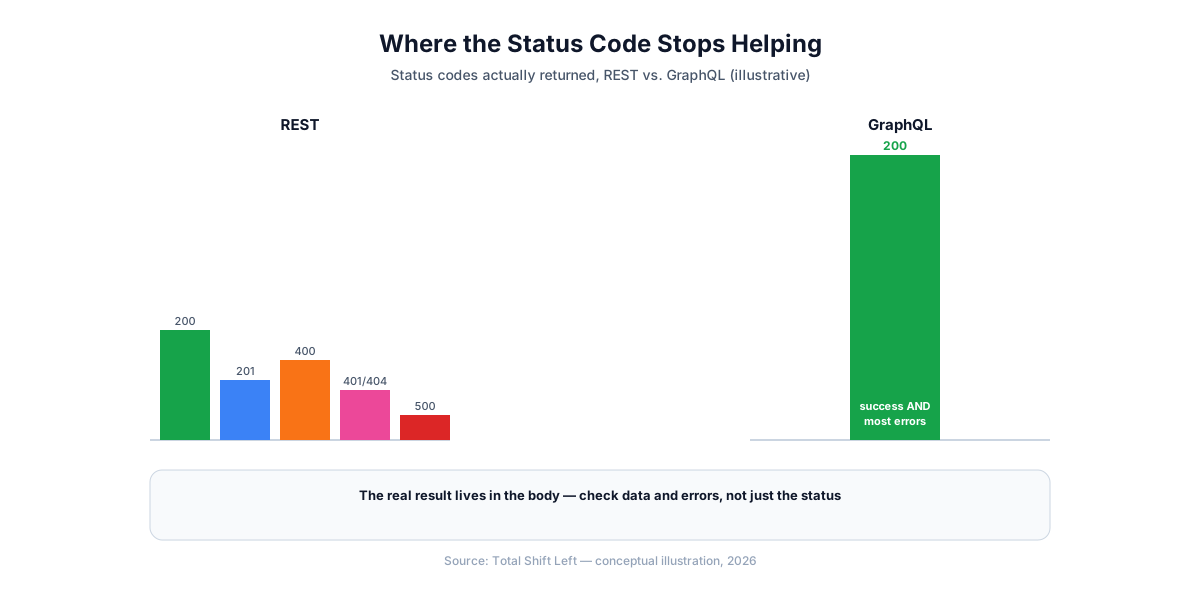
200for any syntactically valid request, whether the operation succeeded, partially succeeded, or failed at the resolver level. The real result lives in the body. - Clients choose exactly which fields to fetch. This solves REST's over-fetching/under-fetching problem by design, but means the same endpoint can return meaningfully different response shapes depending on what the client asked for — your tests need to match the query's actual field selection, not a fixed expected shape.
Testing GraphQL with the Frameworks You Already Have
Because a GraphQL request is just a POST with a JSON body, every framework already covered in this series works with no new library:
# pytest + requests
def test_graphql_get_user(api_session, base_url):
    query = """
    query GetUser($id: ID!) {
      user(id: $id) {
        id
        name
        email
      }
    }
    """
    response = api_session.post(
        f"{base_url}/graphql",
        json={"query": query, "variables": {"id": "1"}},
        timeout=10,
    )
    body = response.json()
    assert response.status_code == 200
    assert "errors" not in body
    assert body["data"]["user"]["id"] == "1"
// k6
const query = `
  query GetUser($id: ID!) {
    user(id: $id) { id name email }
  }
`;

export default function () {
  const res = http.post(
    'https://api.example.com/graphql',
    JSON.stringify({ query, variables: { id: '1' } }),
    { headers: { 'Content-Type': 'application/json' } }
  );
  check(res, {
    'status is 200': (r) => r.status === 200,
    'no errors': (r) => !JSON.parse(r.body).errors,
  });
}
// REST Assured
@Test
void getUserViaGraphQL() {
    String body = """
        {"query": "query GetUser($id: ID!) { user(id: $id) { id name email } }", "variables": {"id": "1"}}
        """;

    given()
        .contentType("application/json")
        .body(body)
    .when()
        .post("/graphql")
    .then()
        .statusCode(200)
        .body("errors", nullValue())
        .body("data.user.id", equalTo("1"));
}
In Postman, select GraphQL as the request body type instead of raw JSON — Postman renders a dedicated query editor and, when introspection is enabled on the target server, autocompletes fields directly from the live schema.
Testing Mutations
Mutations follow the identical request shape — a query field in the body actually contains a mutation operation:
def test_create_post_mutation(api_session, base_url):
    mutation = """
    mutation CreatePost($title: String!, $body: String!) {
      createPost(title: $title, body: $body) {
        id
        title
      }
    }
    """
    response = api_session.post(
        f"{base_url}/graphql",
        json={"query": mutation, "variables": {"title": "foo", "body": "bar"}},
        timeout=10,
    )
    body = response.json()
    assert response.status_code == 200
    assert "errors" not in body
    assert body["data"]["createPost"]["title"] == "foo"
For every mutation, cover five cases:
- Happy path: valid input, the expected shape in
data.<mutation>, and noerrors. - Validation errors: missing required fields, wrong types and out-of-range values, asserting on the machine-readable
errors[0].extensions.code. - Authorization: call it unauthenticated and as a lower-privilege user, and assert it is refused.
- Side effects: query the record afterwards to prove the write actually landed.
- Idempotency, where the mutation is meant to be idempotent: call it twice and assert a consistent outcome.
The errors Array: Testing Failure Cases
A negative test case in GraphQL asserts on the errors array's presence and content, not a 4xx status code:
def test_get_nonexistent_user_returns_error(api_session, base_url):
    query = """
    query GetUser($id: ID!) {
      user(id: $id) { id name }
    }
    """
    response = api_session.post(
        f"{base_url}/graphql",
        json={"query": query, "variables": {"id": "999999"}},
        timeout=10,
    )
    body = response.json()
    assert response.status_code == 200  # still 200
    assert len(body["errors"]) > 0
    assert body["errors"][0]["path"] == ["user"]
Each error object typically includes a message, a path identifying which field in the query failed, and an extensions object many servers use for a machine-readable error code — check what your specific GraphQL server populates there and assert on it, since message text alone is a brittle thing to assert against.
Invalid Queries, Minimal Selections and Fragments
Invalid queries. A query that references a field the schema does not have fails validation before any resolver runs. Many servers return HTTP 400 for this, with a code such as GRAPHQL_VALIDATION_FAILED:
Generate test cases from your spec (free)
Free, runs in your browser, no sign-up needed.
{ "errors": [{ "message": "Cannot query field 'nonExistentField' on type 'User'",
               "extensions": { "code": "GRAPHQL_VALIDATION_FAILED" } }] }
A negative test should assert the status your server uses, the extensions.code, and only a loose match on the message that names the bad field. Message text is written for humans and gets reworded; codes are the stable contract.
Ask only for the fields you assert on. Over-specified selection sets make tests slow and brittle, because they break when an unrelated field is renamed:
# Brittle: breaks if timezone or preferences change
{ users { items { id name email role createdAt lastLoginAt timezone preferences { theme } } } }

# Better: the test only checks that users exist
{ users { items { id } } }
Use fragments for shared selections. When several tests need the same fields, put them in one fragment so a schema change means one edit, not ten:
fragment UserBasics on User { id name email }

query Users { users { items { ...UserBasics } } }
query User($id: ID!) { user(id: $id) { ...UserBasics } }
GraphQL testing tools compared
The schema is the contract, so most of the tooling is schema-driven:
| Tool | What it does | Schema-driven | Security checks | CI-native |
|---|---|---|---|---|
| GraphQL Inspector | Detects breaking schema changes between versions | Yes | No | Yes |
| Schemathesis | Generates queries from the schema and checks responses | Yes | Partial (fuzzing) | Yes |
| graphql-cop | Scans for common GraphQL misconfigurations | Yes | Yes | Yes |
| InQL (Burp extension) | Introspects and builds attack queries | Yes | Yes | No — interactive |
| k6 | Load-tests queries and mutations under concurrency | No | No | Yes |
| Jest or pytest with a GraphQL client | Assertions on business behaviour | No | No | Yes |
| Apollo Rover | Schema linting and composition checks for federated graphs | Yes | No | Yes |
For manual exploration alongside those:
- GraphiQL / Apollo Sandbox — in-browser query explorers, typically bundled with a GraphQL server for manual, ad-hoc exploration with schema-aware autocomplete via introspection.
- Postman — native GraphQL request body type with schema-aware autocomplete, usable for both manual exploration and, via Newman, CI-integrated automated tests.
- Insomnia — also has first-class GraphQL support with a dedicated query editor, similar to Postman's.
- Apollo Studio — a schema registry and monitoring platform for Apollo-based GraphQL APIs, useful for tracking schema changes and query performance over time rather than per-request assertions.
The two checks unique to GraphQL and easiest to forget are query depth and complexity limiting, and introspection being disabled in production. Neither appears in a REST checklist, and both are trivially exploitable when missing.
Test the schema, not just the resolvers
The schema is GraphQL's contract, and most of what breaks consumers is a schema change rather than a resolver bug. Two checks belong in CI before any query-level test runs.
Detect breaking changes on every pull request. Removing a field, making a nullable field non-null, or changing a type are the changes that break clients silently, because the query that used them simply stops working at run time rather than at build time:
# compare the branch schema against the one currently in production
npx graphql-inspector diff \
  'https://api.example.com/graphql' \
  './schema.graphql' \
  --rule considerUsage

# exits non-zero on a breaking change, which is the whole point
What counts as breaking, so the gate is calibrated:
- Breaking: removing a field or type that clients use, changing a field's type (for example
InttoString), renaming a type, changing argument types, or making an optional argument required. - Usually safe: adding fields or types, and making a required argument optional.
- Check carefully: changing nullability. Making an output field non-null is usually safe for clients; making an input field or argument non-null breaks callers that omit it.
Keep the schema artifact in the repository. A schema fetched live at test time cannot tell you what changed, because there is nothing to compare against. Committing schema.graphql and regenerating it on build turns every schema change into a reviewable diff — which is the cheapest possible review for the artifact most likely to break someone.
Authorization is per-field, not per-endpoint
This is the difference that catches teams migrating from REST, and it is a security issue rather than a testing inconvenience.
In REST, authorization is usually enforced at the route. One check per endpoint, and a test per endpoint covers it. In GraphQL there is one route, and authorization has to be enforced at each field a resolver exposes. A single over-permissive resolver leaks data through any query that can reach it — including through a nested path nobody considered:
# the intended query: a user reading their own order
query { me { orders { id total } } }

# the same schema, reached differently — is `email` protected here too?
query { order(id: "42") { customer { email phone } } }
Because authorization is per field, a denied field does not fail the whole query. A response like this is valid GraphQL, not a bug:
{
  "data": { "user": { "name": "Alice", "email": null } },
  "errors": [{ "message": "Forbidden", "path": ["user", "email"] }]
}
So the assertions are per path: the allowed fields are populated, the denied field is null, and there is an error whose path points at exactly that field. Never fail a test just because errors is non-empty without checking which path failed, and never pass one just because data is present.
The test that matters is not "can an unauthenticated user call the API". It is "can an authenticated low-privilege user reach a protected field through some path". Write those tests per sensitive field, and traverse to each field by more than one route, because the schema usually allows more than one.
Two identities are the minimum for this. Shift-Left API's API security testing add-on models them explicitly: you register a second test user (a "principal") and an access matrix of Deny, Own data only or Allow, and the generated checks — created beside your existing GraphQL tests rather than in a separate tool — try to read one user's data as the other. GraphQL-specific checks such as introspection exposure are part of the same catalogue, and findings map to the OWASP API Security Top 10 (2023) with evidence and a fix. It is a paid add-on to Professional, Custom or Enterprise, included in the Trial.
Free PDF + code examples
OpenAPI to Test Generation Template Pack
Go from OpenAPI spec to full test coverage. Includes sample specs, example generated tests, edge case patterns, and CI/CD integration guides.
Download FreeQuery depth, complexity and the N+1 problem
A REST endpoint's cost is roughly fixed. A GraphQL query's cost is chosen by the caller, which makes two failure modes worth explicit tests.
Depth and complexity limits. A deeply nested query on a schema with cyclic relationships can be expensive enough to act as a denial of service. If your server enforces a limit, assert that it does — a limit that was configured but is not active is indistinguishable from no limit until someone finds it.
For example, a deliberately deep query should come back with errors, not data:
def test_excessively_deep_query_is_rejected(api_session, base_url):
    deep_query = "query { user(id: \"1\") { posts { comments { author { posts { comments { author { id } } } } } } } }"
    response = api_session.post(
        f"{base_url}/graphql",
        json={"query": deep_query},
        timeout=10,
    )
    body = response.json()
    assert len(body.get("errors", [])) > 0
N+1 resolution. A query for 50 orders that resolves each order's customer individually issues 51 database queries. This is invisible in a functional test, which passes, and shows up as latency under load. The assertion to write is on query count rather than on the response:
// count downstream calls, not milliseconds — the threshold stays stable
test('order list does not N+1 on customer', async () => {
  const spy = instrumentDatabase();
  await graphql(`{ orders(first: 50) { id customer { name } } }`);
  expect(spy.queryCount).toBeLessThan(5);   // batched, not 51
});
Counting queries rather than timing them gives a test that fails for the right reason and does not flake on a slow CI runner.
The query-count test proves the batching exists; a load test proves it holds at concurrency. Shift-Left API's load testing add-on (also paid, also in the Trial) runs your existing GraphQL tests as load, stress or soak runs — same auth, headers and variables, with a bound data set giving each virtual user different values — and splits each step's time into connection wait, DNS, connect, TLS, time to first byte and download, so an N+1 regression shows up as server time rather than network noise.
Pagination edge cases
Most GraphQL APIs use cursor-based pagination:
{
  users(first: 10, after: "cursor-xyz") {
    edges { node { id } cursor }
    pageInfo { hasNextPage endCursor }
  }
}
Cover the first page without after, a middle page with a valid cursor, the last page (hasNextPage: false), an invalid or expired cursor (a clean error, never a 500), a page size of 0 and a page size above the maximum (rejected or capped, and documented as such).
Common mistakes when testing GraphQL
Asserting only on HTTP 200. GraphQL returns 200 for most errors, with the failure in the errors array. A test that checks the status code and nothing else passes on almost every failure. Assert on errors being absent, and on the shape of data.
Testing only the queries the frontend sends today. The schema permits every valid query, not just the ones currently in use. A field is reachable whether or not anyone reaches it yet, and that includes by an attacker.
Ignoring partial success. GraphQL can return data and errors in the same response — some fields resolved, others failed. Clients frequently mishandle this. Test it explicitly rather than assuming a response is all-or-nothing.
Treating introspection as safe by default. Introspection is a development convenience that publishes your entire schema. Whether it should be enabled in production is a decision to make deliberately, and to assert on.
Asserting on error messages verbatim. Messages are reworded often; assert on extensions.code and path instead.
Skipping schema tests because the resolvers are covered. Resolver tests verify behaviour for a schema that exists. They say nothing about whether that schema still matches what consumers were written against.
GraphQL API testing FAQ
How is testing a GraphQL API different from testing a REST API?
GraphQL uses one endpoint for every operation instead of many endpoints per resource, and it returns HTTP 200 for almost every request — including ones with resolver errors, which appear in an errors array in the response body instead of the status code. Testing GraphQL means checking both the data and errors fields, not relying on the status code the way REST testing typically does.
Do I need a special tool to test GraphQL APIs?
No. Since a GraphQL request is just a POST with a JSON body ({query, variables}) to a single endpoint, any HTTP-capable testing framework — pytest, REST Assured, Playwright, k6, Postman — tests GraphQL with no additional library, just a different body shape and response-checking pattern than REST.
Why does my GraphQL API return 200 even when there's an error?
This is standard GraphQL behavior, not a bug. A GraphQL server typically returns HTTP 200 for any syntactically valid request, and puts operation-level failures — a resolver throwing, a field not found, an authorization failure on one field — into the response body's errors array instead of the HTTP status code.
Should introspection be enabled when testing a GraphQL API?
In development and test environments, yes — introspection is what powers autocomplete and schema exploration in tools like GraphiQL and Postman. In production, it's commonly disabled or restricted, since introspection exposes your full schema (including fields you may not want publicly documented) to anyone who queries it.
What are GraphQL testing best practices?
Check the errors array before data on every test, ask only for the fields you assert on, assert on extensions.code rather than message text, diff the schema on every pull request, test authorization per field with a second user, and test depth limits, N+1 batching and pagination edge cases explicitly.
Can Shift-Left API generate tests for GraphQL APIs?
Yes. Shift-Left API generates and runs tests from a GraphQL schema on every plan, alongside REST and SOAP. It sends queries and mutations over HTTP POST; GraphQL subscriptions are not supported, and gRPC is not supported either.
Sources and further reading
- GraphQL specification — the normative language and execution semantics.
- OWASP GraphQL Cheat Sheet — depth limiting, batching and injection risks to test.
- Grafana k6 documentation — scripted load testing with thresholds you can gate on.
- GraphQL Inspector — schema diffing and breaking-change detection.
- GraphQL: Pagination — the cursor-connection pattern used above.
Key takeaways
- Check
dataanderrorsboth — a200status code alone proves almost nothing in GraphQL. - No new tooling required. pytest, REST Assured, Playwright, k6, and Postman all test GraphQL directly.
- Negative test cases assert on the
errorsarray, not a 4xx status code. - Query depth/complexity limiting is a GraphQL-specific security test with no REST equivalent — don't skip it.
- A response can be partially successful —
dataanderrorscan both be populated in the same response.
Generate GraphQL Test Coverage Automatically
Hand-writing query, mutation and error-path tests for a growing schema scales the way any hand-written suite does. Shift-Left API generates GraphQL tests from your schema, including negative and boundary cases, and runs them in CI next to your REST and SOAP suites.
Get a free developer licence to generate coverage for your own GraphQL API, or start a free trial to add security and load testing.
Continue learning
Go deeper in the Learning Center
Hands-on lessons with runnable code against our live sandbox.
GraphQL lets the client decide what data to fetch. Here's how it works and when it beats REST.
Queries read. Mutations change state. Here's the divide — and how to write both correctly.
Ready to shift left with your API testing?
Import your OpenAPI spec and get a runnable test suite, in our cloud or on your own infrastructure.