
API Testing: The Complete Guide to API Quality Assurance (2026)
Quick answer
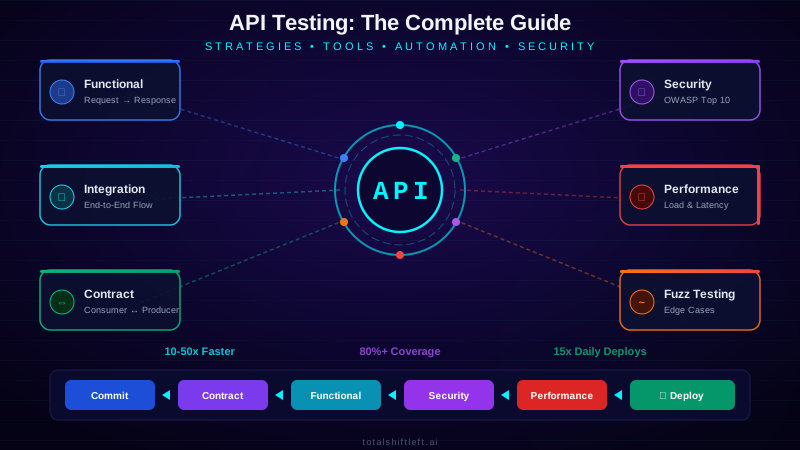
API testing validates an API directly at the service layer — sending requests and checking status codes, response bodies, headers, business logic, and performance — without going through a UI. The main api testing types are functional, integration, contract, performance, security, and fuzz testing, each validating a different quality attribute. A mature api testing process runs tests at three levels: locally before commit, automatically in CI/CD on every pull request, and as synthetic checks in production.
Reviewed by Parveen Kumari

API testing is the practice of sending requests to application programming interfaces and validating that responses, data formats, status codes, error handling, and performance meet specified requirements. It operates at the service layer of the testing pyramid, providing faster feedback and broader coverage than UI-based testing.
Modern software applications are built on APIs. Whether your team is delivering a mobile app, a SaaS platform, or a microservices ecosystem, APIs are the connective tissue that makes everything work. According to Postman's 2025 State of APIs report, over 75% of organizations now consider themselves API-first, and the average enterprise manages more than 15,000 API endpoints.
Yet despite this API-centric reality, many teams still invest the majority of their testing budget in UI-level tests that are slow, brittle, and expensive to maintain. The result is predictable: critical bugs slip through to production, integration failures cascade across services, and teams spend more time debugging than building.
This guide is designed to change that. Whether you are a QA engineer exploring API testing for the first time, a developer looking to shift testing left in your pipeline, or a test architect designing a strategy for hundreds of microservices, this pillar page will give you the complete picture — from fundamentals to advanced techniques, from tool selection to CI/CD integration.
Jump to what you need: api testing types, api testing tools, the api testing process teams run in CI/CD, the api testing checklist to audit your own coverage, or api testing interview questions if you're prepping for a QA or SDET role.
In this guide
- What Is API Testing?
- Why API Testing Is Important
- Types of API Testing
- API Testing Architecture
- API Testing Tools
- Real-World Example: E-Commerce Platform Migration
- API testing challenges and how to solve them
- Best Practices for API Testing
- API Testing Checklist
- Cluster Articles: Deep Dives
- Your first API test, in curl and in pytest
- Frequently asked questions about API testing
Three companion pieces go deeper than this overview can: the nine types of API testing for what each layer proves, how to write API test cases for the template and the boundary examples, and the API testing checklist for a pre-release pass. If you want somewhere to practise the techniques without pointing them at your own environment, public APIs for testing lists the usable sandboxes.
What Is API Testing?
API testing validates the behavior of Application Programming Interfaces at the service layer without depending on a graphical user interface. Instead of clicking through screens, testers send HTTP requests (GET, POST, PUT, DELETE, PATCH) directly to API endpoints and verify:
- Response status codes — Did the API return 200, 201, 400, 404, or 500?
- Response body — Does the JSON or XML payload contain the expected data?
- Response headers — Are content-type, caching, and security headers correct?
- Business logic — Does the API enforce rules (e.g., cannot withdraw more than the account balance)?
- Error handling — Does the API return meaningful error messages for invalid inputs?
- Performance — Does the API respond within acceptable latency thresholds?
API testing sits in the middle of the testing pyramid — above unit tests (which validate individual functions) and below UI tests (which validate end-user workflows). This position makes it the most cost-effective layer for catching integration bugs, business logic errors, and data contract violations.
REST vs GraphQL vs gRPC Testing
The testing approach varies by API protocol:
- REST APIs use standard HTTP methods and are tested by validating request/response pairs against an OpenAPI specification. REST API testing best practices apply to most web applications.
- GraphQL APIs use a single endpoint with query-based requests. Testing focuses on query validation, schema compliance, and resolver logic.
- gRPC APIs use Protocol Buffers and binary encoding. Testing requires specialized tools that understand proto definitions and streaming behaviors.
Regardless of protocol, the core testing principles remain the same: validate inputs, verify outputs, and confirm that the API contract is honored.
Estates that still run SOAP alongside REST need a second toolchain — SOAP and WSDL testing in 2026 covers what is still maintained and what WS-Security costs you.
GraphQL moves the contract into the schema and adds depth-limiting and introspection to the checklist — how to test GraphQL APIs covers both.
If you are being asked to test an MCP server rather than the API behind it, how to test MCP servers has the handshake, tool-schema and injection cases.
Why API Testing Is Important
1. APIs Carry the Business Logic
In modern architectures, the UI is a thin presentation layer. The real business rules — pricing calculations, authentication flows, data transformations — live in the API layer. Testing at this layer catches logic errors where they originate, not where they surface.
2. Faster Feedback Than UI Testing
API tests execute 10-50x faster than equivalent UI tests because they skip browser rendering, DOM manipulation, and network round-trips to load assets. A comprehensive API test suite of 500 tests can run in under 2 minutes, while the same coverage in UI tests might take 45 minutes or more.
3. More Stable and Less Flaky
UI tests break when a button moves, a CSS class changes, or a loading spinner takes an extra 200ms. API tests are immune to these cosmetic changes. They validate the contract — the inputs and outputs — which changes far less frequently than the visual layer.
4. Essential for Microservices
In a microservices architecture, APIs are the only way services communicate. If your API contracts are not tested, a change in one service can silently break ten downstream consumers. Contract testing at the API layer prevents this cascade failure.
5. Security Starts at the API Layer
APIs are the primary attack surface for modern applications. The OWASP API Security Top 10 documents the most critical API vulnerabilities, from broken authentication to mass assignment. API security testing validates that your defenses work before attackers find the gaps.
Types of API Testing
| Type | Validates | Runs Best At | Example Tools |
|---|---|---|---|
| Functional | Endpoint behavior matches spec — positive, negative, and boundary cases | Every commit / PR | Postman, REST Assured, Shift-Left API |
| Integration | API works correctly against real dependencies (DB, queues, third-party services) | CI, pre-merge | Supertest, Karate DSL |
| Contract | Producer and consumer agree on the interface shape | CI, on every change to either side | Pact, Spring Cloud Contract |
| Performance | Latency, throughput, and error rate under load | Nightly / pre-release | k6, Gatling, JMeter |
| Security | Authentication, authorization, input validation, encryption | CI + scheduled scans | OWASP ZAP, Burp Suite |
| Fuzz | Crashes, memory leaks, and unhandled exceptions from malformed input | Scheduled, lower frequency | Schemathesis, custom fuzzers |
Functional Testing
Ready to shift left with your API testing?
Try our no-code API test automation platform free. Generate tests from OpenAPI, run in CI/CD, and scale quality.
Functional API testing validates that each endpoint behaves according to its specification. This includes:
- Positive testing — Valid inputs produce expected outputs
- Negative testing — Invalid inputs trigger appropriate error responses
- Boundary testing — Edge cases (empty strings, maximum values, null fields) are handled correctly
- Data-driven testing — The same test logic runs against multiple data sets
Integration Testing
Integration testing verifies that APIs work correctly when connected to their dependencies — databases, external services, message queues, and caches. While functional tests can use mocks, integration tests hit real (or realistic) backends to validate end-to-end data flow.
Contract Testing
Contract testing ensures that the API producer and consumer agree on the interface. Tools like Pact or Spring Cloud Contract allow consumer teams to define their expectations, and producer teams to verify those expectations are met. This is critical in microservices where teams deploy independently.
Performance Testing
API performance testing measures throughput, latency, and resource consumption under load. Key metrics include:
- Response time (p50, p95, p99 percentiles)
- Requests per second (throughput)
- Error rate under load
- Resource utilization (CPU, memory, connections)
Tools like k6, Gatling, and Apache JMeter specialize in API load testing.
Security Testing
API security testing validates authentication, authorization, input validation, encryption, and rate limiting. This includes testing for OWASP API Security Top 10 vulnerabilities such as Broken Object Level Authorization (BOLA), Broken Authentication, and Excessive Data Exposure.
Fuzz Testing
Fuzz testing sends random, malformed, or unexpected inputs to API endpoints to discover crashes, memory leaks, and unhandled exceptions. It complements structured testing by finding edge cases that human testers would not think to cover.
API Testing Architecture
A mature API testing architecture operates at three levels:
Level 1 — Local Development Developers run API tests on their machines before committing code. This catches obvious errors immediately. Tests use mocked dependencies for speed.
Level 2 — CI/CD Pipeline Automated API tests run on every pull request and merge to main. The pipeline includes:
- Unit tests (fastest, most granular)
- API contract tests (verify interface compatibility)
- API functional tests (validate business logic)
- API integration tests (verify real dependencies)
- API performance baseline tests (catch regressions)
Level 3 — Production Monitoring Synthetic API tests run in production on a schedule (every 1-5 minutes) to detect outages, degraded performance, and broken integrations before users report them.
This three-level architecture ensures that API quality is validated continuously — from the developer's laptop to the production environment. Teams practicing shift-left testing push as much validation as possible to Levels 1 and 2, reducing the blast radius of defects.
API Testing Tools
| Tool | Type | Best For | Open Source | Language |
|---|---|---|---|---|
| Postman | GUI + CLI | Manual exploration + automation | Freemium | JavaScript |
| REST Assured | Library | Java-based API automation | Yes | Java |
| Karate DSL | Framewo |
rk | BDD-style API testing | Yes | Java/Gherkin | | Supertest | Library | Node.js API testing | Yes | JavaScript | | Pact | Contract | Consumer-driven contract testing | Yes | Multi-language | | k6 | Performance | API load testing | Yes | JavaScript | | OWASP ZAP | Security | API security scanning | Yes | Java | | Total Shift Left | No-Code Platform | AI-driven API test automation | SaaS | No-code |
Choosing the Right Tool
The best tool depends on your team's context:
- Small team, rapid prototyping → Postman for exploration, Supertest for automation
- Enterprise Java shop → REST Assured + Karate DSL
- Microservices with many teams → Pact for contract testing + k6 for performance
- Non-technical QA team → No-code platforms like Total Shift Left that generate tests from API specifications
- Security-focused → OWASP ZAP + Burp Suite for penetration testing
For a detailed comparison, see our best API test automation tools guide.
Real-World Example: E-Commerce Platform Migration
Problem
A mid-size e-commerce company was migrating from a monolithic PHP application to a microservices architecture with 35 API services. Their existing test suite was 90% Selenium UI tests that took 4 hours to run and had a 30% flake rate. During the migration, they experienced 12 production incidents in 3 months caused by API contract breaks between services.
Solution
The team implemented a three-tier API testing strategy:
- Contract tests with Pact — Each service defined consumer contracts. The CI pipeline rejected any change that broke a contract.
- Functional API tests — 1,200 API tests covering all critical business flows (checkout, payment, inventory, shipping). Tests ran in 8 minutes.
- Performance baselines — k6 load tests established latency baselines. Any commit causing >10% regression was flagged automatically.
Results
- Production API incidents dropped from 12 per quarter to 1
- Test suite execution time went from 4 hours to 12 minutes
- Flake rate dropped from 30% to 2%
- Deployment frequency increased from weekly to 15 times per day
- Mean Time to Recovery (MTTR) decreased by 65%
API testing challenges and how to solve them
Challenge 1: Test Data Management
Managing test data across multiple API services is complex. Each test needs specific preconditions, and shared test environments create data conflicts.
Solution: Use test data factories that create isolated data per test run. Implement API-based setup and teardown (POST to create, DELETE to clean up). Consider synthetic data generation tools for complex scenarios.
Challenge 2: Environment Dependencies
API tests that depend on external services (payment gateways, third-party APIs) are unreliable when those services are unavailable.
Solution: Use service virtualization or contract-based stubs for external dependencies. Reserve integration tests with real externals for a dedicated pipeline stage that runs less frequently.
Challenge 3: Authentication Complexity
Modern APIs use multi-layered auth (OAuth 2.0, JWT, API keys, mTLS). Setting up test authentication correctly is error-prone.
Solution: Create reusable authentication helpers that handle token generation, refresh, and injection. Store test credentials securely in CI/CD secrets management. Use service accounts dedicated to testing.
Challenge 4: Versioning and Backward Compatibility
When APIs evolve, tests must validate both the new version and backward compatibility with existing consumers.
Solution: Implement API versioning from day one. Use contract tests to verify that existing consumers are not broken. Run tests against multiple API versions in the pipeline.
Challenge 5: Keeping Tests Maintainable
As the API surface grows, test suites become large and difficult to maintain. Duplicated test logic and hard-coded values create maintenance debt.
Solution: Build a test framework with reusable request builders, assertion libraries, and data-driven patterns. Use the Page Object Model equivalent for APIs — endpoint objects that encapsulate request construction and response parsing.
Free 1-page checklist
API Testing Checklist for CI/CD Pipelines
A printable 25-point checklist covering authentication, error scenarios, contract validation, performance thresholds, and more.
Download FreeChallenge 6: Flaky Tests
Network timeouts, race conditions, and shared state cause intermittent test failures that erode trust in the test suite.
Solution: Implement retry logic with exponential backoff for transient failures. Isolate test data to prevent shared-state conflicts. Use deterministic test ordering and avoid implicit dependencies between tests.
Best Practices for API Testing
- Start with the API specification — Use OpenAPI/Swagger definitions as the source of truth for test generation. Spec-first testing ensures complete coverage.
- Test at the right level — Use the testing pyramid: many unit tests, substantial API tests, few UI tests. Do not duplicate coverage across levels.
- Automate from day one — Every new API endpoint should have automated tests before it merges. Make this a pull request requirement.
- Use contract testing for microservices — In distributed systems, contract testing is not optional. It is the primary defense against integration breaks.
- Include negative testing — Test error paths as thoroughly as happy paths. Invalid inputs, missing fields, unauthorized requests, and rate limit violations must all be validated.
- Validate response schemas — Beyond checking individual fields, validate the entire response structure against the API schema. This catches unexpected field additions or type changes.
- Monitor API performance continuously — Establish performance baselines and alert on regressions. A 50ms increase in p99 latency may indicate a serious underlying issue.
- Version your test suites — Keep tests in the same repository as the API code. Tests should evolve with the API, not lag behind.
- Integrate security testing early — Do not wait for penetration tests. Integrate OWASP ZAP or similar tools into your CI/CD pipeline for continuous security validation.
- Make tests self-documenting — Use descriptive test names that explain the business scenario, not the technical implementation. "Customer cannot checkout with expired credit card" beats "test_POST_orders_400".
- Clean up after tests — Every test should leave the environment in the same state it found it. Implement teardown logic that removes test data.
- Review test coverage regularly — Use coverage tooling that flags untested endpoints, methods, and response codes automatically. Aim for 100% endpoint coverage and 80%+ scenario coverage.
API Testing Checklist
- ✔ API specification (OpenAPI/Swagger) documented and version-controlled
- ✔ Automated functional tests for all endpoints (positive and negative scenarios)
- ✔ Contract tests between all API consumers and producers
- ✔ Authentication and authorization tests for every protected endpoint
- ✔ Input validation tests (boundary values, special characters, SQL injection, XSS)
- ✔ Error response format validation (consistent error schema)
- ✔ Performance baseline tests with defined SLOs (latency, throughput)
- ✔ Security scanning integrated into CI/CD pipeline
- ✔ Test data management strategy (factories, cleanup, isolation)
- ✔ Response schema validation against API specification
- ✔ Rate limiting and throttling tests
- ✔ API versioning and backward compatibility tests
- ✔ Test environment parity with production configuration
- ✔ Test reporting dashboard with trend analysis
Cluster Articles: Deep Dives
This pillar page connects to specialized deep-dive articles across two clusters:
API Security Testing Cluster
- API Security Testing: Complete Guide
- OWASP API Security Top 10 Explained
- How to Test API Authentication and Authorization
- JWT Authentication Testing Guide
- OAuth API Testing Best Practices
- API Penetration Testing vs API Security Testing
- Testing API Rate Limiting and Throttling
- API Security Testing Tools Comparison
- Common API Security Vulnerabilities and How to Test Them
- API Security Testing in CI/CD Pipelines
Advanced Microservices Testing Cluster
- Chaos Testing for Microservices
- Fault Injection Testing Explained
- Resilience Testing for Distributed Systems
- Service Dependency Testing Strategies
- Testing Event-Driven Microservices
- Testing Kafka-Based Microservices
- Testing Message Queue Systems
- Microservices Reliability Testing Guide
- End-to-End Testing Strategies for Microservices
- Canary Testing in Microservices Deployments
Your first API test, in curl and in pytest
Every API test is the same three steps — send a request, assert the status, assert the body against the contract. In curl that is one line per assertion:
# status code
curl -s -o /dev/null -w '%{http_code}\n' https://api.example.com/v1/orders/42

# body shape (jq -e exits non-zero when the filter is false or null)
curl -s https://api.example.com/v1/orders/42 \
  | jq -e '.id and .sku and (.qty | type == "number")'
In a test framework the same three steps become a repeatable, reportable case — this one covers the happy path, a validation failure and an authorization failure in one parametrized test:
import pytest, requests

API = "https://api.example.com"

@pytest.mark.parametrize("payload,status", [
    ({"sku": "A-1", "qty": 2}, 201),   # valid
    ({"sku": "A-1", "qty": 0}, 422),   # boundary
    ({"sku": "A-1"},           422),   # missing required field
])
def test_create_order(auth_headers, payload, status):
    r = requests.post(f"{API}/v1/orders", json=payload, headers=auth_headers)
    assert r.status_code == status

def test_create_order_requires_auth():
    assert requests.post(f"{API}/v1/orders", json={}).status_code == 401
Frequently asked questions about API testing
What is API testing?
API testing is the practice of validating Application Programming Interfaces directly by sending requests and verifying responses, business logic, security, and performance without relying on a user interface. It sits at the service layer of the testing pyramid.
Why is API testing more important than UI testing?
API testing catches defects earlier, runs faster (10-50x faster than UI tests), is more stable and less flaky, and covers the business logic layer where most critical bugs originate. Over 80% of web traffic flows through APIs, making them the backbone of modern applications.
What are the main types of API testing?
The main types include functional testing, integration testing, contract testing, performance/load testing, security testing, and fuzz testing. Each type validates a different quality attribute of the API.
How do you automate API testing?
API test automation involves using tools like Postman, REST Assured, or no-code platforms like Total Shift Left to create repeatable test suites that validate endpoints automatically. Tests are typically integrated into CI/CD pipelines for continuous validation.
What tools are used for API testing?
Popular API testing tools include Postman, REST Assured, SoapUI, Karate DSL, Swagger/OpenAPI validators, and no-code platforms like Total Shift Left. The choice depends on team skill level, tech stack, and automation requirements.
How does API testing fit into CI/CD?
API tests run as automated gates in CI/CD pipelines, typically after unit tests and before deployment. They validate contract compliance, functional correctness, and performance baselines on every commit, enabling continuous delivery with confidence.
Sources and further reading
- OpenAPI Specification — the normative spec for describing HTTP APIs.
- RFC 9110 — HTTP Semantics — the normative definition of methods, status codes and headers.
- OWASP API Security Top 10 (2023) — the reference list of API risk categories.
Key takeaways
- API testing is not just one more box to check in your quality process — it is the most efficient and impactful testing investment your team can make.
- By validating at the API layer, you catch bugs earlier, run tests faster, and build the confidence needed for continuous delivery.
- Whether you are starting with manual exploration in Postman or scaling to thousands of automated tests across hundreds of microservices, the principles in this guide apply.
- Start with a specification, automate early, test security continuously, and invest in contract testing for distributed systems.
Ready to accelerate your API testing? Start your free trial with Total Shift Left and generate comprehensive API tests from your OpenAPI specifications — no code required.
Related: What Is Shift Left Testing? | REST API Testing Best Practices | API Testing for Microservices | Contract Testing for Microservices | Best API Test Automation Tools | Automated Testing in CI/CD | Microservices Testing Complete Guide | DevOps Testing Complete Guide
Continue learning
Go deeper in the Learning Center
Hands-on lessons with runnable code against our live sandbox.
An API is how two pieces of software talk to each other. Here's what that actually means — with runnable examples.
REST is the default API style on the web. Here's what it actually means — stripped of jargon and with runnable examples.
A contract is a promise. Contract testing keeps you honest. Here's how to do it right.
Ready to shift left with your API testing?
Try our no-code API test automation platform free.