
Air-Gapped API Testing: Patterns for IL5/IL6 Workloads (2026)
Quick answer
Air-gapped API testing runs entirely inside an authorization boundary with zero outbound network connectivity — no telemetry, license check-ins, LLM API calls, or update downloads at runtime. AI-assisted test generation is viable air-gapped using self-hosted open-source LLMs (Llama 3, Qwen, Mistral) on Ollama, vLLM, or LM Studio, with model weights transferred once via approved channels like a one-way diode.
Reviewed by Sushant Joshi
How to run modern API testing — including AI-assisted test generation — inside fully air-gapped environments. Patterns for classified, DoD IL5/IL6, sovereign-cloud, and regulated-industry deployments where no outbound network is permitted.
In this guide
- What is air-gapped API testing?
- The key components of air-gapped API testing
- What air-gapped actually requires
- Five common phone-home paths
- Air-gapped AI test generation
- Update and licensing patterns
- Air-gapped API testing reference architecture
- Why air-gapped API testing matters at enterprise scale
- Air-gapped API testing tools compared
- Air-gapped API testing in practice: a worked example
- Reference architecture
- Air-gapped API testing metrics that matter
- Air-gapped API testing rollout playbook
- Air-gapped API testing challenges and how to solve them
- Air-gapped API testing best practices
- Air-gapped API testing checklist
- Run the whole test stack offline
What is air-gapped API testing?
Air-gapped API testing is the practice of running modern API testing — including AI-assisted test generation — inside an environment with no outbound network connectivity to anything outside the authorization boundary. It applies to classified workloads, DoD Impact Levels 5/6, sovereign-cloud deployments (Bleu, Delos, Microsoft Government Cloud), and other environments where any outbound dependency at runtime is a procurement-blocking issue.
If your data cannot leave the network, self-hosted LLM test generation covers running the same generation step on Ollama or vLLM inside your own boundary.
The key components of air-gapped API testing
Each enterprise program in this area has the same load-bearing components, regardless of vendor. The components separate cleanly into governance, enforcement, and evidence layers.
Mirrored container distribution
Vendor publishes signed container images and release artifacts to an external mirror; the customer pulls them across the air gap through an approved transfer process (one-way diode, controlled bastion, signed media). Customer's internal registry holds the approved versions; the platform never reaches outside.
Local LLM inference
Open-source LLMs (Llama 3, Qwen 2.5, Mistral) running on Ollama, vLLM, or LM Studio with model weights pulled across the air gap once during build-out. The platform fails closed on local-endpoint outage — no silent fallback.
Offline license management
Signed license files with fixed expiry, no runtime activation server, no "check-in every 7 days" requirement. Renewal is an offline transaction documented in the system's change management.
Local documentation bundle
Help docs ship as a local bundle inside the platform. In-app help links never open external URLs. Documentation updates ride alongside platform updates through the same approved transfer process.
Telemetry off by default
Air-gapped customers need telemetry off by default with explicit opt-in, never opt-out with a hidden phone-home. Auditing the running platform's outbound connections must show zero.
Internal CI/CD
Self-hosted GitLab Runners, internal Jenkins, internal Azure DevOps, internal GitHub Enterprise. External CI services (GitHub-hosted runners, vendor-hosted CI clouds) are excluded by definition.
What air-gapped actually requires
"Air-gapped" is one of the most misused terms in enterprise software. A useful working definition for API testing platforms in 2026:
An air-gapped deployment runs with no outbound network connectivity from the platform's authorization boundary to anything outside it. Every dependency — model weights, container images, license signatures, telemetry, documentation — must be available inside the boundary at runtime.
By this standard, most "on-prem" deployments are not air-gapped. They run on customer infrastructure but still phone home for license checks, fetch container images during scale-out, call cloud LLM APIs for AI features, or send anonymized telemetry to the vendor.
For classified workloads, DoD Impact Level 5 and 6 environments, and many sovereign-cloud deployments (e.g. Bleu in France, Delos / Wolken in Germany, Microsoft Government Cloud regions in approved configurations), air-gapped is the only authorized configuration.
Five common phone-home paths
Before procurement, walk every API testing platform through these five paths. If any of them is not configurable to "fully internal," the tool is not viable for an air-gapped deployment.
| Path | Common implementation | Air-gapped requirement |
|---|---|---|
| License check-in | Periodic call to vendor license server | Offline license file with signed expiry; no runtime check-in |
| Telemetry / analytics | Anonymized usage events to vendor | Disable-able via config; no fallback if disabled |
| Software updates | Auto-pull from vendor container registry | Pull from internal registry only; signed images |
| LLM inference | API calls to OpenAI / Anthropic / etc. | Self-hosted LLM (Ollama, vLLM, LM Studio); no fallback |
| Documentation / help | In-app links to docs.vendor.com | Local doc bundle shipped with the release |
Vendors that score well treat each of these as first-class configuration options, not exceptional cases. Vendors that don't usually have one or two paths that "just work" externally and are not safely disable-able.
Air-gapped AI test generation
The biggest shift between 2024 and 2026 is whether AI-assisted test generation is viable air-gapped. In 2024 the answer was "barely" — the available open-source models lagged cloud LLMs significantly. In 2026 the answer is "yes for most workloads."
A working configuration:
- Model selection. Llama 3 70B, Qwen 2.5 72B, or Mistral Large run with sufficient quality for OpenAPI-driven test generation. Smaller models (8B / 14B) work for simpler endpoints. For SOAP/WSDL where context windows matter, prefer 70B+.
- Inference runtime. Ollama for low-friction deployment, vLLM for higher throughput, LM Studio for desktop-class deployments. All three offer OpenAPI-compatible endpoints that test platforms can target.
- Hardware. A single 70B model needs ~140GB of GPU memory at FP16, halved with reasonable quantization. One A100 or H100 80GB with quantization, or two with FP16, supports a small enterprise team.
- Model weight delivery. Weights pulled across the air gap once during build-out via the same approved transfer process used for any other dependency.
Ready to shift left with your API testing?
Try our no-code API test automation platform free. Generate tests from OpenAPI, run in CI/CD, and scale quality.
Quality guardrails:
- Configure the platform to fail closed if the local LLM endpoint is unavailable. Never silently fall back.
- Log every inference request and response if the authorization boundary requires it; this is straightforward with vLLM and most local runtimes.
- Quantization is fine for test generation; it's measurably worse for some other tasks but stays within margin for spec-based test creation.
Update and licensing patterns
Air-gapped deployments need a vendor-facing operating model that supports them. Patterns that work:
Mirror-and-pull updates. Vendor publishes signed container images and release notes to an external mirror; customer pulls them across the air gap through an approved transfer process; customer's internal registry holds the approved versions. Platform never reaches outside.
Offline license files. A signed license file with a fixed expiry date — no runtime activation server, no "check-in every 7 days" requirement. Renewal is an offline transaction.
Documentation bundles. Help docs ship as a local bundle inside the platform. No "Open in browser" links to docs.vendor.com from the help menu.
Telemetry off by default. Some vendors enable telemetry and trust customers to disable it. Air-gapped customers need telemetry off by default with an explicit opt-in, never opt-out.
Air-gapped API testing reference architecture
A reference architecture for air-gapped API testing in 2026:
- Test platform running in containers on customer infrastructure inside the authorization boundary; pulled from internal registry; offline license file.
- Self-hosted LLM (Ollama / vLLM / LM Studio) on dedicated GPU infrastructure inside the same boundary; model weights loaded once at build-out.
- Source-controlled test definitions in an internal git repository; CI/CD runners are also internal, executed by a runner that operates entirely behind your firewall with no outbound connectivity.
- Run report retention in internal object storage with retention policy aligned to the authorization period.
- No outbound network rules at the boundary firewall, verified by the security team.
- Offline update process documented as part of the system's change management.
For deployment topology that supports this configuration, see the deployment page and the public-sector industry page. For broader on-prem patterns, see on-prem API testing platforms.
Air-gapped API testing in 2026 is no longer a niche capability. The combination of strong open-source LLMs and well-structured vendor delivery models means modern AI-assisted testing is viable inside classified, IL5/IL6, and sovereign-cloud boundaries. The procurement-side discipline is verifying every phone-home path during evaluation — because the worst time to find one is during the authorizing official's review.
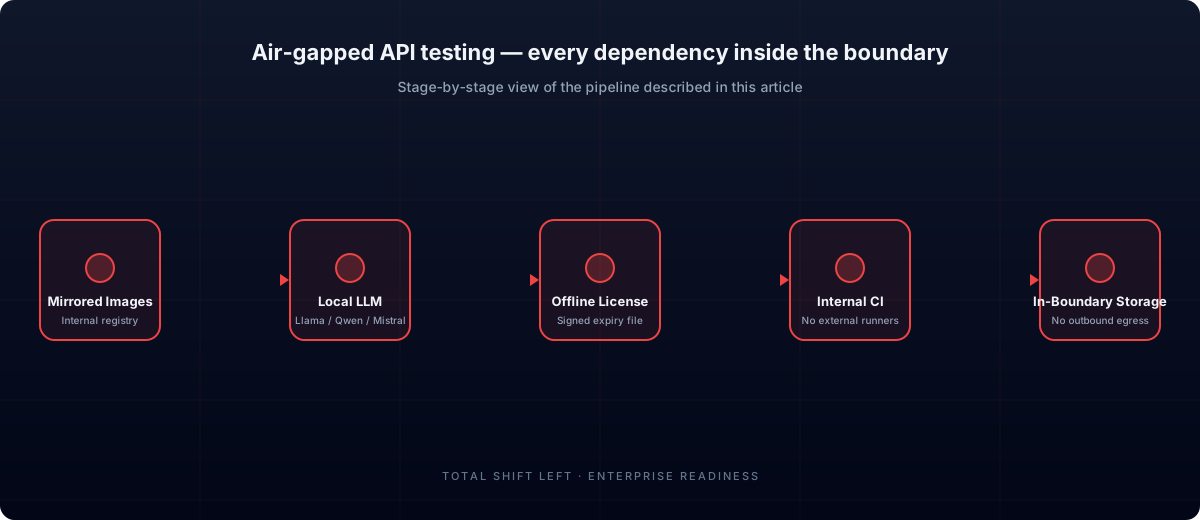
Air-gapped API testing topology — every dependency inside the boundary.
Why air-gapped API testing matters at enterprise scale
DoD impact-level 5/6 environments and FedRAMP High systems uniformly require air-gapped operation for any tooling touching authorized data. Public-sector procurement timelines for non-air-gapped tools have stretched to 18+ months as authorizing officials block exception requests. The shift in 2026 is that modern AI-assisted testing is finally viable air-gapped — open-source LLMs have closed the capability gap to cloud LLMs for spec-driven test generation.
Air-gapped API testing tools compared
A practical view of the tool categories that scale across enterprise testing programs in this area:
| Category | Example tools |
|---|---|
| Local LLM runtimes | Ollama (Llama 3 70B), vLLM (high throughput), LM Studio (GUI deployments) |
| Internal container registries | Harbor, Quay, Artifactory, AWS ECR with cross-network mirroring |
| Offline package management | Apt mirrors, npm enterprise registries, PyPI mirrors with diff-only updates |
| Approved transfer mechanisms | One-way data diodes, controlled bastions, signed media transfer |
| Internal CI/CD | Jenkins, GitLab self-managed, internal GitHub Enterprise |
Tool selection is secondary to architecture. The patterns above hold regardless of which specific vendor you adopt.
Air-gapped API testing in practice: a worked example
A representative deployment pattern from an enterprise rollout in this area:
Problem. A defense systems integrator operating in an IL5 environment had no automated API testing — the prior commercial tool failed authorization because it required internet egress for license check-in and AI features. Every release was hand-tested.
Solution. The integrator deployed a self-hosted API testing platform with offline license, signed container images pulled across the air gap monthly, and Llama 3 70B running on local GPU infrastructure for AI test generation. CI/CD ran on internal GitLab self-managed runners.
Results. API test coverage reached 85% within 6 months. Release cycles shortened from 6-week manual cycles to 2-week automated cycles. Authorizing official approved the architecture without exception. The model has since been replicated across two additional IL5 systems.
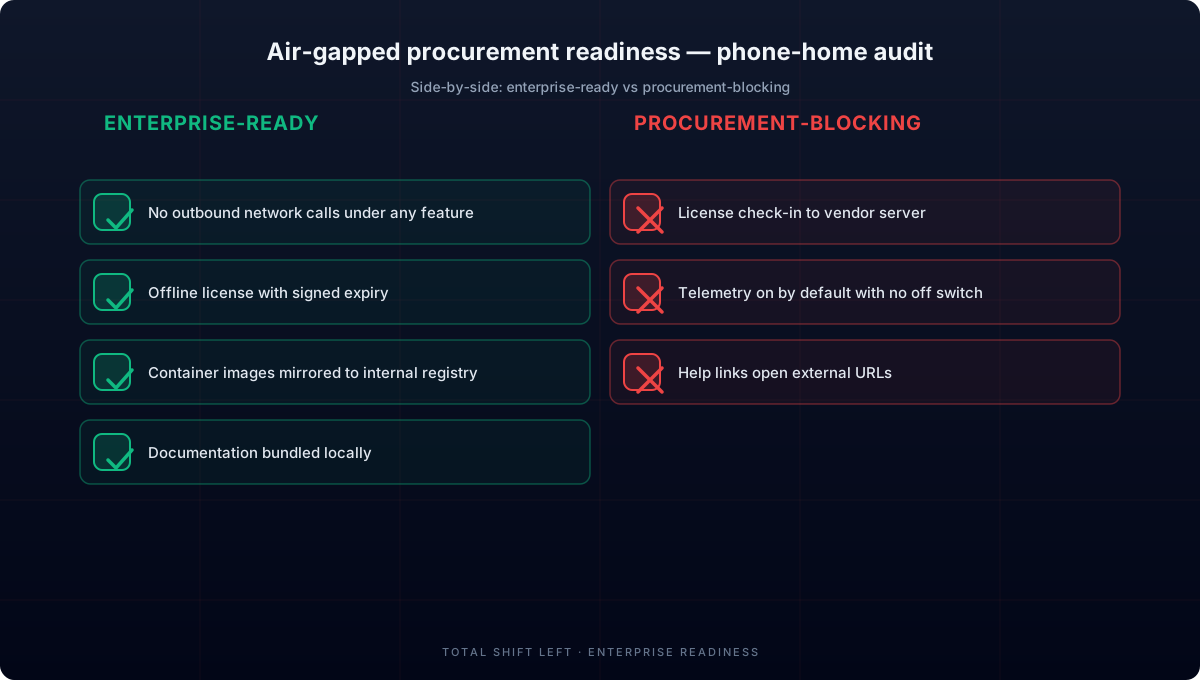
Air-gapped API testing — procurement readiness checklist.
Reference architecture
An air-gapped API testing architecture is structurally similar to on-prem but with strictly enforced offline operation. Test platform runs from container images mirrored to the internal registry on the approved cadence — never pulled live from external sources. Self-hosted LLM runs on dedicated GPU infrastructure with model weights pulled across the air gap once during build-out, never updated from outside. License management uses offline license files with signed expiry; renewal is an offline transaction documented in the system's change management. Documentation ships as a local bundle inside the platform; help-menu links never open external URLs. Telemetry is off by default with no fallback; the platform must fail closed when external endpoints are referenced. CI/CD runs entirely on internal runners with internal git. Run report retention uses internal object storage. The defining property is that every dependency — at build time, runtime, and update time — is available inside the boundary.
Free 1-page checklist
API Testing Checklist for CI/CD Pipelines
A printable 25-point checklist covering authentication, error scenarios, contract validation, performance thresholds, and more.
Download FreeAir-gapped API testing metrics that matter
Three metrics matter for air-gapped operations. Outbound-egress audit results — count of detected outbound connection attempts during the reporting period — must be zero; even an attempted (blocked) connection is a procurement signal. Update cadence — calendar days behind the vendor's current release — depends on the approved transfer cadence; quarterly is typical for IL5+ environments. Model freshness — the LLM model's training cutoff date — affects test-generation quality but is bounded by the approved transfer process; document the trade-off explicitly. Report to the AO, ISSO, and security operations on a cadence aligned with the authorization's continuous-monitoring requirements.
Air-gapped API testing rollout playbook
Air-gapped rollout is bounded by approved-transfer cadence rather than technical complexity. Months 1-2: vendor evaluation. Walk every potential phone-home path with the vendor in detail. Demand documentation of license, telemetry, update, inference, and documentation paths. Eliminate vendors whose answers are unsatisfactory. Months 2-3: hardware procurement. Provision GPU infrastructure for the LLM. Stand up internal container registry. Configure approved transfer mechanism. Months 4-6: deployment. Pull initial container images and model weights across the air gap. Deploy the platform. Verify zero-egress with security operations. Months 6-12: rollout. Onboard product teams. Establish the offline update cadence as part of regular change management. Document the operational runbook for the AO. Most air-gapped deployments reach steady state in 9-12 months; the bound is procurement and authorization process, not technical work.
Air-gapped API testing challenges and how to solve them
Vendor license check-in requires internet. Negotiate offline license file with signed expiry. Renewal is an offline transaction. Vendors that won't support this are not viable for air-gapped deployment.
Container registry pull during scale-out fails air-gapped. Mirror signed images to internal registry on the approved cadence. Use deployment manifests that reference internal registry URLs only.
AI features fall back to cloud when local LLM unreachable. Verify "fail closed" behavior in the security questionnaire. Test by blocking the local endpoint and confirming the platform errors rather than calling out.
Vendor support requires remote access. Configure approved bastion access with audit log capture. Many vendors accept this; treat refusal as a vendor-fit signal.
Air-gapped API testing best practices
- Verify every potential phone-home path before procurement; demand documentation
- Require offline license files with no runtime activation server
- Mirror signed container images to an internal registry; pull only from internal
- Run AI inference fully local (Ollama / vLLM / LM Studio) with verified fail-closed behavior
- Provision local GPU infrastructure sized for the model class needed (70B+ for context-heavy specs)
- Document the offline update process as part of the system's change management
- Use approved transfer mechanisms for any inbound artifact (one-way diode, signed media, bastion)
Air-gapped API testing checklist
A pre-flight checklist enterprise teams can run against their current state:
- ✔ No outbound network connectivity is required for any platform feature
- ✔ License is offline with signed expiry — no runtime check-in
- ✔ Container images are pulled only from internal registry
- ✔ AI inference is fully local with documented "fail closed" behavior
- ✔ Local GPU infrastructure sized for the required model class
- ✔ Documentation ships as a local bundle; no external links
- ✔ Telemetry is off by default with no fallback
- ✔ Vendor support model accepts approved bastion / one-time access patterns
See also: generate tests from openapi in our learn hub for the underlying concept.
Run the whole test stack offline
An air-gapped run has one rule: nothing resolves outside the network boundary. Pin every image by digest, mirror them into the internal registry, and give the runner no egress:
# docker-compose.airgap.yml — every image pulled from the internal mirror
services:
  api:
    image: registry.internal/acme/orders-api@sha256:2f9a...c41
    networks: [airgap]
  runner:
    image: registry.internal/tools/test-runner@sha256:8b13...77e
    depends_on: [api]
    environment:
      OPENAPI_SPEC: /specs/orders.yaml     # mounted, not fetched
      NO_PROXY: "*"
      HTTP_PROXY: ""                       # no egress path at all
    volumes:
      - ./specs:/specs:ro
      - ./results:/results
    networks: [airgap]
networks:
  airgap:
    internal: true      # docker refuses to give this network a gateway
Sources and further reading
- NIST SP 800-218 (SSDF) — the secure software development practices auditors map to.
- HashiCorp Vault documentation — secret storage and dynamic credentials for test runs.
- Ollama — running open-weight models locally.
Key takeaways
- Air-gapped API testing in 2026 is no longer a niche capability requiring a custom build.
- Modern open-source LLMs combined with vendor delivery models that accept offline license, mirrored container registries, and verified fail-closed behavior make AI-assisted testing fully viable inside classified, IL5/IL6, and sovereign-cloud boundaries.
- The procurement-side discipline is enumerating every phone-home path during evaluation — because the worst time to find one is during the authorizing official's review.
Air-gapped API testing FAQ
What does air-gapped mean for an API testing platform?
No outbound network connectivity from the platform to anything outside the authorization boundary. No telemetry phone-home, no license-server check-in, no LLM API calls, no software-update downloads at runtime. Every dependency must be available inside the boundary.
Can AI test generation work air-gapped?
Yes. Open-source LLMs (Llama 3, Qwen, Mistral) running on Ollama, vLLM, or LM Studio give you AI-assisted test generation with inference fully inside the boundary. The model weights are loaded once during build-out and never updated from outside.
How are platform updates handled in air-gapped mode?
Vendor publishes signed container images and release artifacts to an external mirror; the customer pulls them across their air gap through an approved transfer process (one-way diode, sneakernet, or controlled bastion); the customer's internal registry holds the approved versions. Platform itself never reaches out.
What's the difference between air-gapped and on-prem?
On-prem just means the platform runs on customer infrastructure — it can still phone home, fetch updates online, or call external APIs. Air-gapped means none of those external interactions exist. Most "on-prem" deployments are not air-gapped.
Ready to shift left with your API testing?
Try our no-code API test automation platform free.