
10 Best Self-Hosted API Testing Tools (2026)
Quick answer
On-prem API testing platforms run entirely on infrastructure the customer controls — no required vendor data plane or outbound connectivity — driven in 2026 by AI-policy review blocking cloud-LLM spec uploads, data-residency rules, and cheaper audit discipline inside an existing authorization boundary. Buyers should evaluate against seven dimensions: deployment topology, self-hosted LLM with documented fail-closed behavior, first-class REST/SOAP/GraphQL coverage, SSO, audit evidence, first-party CI/CD plugins, and update cadence.
Reviewed by Sushant Joshi
Why enterprise teams are returning to on-prem API testing in 2026 — AI-policy alignment, data residency, and audit-trail discipline. Buyer's checklist covering deployment topology, LLM hosting, multi-protocol coverage, and CI/CD integration.
In this guide
- What is self-hosted API testing?
- The key components of self-hosted API testing
- Why on-prem is back
- Seven-dimension buyer checklist
- LLM hosting: the new dimension
- Multi-protocol coverage that actually matters
- What to ignore in vendor demos
- Why self-hosted API testing matters at enterprise scale
- Self-hosted API testing tools compared
- Self-hosted API testing in practice: a worked example
- Self-hosted API testing reference architecture
- Self-hosted API testing metrics that matter
- Self-hosted API testing rollout playbook
- Self-hosted API testing challenges and how to solve them
- Self-hosted API testing best practices
- Self-hosted API testing checklist
- A self-hosted stack you can run today
What is self-hosted API testing?
On-prem API testing platforms are testing tools that run entirely on infrastructure the customer organization controls — physical data centers, single-tenant cloud accounts, or private-cloud environments — without any required vendor-side data plane or required outbound network connectivity. The pattern is increasingly preferred by regulated buyers in 2026 due to AI-policy review, data-residency requirements, and audit-trail discipline that's materially cheaper inside an existing authorization boundary.
For the head-to-head with the git-native option specifically, see Bruno vs Postman — the storage model is the whole argument.
The key components of self-hosted API testing
Each enterprise program in this area has the same load-bearing components, regardless of vendor. The components separate cleanly into governance, enforcement, and evidence layers.
Container-based deployment
Helm charts or Docker Compose for reproducible install. Ops teams deploy and update on their cadence using the operational tooling already in place. Vendors that don't ship signed container images are not viable for regulated buyers.
On-prem identity
SAML or OIDC integration with the organizational IdP (Azure AD / Entra ID, Okta, Ping). Local-only authentication is excluded; SSO with group-to-role mapping is the default. Sessions and audit events flow into the existing SIEM.
Self-hosted LLM
AI test generation runs on dedicated GPU infrastructure inside the same network segment as the platform. Ollama with Llama 3 70B is the most common starting configuration; vLLM substituted when throughput scales past a small team. Documented "fail closed" behavior on local-endpoint outage.
First-party CI/CD plugins
Plugins for the systems the platform engineering team already operates — Jenkins, GitHub Enterprise, Azure DevOps, GitLab self-managed, CircleCI, Bitbucket Pipelines. Newman-style CLI hacks are excluded; first-class plugin behavior with quality gates is the default.
Multi-protocol coverage
REST, SOAP / WSDL, and GraphQL all first-class — not legacy compatibility modes. Realistic enterprise integration surfaces still include SOAP for core banking, insurance policy administration, and HL7 / government enterprise service buses.
Audit-ready evidence
Per-release run reports exportable in standard formats (JUnit, JSON, optionally PDF) retained in on-prem object storage (MinIO, NetApp, Pure) with immutability where the audit framework requires it.
Why on-prem is back
For most of the last decade, "API testing platform" meant SaaS. Lower TCO, faster updates, no ops burden — the trade-off looked obvious. In 2026, the trade-off looks different at regulated enterprises:
- AI policy review flags tools that send OpenAPI specs to cloud LLMs. The spec describes the surface of regulated data; sending it outside the boundary is a procurement-blocking event.
- Data-residency requirements (Schrems II for EU customers, NAIC Insurance Data Security Model Law for US insurers, equivalent for healthcare and government) make multi-region SaaS testing harder to authorize than single-region or on-prem.
- Audit discipline is materially cheaper when the entire test pipeline runs on infrastructure already covered by the existing SOC 2, ISO 27001, HIPAA, or FedRAMP authorization. A SaaS testing tool means a separate vendor risk review.
The result: a meaningful share of enterprise API testing buys in 2026 are returning to on-prem or single-tenant private-cloud deployments, with cloud SaaS reserved for less-regulated workloads.
Seven-dimension buyer checklist
A practical evaluation matrix for on-prem API testing platforms:
| Dimension | What to require |
|---|---|
| Deployment topology | Reproducible install via container images / Helm; documented HA pattern; network ingress/egress fully documented |
| LLM hosting | Self-hosted LLM out of the box (Ollama, vLLM, LM Studio, or any OpenAPI-compatible endpoint); no required outbound calls |
| Multi-protocol coverage | REST, SOAP/WSDL, GraphQL all first-class; not legacy compatibility modes |
| Authentication & access | SSO (SAML, OIDC, Azure AD), RBAC with project scope, session and audit log capture |
| Audit & evidence | Per-release run reports exportable in standard formats (JUnit, JSON, optionally PDF); immutable retention option |
| CI/CD integration | First-party plugins for the systems you actually use; no Newman-style CLI hacks |
| Update & support model | Documented release cadence; on-prem support SLA; clear deprecation policy |
Vendors that score well on six of seven and have a roadmap for the seventh are usually viable. Anything below five suggests they're SaaS-first and on-prem is an afterthought.
LLM hosting: the new dimension
The single biggest shift in evaluation criteria from 2024 to 2026 is on the AI inference path. A test platform that supports AI-assisted test generation but requires an OpenAI / Anthropic / Google API key to do so will fail AI-policy review at regulated buyers.
Ready to shift left with your API testing?
Try our no-code API test automation platform free. Generate tests from OpenAPI, run in CI/CD, and scale quality.
Specifically require:
- A documented configuration that points the platform at a self-hosted inference endpoint (Ollama, vLLM, LM Studio, or any OpenAPI-compatible endpoint such as TGI or LocalAI).
- An execution component such as an on-prem or air-gapped test-runner agent so test runs, not just inference, stay inside the authorization boundary.
- No silent fallback to a public LLM if the local endpoint is unreachable. The platform must fail closed.
- Documented prompt content for any inference call so security review can confirm what the platform sends to the model.
Vendors that "support BYOM" but fall back to cloud inference under load are a procurement risk. Confirm the failure mode in the security questionnaire.
Multi-protocol coverage that actually matters
In regulated industries, REST is necessary but not sufficient. Realistic integration surfaces still include:
- SOAP / WSDL for core banking middleware, insurance policy administration (Guidewire, Duck Creek), HL7-bridged healthcare integrations, and most government enterprise service buses.
- GraphQL for newer customer-facing APIs.
- JMS, IBM MQ, Kafka for event-driven integration in BFSI and government.
A platform that "supports SOAP" but treats it as a legacy compatibility layer often produces unreliable contract validation against real WSDL services. Test SOAP coverage in your evaluation against an actual production WSDL — not a vendor sample.
For the SOAP-heavy industries, see the banking, insurance, and public-sector industry pages.
What to ignore in vendor demos
Three things that get oversold in API testing platform demos and shouldn't drive an enterprise buy:
Test creation speed. Every modern platform demos a fast spec import and AI-generated test suite. The differentiator is what happens after import — coverage tracking, contract drift detection, and test maintenance over months. Ask to see a six-month-old test suite running.
Pretty dashboards. Coverage charts and trend graphs are easy to build. The procurement-side question is whether the underlying data is exportable, retainable, and auditable. Ask for a sample exportable report.
Generic CI/CD support. "Works with any CI" usually means a CLI runner. The differentiator at enterprise scale is first-party plugins with quality gates that integrate cleanly with the systems your platform team already operates. Ask which plugins are first-party vs community.
For commercial pages aligned to this evaluation, see /integrations for CI/CD coverage and /deployment for topology details.
On-prem API testing in 2026 is no longer a downgrade. The capability gap to cloud SaaS has closed for most workflows, and the procurement and authorization advantages compound at regulated enterprises. The buyer-side discipline is shifting evaluation criteria from "fastest demo" to "cleanest authorization boundary" — and asking the right seven dimensions of the vendor up front.
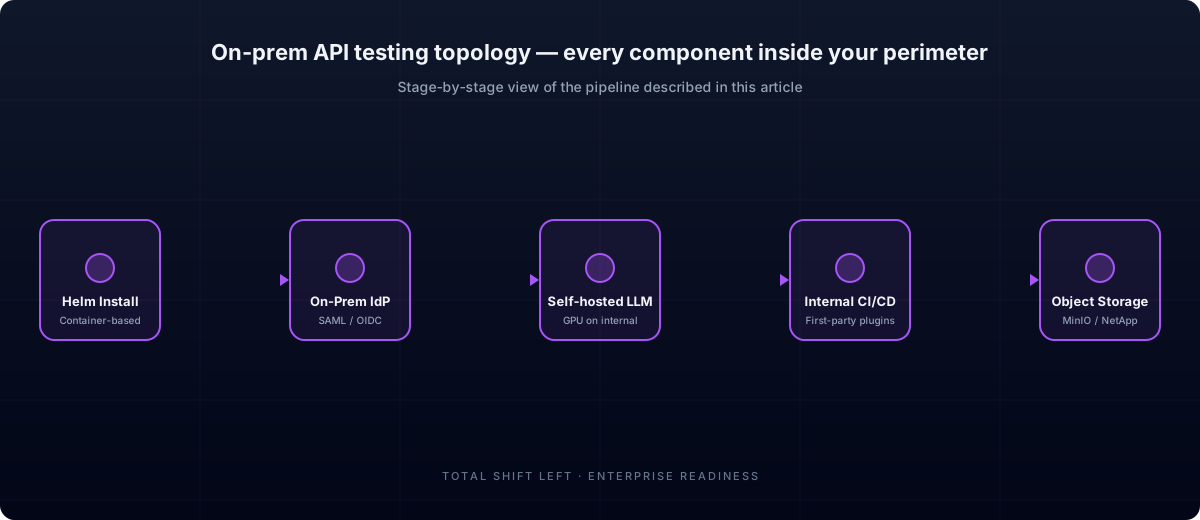
On-prem API testing platform topology — self-hosted everywhere.
Why self-hosted API testing matters at enterprise scale
Gartner's 2025 Magic Quadrant for software test automation flagged the return of on-prem deployment as a 2026 trend, with regulated buyers (BFSI, healthcare, public sector) explicitly disqualifying SaaS-only vendors during procurement. Forrester separately tracked AI-policy review at Fortune 500 organizations and found that 40%+ now have explicit policies blocking cloud-LLM-backed development tools — a population that overlaps heavily with SaaS API testing buyers.
Self-hosted API testing tools compared
A practical view of the tool categories that scale across enterprise testing programs in this area:
| Category | Example tools |
|---|---|
| Container distribution | Helm charts, Docker Compose, Kubernetes manifests with offline-friendly defaults |
| Self-hosted LLM runtimes | Ollama (default), vLLM (high throughput), LM Studio (desktop-class) |
| CI/CD plugins (first-party) | Jenkins, GitHub Actions, Azure DevOps, GitLab CI, CircleCI, Bitbucket |
| On-prem identity | Azure AD / Entra ID, Okta, Ping with SAML / OIDC |
| Evidence retention | On-prem object storage (MinIO, NetApp, Pure) with immutability |
Tool selection is secondary to architecture. The patterns above hold regardless of which specific vendor you adopt.
Self-hosted API testing in practice: a worked example
A representative deployment pattern from an enterprise rollout in this area:
Problem. A European retail bank evaluated three SaaS API testing platforms over six months. All three failed AI policy review because they sent OpenAPI specs to OpenAI for AI test generation. The procurement team was blocked from proceeding despite strong technical fit.
Solution. The bank pivoted to a self-hosted-capable platform with self-hosted LLM (Ollama on dedicated GPU infrastructure inside the existing CDE-adjacent network segment). Procurement closed the buy in 8 weeks. Implementation took 4 weeks across the full SDLC.
Results. API test coverage on payment, customer-data, and core-banking APIs reached production-equivalent levels within 90 days. AI policy review approved the architecture without exception. The platform replaced ReadyAPI for the SOAP-heavy core-banking integrations and Postman for ad-hoc REST work.
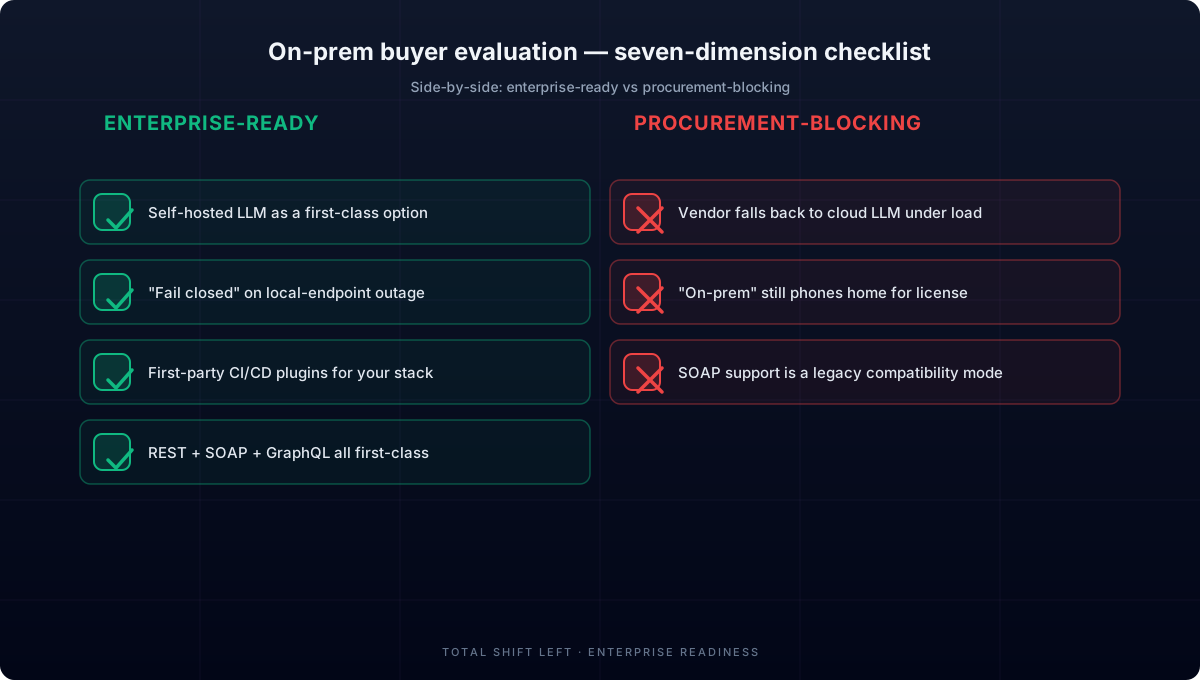
On-prem API testing platform — buyer evaluation checklist.
Self-hosted API testing reference architecture
A reference on-prem API testing architecture in 2026 has six layers. Container-based deployment uses Helm charts or Docker Compose for reproducible install; ops teams deploy and update on their cadence. Identity integration via SAML / OIDC connects to the organizational IdP — Azure AD, Okta, Ping; never local-only auth. Self-hosted LLM runs on dedicated GPU infrastructure inside the same network segment as the platform — Ollama with Llama 3 70B for general use, vLLM for higher throughput. Database is internal PostgreSQL or MongoDB with backup integration into the existing data-protection infrastructure. First-party CI/CD plugins integrate with the systems the platform engineering team already operates — Jenkins, GitHub Enterprise, Azure DevOps, GitLab self-managed, CircleCI, Bitbucket. Object storage for run-report retention uses MinIO, NetApp, or Pure with immutability where the audit framework requires it. The architecture is intentionally similar to other internal platforms the org already runs — minimizing the operational learning curve.
Free 1-page checklist
API Testing Checklist for CI/CD Pipelines
A printable 25-point checklist covering authentication, error scenarios, contract validation, performance thresholds, and more.
Download FreeSelf-hosted API testing metrics that matter
Four metrics establish on-prem platform health. Time-to-onboarding — calendar days from a new product team starting evaluation to producing standard evidence — is the platform team's primary KPI; the golden path target is under 5 days. Update lag — releases behind the vendor's current — is the operational health metric; staying within 1-2 releases of the vendor is the working target. NPS / satisfaction — measured quarterly with consuming product teams — separates platforms with traction from platforms that produce shadow tooling around them. Authorization-blocking events — count of procurement / security review failures per quarter — should be zero for a properly chosen on-prem platform; non-zero indicates the architecture is missing a control regulated buyers expect. Report all four to engineering leadership and platform-team stakeholders.
Self-hosted API testing rollout playbook
A 12-week on-prem rollout works for most regulated buyers. Weeks 1-3: procurement. Run vendor RFP against the seven-dimension checklist. Run hands-on POCs against your test corpus, not vendor samples. Close commercial terms. Weeks 4-6: deployment. Stand up the platform on internal infrastructure. Integrate with IdP, SIEM, and CI/CD systems. Deploy self-hosted LLM. Weeks 7-9: pilot. Onboard one or two willing product teams. Validate the golden path produces standard evidence. Iterate on documentation. Weeks 10-12: rollout. Open onboarding to all teams. Establish ongoing support and update cadence. Document the operational runbook. Most enterprises reach 30-50% adoption by month 6 and 60-80% by month 12; full enterprise standardization takes 18-24 months.
Self-hosted API testing challenges and how to solve them
Self-hosted LLM hardware is unavailable internally. Provision dedicated GPU infrastructure (H100 or A100 80GB) on the existing internal cloud. Quantization brings 70B-class models within reach of a single GPU.
Vendor support requires VPN access to the deployment. Negotiate jump-host-only access with audit log capture. Many vendors accept this; those that don't are usually SaaS-first and not the right fit.
Update cadence is harder than SaaS. Schedule monthly maintenance windows. Use the vendor's signed container images. Validate in a lower environment before promoting.
Cost is higher than SaaS for small deployments. Realistic at scale — but the cost of a procurement-blocking failure during AI-policy review is much higher. Account for total cost of ownership including procurement time.
Self-hosted API testing best practices
- Require self-hosted LLM as a first-class option, not an afterthought
- Verify "fail closed" on local-endpoint outage — never silent fallback to a public LLM
- Choose vendors with signed container images and documented offline update paths
- Provision dedicated GPU infrastructure for AI test generation; quantization makes 70B-class models accessible
- Negotiate audit-logged jump-host support access; never standing VPN connections
- Plan for monthly maintenance windows; avoid waiting until release cadence forces a major upgrade
- Use on-prem identity (Azure AD, Okta, Ping) with SAML/OIDC; avoid local-only auth
Self-hosted API testing checklist
A pre-flight checklist enterprise teams can run against their current state:
- ✔ Vendor offers self-hosted deployment as a first-class option
- ✔ AI inference path is fully self-hosted with documented "fail closed" behavior
- ✔ Container images are signed; offline update path is documented
- ✔ CI/CD plugins are first-party for the systems your team operates
- ✔ Multi-protocol coverage (REST + SOAP + GraphQL) is first-class
- ✔ RBAC, audit log, and SSO via SAML/OIDC are available
- ✔ Update cadence and support model are documented in the contract
- ✔ Total cost of ownership is calculated including hardware, ops, and procurement time
Related reading: air-gapped API testing · FedRAMP-aligned API testing controls.
A self-hosted stack you can run today
Self-hosted API testing does not require a platform purchase to get started — mock server, generated test suite and result reporting all run as containers inside your own network:
# docker-compose.yml — everything on your own hardware, no egress
services:
  mock:
    image: stoplight/prism:4
    command: mock -h 0.0.0.0 /specs/openapi.yaml --dynamic
    volumes: ['./specs:/specs:ro']
    ports: ['4010:4010']

  runner:
    image: python:3.12-slim
    working_dir: /work
    volumes: ['./:/work']
    environment:
      TARGET_URL: http://api-under-test:8080
    command: >
      sh -c "pip install --quiet schemathesis &&
             schemathesis run /work/specs/openapi.yaml
               --url $$TARGET_URL --checks all
               --report junit --report-junit-path /work/out/results.xml"

  report:
    image: nginx:alpine
    volumes: ['./out:/usr/share/nginx/html:ro']
    ports: ['8081:80']
Two things decide whether a commercial self-hosted platform is worth it on top of this: whether it can run fully air-gapped (no licence call-home), and whether it integrates with your own identity provider rather than its own user database. Both belong in the evaluation, not in the renewal.
Sources and further reading
- Hoppscotch documentation — the open-source, self-hostable API client.
- Kubernetes documentation — the platform primitives cloud-native tests run on.
- HashiCorp Vault documentation — secret storage and dynamic credentials for test runs.
Key takeaways
- On-prem API testing in 2026 is not a downgrade — it is the most defensible architecture for regulated buyers facing AI-policy review and data-residency constraints.
- The capability gap to cloud SaaS has closed for most workflows, and the procurement and authorization advantages compound at scale.
- The buyer-side discipline is selecting a vendor whose self-hosted story is a first-class option and not an afterthought retrofitted to satisfy a procurement form.
Self-hosted API testing FAQ
Why is on-prem API testing growing again in 2026?
Three forces. First, AI policy review at regulated organizations increasingly blocks tools that send specs or payloads to cloud LLMs. Second, data-residency requirements (GDPR Schrems II, NAIC, sector- specific rules) make multi-region SaaS testing harder to authorize. Third, audit-trail discipline is easier when the entire test path runs on infrastructure your team already governs.
What's the difference between on-prem and self-hosted?
Most vendors use the terms interchangeably. Strictly, on-prem means running on physical infrastructure your organization owns or leases; self-hosted means running on infrastructure your organization controls, which can include private cloud or single-tenant cloud accounts. The procurement implication is usually the same — the data and inference paths stay inside your boundary.
Does on-prem mean giving up AI test generation?
No. Modern open-source LLMs (Llama 3, Qwen, Mistral) running on Ollama, vLLM, or LM Studio give you AI-assisted test generation with all inference inside your boundary. The capabilities gap versus cloud LLMs is real but smaller than it was 12 months ago.
Can on-prem platforms keep up with releases?
Modern on-prem platforms ship via container images updated on a regular cadence. The release-management overhead is similar to any other internal platform — schedule a maintenance window, validate in lower environments, promote. Vendors that release every few weeks can keep on-prem deployments only one or two releases behind cloud.
Ready to shift left with your API testing?
Try our no-code API test automation platform free.