
Automate with AI: 10 API Test Workflows You Can Run Today (2026)
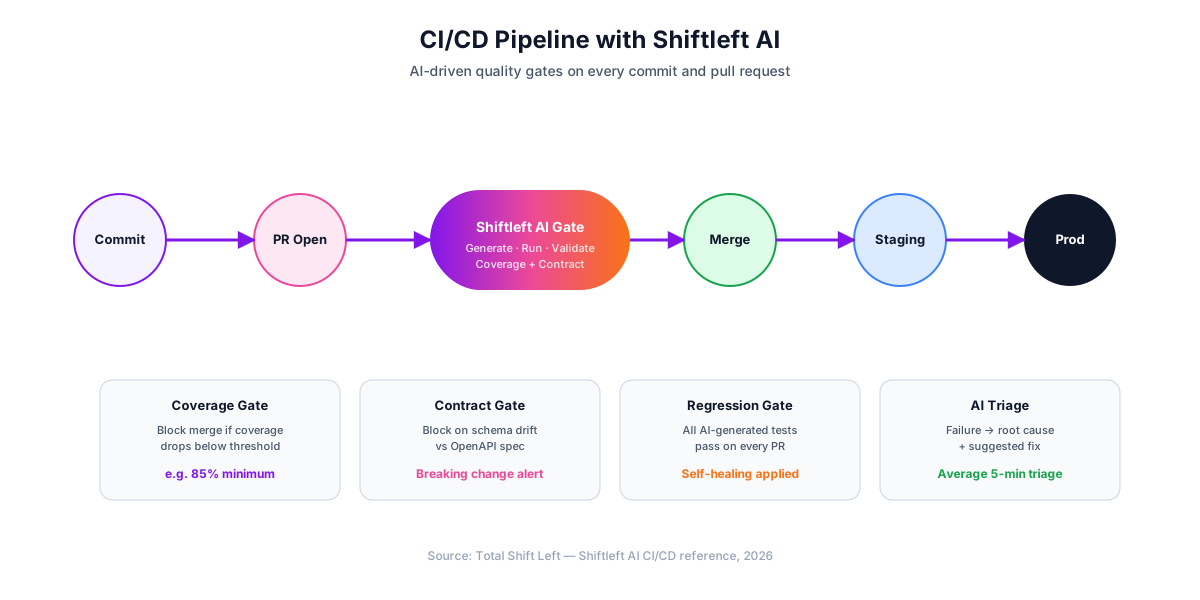
"[Automate with AI](/automate-with-ai)" is a phrase that gets used loosely. In API testing it covers everything from "AI suggests assertions while a human writes a script" to "AI authors and operates the entire suite end-to-end." The operational impact differs by an order of magnitude. This guide is concrete: ten specific [AI API automation](/ai-api-automation) workflows engineering teams run with [Shiftleft AI](/shift-left-ai) in 2026 — what each does, how it works, what it replaces.
For category framing, see what is Shift Left AI and the complete AI API testing guide.
Table of Contents
- Introduction
- What Does It Mean to Automate API Testing with AI?
- Why This Matters Now for Engineering Teams
- Key Components Behind Every AI Workflow
- Reference Architecture
- The 10 Workflows: Tools and Platforms
- Real-World Example: A Day in CI
- Common Challenges
- Best Practices
- Implementation Checklist
- FAQ
- Conclusion
Introduction
The teams getting the most out of AI API testing in 2026 are not the ones using AI as an autocomplete tool. They are the ones who have handed entire workflows — generation, regression, triage, governance — to AI, and have humans review only the exceptions. This article inventories those workflows.
What Does It Mean to Automate API Testing with AI?
True automation means the AI owns the workflow end-to-end: it triggers itself on a signal (commit, schema change, failure), executes its work, and either ships a result or escalates. Compare that to "AI-assisted" testing where a human still drives. See AI API automation vs traditional API testing for the distinction.
Why This Matters Now for Engineering Teams
API surface area has outgrown manual QA capacity. Most teams ship faster than their test suites can be maintained by hand. AI workflows compress weeks of QA labor into seconds of CI time. The economics now favor AI-first.
Key Components Behind Every AI Workflow
- Spec ingestor (OpenAPI / GraphQL / gRPC).
- Generator (how AI generates API tests from OpenAPI).
- Runner in CI/CD (Shiftleft AI in CI/CD pipelines).
- Healer for intentional changes.
- Triage agent that classifies failures.
- Governance layer that gates merges.
Ready to shift left with your API testing?
Try our no-code API test automation platform free. Generate tests from OpenAPI, run in CI/CD, and scale quality.
Reference Architecture
The 10 Workflows: Tools and Platforms
- Spec-to-suite generation. Point AI at OpenAPI; ship a full suite. Replaces weeks of manual scripting.
- AI-driven regression testing. Every commit re-runs full coverage. See automating API regression with AI.
- Contract validation on every commit. Detailed in AI API contract testing.
- Self-healing on intentional schema change. AI updates assertions, not flags failures.
- Negative-case generation. AI explores boundary, malformed, and adversarial inputs.
- Breaking-change detection in PRs. Spec diff + impact analysis posted as a PR comment.
- Failure triage agent. Classifies failures as flake / real bug / intentional / infra.
- AI-generated mocks. Synthetic services from spec for consumer testing.
- Coverage gap detection. AI identifies untested endpoints, parameters, and error paths automatically.
- Governance reporting. Per-service contract health, SLA dashboards.
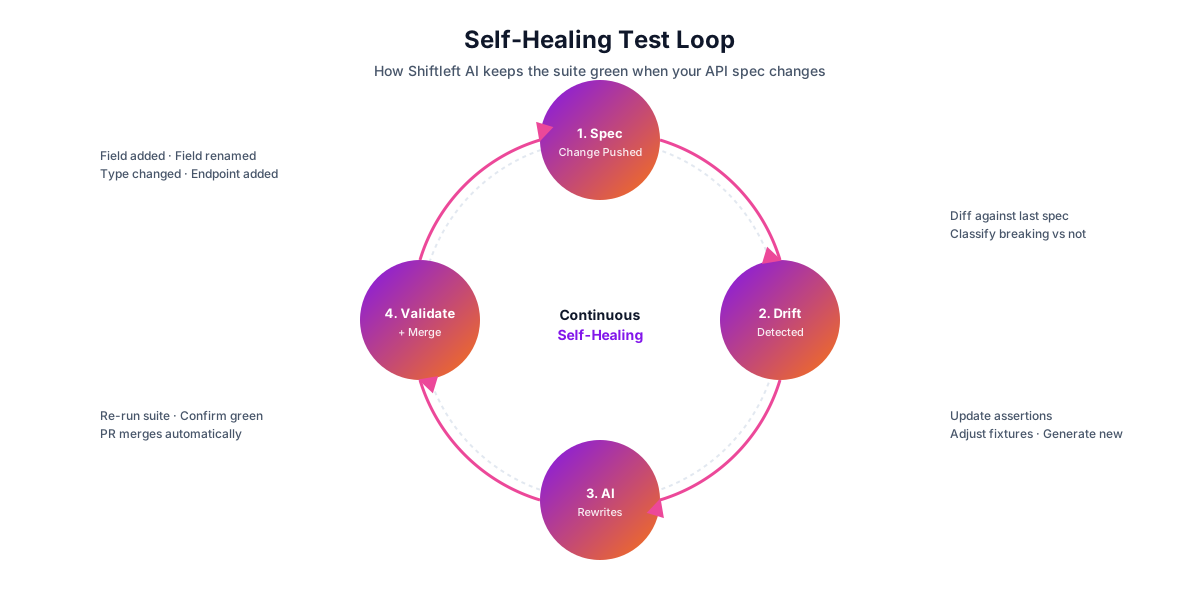
Real-World Example: A Day in CI
A team of 30 engineers ships 80 PRs across 60 services in a typical day. Each PR triggers spec re-parse, generation, regression, contract validation, and triage. Total human time spent on tests that day: ~40 minutes (reviewing escalated failures). Pre-AI it was ~30 hours.
Common Challenges
- Treating AI as a chat assistant instead of a workflow owner.
- Stale OpenAPI specs.
- Lack of preview environments per PR.
- Allowing flaky tests to erode trust before triage matures.
Best Practices
- Automate one workflow at a time; let it stabilize for two weeks before adding the next.
- Always pair generation with self-healing — a frozen suite decays.
- Make the spec the single source of truth.
- Treat AI failures as data: track precision and recall.
- Cross-reference Postman vs Shiftleft AI when migrating from a manual platform.
Implementation Checklist
- List your current manual testing workflows.
- Score each by labor cost and frequency.
- Pick the top three; map them to the 10 workflows above.
- Connect Shiftleft AI to your CI.
- Wire OpenAPI spec into the build artifact pipeline.
- Stand up preview environments per PR.
- Roll out workflow #1 (generation) and let it bake.
- Add workflow #2 (regression / contract).
- Add triage agent once volume justifies it.
- Track time-saved per workflow as a KPI.
See also: generate tests from openapi in our learn hub for the underlying concept.
FAQ
How long to roll out all 10? Most teams take 6–12 weeks for full coverage.
Do I need a separate tool per workflow? No — modern AI API testing platforms cover all 10.
What about non-OpenAPI APIs? Most platforms support GraphQL SDL and gRPC proto similarly.
Will this replace QA engineers? It changes the job — QA becomes test architects and triage owners, not script writers.
Where do I start? Generation. It is the highest-leverage workflow and the easiest to validate.
Conclusion
If you only "automate with AI" in the autocomplete sense, you will leave most of the value on the table. Treat AI as a workflow owner and you replace weeks of QA labor with seconds of CI time. Start your free trial and pick workflow #1 today. For deeper context: what is Shift Left AI, AI API testing complete guide.
Ready to shift left with your API testing?
Try our no-code API test automation platform free.