
10 Best Postman Alternatives for API Testing (2026)
Quick answer
The best Postman alternative depends on why you are leaving. For a free, open-source client with no cloud account: Bruno (Git-native) or Hoppscotch (browser-based, self-hostable). For a lighter client: Insomnia or Thunder Client in VS Code. For design plus testing: Apidog. For SOAP: ReadyAPI or SoapUI. For automated tests generated from an OpenAPI spec: Shift-Left API or Schemathesis.
Reviewed by Sushant Joshi
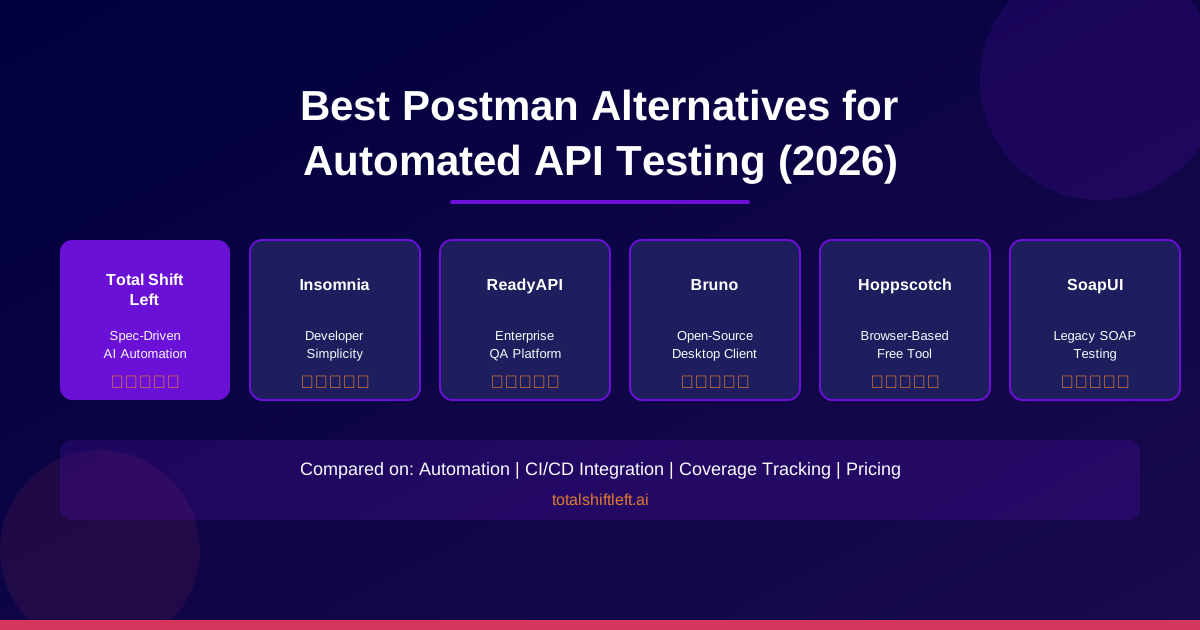
Postman is the default API client, and for many teams it is still the right one. But "Postman alternatives" is one of the most searched API tooling terms for good reasons: pricing on team plans, cloud sync by default, a heavier app than many testers need, and collection-based automation that gets harder to maintain as an API grows. This guide compares ten Postman alternatives for API testing, grouped by what you actually want to replace, with pricing, licence and CI/CD fit for each. Prices and licences were re-checked against each vendor's own pages in October 2026, and a new quick-pick table matches tools to the constraints people search for most: no account, VS Code, browser-based, self-hosted, or free for CI.
It is one of the two pillars of our tools hub; the other is the best API testing tools, which covers frameworks, load and security tools as well. If you are an enterprise or regulated team replacing Postman for governance reasons, our Postman alternative for enterprise and regulated teams page covers that case directly.
Why teams look for Postman alternatives
None of these is a reason to leave on its own. Each is a reason to check whether a different tool fits better:
- Cost at team scale. Collaboration features sit on paid per-user plans, and plan limits change from time to time. Teams of 20 or more often find the bill growing faster than the value.
- Cloud by default. Collections, environments and history sync to Postman's cloud, and most features need an account. Regulated teams and anyone who wants collections reviewed in Git often push back.
- A heavy app for a simple job. Postman has become a full API platform. Testers who want to send a request and read the response feel the weight.
- Collection-based automation does not scale linearly. Every request and assertion in a collection is written and maintained by hand. A collection that covers 40 of 150 endpoints can still report a 100% pass rate.
- CI needs more than a runner. Newman and the Postman CLI run collections in a pipeline, but they do not tell you which endpoints, methods and status codes have no test. See why Postman collections aren't enough for CI/CD.
If none of those bite, stay. If any do, the list below sorts the options by the problem they solve. Before switching, it helps to know exactly what you are replacing: API testing with Postman covers the workflow most teams use today.
Quick-pick: 10 Postman alternatives compared
| Tool | Replaces Postman for | Pricing | Licence | CI/CD |
|---|---|---|---|---|
| Bruno | A local, Git-native client | Free; Pro from $6 and Ultimate $11 per user/month (annual) | Open source (MIT) | Bruno CLI (bru run) |
| Hoppscotch | A browser-based or self-hosted client | Free; paid cloud and enterprise editions | Open source (MIT) | Hoppscotch CLI |
| Insomnia | A lighter desktop client | Free tier; paid team plans | Open-source core (Apache-2.0, Kong) | Inso CLI |
| Thunder Client | A client inside VS Code | Free tier; paid from $3 per user/month (annual) | Proprietary | CLI and CI/CD on Starter and above |
| Apidog | Design, mock, debug and test in one | Free tier; paid per user | Proprietary | Apidog CLI |
| ReadyAPI / SoapUI | SOAP and enterprise functional testing | ReadyAPI by quote; SoapUI free | Proprietary / open source (EUPL) | Jenkins, Azure DevOps, TeamCity plugins; CLI |
| Shift-Left API | Spec-driven automated testing in CI | Free single-user licence; team plans by quote | Proprietary | GitHub Actions, Jenkins, Azure DevOps; REST API for others |
| Schemathesis | Free tests generated from OpenAPI | Free | Open source (MIT) | Command line, GitHub Action (schemathesis/action) |
| Karate | Collections replaced by readable test code | Free; paid IDE add-ons | Open source (MIT) | Any CI (Maven, Gradle, standalone JAR) |
| k6 | Scripted API checks plus load testing | Free; paid Grafana Cloud k6 | Open source (AGPL-3.0) | Any CI, with pass/fail thresholds |
Prices are as published on each vendor's pricing page in October 2026, annual billing where a figure is shown; check before you buy. A lot of teams end up running two: one client for exploration (Bruno, Insomnia or Postman) plus one tool for automation. They solve different problems.
Which Postman alternative fits your constraint?
Most searches for a Postman alternative start from a constraint rather than a feature list. This table maps the common ones to the shortlist:
| If you need | Pick | Why |
|---|---|---|
| No account or sign-up | Bruno; Hoppscotch | Bruno never asks for an account; Hoppscotch runs in the browser without one and can be self-hosted |
| A client inside VS Code | Thunder Client; Bruno for file-based collections | Thunder Client lives in the editor; Bruno keeps .bru files in the repository you already have open |
| A client that runs in the browser | Hoppscotch | Zero install; self-host it with Docker to keep traffic inside your network |
| Everything self-hosted | Hoppscotch (Docker); SoapUI Open Source; Shift-Left API | Hoppscotch and SoapUI run on your own machines; Shift-Left API offers a self-hosted deployment on every plan |
| Mac, Windows and Linux desktop apps | Bruno; Insomnia; Hoppscotch desktop | All three ship builds for all three operating systems |
| An open-source client | Bruno and Hoppscotch (MIT); Insomnia core (Apache-2.0) | Licence, not just price, is what lets a platform team fork, audit or self-host |
| Free automated tests in CI | Schemathesis; Karate; k6; Bruno CLI | All free and open source; Shift-Left API's single-user developer licence is also free |
If two rows point at different tools, that is the client-plus-automation split again: pick one from each.
Free and open-source Postman alternatives
1. Bruno: Git-native, local-first
Bruno stores each request as a plain-text .bru file in your repository. There is no account and no cloud sync; Git handles versioning and review.
- Strengths: collections live next to the code and go through pull requests; no vendor lock-in; free tier is genuinely usable; JavaScript pre- and post-request scripts; the Bruno CLI runs collections in CI.
- Limitations: smaller ecosystem than Postman; team features such as shared environments are basic; no test generation from a spec.
- Who it is for: teams that treat API requests as code. The full head-to-head is in Bruno vs Postman.
2. Hoppscotch: browser-based and self-hostable
Hoppscotch is a fast, open-source client that runs in the browser (or as a desktop app) and supports REST, GraphQL, WebSocket, SSE and more. It can be self-hosted with Docker.
- Strengths: zero install; self-hosting keeps data inside your network; very light.
- Limitations: smaller feature set than Postman; collaboration and automation are lighter; enterprise features are paid.
- Who it is for: teams that cannot use a vendor cloud and anyone who wants a quick, no-install client.
3. Insomnia: a lighter desktop client
Insomnia, maintained by Kong, is a clean desktop client with strong GraphQL support plus gRPC, WebSocket and SSE requests. It can store projects locally, in Git or in Kong's cloud.
Ready to shift left with your API testing?
Try our no-code API test automation platform free. Generate tests from OpenAPI, run in CI/CD, and scale quality.
- Strengths: clean, fast UI; good design-tool integration; open-source core; Inso CLI for CI.
- Limitations: scripting and automation are less extensive than Postman's; team sync is a paid feature.
- Who it is for: individuals and small teams who want Postman-like ergonomics with less platform around it. See Postman vs Insomnia.
Clients for specific workflows
4. Thunder Client: inside VS Code
Thunder Client is a VS Code extension for sending and testing requests without switching windows.
- Strengths: lives in the editor; fast; collections can be saved in the workspace.
- Limitations: tied to VS Code; team features are basic; several features moved to paid tiers.
- Who it is for: VS Code-first developers who want zero context switching.
5. Apidog: design, mock and test in one
Apidog combines API design, mocking, debugging and automated testing around a spec-first workflow.
- Strengths: design-first with mocks built in; good OpenAPI import and export; competitive pricing.
- Limitations: testing depth is moderate compared with specialist tools; enterprise maturity is still growing.
- Who it is for: small and mid-sized teams who want one subscription for the API lifecycle. Head-to-head: Apidog vs Postman; for teams weighing it against us, the Apidog alternative page.
6. ReadyAPI and SoapUI: SOAP and enterprise QA
SoapUI Open Source (free) and its commercial sibling ReadyAPI (SmartBear) are the long-standing tools for SOAP and WSDL testing, common in banking, telecoms and government.
- Strengths: deep SOAP and WSDL support; data-driven testing; security scans; virtualization; official Jenkins, Azure DevOps and TeamCity plugins.
- Limitations: heavy, desktop-centric Java app; Groovy for complex logic; load testing licensed separately; cost at scale.
- Who it is for: SOAP-heavy enterprise estates. See ReadyAPI vs Postman and, if you are leaving ReadyAPI too, the ReadyAPI alternative page.
Postman alternatives for automated testing
7. Shift-Left API: spec-driven automation (our product)
To be clear about our bias: this is our product. Shift-Left API replaces hand-built collections with tests generated from an OpenAPI, Swagger, WSDL or GraphQL schema, or from requirement documents, and runs them in CI.
- Strengths:
- Generates positive, negative, boundary and auth-bypass tests per operation; a deterministic engine produces the suite even with no AI key, and AI (your own key, or a self-hosted model on Trial and Enterprise) adds and polishes cases.
- Tests REST, SOAP and GraphQL on every plan; JSON-RPC 2.0, MCP and WebSocket-RPC testing on Trial and Enterprise.
- Postman collection import creates one test per request, carries assertions over (compiling checks from the collection's scripts where they cannot be mapped directly), imports variable captures, maps collection and folder auth into reusable profiles, and lists anything it left out. Pre-request scripts and environment files are not imported.
- Coverage against the whole spec, so untested endpoints are visible; first-party GitHub Actions, Jenkins and Azure DevOps integrations, plus the REST API for any other CI.
- When the spec changes, the diff is classified as breaking or non-breaking and waits for approval; when a test fails, AI repair is a proposal a person accepts.
- Load testing and OWASP-mapped API security testing are paid add-ons that reuse the same functional tests.
- Limitations: newer than the incumbents; best value when you have a spec; ad-hoc request debugging is not its main job, so many teams keep a lightweight client alongside it.
- Who it is for: teams with contract-first APIs who want high coverage in CI without maintaining collections. The enterprise Postman alternative page covers governance, self-hosting and migration in more detail.
8. Schemathesis: free generated tests from OpenAPI
Schemathesis reads an OpenAPI or GraphQL schema and generates property-based tests that look for server errors, schema violations and other conformance problems.
- Strengths: free and open source; finds crashes and contract drift no one thought to test; easy to drop into CI.
- Limitations: command-line and code oriented; does not know your business rules, so it complements rather than replaces authored tests.
- Who it is for: engineering-led teams who want generated coverage at no licence cost.
9. Karate: collections replaced by readable test code
Karate writes tests in a Gherkin-style DSL with built-in assertions, mocks and performance testing through Gatling.
- Strengths: readable by testers who do not write Java; tests live in Git; runs in any CI; free and open source.
- Limitations: still hand-authored; the DSL has its own learning curve.
- Who it is for: technical QA teams that want versioned test code instead of collections. Tutorial: Karate framework for API testing.
10. k6: scripted checks plus load
k6 (Grafana) runs JavaScript test scripts with checks and thresholds, so the same tool covers functional smoke checks and load.
- Strengths: scripts are versionable and reviewable; excellent CI integration with pass/fail thresholds.
- Limitations: command-line only, no GUI for building requests; not a replacement for exploratory testing.
- Who it is for: teams doing load testing who want one scriptable tool. See API load testing tools.
How to evaluate a Postman alternative
- Audit what you have. Count the endpoints, methods and status codes your collections cover against your full API surface. That gap is what a new tool has to close.
- Decide which job you are replacing. A better client, better automation, or both. They are often two different tools.
- Check your spec maturity. A complete OpenAPI document makes spec-driven tools pay off immediately; without one, factor in the effort to write it.
- Pilot with your real API. Import your real collection or spec into two or three candidates and compare coverage, not demos.
- Verify CI/CD in your pipeline. JUnit output, exit codes, environment variables, run time and secrets handling.
- Price total cost. Licences, maintenance time, training, and the cost of defects that escape.
Free ZIP: scorecard CSV + RFP CSV + guide
API Testing Tool Evaluation Scorecard & RFP Template
A vendor-neutral, weighted scorecard (35 criteria) and 50 RFP questions for comparing API testing tools. No tool is pre-scored: you score from your pilot.
Download FreeCommon mistakes:
- Porting collections one-for-one. You carry over every gap and stale assertion. Import as a starting point, then generate or write fresh coverage from the spec.
- Choosing on UI similarity. A Postman look-alike changes little if the automation model is the same.
- Removing Postman too early. Run both for at least two sprints and compare what each catches.
- Ignoring spec quality. Spec-driven tools amplify the spec in both directions.
Once you switch, track endpoint coverage against the spec, maintenance hours per sprint, time from new endpoint to first test in CI, pipeline run time and false-failure rate. If they do not move, the switch did not pay off.
How to migrate from Postman
Most alternatives import Postman collections directly:
- Bruno: import a Postman collection from the app; requests become
.brufiles. - Hoppscotch: imports Postman collections and environments.
- Insomnia: imports collections through the UI.
- Apidog: imports collections and environments.
- Shift-Left API: imports collections as tests with their assertions, captures and auth, then lets you generate fuller coverage from the spec.
If your collections rely on heavy JavaScript pre-request scripts, budget time to port them: simple scripts translate cleanly, complex ones often do not.
The most portable move is to convert the collection to OpenAPI first. Every spec-driven tool imports that format, and it turns "migrate off Postman" from a rewrite into an import:
# 1. export the collection from Postman, then convert it to a spec
npx postman-to-openapi ./Orders.postman_collection.json -f openapi.yaml

# 2. review it: a converted collection only describes the saved requests,
#    so tighten the schemas and add the response codes it missed
npx @stoplight/spectral-cli lint openapi.yaml

# 3. the spec now drives whichever tool you pick
npx @stoplight/prism-cli mock openapi.yaml --port 4010          # mocking
schemathesis run openapi.yaml --url "$STAGING" --checks all      # generated tests
npx openapi-to-postmanv2 -s openapi.yaml -o collection.json -p   # and back, if needed
For the trade-offs between keeping collections and moving to the spec, see Postman vs OpenAPI test automation. Other head-to-heads in this hub: curl vs Postman and Swagger vs Postman. Every competitor we compare ourselves with is on the alternatives hub.
More from the API Test Automation Tools & Frameworks hub
Every guide in this hub, grouped by format. The API Test Automation Tools & Frameworks hub page has the full list.
Tools and comparisons
- API Test Automation vs RPA: What Is the Difference?
- API Testing Frameworks: REST Assured vs Karate vs pytest
- 10 Best Backend Testing Tools in 2026 (Compared)
- Best No-Code Test Automation Tools (2026): 6 Compared
- REST Assured vs Karate: Which Java API Test Framework (2026)
How-to tutorials
- API Testing in C#: HttpClient, xUnit, RestSharp and .NET 8
- API Testing with JavaScript: Jest, Supertest, Playwright and Ajv
- API Testing with Python: pytest + requests Tutorial (2026)
- Cypress API Testing Tutorial: cy.request() Guide (2026)
- No-Code API Testing: How to Automate API Tests Without Code
- REST Assured Tutorial: API Testing in Java (2026)
Guides and concepts
Postman alternatives FAQ
What are some API testing tools like Postman?
The closest Postman-style clients are Insomnia, Bruno, Hoppscotch, Thunder Client and Apidog. All let you build and send requests, save them in collections and write test scripts. Bruno and Hoppscotch are open source; Insomnia has an open-source core; Thunder Client runs inside VS Code; Apidog adds API design and mocking.
What is the best open-source Postman alternative?
Bruno and Hoppscotch are the strongest open-source options, both MIT licensed. Bruno stores collections as plain-text files in your Git repository and needs no account. Hoppscotch runs in the browser and can be self-hosted. For automated testing rather than a client, Schemathesis is an open-source tool that generates tests from an OpenAPI spec.
Is there a free Postman alternative?
Yes. Bruno, Hoppscotch, SoapUI Open Source, Karate, k6 and Schemathesis are free and open source, and Insomnia, Thunder Client and Apidog have free tiers. Shift-Left API offers a free single-user developer licence, renewed free every six months, for spec-driven automated testing.
What is the best Postman alternative for VS Code?
Thunder Client is the best-known VS Code extension for sending and testing API requests without leaving the editor. Bruno is a good alternative if you want collections stored as files in the same repository you have open in VS Code, though it runs as its own desktop app.
Which Postman alternative is best for automated testing in CI/CD?
If you maintain an OpenAPI spec, a spec-driven tool that generates tests and runs them in CI is the biggest step up from Newman: Shift-Left API (no-code, first-party GitHub Actions, Jenkins and Azure DevOps integrations) or Schemathesis (open source, command line). If your team prefers code, Karate or REST Assured replace collections with versioned test code.
How do I migrate from Postman to another tool?
Export your collections and environments, then import them; Bruno, Hoppscotch, Insomnia, Apidog and Shift-Left API all import Postman collections. Check what each importer keeps: test scripts, pre-request scripts, variables and auth. Converting the collection to an OpenAPI document first makes the move portable to any spec-driven tool.
Is there a Postman alternative that works without an account?
Yes. Bruno never asks for an account: collections are plain files on disk, and sync is whatever Git you already use. Hoppscotch runs in the browser without signing in, and self-hosting it keeps the traffic inside your network. SoapUI Open Source, Karate, k6 and Schemathesis run locally with no account either. Shift-Left API needs a licence, but the single-user developer licence is free.
Sources and further reading
- Postman Learning Center: what you are migrating from, including collections and the Postman CLI.
- Bruno documentation: the file-based, Git-friendly API client.
- Hoppscotch documentation: the open-source, self-hostable client.
- Insomnia documentation: Kong's API client and the Inso CLI.
- Bruno CLI:
bru runfor running collections in CI. - Schemathesis documentation: tests generated from OpenAPI and GraphQL.
- Karate documentation: the Gherkin-style DSL, mocks and Gatling-based performance tests.
- Grafana k6 documentation: checks, thresholds and CI integration.
- OpenAPI Specification: the portable format to convert collections into.
Replacing Postman across an enterprise or regulated team? Book a demo and we will import one of your collections and specs and run the result in your pipeline.
Ready to shift left with your API testing?
Import your OpenAPI spec and get a runnable test suite, in our cloud or on your own infrastructure.