
Migrate From Postman to Spec-Driven API Testing (2026)
Quick answer
Migrating from Postman to spec-driven testing means replacing manually maintained collections with tests auto-generated from your OpenAPI specification, typically completed in 1-2 weeks. The five-step process — audit collections, validate the spec, generate tests, compare coverage, connect CI/CD — closes coverage gaps from 30-60% to over 90% while running Newman and the new suite in parallel for at least two sprints before cutover.
Reviewed by Sushant Joshi
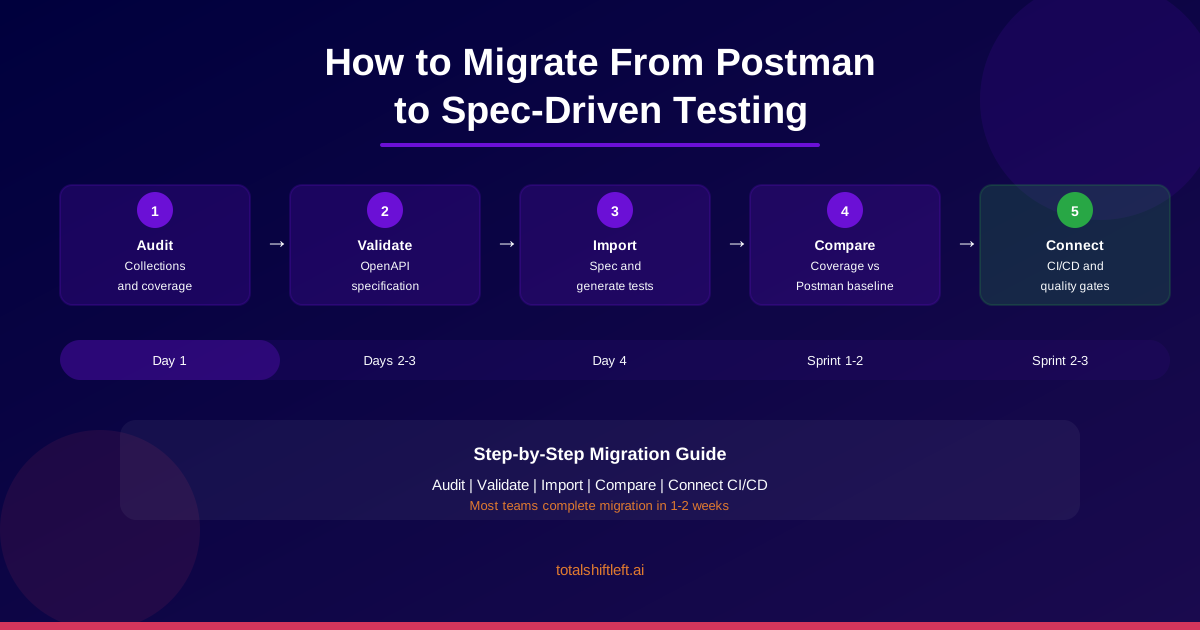
Migrating from Postman to spec-driven testing means transitioning from manually maintained request collections to automated test generation from your OpenAPI specification. This guide provides a step-by-step migration process covering collection auditing, spec validation, test generation, coverage comparison, and CI/CD integration that most teams complete in 1-2 weeks.
The head-to-head on the two most common API clients is in Apidog vs Postman, including pricing, offline use and self-hosting.
The other comparison teams usually run at the same time is Postman vs Insomnia, which turns on how much platform you want around the client.
In this guide
- What migrating from Postman to spec-driven testing involves
- Why this migration improves API testing outcomes
- Key components of a successful migration
- The complete migration workflow
- Tools and approaches for the transition
- Real team migration results
- Common challenges and how to solve them
- Best practices for a smooth transition
- Your migration readiness checklist
Migrating from Postman to spec-driven API testing is not about replacing one tool with another. It is about shifting from a manually maintained testing artifact to an automated approach that stays in sync with your API by design. Teams that make this transition typically see coverage increase from 30-50% to over 90% while reducing test maintenance effort by 80% or more.
The migration does not need to be disruptive. Postman remains a valuable development and exploration tool. What changes is how automated tests get into your CI/CD pipeline: instead of exporting hand-crafted collections and running them through Newman, you import your OpenAPI specification into a spec-driven platform that generates and maintains tests automatically. This guide walks through each step with practical advice on what to do, what to watch for, and how to validate that coverage improves throughout the transition.
If part of the team is still learning the tool being migrated away from, how to use Postman for API testing covers collections, environments and Newman — useful context for understanding what the migration actually replaces.
What Is Migrating From Postman to Spec-Driven Testing?
Migrating from Postman to spec-driven testing is the process of replacing Postman collections as your CI/CD API testing strategy with automated test generation from your OpenAPI specification. The migration preserves Postman as an interactive development tool while moving automated pipeline testing to a platform that generates, maintains, and tracks tests from your API definition.
The migration involves five key phases: auditing existing Postman collections to establish a coverage baseline, validating your OpenAPI specification for completeness and accuracy, importing the spec into a spec-driven platform to generate tests, comparing generated coverage against Postman baselines, and connecting the new approach to your CI/CD pipeline with quality gates.
This is fundamentally different from a tool swap. You are not converting Postman scripts into another format. You are adopting a new paradigm where the API specification drives test generation, eliminating the manual maintenance that makes collection-based testing unsustainable at scale. For background on why this shift matters, see why Postman collections fall short in CI/CD.
Why Migrating From Postman to Spec-Driven Testing Matters
Coverage Gaps Close Dramatically
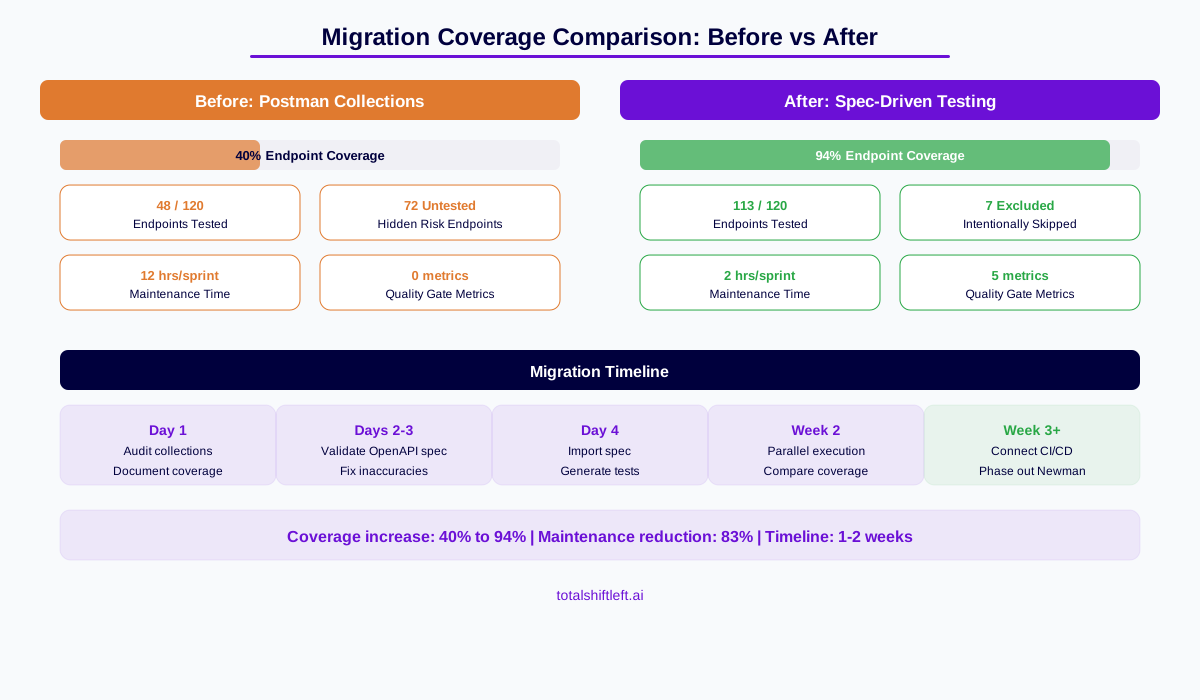
Teams using Postman collections typically cover 30-60% of their API endpoints. The remaining endpoints exist in a testing blind spot where defects can reach production undetected. Spec-driven generation systematically creates tests for every endpoint, method, and response code defined in the specification, closing coverage gaps that manual approaches cannot address at scale.
Test Maintenance Effort Drops Significantly
QA engineers using Postman at scale report spending 40-60% of their sprint time updating collections to match API changes. After migration, maintenance drops to under 10% because tests are generated from the specification instead of maintained by hand. The Postman vs OpenAPI comparison quantifies these differences in detail.
CI/CD Quality Improves
Newman provides binary pass/fail pipeline gates. Spec-driven platforms provide configurable quality gates that evaluate pass rate, endpoint coverage, schema compliance, and response time thresholds. This richer quality evaluation catches regressions that simple pass/fail gates miss.
Collection Drift Becomes Impossible
The root cause of collection drift is maintaining tests as a separate artifact from the API definition. When tests generate from the spec, drift is structurally impossible. The spec changes, you re-import it, approve the change and regenerate, and coverage stays current. This is the foundation of reliable API contract testing.
Key Components of a Successful Migration
Collection Audit
Before replacing anything, document your current state thoroughly. Export all Postman collections, count the endpoints covered, identify which requests have test assertions versus empty test tabs, and compare the collection inventory against your full API surface. This baseline reveals the coverage gap and provides the metric your migration must beat.
Spec Validation
Your OpenAPI specification must be accurate and complete for generated tests to be meaningful. Spec validation includes structural linting (using tools like Spectral or Swagger Editor), completeness checking (every endpoint and schema is defined), and accuracy verification (the spec matches current live API behavior, not historical or planned behavior).
Test Generation
The spec-driven platform parses your specification and generates test cases covering positive scenarios, negative inputs, boundary values, schema validation, and error paths automatically. Review generated tests to verify data makes sense for your domain and configure authentication for your test environment.
Coverage Comparison
Compare generated test coverage against your collection audit. The new approach should meet or exceed Postman coverage across endpoints, methods, and status codes. Identify any Postman-specific scenarios (business logic tests, multi-step workflows) that need custom test cases in the new platform.
Parallel Execution
Run both Newman and spec-driven tests in your CI/CD pipeline simultaneously for at least two sprint cycles. This parallel period validates that the new approach catches everything the old approach did, plus reveals additional defects from the broader coverage that generated tests provide.
Migration Workflow: Five Steps
Step 1: Audit Your Current Postman Collections
Export all relevant Postman collections as JSON and analyze them systematically.
What to document:
- Total number of requests across all collections
- Which API endpoints have corresponding Postman requests and which do not
- Which requests have test scripts with actual assertions versus empty test tabs
- What types of assertions exist: status code checks, body validation, schema verification, timing checks
- Which environments are configured and what variables they contain
- How collections are organized: by endpoint, by feature, by team, or ad hoc
- Hours per sprint spent on collection maintenance, script updates, and Newman troubleshooting
How to identify coverage gaps: Compare collection endpoints against your API specification or route listing. If you have an OpenAPI spec, map collection requests to spec operations. If you do not have a spec, use your framework's route listing to build an endpoint inventory. Most teams discover their collections cover 30-60% of the actual API surface when they conduct this analysis for the first time.
Document the maintenance burden: Track how many hours per sprint your team spends on collection updates, environment synchronization, test script debugging, and Newman configuration. This metric establishes the baseline that justifies the migration and provides ROI data for stakeholders who need to approve the investment.
Step 2: Validate Your OpenAPI Specification
Spec-driven testing is only as good as the specification it generates from. Investment in spec accuracy before generating tests is the highest-leverage activity in the entire migration.
Run a structural linter. Tools like Spectral or the Swagger Editor identify missing descriptions, schema inconsistencies, deprecated patterns, and structural errors. Fix all errors and address warnings that affect test generation quality.
Ready to shift left with your API testing?
Try our no-code API test automation platform free. Generate tests from OpenAPI, run in CI/CD, and scale quality.
Check for completeness. Every endpoint your API exposes should be defined in the spec. Every request body and response schema should be fully specified with data types, required fields, and constraints. Missing schemas mean missing test coverage, which undermines the migration purpose.
Verify accuracy against the live API. The spec should reflect current behavior, not planned behavior from months ago. Send test requests to your API and compare actual responses against schema definitions. Fix discrepancies in the spec before proceeding to test generation.
Validate example values. If your spec includes example values, verify they produce valid requests. Spec-driven platforms often use examples as test data, so incorrect examples lead to false failures that waste debugging time during migration.
Step 3: Import the Spec and Generate Tests
With a validated specification, import it into a spec-driven platform.
The platform parses your specification and creates a comprehensive map of every endpoint, HTTP method, parameter, request body, and response schema. This map becomes the foundation for automatic test generation.
What gets generated automatically:
- Positive tests for every endpoint and method combination defined in the spec
- Response schema validation for every defined status code
- Parameter validation tests covering required fields, data types, and boundary values
- Authentication flow tests based on security schemes defined in the spec
- Negative tests for common error scenarios (400, 401, 403, 404, 422)
What to review after generation:
- Generated test data should make domain sense for your business context
- Test ordering may need adjustment if endpoints depend on data created by other endpoints
- Authentication configuration needs valid credentials for your test environment
- Edge cases specific to your business logic may need custom test additions
If the collections you audited in Step 1 carry auth settings, you don't have to re-enter them: Total Shift Left's Postman collection import maps API Key, Basic, Bearer, Digest, NTLM, Hawk, JWT Bearer, OAuth 1.0 and OAuth 2.0 settings into auth profiles, keeping the collection → folder → request inheritance intact.
What a Postman import carries over in Shift-Left API
Generating from the spec does not mean throwing the collection away. Shift-Left API's Postman import runs alongside spec generation and brings the collection's hard-won knowledge across as tests:
- One test per request, so the import's count matches your Step 1 audit and nothing is merged away.
- Assertions carried over. Common
pm.testchecks are mapped to native assertions; checks the translator cannot map are compiled from the collection's own script. A check that cannot be converted at all stays as a flagged placeholder that fails on every run until someone converts or rewrites it — it never passes silently — and Fix explains why it could not be converted. - Variable captures imported, so a
pm.environment.set('orderId', …)hand-off between requests keeps working, and a variable at the start of a URL is treated as the base URL. - Auth mapped into profiles as described above, including OAuth 2.0 with PKCE and the advanced parameters.
- A list of anything left out, so the gap between the collection and the imported tests is explicit rather than discovered later.
Form and file bodies import correctly too. Akamai EdgeGrid, ASAP and AWS Signature auth are not mapped into profiles yet, so collections that use them need those profiles set up by hand.
Step 4: Compare Coverage Against Postman Collections
Before making any pipeline changes, validate that the new approach meets or exceeds your existing coverage baseline.
Generate a coverage report from the spec-driven platform showing tested endpoints, methods, status codes, and parameter combinations.
Compare against your Step 1 audit to identify any scenarios from Postman that are not covered by generated tests. Common gaps include:
- Business logic assertions that check specific field values or calculated totals
- Multi-step workflow tests that create, update, and verify data in sequence
- Edge cases captured in Postman scripts from debugging past production incidents
- Custom authentication flows not represented in the spec security schemes
The last two gaps no longer need to be hand-built from scratch. In Shift-Left API, a multi-step journey can be built as a workflow from the spec and your existing tests, or from a one-sentence description, with each step's data wired to the step that produces it; and a custom login — a sign-in request, a one-time code, a token exchange — can be captured once as a "sign in with steps" auth profile that every test, pack and workflow then uses.
For each identified gap, add custom test cases in the spec-driven platform. The goal is to match or exceed existing Postman coverage before changing the pipeline. See the detailed comparison for a feature-by-feature evaluation.
Step 5: Connect CI/CD Pipeline and Configure Quality Gates
With tests generated and coverage validated, integrate the spec-driven approach with your delivery pipeline.
For Azure DevOps: Add a spec-driven test execution task to your build pipeline. Configure JUnit result publishing and quality gate evaluation with pass rate and coverage thresholds appropriate for your current baseline.
For Jenkins: Use the pipeline step or REST API integration in your Jenkinsfile. The step executes tests, publishes JUnit results, and evaluates quality gates in a single pipeline action.
For GitHub Actions: Use the official Shift-Left API action to run a test pack as a workflow step, publish the JUnit results, and gate the build on pass rate.
For GitLab CI, CircleCI, Bitbucket Pipelines or other CI tools: Use the CI runner or REST API to trigger test execution and retrieve results. Parse JUnit XML output for standard reporting and gate evaluation.
Configure quality gates progressively. Start with achievable thresholds based on your current baseline: if Postman covered 40% of endpoints, set the initial coverage gate at 70% and increase over time. This approach prevents blocking deployments due to legitimate failures in newly tested endpoints that need investigation and fixing.
Run in parallel for two sprint cycles. Keep your Newman pipeline step active alongside the new spec-driven tests. Compare results side by side. The spec-driven approach should catch everything Newman catches plus additional failures from broader coverage. Remove the Newman step only after confirming parity.
Tools for Postman to Spec-Driven Migration
| Migration Phase | Tool/Approach | Purpose |
|---|---|---|
| Collection audit | Postman Export + manual review | Document current coverage baseline |
| Spec linting | Spectral, Swagger Editor | Identify structural spec issues |
| Spec validation | Manual API testing against spec | Verify spec matches live behavior |
| Test generation | Total Shift Left | Auto-generate from OpenAPI spec; import collections with assertions, captures and auth |
| Coverage comparison | Platform coverage reports | Compare new vs Postman baseline |
| CI/CD integration | Azure DevOps, Jenkins, GitHub Actions | Pipeline connection with quality gates |
| Parallel validation | Newman + spec-driven in pipeline | Confirm parity before cutover |
Migrating from Postman in practice: a worked example
Illustrative scenario: a composite of a typical rollout, not a named customer's measured results.
Problem: A financial services API team maintained Postman collections covering 45% of their 120 REST endpoints. One QA engineer spent roughly 60% of each sprint updating collections as the API evolved across 6 feature teams. The team ran Newman in Azure DevOps reporting 99% pass rates, but experienced monthly production incidents from untested endpoints. Management trusted the pass rate metric and did not allocate additional testing resources, creating a cycle where coverage could not improve.
Free Guided worksheet
Build Your Testing Strategy in 30 Minutes
A structured worksheet that walks you through defining your testing strategy in 30 minutes. Cover architecture, tools, layers, and team responsibilities.
Download FreeSolution: The QA engineer conducted a one-day collection audit that quantified the 55% coverage gap with a concrete endpoint-by-endpoint comparison. This data convinced management to approve a migration. The team validated their OpenAPI specification over two days, correcting 14 discrepancies between the spec and live API behavior. They imported the corrected spec into Total Shift Left and generated a test suite covering nearly all of their endpoints. For two sprints, both Newman and spec-driven tests ran in the pipeline simultaneously.
What changes: Endpoint coverage moves from the collections' partial view to nearly the whole spec. The parallel period surfaces schema violations and undocumented behaviour changes that the collections never tested. The QA engineer moves sprint time from collection maintenance to exploratory testing and API security testing. Quality gates on coverage and pass rate give the pipeline real protection, and the team removes the Newman step once stakeholders have seen both suites side by side. Track production incidents against your own baseline to judge the effect.
Migrating from Postman challenges and how to solve them
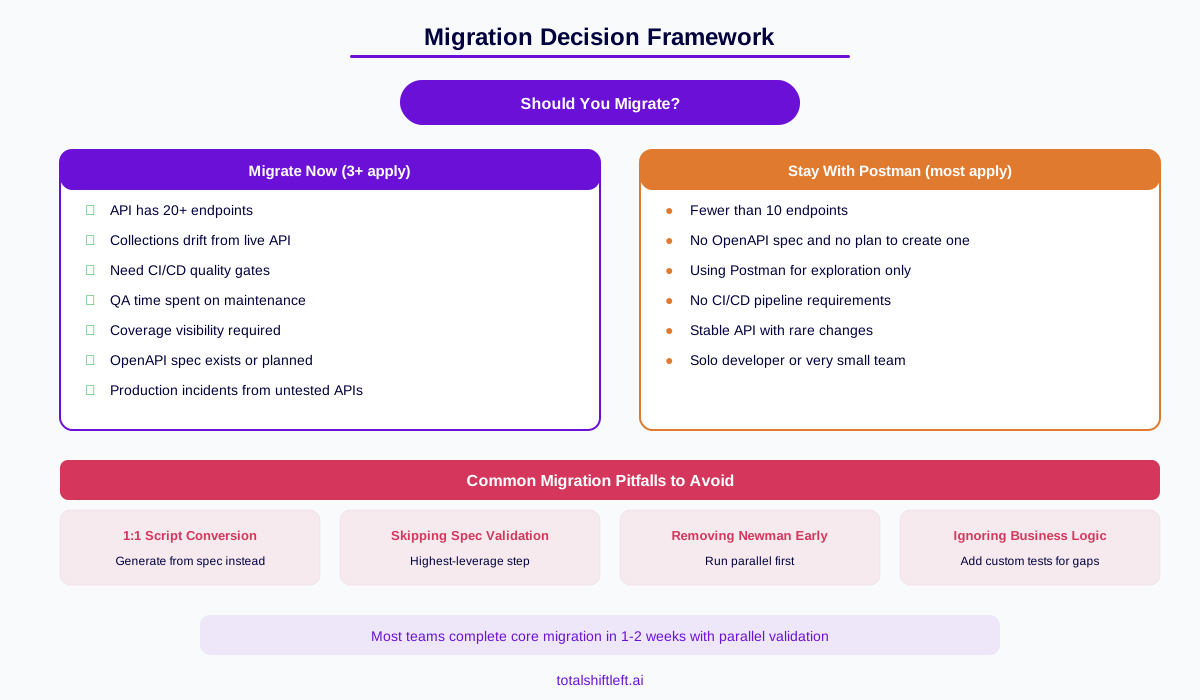
Challenge: Trying to convert Postman scripts one-by-one. Spec-driven testing is a different paradigm, not a format conversion. Do not attempt to translate individual Postman test scripts into the new platform by hand. Instead, generate from the spec, let the collection import carry existing assertions across, and add custom tests only for gaps neither covers. The overlap between generated tests and Postman script coverage is typically 80% or more. To bring across environments and existing requests as a starting point, you can bring your existing Postman collections in directly rather than rebuilding them from scratch.
Challenge: Skipping spec validation. An inaccurate specification produces inaccurate tests, leading to false failures that waste time and erode team confidence in the new approach. Spec validation is the highest-leverage step. Invest the time to verify that your spec matches live API behavior before generating tests.
Challenge: Removing Newman before parallel validation. Run both approaches simultaneously for at least two sprint cycles until data confirms the new approach provides equal or better coverage and defect detection. Premature removal risks missing regressions that only the old approach currently catches.
Challenge: Ignoring custom business logic tests. Spec-driven generation handles structural validation (schemas, status codes, parameter validation) but not domain-specific business rules. Plan time to add custom tests for calculated fields, referential integrity checks, workflow state transitions, and other business logic scenarios after initial generation.
Challenge: Incomplete OpenAPI specification. If your spec does not cover all endpoints, generate tests for what it does cover and build the spec incrementally. Start with the highest-traffic and most critical endpoints. Each spec addition automatically generates new tests, providing increasing value over time.
Challenge: Team resistance to changing workflows. Developers comfortable with Postman may resist the transition. The parallel execution period provides objective comparison data: coverage metrics, maintenance hours, and defects caught. Let results drive adoption rather than mandating change. See the best Postman alternatives guide for how other teams evaluate options.
Migrating from Postman best practices
- Do not treat migration as a tool swap. You are changing paradigms from manual to automated test generation. Approach it as a process improvement, not just a tool replacement.
- Invest most effort in spec validation. Two days of spec validation prevents weeks of debugging false test failures from inaccurate specifications.
- Run parallel for minimum two sprints. Data-driven transition decisions prevent coverage regressions and build team confidence in the new approach.
- Keep Postman for exploration and debugging. Migration removes collections from CI/CD, not from your development workflow. Postman remains valuable for interactive work.
- Start quality gates conservatively. Set initial thresholds below your target and increase progressively. Blocking deployments with aggressive gates during migration creates organizational friction.
- Document the coverage baseline. The before/after comparison is your migration success metric and ROI justification for stakeholders.
- Add custom tests for business logic in a second phase. Get the automated generation running first, then layer on domain-specific tests.
- Train the team on spec maintenance. Long-term value depends on keeping the OpenAPI specification accurate. Make spec updates part of the definition of done for API changes.
Migration Readiness Checklist
- Current Postman collection coverage has been audited and documented
- The coverage gap between collections and actual API surface is quantified
- An OpenAPI specification exists or a plan to create one is approved
- The specification has been linted and validated against live API behavior
- A spec-driven platform has been evaluated with your actual API spec
- Generated test coverage meets or exceeds Postman collection coverage
- Custom tests have been added for business logic scenarios
- CI/CD pipeline integration has been tested with JUnit output
- Quality gate thresholds have been defined based on current baselines
- A parallel execution plan covers at least two sprint cycles
- Team members understand Postman remains for interactive use
- Stakeholders have reviewed the coverage comparison data
See also: postman alternatives in our learn hub for the underlying concept.
The migration, end to end
The migration has three steps and none of them requires rewriting a test. Start by turning the collection into a specification:
# 1. collection -> OpenAPI
npx postman-to-openapi ./Orders.postman_collection.json -f openapi.yaml

# 2. fix what the conversion could not know — a collection only describes the
#    requests someone happened to save, so response codes and schemas are thin
npx @stoplight/spectral-cli lint openapi.yaml
$EDITOR openapi.yaml

# 3. generate the suite from the spec and run it where Newman used to run
schemathesis run openapi.yaml --url "$STAGING_URL" --checks all \
  --report junit --report-junit-path results.xml
Keep Newman running in parallel for a release or two. When the generated suite catches everything the collection caught, the collection becomes an exploration tool rather than a test asset — which is what it was always best at:
# .github/workflows/api-tests.yml — both, during the transition
- run: npx newman run collection.json --reporters cli,junit --reporter-junit-export newman.xml
  continue-on-error: true          # informational once the spec suite is trusted
- run: schemathesis run openapi.yaml --url "$STAGING_URL" --checks all
Frequently asked questions about migrating from Postman
How long does it take to migrate from Postman to spec-driven testing?
Most teams complete the core migration in 1-2 weeks. Day one covers collection auditing and spec import with initial test generation. Days two through four address spec validation and accuracy corrections. The second week covers CI/CD integration, quality gate configuration, and the start of parallel execution. The parallel validation period runs for two additional sprints before removing Newman from the pipeline.
Do I need to rewrite all my Postman test scripts?
No. Spec-driven testing generates tests automatically from your OpenAPI specification, making script rewriting unnecessary, and a collection import can carry existing assertions across. You may need to add custom tests for complex business logic scenarios that go beyond structural validation (schemas, status codes, parameter validation), but this typically represents a small fraction of your overall test suite.
Can I run Postman and spec-driven tests in parallel during migration?
Yes, and parallel execution is the recommended approach. Running both Newman and spec-driven tests in your pipeline during the transition period provides side-by-side coverage and defect detection comparison. Phase out the Newman step only after data confirms the spec-driven approach catches everything Newman caught plus additional issues from broader coverage.
What if my OpenAPI specification is incomplete or outdated?
Spec validation is the highest-leverage step in the migration. Use linters like Spectral to identify structural issues, compare the spec against live API behavior by sending test requests, and update incrementally starting with your highest-traffic endpoints. Most teams spend 1-3 days on spec validation. An incomplete spec still generates tests for the endpoints it covers, providing immediate value while you expand the spec over time.
Should I delete my Postman collections after migration?
No. Keep Postman installed and collections accessible for exploratory testing, debugging, and interactive API development. The migration removes collections from your CI/CD pipeline, not from your development workflow. Many teams continue using Postman daily for request building and debugging alongside automated spec-driven pipeline testing.
Sources and further reading
- Postman Learning Center — Postman's own documentation for collections and scripts.
- OpenAPI Specification — the normative spec for describing HTTP APIs.
- Schemathesis documentation — property-based testing driven straight from an OpenAPI spec.
Key takeaways
- Migrating from Postman to spec-driven API testing is a shift from manual artifact maintenance to automated test generation driven by your API specification.
- The five-step process -- audit, validate, generate, compare, connect -- provides a structured path that most teams complete in 1-2 weeks without disrupting their development workflow.
- The parallel execution period ensures no coverage regression during the transition.
- The goal is not to abandon Postman. It remains an excellent API development and exploration tool.
- The goal is to stop relying on manually maintained collections for your automated testing pipeline and instead let your OpenAPI specification drive test generation, coverage tracking, and quality gate evaluation in CI/CD.
Ready to start your migration? Start a free 15-day trial and import your OpenAPI spec to see how generated coverage compares against your existing Postman collections. Solo developer? Get the free Citizen Developer Edition — single-user. Check our pricing plans for teams ready to automate their API testing pipeline.
Continue learning
Go deeper in the Learning Center
Hands-on lessons with runnable code against our live sandbox.
Postman is the default — but not always the right fit. Here are the alternatives that actually matter in 2026.
Turn an OpenAPI spec into hundreds of tests in minutes. Here's what the AI actually does well — and where it still needs you.
Ready to shift left with your API testing?
Try our no-code API test automation platform free.