
6 Best Postman Alternatives for Automated API Testing in 2026
Quick answer
For spec-driven automated testing with no manual scripting, Total Shift Left is a strong Postman alternative. For a free, open-source client with no cloud account, Bruno (Git-native) or Hoppscotch (browser-based) are the top picks. For enterprise QA across SOAP and REST, ReadyAPI covers the most ground; for legacy SOAP specifically, SoapUI's free edition remains the standard.
Reviewed by Sushant Joshi
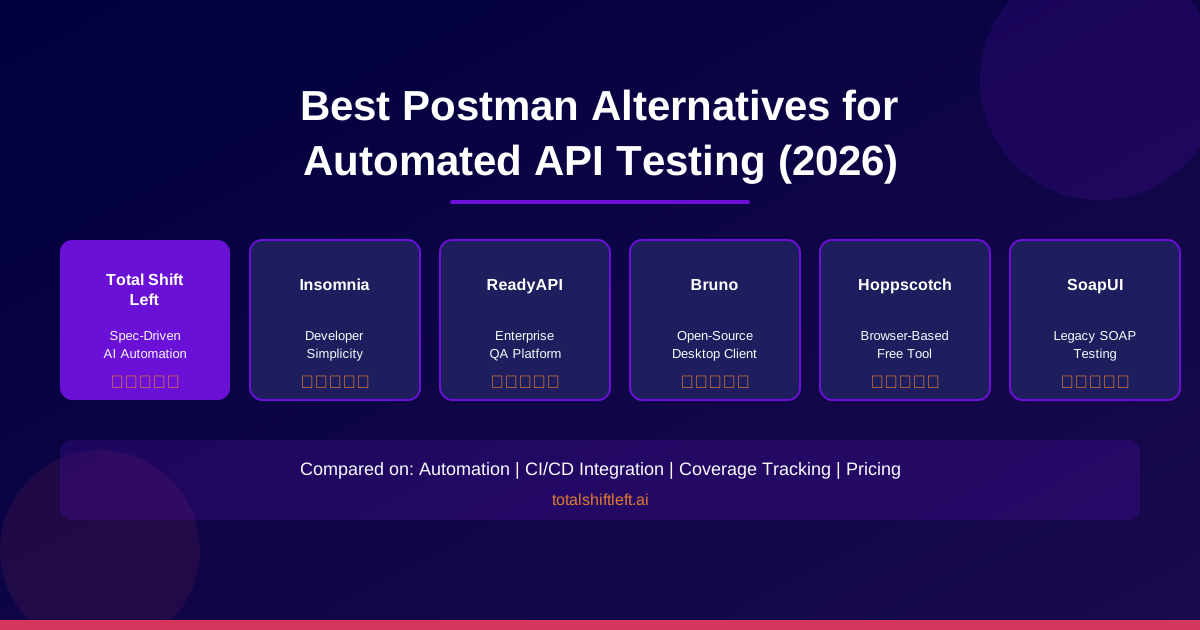
Every engineering team that has scaled an API past fifty endpoints knows the pain: Postman collections that started simple become sprawling maintenance projects that consume entire sprints. The gap between exploratory API development and production-grade automated testing has never been wider, and the tools you choose determine which side of that gap your team lands on.
Postman alternatives for automated testing are API testing tools that replace or supplement Postman with stronger automation, CI/CD integration, and spec-driven test generation. Teams adopt these alternatives when manual collection workflows become a bottleneck for scaling API quality across growing API surfaces.
In this guide
- What Are Postman Alternatives for Automated Testing?
- Why Postman Alternatives Matter in 2026
- How Spec-Driven Testing Changes the Workflow
- Step-by-Step Framework for Evaluating Alternatives
- Common Mistakes When Switching from Postman
- Best Practices for Choosing and Adopting an Alternative
- Tools Comparison: Postman Alternatives Ranked
- Real-World Migration Example
- Metrics for Evaluating Your Alternative
- Quick-Reference Comparison Table
- What matters most when choosing a Postman alternative
Before switching, it is worth knowing what you are switching from — how to use Postman for API testing covers the workflow most teams are replacing, and curl vs Postman covers the alternative that needs no installation at all.
What Are Postman Alternatives for Automated Testing?
Postman alternatives for automated testing are tools and platforms that provide API testing capabilities with a stronger focus on automation, CI/CD integration, and reduced manual maintenance compared to Postman's collection-based workflow. They range from open-source API clients like Bruno and Hoppscotch to AI-powered spec-driven platforms like Total Shift Left.
The key distinction is the automation model. Postman requires teams to manually build requests, write JavaScript test scripts, and maintain collections as the API evolves. Alternatives either simplify this process or eliminate it entirely by generating tests from API specifications. Some alternatives focus on replacing the API client experience with better local-first workflows, while others rethink the entire testing lifecycle by treating the OpenAPI specification as the single source of truth.
Understanding where each tool fits on this spectrum is critical for making the right choice. A team that needs a better request builder has different requirements than a team that needs automated test generation running in CI/CD pipelines on every commit.
The head-to-head on the two most common API clients is in Apidog vs Postman, including pricing, offline use and self-hosting.
Teams on SmartBear tooling asking the same question should start with the best ReadyAPI alternatives, which covers what actually replaces its SOAP and data-driven features.
For the head-to-head with the git-native option specifically, see Bruno vs Postman — the storage model is the whole argument.
The other comparison teams usually run at the same time is Postman vs Insomnia, which turns on how much platform you want around the client.
Why Postman Alternatives Matter in 2026
Postman's Pricing Model Has Changed
Postman's move toward cloud-first enterprise pricing means teams that once used it for free now face per-seat costs for collaboration features. For organizations with 20 or more developers touching API tests, these costs add up without delivering proportional automation value. The free tier restrictions on collection runs and collaboration have pushed even small teams to evaluate whether the value justifies the cost.
Collection Maintenance Does Not Scale
A team with 100 REST endpoints and 3 HTTP methods each faces maintaining 300 individual requests with hand-written assertions. When the API changes, someone must manually update every affected request. Studies from DevOps Research and Assessment (DORA) show that teams spending more than 25% of sprint time on test maintenance have significantly lower deployment frequency. The collection-based model creates a linear relationship between API surface growth and maintenance effort that becomes unsustainable.
CI/CD Demands Have Outgrown Newman
Newman, Postman's command-line runner, can execute collections in pipelines. However, it provides no coverage tracking, no quality gate evaluation, and no automatic synchronization with API changes. Modern CI/CD pipelines need quality gates that evaluate metrics against thresholds, not just pass/fail results. Newman also requires exporting collections and environments as JSON files, creating synchronization overhead between the Postman workspace and the pipeline.
Coverage Visibility Is Essential
When Newman reports 100% pass rate on 40 tested endpoints while 110 endpoints have zero tests, the metric is misleading. Teams need API test coverage that maps results against the full API surface defined in their specification. Without this visibility, teams operate with false confidence about API quality.
The Spec-First Movement Is Accelerating
API-first design practices mean more teams maintain OpenAPI specifications as living documentation. Once you have a machine-readable API definition, generating tests from it is faster than writing them by hand. Tools that leverage this specification unlock automation that collection-based workflows cannot match.
How Spec-Driven Testing Changes the Workflow
The architectural difference between collection-based and spec-driven testing explains why teams gain so much efficiency from the switch. In the traditional Postman workflow, a developer manually creates each request, writes test assertions in JavaScript, organizes collections by folder, exports the collection for Newman, and debugs failures in CI/CD when the exported version drifts from the workspace. Each step requires human effort and introduces opportunities for inconsistency.
In the spec-driven workflow, the platform reads your OpenAPI spec, generates comprehensive tests automatically, runs them in your pipeline, and tracks coverage against the full API surface. Adding a new endpoint to your API requires adding it to the spec. The platform handles test creation, assertion logic, and coverage tracking. When a schema changes, the diff is surfaced for review and you regenerate from the new spec rather than editing tests by hand.
This workflow shift means that test creation scales with the API rather than with team capacity. A 50-endpoint API and a 500-endpoint API require the same human effort: maintain the specification and let the platform handle the rest.
Step-by-Step Framework for Evaluating Alternatives
Choosing the right Postman alternative requires a structured evaluation rather than a feature-checklist comparison. Follow this framework to identify the best fit for your team.
Step 1: Audit your current testing state. Count how many endpoints, methods, and status codes your existing Postman collections cover versus your total API surface. This baseline reveals the gap that a new tool needs to close.
Step 2: Define your automation requirements. Determine whether you need a better API client, a CI/CD testing tool, or both. Teams doing exploratory testing have different needs than teams building pipeline quality gates.
Step 3: Assess your OpenAPI spec maturity. If you maintain a complete, validated OpenAPI specification, spec-driven tools deliver immediate value. If your spec is incomplete or nonexistent, factor in the effort to create one or choose tools that work without specs.
Step 4: Run a parallel pilot. Import your real API spec into two or three candidate tools and compare generated coverage against your existing Postman collections. Real-world results matter more than demo capabilities.
Step 5: Measure total cost of ownership. Include licensing costs, maintenance time, training effort, and the cost of defects that escape to production. The cheapest tool by licensing may be the most expensive by total cost.
Ready to shift left with your API testing?
Try our no-code API test automation platform free. Generate tests from OpenAPI, run in CI/CD, and scale quality.
Step 6: Validate CI/CD integration. Test each candidate in your actual pipeline. Verify JUnit output, exit codes, environment variable support, and execution time before committing to a migration.
Common Mistakes When Switching from Postman
Migrating collections instead of generating new tests. Some teams try to convert Postman collections into the new tool's format. This carries forward all the gaps and maintenance problems of the original collections. When you do want to bring existing work across, import your Postman collections as a starting point, but favor generating fresh tests from your spec rather than porting stale assertions.
Choosing based on UI similarity. Developers comfortable with Postman often gravitate toward alternatives that look similar. UI familiarity is less important than automation depth. A tool with a different interface but automatic test generation delivers more value than a Postman clone.
Skipping the parallel validation period. Removing Postman before validating that the new tool catches the same defects (and more) risks losing test coverage during the transition. Run both tools simultaneously for at least two sprints.
Ignoring spec quality. Spec-driven tools amplify spec quality in both directions. A well-defined spec with response schemas, parameter constraints, and examples produces comprehensive tests. A minimal spec produces minimal tests. Invest in spec quality before judging the tool.
Underestimating team adoption effort. Even superior tools require training and workflow adjustment. Plan for a transition period and designate a team champion who learns the new tool deeply and supports others through the change.
Best Practices for Choosing and Adopting an Alternative
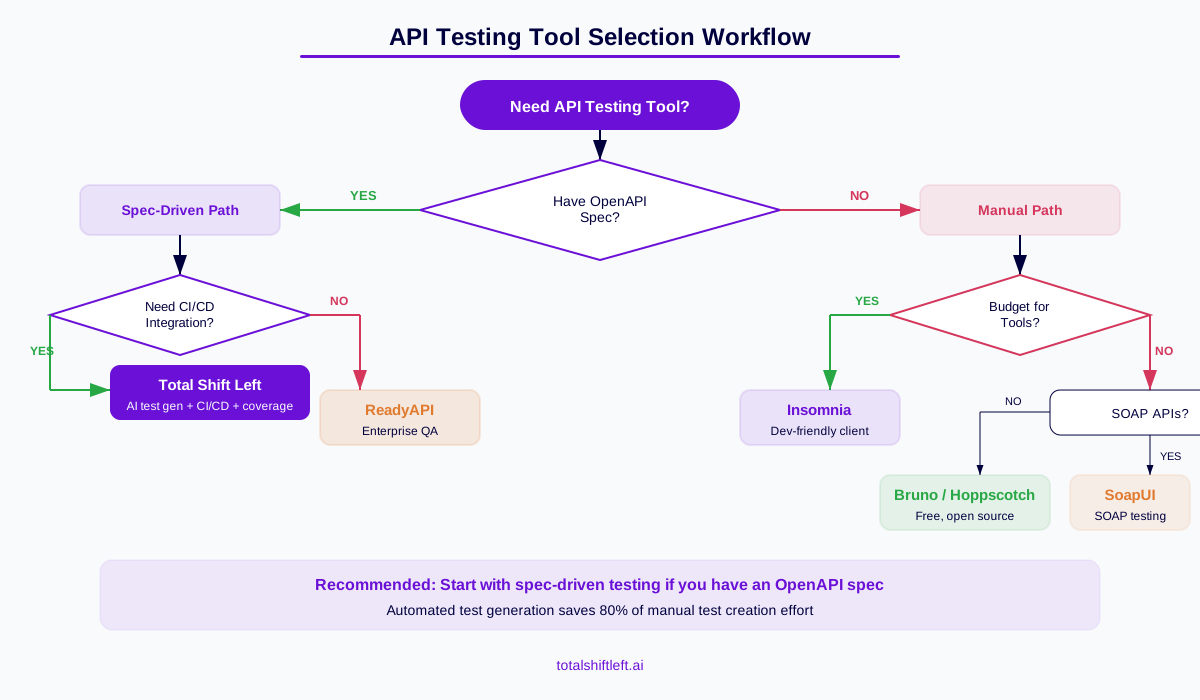
- Start with your OpenAPI spec. If you do not have one, generate it from code annotations before evaluating any tool. A complete spec unlocks the full value of spec-driven alternatives.
- Evaluate automation depth, not UI polish. The most important differentiator is how much manual effort each tool eliminates, not how the interface looks.
- Require CI/CD integration in your evaluation criteria. Any alternative must run headlessly in your pipeline with standard output formats. Tools built for CI/CD pipeline integration provide native support rather than requiring workarounds.
- Test with your actual API. Import your real spec and compare coverage against your existing Postman collections rather than relying on demo APIs.
- Run parallel during transition. Never remove existing tests until the new tool demonstrates equal or better coverage and defect detection.
- Prioritize coverage tracking. Choose tools that map results against your full API surface, not just the endpoints with tests.
- Consider total cost of ownership. Factor in maintenance time for collections, scripting effort, and the cost of missed defects alongside licensing fees.
- Involve developers in the evaluation. The tool must fit the development workflow, not just the QA process. Developer buy-in determines adoption success.
Tools Comparison: Postman Alternatives Ranked
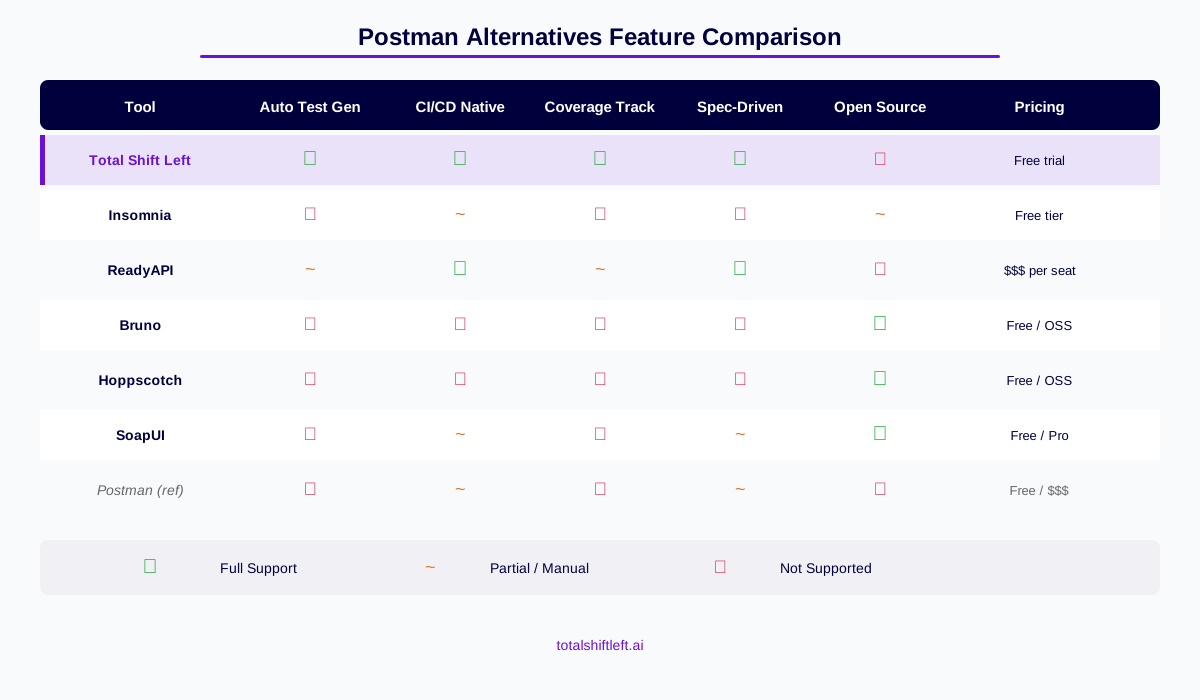
| Tool | Auto Test Gen | CI/CD Native | Coverage Tracking | Spec-Driven | Open Source | Best For |
|---|---|---|---|---|---|---|
| Total Shift Left | Yes | Yes | Yes | Yes | No | Automated spec-driven testing |
| Insomnia | No | Partial | No | No | Partial | Developer simplicity |
| ReadyAPI | Partial | Yes | Partial | Yes | No | Enterprise QA teams |
| Bruno | No | No | No | No | Yes | Git-native API client |
| Hoppscotch | No | No | No | No | Yes | Free browser-based testing |
| SoapUI | No | Partial | No | Partial | Yes | Legacy SOAP testing |
1. Total Shift Left -- Best for Spec-Driven Automated Testing
Total Shift Left takes a fundamentally different approach to API testing. Instead of manually building collections, you import your OpenAPI specification and the platform generates comprehensive test suites automatically, covering positive paths, negative cases, edge cases, and schema validation using AI-powered analysis.
How Total Shift Left does this: Positive, negative, boundary, and schema-validation tests are generated directly from the OpenAPI spec you import — nothing to hand-write or maintain as collections drift. Teams that can't send API specs to a third-party cloud can point generation at a self-hosted LLM (Ollama, LM Studio, vLLM, or any OpenAI-compatible endpoint) instead, so the spec never leaves their own infrastructure.
Strengths: Automatic test generation from OpenAPI specs eliminates manual test creation. Full CI/CD integration produces JUnit output for Azure DevOps, Jenkins, and GitHub Actions. Contract testing and coverage tracking are built in. Spec changes are detected when you re-import the spec and become new endpoint versions once you approve them, and when a test fails, Fix with AI proposes a repair that cites the spec, requirement and run evidence for a person to accept, which reduces maintenance without hiding real failures. A local agent runs tests against APIs that are only reachable from your own machine.
For teams leaving Postman specifically: the Postman import now creates one test per request, carries the collection's assertions over (checks it cannot map are compiled from the collection's own script), imports variable captures, maps collection and folder auth into reusable profiles, and lists any requests it left out. OAuth 2.0 works the way Postman users expect — Postman's grant types plus Device Code, Get New Access Token, provider pre-fill for Entra ID, Okta, Auth0, Keycloak and Google, and automatic refresh. Iteration data moves to data-driven testing over CSV, Excel, JSON, databases or APIs, and a spec-generated mock server replaces Postman mocks. JSON-RPC 2.0 and MCP server testing are available on the Trial and Enterprise editions, and performance/load and OWASP-mapped security testing are paid add-ons (both included in the Trial).
Limitations: Works best with an API specification (OpenAPI, WSDL or GraphQL); without one, tests come from an imported Postman collection or from requirement documents rather than being generated per operation. Focused on API testing rather than general-purpose API development.
Best for: Teams with OpenAPI specs that want automated testing in CI/CD without writing test scripts. See the detailed Postman comparison for workflow differences.
2. Insomnia -- Best for Developers Who Want Simplicity
Insomnia, maintained by Kong, offers a clean interface for REST, GraphQL, and gRPC requests with Git-based sync and plugin support.
Strengths: Clean, fast UI with minimal clutter. Git-based project sync without proprietary cloud requirements. Good plugin ecosystem. Free tier available for individual developers.
Limitations: Limited test automation. No spec-driven test generation. Scripting less mature than Postman. Kong acquisition has introduced some feature instability.
Best for: Individual developers or small teams that need a lightweight request builder with Git-friendly storage.
3. ReadyAPI (SmartBear) -- Best for Enterprise QA Teams
ReadyAPI is a full-featured commercial platform covering functional testing, load testing, and security scanning for QA teams with complex testing requirements.
Strengths: Mature functional, performance, and security testing in one platform. Data-driven testing with Excel and database sources. Strong SOAP and legacy protocol support. Enterprise reporting and compliance features.
Limitations: Expensive per-seat licensing. Steep learning curve. Desktop-heavy workflow. Overkill for teams focused on REST API testing.
Best for: Large enterprise QA teams with complex testing requirements across REST, SOAP, and legacy protocols.
4. Bruno -- Best Open-Source Desktop Alternative
Bruno stores API collections as plain files on your filesystem using a markup language called Bru, with no cloud sync or accounts required.
Strengths: Fully offline with no account required. Collections stored as plain text files in your repo. Open source and actively developed. Supports JavaScript scripting.
Free Interactive spreadsheet + guide
Test Automation ROI Calculator
Quantify the ROI of test automation for your team. Input your team size, bug rates, and fix times — get projected savings in hours and dollars.
Download FreeLimitations: No built-in test automation or CI/CD runner. Smaller ecosystem than Postman. Limited collaboration features. No spec-driven test generation.
Best for: Developers who want a privacy-first, Git-native API client for exploratory testing.
5. Hoppscotch -- Best Free Browser-Based Option
Hoppscotch is an open-source, browser-based API development tool supporting REST, GraphQL, WebSocket, and more with no installation required.
Strengths: Free and open source. No installation required. Fast and lightweight. Self-hostable for on-premise teams.
Limitations: Limited automation and scripting. No CI/CD integration. No test generation from specs. Less mature than established tools.
Best for: Quick API exploration and debugging without installation overhead.
6. SoapUI Open Source -- Best for Legacy SOAP Testing
SoapUI has been around for over a decade and remains the standard tool for SOAP API testing with the open-source edition handling basic REST and SOAP testing.
Strengths: Excellent SOAP and WSDL support. Free open-source edition. Groovy scripting for complex test logic. Large community and documentation.
Limitations: Dated UI and slow performance. SOAP-centric design makes REST workflows awkward. Open-source edition lacks reporting and CI/CD features. Steep scripting learning curve.
Best for: Teams maintaining SOAP APIs that need free XML and WSDL support.
Real-World Migration Example
Illustrative scenario: a composite of a typical rollout, not a named customer's measured results.
Problem: A financial services platform with 120 REST endpoints was using Postman collections maintained by a dedicated QA engineer. Collections covered approximately 45% of the API surface. The QA engineer spent roughly 60% of each sprint updating collections to match API changes rather than finding defects. CI/CD ran Newman with a 100% pass rate that masked the 55% of untested endpoints.
Solution: The team imported their OpenAPI specification into Total Shift Left and generated a comprehensive test suite in under two hours. They ran the spec-driven tests alongside Newman for two sprints to compare coverage and results.
What changes in the first month:
- Endpoint coverage moves from the collections' partial view to nearly the whole spec
- The generated tests surface schema violations and undocumented behavior changes that the Postman collections had missed
- The QA engineer redirected sprint time from collection maintenance to exploratory testing and test strategy
- CI/CD pipeline execution time decreased because spec-driven tests ran without Newman's overhead
- The team phased out Newman after the parallel validation period
- Monthly test maintenance drops sharply, because tests come from the spec rather than hand-edited collections
The key insight from this migration was that the Postman collections were not just incomplete but actively misleading. A 100% pass rate on partial coverage gave the team false confidence that their API was well-tested.
Metrics for Evaluating Your Alternative
Once you adopt an alternative, track these metrics to confirm it delivers on its promise:
- Endpoint coverage percentage. The ratio of tested endpoints to total endpoints defined in your specification. Target 90% or higher.
- Test maintenance hours per sprint. How much time the team spends updating, fixing, or debugging tests. This should decrease significantly with spec-driven tools.
- Defect escape rate. The number of API defects found in production that should have been caught by automated tests. A decreasing trend confirms your alternative provides better coverage.
- Time to first test. How long it takes to go from a new endpoint in the spec to having automated tests running in CI/CD. Spec-driven tools should achieve this in minutes.
- Pipeline execution time. Total time for the API test stage in your CI/CD pipeline. Monitor this to ensure testing does not bottleneck deployments.
- False failure rate. The percentage of test failures caused by test issues rather than actual API defects. A good tool keeps this low; track it during the trial.
Quick-Reference Comparison Table
| Evaluation Criteria | Postman + Newman | Total Shift Left | Bruno | Hoppscotch | ReadyAPI | SoapUI OSS |
|---|---|---|---|---|---|---|
| Test creation method | Manual | Auto from spec or requirement docs; Postman import | Manual | Manual | Partial auto | Manual |
| CI/CD integration | Via Newman export | Native JUnit | None | None | Native | Via plugin |
| Coverage tracking | None | Full API surface | None | None | Partial | None |
| Spec synchronization | Manual update | Change detection; breaking changes reviewed | None | None | Partial | None |
| AI repair of failing tests | No | Yes (proposals a person accepts) | No | No | No | No |
| Quality gates | Pass/fail only | Configurable thresholds | N/A | N/A | Configurable | Pass/fail |
| Pricing model | Per-seat cloud | Per-project | Free | Free | Per-seat enterprise | Free (OSS) |
| Offline execution | Via Newman | Local runner | Yes | Browser only | Desktop | Desktop |
| Learning curve | Low | Low | Low | Very low | High | Medium |
| Best team size | 1-10 | 5-500+ | 1-5 | 1-3 | 20+ | 5-20 |
What matters most when choosing a Postman alternative
- Postman's collection-based workflow creates linear scaling problems that grow with your API surface. Alternatives built on automation eliminate this bottleneck.
- Spec-driven test generation is the most impactful differentiator. Tools that import your OpenAPI spec and produce tests automatically deliver 10x efficiency gains over manual collection building.
- CI/CD integration depth matters more than GUI features. Evaluate how each tool runs in your pipeline, not how it looks on a developer's screen.
- Coverage tracking against the full API surface exposes the false confidence created by 100% pass rates on partial test suites.
- Open-source alternatives like Bruno and Hoppscotch excel for exploratory testing but lack the automation needed for CI/CD quality gates.
- Run parallel evaluations with your real API spec before committing to a migration. Demo capabilities do not predict real-world value.
- Total cost of ownership including maintenance time and escaped defects outweighs licensing cost in every serious evaluation.
Take your collection with you before you switch
Whatever you move to, convert the collection to OpenAPI first. That is the format every alternative on this list imports, and it turns "migrate off Postman" from a rewrite into an import:
# 1. export the collection from Postman, then convert it to a spec
npx postman-to-openapi ./Orders.postman_collection.json -f openapi.yaml

# 2. review it — a converted collection only describes the saved requests,
#    so tighten the schemas and add the response codes it missed
npx @stoplight/spectral-cli lint openapi.yaml

# 3. the spec now drives whichever tool you pick
npx @stoplight/prism-cli mock openapi.yaml --port 4010          # mocking
schemathesis run openapi.yaml --url "$STAGING" --checks all      # generated tests
npx openapi-to-postmanv2 -s openapi.yaml -o collection.json -p   # and back, if needed
To see how Shift-Left API compares with individual tools, read the Shift-Left API vs Apidog, vs Bruno and vs Insomnia comparisons.
Frequently asked questions about Postman alternatives
Why are teams looking for Postman alternatives in 2026?
Teams are moving away from Postman due to pricing changes, limited spec-driven automation, cloud-only collaboration requirements, and difficulties scaling manual collection-based workflows in CI/CD pipelines. As API surfaces grow beyond 20-30 endpoints, the manual maintenance overhead of collection-based testing becomes a significant productivity drag.
What is the best Postman alternative for automated API testing?
For teams that want automated, spec-driven API testing, Total Shift Left is a strong alternative. It imports your OpenAPI spec and generates comprehensive test suites automatically with full CI/CD integration, coverage tracking, and AI repair of failing tests that you approve, eliminating the manual collection-building workflow that Postman requires.
Can I use open-source tools as Postman alternatives?
Yes. Bruno, Hoppscotch, and SoapUI all offer open-source editions. They work well for manual exploratory testing and small teams, but lack automated test generation, coverage tracking, and CI/CD integration depth that commercial spec-driven platforms provide.
How do spec-driven Postman alternatives differ from collection-based tools?
Spec-driven tools import your OpenAPI specification and automatically generate test cases covering positive paths, negative scenarios, and edge cases. Collection-based tools like Postman require manual creation and maintenance of every request and assertion, which becomes unsustainable at scale.
Is it worth migrating from Postman to a spec-driven alternative?
If your API has more than 20 endpoints and you need CI/CD quality gates, migration typically pays off within weeks. Spec-driven platforms eliminate collection drift, provide automatic coverage tracking, and reduce test maintenance effort significantly. See the Postman vs OpenAPI test automation comparison for a detailed analysis.
Sources and further reading
- Bruno documentation — the file-based, git-friendly API client.
- Hoppscotch documentation — the open-source, self-hostable API client.
- Insomnia documentation — Kong's API client and its CLI runner.
Key takeaways
- The right Postman alternative depends on where your team sits in the API testing maturity curve.
- For exploratory work and small teams, Bruno and Hoppscotch offer clean, free experiences.
- For enterprise QA across multiple protocols, ReadyAPI covers the breadth at a premium.
- For automated, spec-driven testing in CI/CD, Total Shift Left generates tests from your OpenAPI spec and runs them in your pipeline without manual collection maintenance.
- The biggest shift in API testing is moving from manually curated collections to spec-driven automation.
- If your team maintains OpenAPI specifications, the manual approach of building and updating Postman collections becomes a bottleneck that spec-driven tools eliminate entirely.
Ready to see the difference spec-driven testing makes? Start a free 15-day trial and import your OpenAPI spec to generate your first test suite in minutes. Solo developer? Get the free Citizen Developer Edition — single-user. Check our flexible pricing plans to find the option that fits your team size and testing needs.
Continue learning
Go deeper in the Learning Center
Hands-on lessons with runnable code against our live sandbox.
Postman is the default — but not always the right fit. Here are the alternatives that actually matter in 2026.
Every tool now claims AI. Here's what actually works — and how to tell the genuine from the marketing.
Ready to shift left with your API testing?
Try our no-code API test automation platform free.