
API Schema Validation: How to Catch Schema Drift (2026)
Quick answer
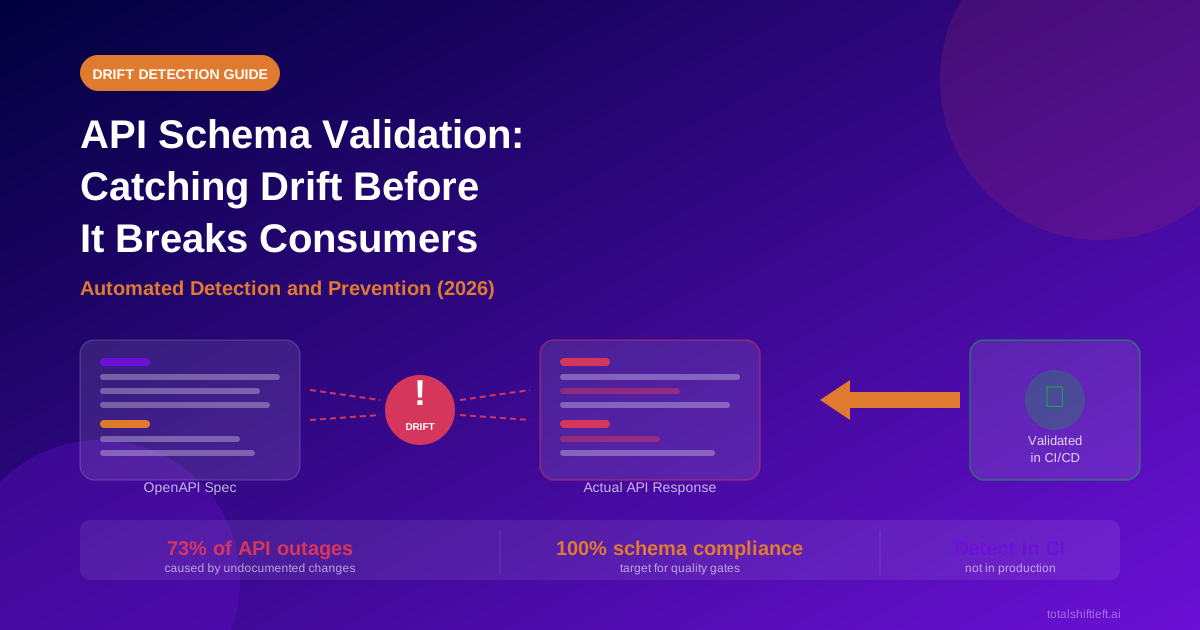
API schema validation drift detection automatically compares live API responses against the documented OpenAPI specification to catch undocumented changes — in one real case, drift caused three production incidents a month before detection. Six common drift types include type changes, removed or renamed fields, format changes, nullable transitions, and nested structure reorganization. Running validation on every commit and treating failures as build-blocking cuts mean time to detect from weeks to minutes.
Reviewed by Sushant Joshi
In this guide
- What API schema validation drift detection is
- Why drift detection matters for API reliability
- Key components of schema drift
- How automated schema validation works in CI/CD
- Tool comparison for drift detection
- Real implementation example with results
- Common challenges and solutions
- Best practices for preventing drift
- Implementation checklist
- Frequently asked questions
A developer renames a response field from user_id to userId. The API still works. Unit tests still pass. The OpenAPI spec does not get updated. Three weeks later, a mobile client that depends on user_id starts crashing in production. The team spends two days tracing the issue back to a field rename that happened across 47 commits ago.
This scenario plays out repeatedly across organizations that rely on APIs as integration contracts. The root cause is always the same: the API's actual behavior drifted from its documented specification, and nothing in the development workflow detected the divergence.
API schema validation drift detection solves this by automatically comparing every API response against the OpenAPI specification during CI/CD pipeline execution. When a developer's code change causes the API response to deviate from the documented schema -- whether through a type change, a removed field, a format modification, or a structural reorganization -- the validation catches it immediately and blocks the deployment.
This guide covers how schema drift occurs, why manual reviews fail to catch it, how to implement automated detection, and the practices that prevent drift from being introduced in the first place. Whether your team maintains a single API or dozens of microservices, these techniques protect your consumers from silent breaking changes.
Designing the contract before the handler changes what testing has to do at all — schema-first API development and testing covers that loop end to end.
Which version of the spec you are on changes what a validator will accept — OpenAPI 3.0 vs 3.1 lists every difference that affects testing.
For what a schema assertion can and cannot prove before a release, see Pact vs Postman for contract testing.
What Is API Schema Validation Drift Detection?
API schema validation drift detection is the practice of automatically verifying that your API's live responses conform to the structure, types, and formats defined in your OpenAPI specification. When the actual response deviates from the documented contract -- a condition called schema drift -- the validation system flags the discrepancy as a failure in your CI/CD pipeline.
Drift takes many forms, from obvious changes like renamed fields to subtle shifts like a previously non-null field starting to return null under certain conditions. The diagram below illustrates the six most common types of schema drift that silently break API consumers:
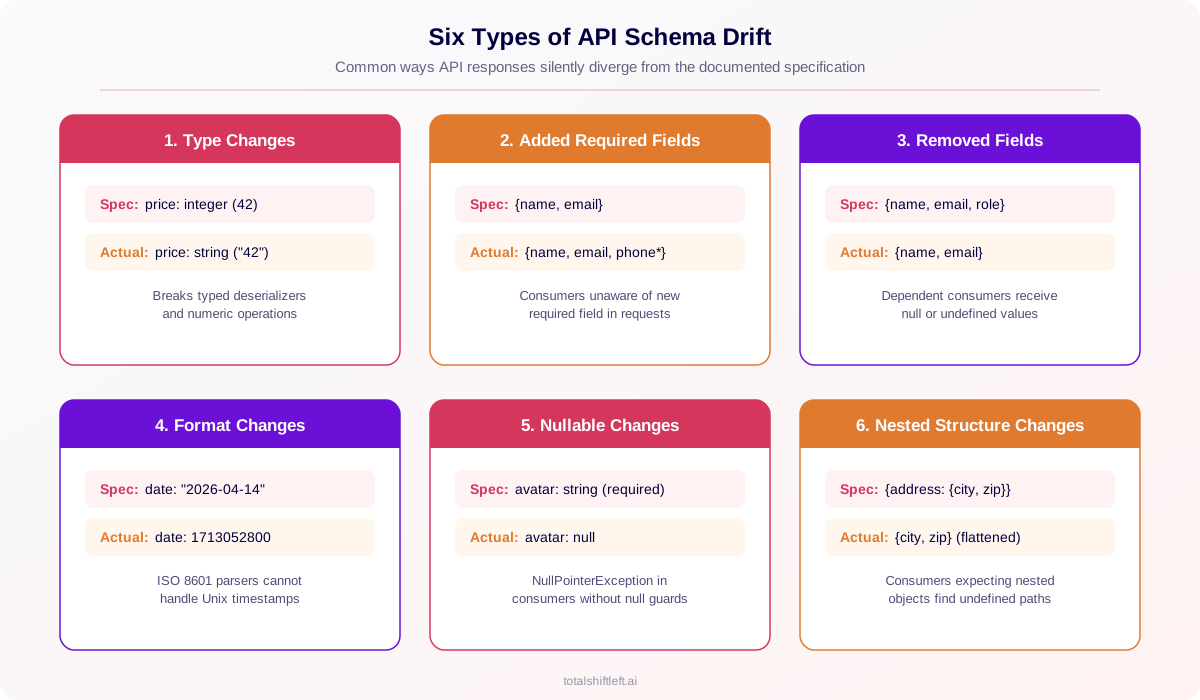
The core concept is straightforward: your OpenAPI spec defines a contract, and schema validation enforces that contract automatically. Without enforcement, the spec becomes aspirational documentation rather than a reliable description of API behavior.
Unlike manual testing, where a QA engineer checks specific response fields, automated schema validation is exhaustive. It verifies every field in every response against the corresponding schema definition -- types, formats, required properties, nullable rules, and nested structures. This thoroughness is what makes it effective at catching the subtle changes that human reviewers miss.
Why API Schema Validation Drift Detection Is Important
Prevents silent consumer breakage
The most dangerous aspect of schema drift is its invisibility. The API continues to function. Server-side tests pass because they test the implementation, not the contract. The drift only surfaces when a consumer -- often in a different team or organization -- experiences a failure. By then, the change may be buried under weeks of commits, making it difficult and expensive to diagnose and fix.
Catches what code review misses
Code review is effective for logic errors but structurally poor at detecting schema drift. Reviewers focus on the business logic of a pull request, not on whether a response model change is consistent with the OpenAPI spec. The spec and the code are different files, often in different directories, so changes to one do not visually highlight the need to update the other. Studies of API-related incidents consistently show that 60-70% of breaking changes pass through code review without being flagged.
Enforces the spec as the single source of truth
Without automated validation, the OpenAPI spec gradually becomes unreliable. Developers stop trusting it because they know it may not reflect reality. Consumers cannot rely on it for client generation or integration planning. Schema validation reverses this erosion by ensuring every deployment is spec-compliant, making the specification a trustworthy contract rather than optimistic documentation.
Reduces mean time to detection
When drift is caught in the CI/CD pipeline, the developer who introduced it is still working on the related code and has full context about the change. Fixing a schema mismatch at this point takes minutes. When drift is discovered weeks later through a production incident, the investigation alone can take hours, and the fix requires understanding code that someone else wrote weeks ago. Automated detection reduces mean time to detection from weeks to minutes.
Enables safe API evolution in microservices
In microservices architectures where services communicate through APIs, schema drift in one service can cascade into failures across the entire system. Automated validation ensures that each service's API contract is enforced at the pipeline level, preventing drift from propagating through service dependencies. This is closely related to API contract testing, which extends validation to include consumer-specific expectations.
Key Components of API Schema Drift
Understanding the specific types of drift helps you configure validation rules and communicate findings to development teams. Each type has distinct causes and impacts.
Type changes
A field's data type changes without spec updates. An integer becomes a string, a boolean becomes an integer, or an array becomes a single object. Type changes break deserialization in statically typed consumers and cause runtime errors in dynamically typed ones that perform type-specific operations.
Required field modifications
Fields are added as required in the implementation without being documented in the spec, or required fields are made optional without consumer notification. Added required fields break request validation for consumers that do not send them. Removed required fields cause consumers to rely on data that may no longer be present.
Removed or renamed fields
Fields that consumers depend on are removed or renamed. This is the most immediately destructive form of drift because consumers that reference the old field name receive undefined or null values, typically causing application errors. The challenge is that the removal may be intentional for one consumer while breaking others.
Format changes
The data format of a field changes while the type remains the same. A date field switches from ISO 8601 strings to Unix timestamps. An ID field changes from integer to UUID string. An amount field gains decimal precision. These changes pass type validation but break consumers that parse based on the expected format.
Nullable transitions
A field that was never null starts returning null under certain conditions, or a nullable field becomes non-nullable. Nullable transitions are particularly insidious because they appear intermittently -- the field may only be null for certain data states, making the drift difficult to reproduce and diagnose.
Ready to shift left with your API testing?
Try our no-code API test automation platform free. Generate tests from OpenAPI, run in CI/CD, and scale quality.
Nested structure reorganization
Object hierarchies are flattened, nested, or reorganized. A field moves from response.data.user.name to response.user_name. The data is semantically equivalent, but consumers parsing the original structure find empty or undefined paths.
Schema Validation Workflow in CI/CD
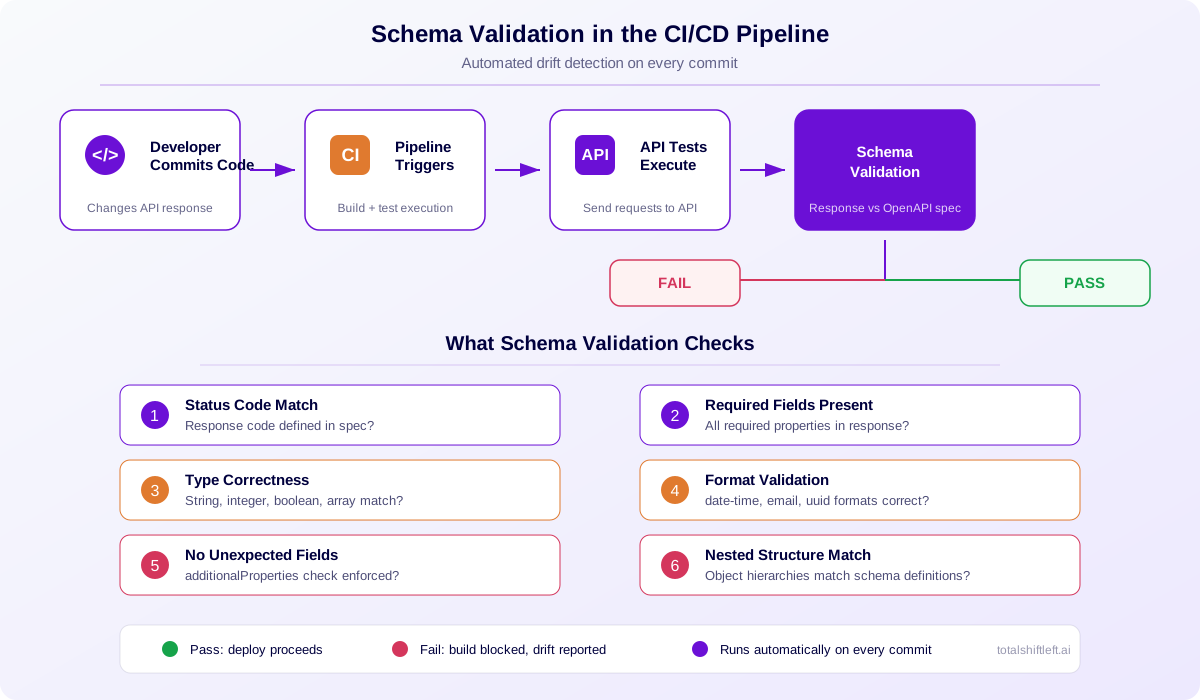
Effective schema drift detection integrates directly into your CI/CD pipeline, running on every commit as part of the automated test suite. The workflow below shows how schema validation fits into the deployment pipeline and what it checks at each stage:
How the validation process works
The validation process is embedded within API test execution, not run as a separate step:
- Test sends a request to an API endpoint based on the OpenAPI spec definition
- API returns a response with status code, headers, and body
- Validator intercepts the response before business logic assertions execute
- Validator checks the response against the corresponding schema definition:
- Status code matches a defined response in the spec
- All required fields are present in the response body
- Field types match (string, integer, boolean, array, object)
- Field formats match (date-time, email, uuid, uri)
- No unexpected fields appear (when
additionalProperties: false) - Nested object structures match their schema definitions
- Nullable rules are respected
- Any mismatch is recorded as a schema validation failure
- Pipeline treats failures as build-blocking -- drift cannot proceed to deployment
This process runs on every test execution, in every pipeline run, across every endpoint. Drift is detected at the commit that introduces it, with full context about which field, which type, and which endpoint is affected — the same signal that automated breaking-change and spec-drift detection surfaces continuously as your API evolves.
Integration approaches
Spec-driven testing platforms. Tools like Total Shift Left perform schema validation automatically because tests are generated from the OpenAPI specification. Every response is validated against the schema that defined the test. No additional configuration or validation libraries are needed.
Code-based test frameworks. If you use RestAssured, Pytest, SuperTest, or similar frameworks, add a schema validation middleware that loads your OpenAPI spec and validates every response. Libraries like openapi-core (Python), atlassian-oai (Java), and express-openapi-validator (Node.js) provide this capability.
Contract testing tools. Contract testing extends schema validation by adding consumer-driven contracts. Tools like Pact verify not just that the schema is correct, but that each consumer's specific field dependencies are satisfied. This is essential for multi-consumer APIs in microservices architectures.
For pipeline configuration details across Azure DevOps and Jenkins, see the CI/CD integration guide.
Tools for API Schema Validation Drift Detection
| Feature | Total Shift Left | Pact | openapi-core | Schemathesis | Dredd |
|---|---|---|---|---|---|
| Validation type | Automatic per-response | Consumer contracts | Library-based | Property-based | Contract compliance |
| Spec format | OpenAPI 3.x, Swagger 2.0 | Pact contracts | OpenAPI 3.x | OpenAPI 3.x | OpenAPI 2.0/3.x |
| Setup complexity | No-code import | Consumer/provider setup | Code integration | CLI configuration | Config files |
| Drift detection | Every response, every test | Per consumer contract | Per instrumented test | Randomized inputs | Per endpoint |
| CI/CD integration | GitHub Actions, Azure DevOps, Jenkins, CI runner, REST API | CI plugins | Framework-dependent | CLI | CLI |
| Coverage tracking | Endpoint, method, status, parameter | Consumer-based | No | No | No |
| Multi-consumer support | Via coverage dashboards | Native (consumer-driven) | No | No | No |
| Repair after change | AI repair of failing tests, proposed for review; spec changes held for approval at import | No | No | No | No |
Total Shift Left handles schema validation as a built-in feature of spec-driven testing -- import your OpenAPI spec, and every generated test automatically validates responses against the schema. For teams evaluating options, the Total Shift Left vs Postman comparison covers drift detection capabilities in detail.
Shift-Left API also applies the drift check to runs that pass. A green test is examined for whether the response still matches its documentation, whether the test would notice a regression, and whether the requirement it is linked to was actually verified — so drift in a field no assertion happens to look at is still caught. Suggestions from this check only ever add assertions; they never loosen one.
Pact is the strongest option for consumer-driven contract testing in microservices, where you need to verify that each consumer's specific expectations are met, not just that the schema is correct.
For teams using code-based test frameworks, openapi-core and similar libraries add schema validation to existing test suites with minimal code changes.
API schema validation in practice: a worked example
The problem
A healthcare platform with 28 microservices experienced recurring integration failures. An internal audit revealed that 12 of their 28 services had schema drift -- their actual API responses did not match their documented OpenAPI specifications. The drift had accumulated over 8 months of development without detection, causing an average of 3 production incidents per month related to deserialization errors and missing fields across service boundaries.
The solution
The team implemented automated schema validation in three phases:
Phase 1 (Week 1-2): Spec reconciliation. They compared each service's actual responses against its OpenAPI spec using automated comparison scripts. They found 47 individual drift instances across 12 services and updated the specs to reflect the current reality, establishing an accurate baseline.
Phase 2 (Week 3): Validation integration. They configured their CI/CD pipeline to run schema validation on every pull request using a spec-driven testing platform. Every API response was automatically validated against the updated OpenAPI specification. They adopted spec-driven test generation to create comprehensive test suites from the reconciled specs.
Phase 3 (Week 4+): Prevention. They implemented spec-first development practices: spec changes were required before code changes, pre-commit hooks validated spec structure, and spec diffs in pull requests required approval from API owners.
The results
- Schema drift instances: reduced from 47 to 0 within 6 weeks
- Integration-related production incidents: decreased from 3 per month to 0.2 per month (1 in 5 months)
- Mean time to detect breaking changes: reduced from 18 days to 4 minutes (pipeline execution time)
- Developer confidence in specs: internal survey showed spec trust increased from 23% to 91%
- Client SDK regeneration: became reliable, enabling automated client updates across consumer teams
Common Challenges in Schema Drift Detection
Existing drift in legacy APIs
Challenge: Most teams implementing schema validation for the first time discover that their specs already have significant drift. Running validation immediately produces hundreds of failures, making it impossible to distinguish new drift from pre-existing issues.
Solution: Start with a reconciliation phase. Run a one-time comparison between actual responses and specs, then update the specs to match reality. This establishes an accurate baseline. From that point forward, validation catches new drift at the commit level. Consider using API regression testing techniques to systematically verify the reconciled baseline.
Triage tooling helps with the first noisy run. In Shift-Left API, a failed run is grouped into a handful of causes, each with a verdict — test defect, data issue, environment problem, or suspected product bug — and it reads what the server actually returned, so a gateway error page or a sign-in redirect is not mistaken for schema drift. Hundreds of failures that share one cause show up as one item, and every test sharing that cause can be fixed in one step once a person accepts the change. See run failure analysis.
Free 1-page checklist
API Testing Checklist for CI/CD Pipelines
A printable 25-point checklist covering authentication, error scenarios, contract validation, performance thresholds, and more.
Download FreeSpec maintenance burden
Challenge: Teams resist schema validation because it requires keeping the OpenAPI spec perfectly synchronized with the implementation. Every code change that affects API responses requires a corresponding spec update, adding overhead to development.
Solution: Adopt spec-first development where the spec is updated before the code, not after. When the spec drives implementation, maintenance becomes part of the development workflow rather than an afterthought. Code generation from specs (server stubs, client SDKs) creates structural incentives for spec accuracy.
False positives from optional fields
Challenge: APIs that return optional fields inconsistently -- present in some responses, absent in others -- trigger validation failures when the validator expects fields that are not returned for a particular request.
Solution: Define optional fields correctly in the OpenAPI spec using required arrays and nullable: true properties. Ensure test data covers scenarios where optional fields are both present and absent. Well-configured validators distinguish between missing optional fields (acceptable) and missing required fields (drift).
Performance impact on CI/CD pipelines
Challenge: Schema validation adds processing time to each test execution, which can slow down CI/CD pipelines, especially for large APIs with hundreds of endpoints.
Solution: Schema validation overhead is typically milliseconds per response -- negligible compared to network latency. For very large test suites, use parallel execution to maintain acceptable pipeline times. The time investment is orders of magnitude less than the time spent debugging production drift incidents.
Handling intentional breaking changes
Challenge: Sometimes drift is intentional -- a field is deliberately renamed, a type is changed, or a field is removed. The validation system flags these as failures even though they are planned changes.
Solution: The correct workflow for intentional changes is: update the spec first, then change the implementation. When the spec change happens before the code change, the validation system sees consistency, not drift. If the change affects consumers, the spec diff in the pull request serves as the notification mechanism. For consumer notification, combine schema validation with contract testing to identify which consumers are affected.
Best Practices for Schema Drift Prevention
-
Adopt spec-first development. Change the OpenAPI spec before changing the code. When the specification drives implementation, drift is structurally prevented rather than reactively detected.
-
Generate server stubs from the spec. Use code generation tools to create server stubs from your OpenAPI specification. This creates a structural dependency between the spec and the implementation -- code changes require spec changes first.
-
Run validation on every commit, not just releases. Schema drift is introduced through individual commits. Running validation only on release branches delays detection and increases the effort required to trace the source of drift.
-
Treat schema failures as build-blocking. Configure your CI/CD pipeline to fail the build on any schema validation failure. A response that does not match the spec is a breaking change, even if all functional tests pass. This is equivalent to treating compilation errors as blocking -- the contract must be satisfied.
-
Add pre-commit spec linting. Use tools like Spectral to validate your OpenAPI spec structure before it enters version control. This catches syntax errors, missing references, and structural issues that would cause validation failures downstream.
-
Require spec review for API changes. Configure your pull request process to require review from API owners when the OpenAPI spec file changes. This ensures that schema changes are intentional and communicated, not accidental side effects.
-
Track schema compliance as a metric. Monitor schema compliance percentage alongside test pass rate and code coverage. Trending this metric reveals patterns: a sudden drop indicates a breaking change, while a gradual decline suggests spec maintenance is slipping.
-
Keep validation and functional tests together. Run schema validation as part of your API test suite, not as a separate pipeline step. This ensures every test execution validates the contract, and developers see schema failures alongside functional failures in the same report.
Schema Drift Detection Checklist
Use this checklist to verify your drift detection implementation is complete:
- ✔ OpenAPI spec validated with a linter and confirmed to match current API behavior
- ✔ Schema validation integrated into the API test suite (not run separately)
- ✔ Validation runs on every pull request and commit to the main branch
- ✔ Schema validation failures configured as build-blocking in CI/CD pipeline
- ✔ All response status codes (2xx, 4xx, 5xx) validated against spec definitions
- ✔ Type checking enabled for all response fields (string, integer, boolean, array, object)
- ✔ Format validation enabled (date-time, email, uuid, uri)
- ✔
additionalPropertiesset tofalseon response schemas to detect unexpected fields - ✔ Nullable rules defined and enforced for all response fields
- ✔ Nested object structures validated against schema definitions
- ✔ Spec-first development workflow adopted (spec changes before code changes)
- ✔ Pre-commit hook configured for spec linting
- ✔ Spec file changes require API owner review in pull requests
- ✔ Schema compliance metric tracked and trending upward
See also: contract testing in our learn hub for the underlying concept.
Assert the response against the schema, not against a fixture
A fixture comparison passes until someone adds a field. Validating the live response against the schema in the spec catches drift in both directions:
// schema-drift.test.js
import Ajv2020 from 'ajv/dist/2020.js';
import addFormats from 'ajv-formats';
import { readFileSync } from 'node:fs';
import yaml from 'js-yaml';

const spec = yaml.load(readFileSync('openapi.yaml', 'utf8'));
const ajv = addFormats(new Ajv2020({ strict: false, allErrors: true }));
const validate = ajv.compile(spec.components.schemas.Order);

test('GET /v1/orders/{id} matches the published schema', async () => {
  const res = await fetch(`${process.env.API}/v1/orders/42`);
  expect(res.status).toBe(200);
  const body = await res.json();
  if (!validate(body)) throw new Error(ajv.errorsText(validate.errors));
});
Run the same check against the spec history so a drift that was introduced deliberately shows up as a reviewed change rather than a surprise:
git show origin/main:openapi.yaml > /tmp/base.yaml
oasdiff diff /tmp/base.yaml openapi.yaml --format text
oasdiff breaking /tmp/base.yaml openapi.yaml --fail-on ERR
API schema validation FAQ
What is API schema drift?
API schema drift occurs when the actual API response structure diverges from the documented schema in your OpenAPI specification. This happens when developers modify response fields, change data types, add or remove properties, or alter nested structures without updating the spec. Drift is one of the most common causes of integration failures in API-dependent systems.
How do I detect schema drift automatically?
Automated schema validation compares live API responses against your OpenAPI specification during test execution in CI/CD pipelines. Every response is checked for status code correctness, required field presence, type matching, format compliance, and structural consistency. Any mismatch is flagged as a validation failure that blocks the build.
What is the difference between schema validation and contract testing?
Schema validation checks that API responses match the documented specification structure -- field names, types, formats, and required properties. Contract testing goes further by verifying that specific consumer expectations are met, including which fields each consumer depends on, value ranges, and interaction sequences. Schema validation is spec-centric while contract testing is consumer-centric. For most teams, schema validation is the foundation, with contract testing added for multi-consumer APIs.
How often should I run schema validation?
Run schema validation on every commit as part of your CI/CD pipeline. Drift is introduced through code changes, so validating on every change ensures drift is detected the moment it appears, not weeks later when a consumer reports a production failure. Treat schema validation failures as build-blocking events.
Can schema validation prevent breaking changes in microservices?
Yes. In microservices architectures where services communicate through APIs, schema validation acts as an automated contract enforcement layer. When Service A changes its response structure, schema validation in Service B's pipeline detects the incompatibility before deployment. Combined with contract testing, this provides comprehensive protection against breaking changes across the service mesh.
What tools support automated API schema validation?
Spec-driven testing platforms like Total Shift Left perform schema validation automatically on every test execution because tests are generated from the OpenAPI spec. For code-based frameworks, libraries like openapi-core (Python) and atlassian-oai (Java) provide runtime validation. Contract testing tools like Pact add consumer-driven validation on top of schema checks.
Sources and further reading
- JSON Schema 2020-12 — the schema dialect OpenAPI 3.1 aligns with.
- oasdiff — breaking-change detection between two OpenAPI documents.
- Spectral (Stoplight) — the OpenAPI linter most governance programmes standardise on.
Key takeaways
- API schema validation drift detection transforms your OpenAPI specification from passive documentation into an actively enforced contract.
- By validating every API response against the spec during CI/CD pipeline execution, you catch type changes, removed fields, format modifications, and structural reorganizations at the moment they are introduced -- not weeks later when a consumer breaks in production.
- The implementation path is clear: reconcile your existing specs with reality, integrate validation into your test suite, configure build-blocking quality gates, and adopt spec-first development practices to prevent drift at the source.
- Teams that follow this approach consistently report near-zero schema-related production incidents and dramatically improved trust in their API documentation.
Ready to enforce your API contracts automatically? Start a free 15-day trial and import your OpenAPI spec to detect drift from day one. Solo developer? Get the free Citizen Developer Edition — single-user. See pricing for plan details.
Continue learning
Go deeper in the Learning Center
Hands-on lessons with runnable code against our live sandbox.
Most API bugs live in input validation. Here's how to test it systematically.
A contract is a promise. Contract testing keeps you honest. Here's how to do it right.
Fifteen conventions that make REST APIs a joy to use — and the absence of any one is a smell.
Ready to shift left with your API testing?
Try our no-code API test automation platform free.