
How to Generate API Tests from OpenAPI with AI (2026)
Quick answer
To generate API tests from an OpenAPI spec: lint the spec, add response schemas and parameter constraints so there's enough signal to reason from, import it into a spec-driven AI platform, and let the engine parse every endpoint and produce happy-path, edge-case, negative, and auth tests. A spec that took a developer a week to test by hand becomes a 400+ test suite in under 15 minutes — and it regenerates automatically when the spec changes.
Reviewed by Smeet Gohel
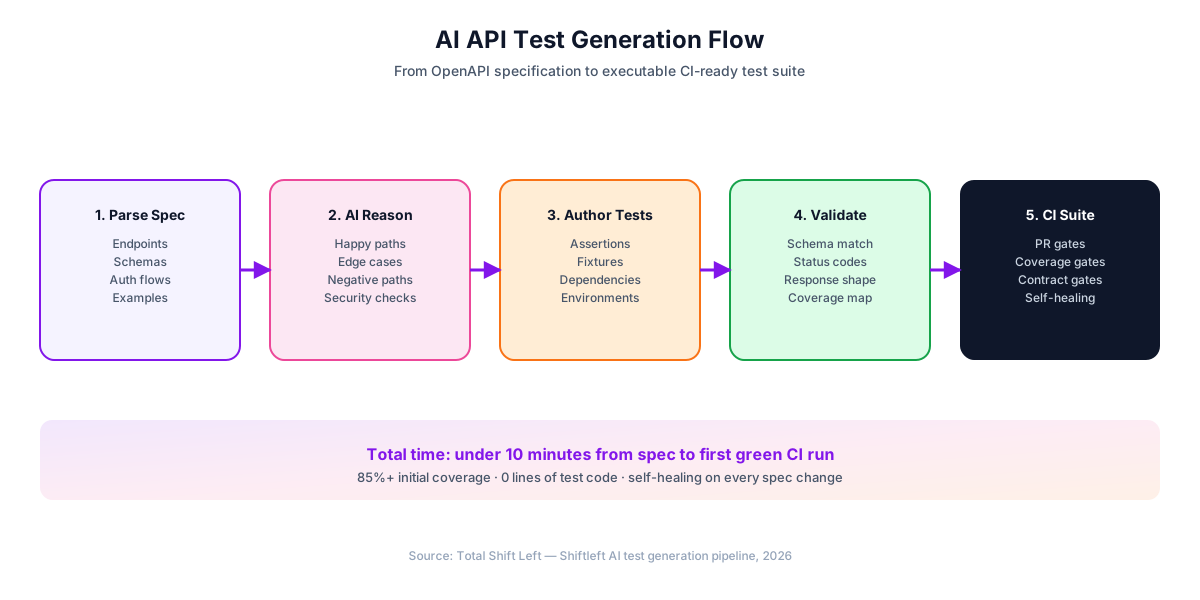
Most API teams already maintain a machine-readable description of their entire API surface — the OpenAPI specification. It defines every endpoint, parameter, request body, response schema, and authentication mechanism, which is everything a test generator needs to produce hundreds of structured test cases automatically. When an engineer connects a spec to Shiftleft AI, a complete test suite is ready in 5–15 minutes: happy paths, edge cases, negative paths, contract validation, and security probes, generated without writing a single test by hand.
This guide is the practical how-to: preparing a spec so it generates useful tests, the five-stage pipeline that turns the spec into a suite, how the leading tools compare, and a day-by-day rollout plan. For the category-level framing see What is Shift Left AI; for the broader testing playbook see AI API Testing Complete Guide.
In this guide
- What Is AI API Test Generation?
- Why AI test generation from OpenAPI matters in 2026
- Prepare Your OpenAPI Spec
- Key Components of the Generation Engine
- AI test generation from OpenAPI reference architecture
- Generate Contract and Schema Validation Tests
- AI test generation from OpenAPI tools compared
- AI test generation from OpenAPI in practice: a worked example
- AI test generation from OpenAPI challenges and how to solve them
- AI test generation from OpenAPI best practices
- AI test generation from OpenAPI checklist
- AI test generation from OpenAPI FAQ
What Is AI API Test Generation?
AI API test generation is the automated production of an API test suite from a specification, using an AI engine that reasons about test cases the spec implies but does not enumerate — the way a senior test engineer would, minus the keystrokes.
Unlike template-based generators, which produce one shallow test per endpoint, an AI reasoning layer identifies:
- Positive tests that send valid requests and verify success responses
- Negative tests that send invalid inputs and verify proper error handling
- Boundary tests that probe min/max values, string length limits, and enum constraints
- Schema validation tests that confirm response structures match the OpenAPI Specification
- Authentication tests that verify security scheme enforcement
The output is not a black box. Tests are human-readable, reviewable, and editable — engineers approve the AI's output the way they'd approve a teammate's pull request. The category covers five stages:
Parse. Read the OpenAPI or GraphQL spec into a structured internal representation. Resolve $ref references, evaluate oneOf / anyOf polymorphism, expand allOf composition.
Reason. Identify test cases. For every endpoint: happy path per documented status, edge cases for each parameter (boundaries, types, formats), negative paths (missing required fields, wrong types, invalid auth), contract assertions (every field, type, and constraint), security probes (authn/authz, common OWASP API Security Top 10 patterns).
Author. Produce executable, human-readable tests with fixtures, requests, assertions, and metadata. The output format is platform-specific but consistently reviewable.
Validate. Run the generated tests against the actual API or a mock to verify they execute. Quarantine tests that fail validation for review.
Deliver. Package the suite for CI/CD execution with environment configs, auth mappings, and gate policies.
A generation engine that performs all five stages is in the AI test generation category. An engine that does only two or three (a parser plus a templating layer) produces brittle output. The full feature comparison is in AI vs Codeless API Testing Tools.
To measure how much of the spec your suite actually touches, the OpenAPI test coverage guide sets out endpoint, response-code and schema coverage and how to compute each.
If your data cannot leave the network, self-hosted LLM test generation covers running the same generation step on Ollama or vLLM inside your own boundary.
The maintenance half of generated suites is covered separately in how self-healing API tests work.
Which version of the spec you are on changes what validators accept — OpenAPI 3.0 vs 3.1 lists every difference.
Why AI test generation from OpenAPI matters in 2026
Three reasons AI generation matters operationally in 2026.
Spec investment finally pays off. Many teams maintain OpenAPI specs as documentation but get little engineering leverage from them. This is exactly what generating a full suite directly from your OpenAPI schema delivers — the spec becomes the source of test coverage, so the spec investment becomes a quality investment, automatically.
Coverage decoupled from labor. Traditional automation grows coverage at the rate engineers can write tests. AI generation grows coverage at the rate the spec grows. For teams shipping new endpoints frequently, this is the difference between coverage rising and coverage decaying. The full coverage curve is in AI API Automation vs Traditional API Testing.
Edge cases stop being optional. A senior test engineer writing tests by hand might cover the top 3–5 edge cases per endpoint. The AI covers every case the spec implies — boundary values, format violations, type mismatches, every status code. Coverage of negative paths typically jumps 5–10× over hand-authored suites.
These outcomes are why teams that adopt AI generation in 2026 see coverage move from 40–60% to 85–95% within 90 days. The full case data is in AI API Testing Complete Guide.
Prepare Your OpenAPI Spec
An AI engine can only reason about what the spec tells it. The quality of the generated suite tracks the richness of the spec directly, so before importing anything, get these five things right:
Complete response schemas. Every operation should define response schemas for success and error status codes — at minimum 200/201, 400, 401, 403, 404, and 500. Without error response schemas, the engine can't generate negative tests that verify proper error handling.
Parameter constraints. Use OpenAPI's constraint keywords: minimum, maximum, minLength, maxLength, pattern, enum, format, required. A field defined as type: integer, minimum: 1, maximum: 100 gives the reasoner enough information to generate boundary tests at 0, 1, 100, and 101 automatically. Without constraints, it can only verify type correctness.
Example values. The example property on parameters and schema fields anchors generated fixtures to realistic data. A username field with example: "jane.doe" produces more meaningful tests than one filled with a random string that fails a business validation rule.
Ready to shift left with your API testing?
Try our no-code API test automation platform free. Generate tests from OpenAPI, run in CI/CD, and scale quality.
Security scheme definitions. Define authentication mechanisms (API key, bearer token, OAuth2) in securitySchemes and apply them via security. This is what lets the engine generate auth tests that check unauthenticated requests get a 401 and unauthorized requests get a 403.
Request body schemas. For POST, PUT, and PATCH, define detailed request bodies with required fields, nested objects, and validation constraints — the more precise the definition, the more targeted the negative tests (missing required fields, wrong types, invalid nested structures).
A minimal but well-constrained operation looks like this:
paths:
  /orders/{orderId}:
    get:
      operationId: getOrder
      parameters:
        - name: orderId
          in: path
          required: true
          schema:
            type: string
            format: uuid
      responses:
        '200':
          description: Order found
          content:
            application/json:
              schema:
                $ref: '#/components/schemas/Order'
        '401':
          description: Missing or invalid auth token
        '404':
          description: Order does not exist
      security:
        - bearerAuth: []
Run a linter (Spectral or swagger-cli) first — a spec that fails validation produces incomplete or broken tests. A 40-endpoint spec enriched this way typically yields 300–500 generated test cases; the same spec with only happy-path responses defined might yield 40.
Key Components of the Generation Engine
The engine has six functional components.
1. Spec parser. Multi-format: OpenAPI 3.x, Swagger 2.0, GraphQL SDL, Postman collections, live-traffic recordings. Resolves references, evaluates polymorphism.
2. Case reasoner. Identifies test cases per endpoint based on documented status codes, parameters, body schemas, and security definitions. Includes a library of common case patterns (boundary values, format violations, auth failure modes).
3. Test author. Converts each case into an executable test with request, fixture data, assertions, and metadata. Produces readable output (no minified or obfuscated code).
4. Schema validator. Runs each generated test against schema validation to ensure assertions match the spec. Catches generation errors before delivery.
5. Live validator. Runs each test against the actual API or a mock to verify execution. Quarantines tests that fail validation; engineers review.
6. CI packager. Bundles the suite with environment configs, auth mappings, gate policies, and CI plugin metadata.
Shiftleft AI ships all six components. The CI integration of the packager output is detailed in Shiftleft AI for CI/CD Pipelines.
AI test generation from OpenAPI reference architecture
The generation pipeline at the architecture level.
A spec arrives — by repository connection, URL, file upload, or live-traffic discovery. The parser produces an internal representation: a graph of endpoints, schemas, and security schemes with references resolved.
The reasoner walks the graph. For each endpoint it identifies happy-path cases (one per documented success status), edge cases (one per parameter boundary or format), negative paths (one per documented error status plus generic missing-required-field cases), contract assertions (one per response field), and security probes (one per security scheme).
The author converts each reasoned case into an executable test. Fixtures use schema-valid synthetic data; assertions cover status, body fields, and headers; metadata tags the test by category, endpoint, and severity.
The schema validator runs every test through static checking — does the assertion match the spec? — and quarantines failures. The live validator runs every passing test against the real API or a mock to verify execution; runtime failures are quarantined for review. Quarantined tests don't ship to CI; engineers review and either fix the spec, fix the test, or accept the case is invalid.
The CI packager produces a deployable suite — typically completed within 5–10 minutes for a service with 50–100 endpoints.
Generate Contract and Schema Validation Tests
Contract and schema validation tests deserve a separate call-out because they're what most teams get wrong first: they generate happy-path tests, skip contract checks, and then get paged when a producer silently drops a field a consumer depends on.
A schema-aware engine generates two kinds of these automatically once the spec defines response schemas per status code:
- Contract assertions — one per response field, type, and constraint, run on every response so an undocumented field, a type change (
string→integer), or a dropped required field fails the test immediately rather than surfacing as a production incident. - Schema drift checks — comparing the live API's actual responses against the spec on a schedule, not just at test time, to catch cases where the implementation and the spec quietly diverge between releases. See detecting schema drift for the deeper pattern.
The generation engine can produce these from the same OpenAPI spec used for functional tests — no separate contract-testing tool or Pact broker required for schema-level contracts. Teams doing consumer-driven contract testing across services still want a dedicated tool; see contract testing for microservices for when that's the right call instead.
AI test generation from OpenAPI tools compared
The 2026 generation engine landscape, compared on how each actually produces tests:
| Tool | Approach | Test types | Negative tests | CI/CD integration | No-code |
|---|---|---|---|---|---|
| Shiftleft AI | AI reasoning over the full spec | Positive, negative, boundary, schema, auth | Automatic, from error schemas | Azure DevOps, Jenkins, REST API, CLI | Yes |
| Schemathesis | Property-based fuzzing | Randomized edge cases | Randomized invalid inputs | CLI | No — Python |
| Dredd | Template-based contract checks | Contract compliance only | No | CLI | No — config files |
| Postman + Postbot | AI-assisted snippet suggestions | Manual, AI-drafted starting points | Manual only | Newman CLI | Partial |
| Code-based (REST Assured, supertest, Karate) | Hand-written | Whatever the author writes | Manual only | Native to the framework | No |
Shiftleft AI is purpose-built for OpenAPI test automation — a full parse/reason/author/validate/deliver pipeline with built-in coverage dashboards. Schemathesis is strong for security-focused fuzz testing but produces randomized inputs rather than deterministic, reviewable test cases, which makes it a harder fit for pipeline quality gates. Dredd verifies an implementation matches its spec but doesn't generate negative or boundary tests. Postman's Postbot is useful for one-off exploration inside the collection editor, not a full generation pipeline — see Shiftleft AI vs Postman for the detailed comparison.
Free PDF + code examples
OpenAPI to Test Generation Template Pack
Go from OpenAPI spec to full test coverage. Includes sample specs, example generated tests, edge case patterns, and CI/CD integration guides.
Download FreeFor most teams in 2026 the choice is between a full AI pipeline and a combination of Schemathesis-for-fuzzing plus manual authoring for business logic. The full TCO comparison is in AI API Automation vs Traditional API Testing.
AI test generation from OpenAPI in practice: a worked example
A platform engineering team with a 47-endpoint REST payments service connected their OpenAPI spec to Shiftleft AI for the first time.
Pipeline run. The parser ingested the OpenAPI spec in 12 seconds. The reasoner identified 412 test cases — 47 happy paths, 188 edge cases, 124 negative paths, 47 contract validation passes, and 6 security probes. The author produced 412 tests in 2 minutes. The schema validator passed 408 of them; 4 were quarantined due to ambiguous spec definitions (the spec said string but examples showed UUIDs). The live validator ran the 408 against a mock; 396 passed; 12 were quarantined for review.
Review. The QA engineer reviewed the 16 quarantined tests in 25 minutes — fixing 8 by tightening spec definitions, accepting 5 as legitimate edge cases requiring fixture adjustments, deleting 3 that were genuinely invalid given the API's actual behavior.
Outcome. 408 production-ready tests for the payments service, generated in under 15 minutes total (12 minutes pipeline + 3 minutes review setup). Coverage jumped from 31% (the prior hand-written suite) to 88%. The team retired their hand-written suite within the week.
This is a typical first-run experience. The full team-level impact is in AI API Testing Complete Guide.
AI test generation from OpenAPI challenges and how to solve them
Five common challenges in AI generation.
Spec ambiguity. When the spec is vague (e.g., string without format), the AI must guess. Quarantines surface these for human resolution. Treat them as spec-improvement opportunities.
Multi-step workflows. A single endpoint test cannot capture "create order, fetch order, update order" sequences. Configure named workflow definitions in the platform; the AI uses them as scaffolds.
Dynamic content. Endpoints whose responses change based on time, geo, or other context need fixture seeding or mock backing. Configure the seeding once per environment.
Highly polymorphic responses. oneOf and anyOf schemas produce many cases; the AI handles them but the volume can surprise engineers. Coverage settings can cap per-endpoint cases.
Auth-required endpoints. OAuth2, mTLS, custom auth — these need configuration before generation can validate live. Configure auth per environment in the platform dashboard.
The full operational pattern is in Shiftleft AI for CI/CD Pipelines.
AI test generation from OpenAPI best practices
Five practices for high-quality AI generation.
1. Lint the spec first. Run spectral or equivalent before connecting; better spec input = better tests.
2. Document examples. OpenAPI example and examples fields significantly improve fixture quality. Invest 15 minutes per endpoint in good examples.
3. Mark stable vs experimental. Use OpenAPI extensions to mark experimental endpoints; the AI treats them with looser gates.
4. Provide named workflows for multi-step flows. Define them once; the AI uses them across regenerations.
5. Review the first batch with the engineer who owns the API. They catch spec mismatches the platform cannot. After the first batch, regeneration becomes mostly hands-off.
The full workflow inventory is in Automate with AI: 10 API Test Workflows.
AI test generation from OpenAPI checklist
A 7-day generation onboarding checklist for one service.
- Day 1. Audit the spec against the five readiness checks above. Lint with spectral. Confirm examples are populated for the top 20 endpoints.
- Day 2. Sign up for Shiftleft AI free trial. Connect the spec.
- Day 3. Run generation. Review the quarantine queue with the API owner. Resolve spec ambiguities.
- Day 4. Configure auth and environments. Run live validation.
- Day 5. Define any named workflows for multi-step flows.
- Day 6. Run the suite against the preview environment for 3 PRs.
- Day 7. Wire as a CI step (see Shiftleft AI for CI/CD Pipelines).
By day 7 the service is generating, validating, and gating. Subsequent services typically take half as long — patterns and configurations carry over.
See also: generate tests from openapi in our learn hub for the underlying concept.
AI test generation from OpenAPI FAQ
How do I generate API tests from an OpenAPI spec?
Lint the spec, make sure every operation defines response schemas for success and error status codes, add parameter constraints (minimum/maximum/pattern/enum) and example values, then import the spec into a spec-driven AI platform such as Shiftleft AI. The engine parses every endpoint and produces happy-path, edge-case, negative, and authentication tests automatically — typically 300–500 tests for a 40-endpoint spec in 5–10 minutes.
What types of tests can AI generate from an OpenAPI spec?
Positive tests (valid requests expecting success), negative tests (invalid inputs expecting proper error responses), schema validation tests (response structure matches the spec), boundary tests (min/max values, string lengths), and authentication tests. Coverage depends on how thoroughly the spec defines response schemas, parameter constraints, and security schemes.
Do I need a complete OpenAPI spec to generate tests?
No — you can generate tests from a partial spec, but coverage depends on spec quality. At minimum you need endpoint paths, HTTP methods, and response schemas. Adding parameter constraints, examples, and error responses produces more comprehensive tests.
Can I generate API tests from an OpenAPI spec without writing code?
Yes. No-code platforms import the OpenAPI specification and generate complete test suites automatically — you configure environments and credentials through a UI, not scripts, and the generated tests run in CI/CD via CLI or REST API integration with zero custom code.
What protocols does AI test generation support?
Spec-driven AI generation works from OpenAPI 3.x and Swagger 2.0 specs (REST APIs) and GraphQL SDL, plus imported Postman collections and live-traffic recordings. Coverage of any protocol is bounded by how much the spec documents — richer specs produce richer test suites.
How often should I regenerate tests when my API changes?
Every time the OpenAPI spec is updated. Spec-driven platforms detect spec changes and regenerate affected tests automatically, keeping the suite synchronized without manual intervention — pair this with schema drift detection to catch undocumented changes.
Are the generated tests reviewable, or a black box?
Reviewable. Tests are human-readable — engineers approve the AI's output the way they'd approve a teammate's pull request, and can edit any test; the platform tracks edits and preserves them through self-healing regeneration.
How does this compare to template-based generators?
Template-based tools produce fewer cases and miss edge cases the spec implies but doesn't enumerate. AI reasoning catches them. See AI vs Codeless API Testing Tools.
Sources and further reading
- OpenAPI Specification — the normative spec for describing HTTP APIs.
- Schemathesis documentation — property-based testing driven straight from an OpenAPI spec.
- JSON Schema 2020-12 — the schema dialect OpenAPI 3.1 aligns with.
Key takeaways
- AI API test generation is the operational core of the Shift Left AI category.
- Understanding the pipeline — parse, reason, author, validate, deliver — explains why spec quality determines test quality and why review-by-API-owner is the practical handshake.
- Engineers who adopt it move from authoring tests to curating spec and policy, both higher-leverage problems.
Start a free trial of Shiftleft AI, connect a real spec, and watch the pipeline produce a CI-ready suite within 15 minutes. For cluster context see What is Shift Left AI, AI API Testing Complete Guide, and the Shiftleft AI platform page.
Continue learning
Go deeper in the Learning Center
Hands-on lessons with runnable code against our live sandbox.
Turn an OpenAPI spec into hundreds of tests in minutes. Here's what the AI actually does well — and where it still needs you.
A contract is a promise. Contract testing keeps you honest. Here's how to do it right.
Ready to shift left with your API testing?
Try our no-code API test automation platform free.