
API Testing for HIPAA Compliance: A Practical Guide (2026)
Quick answer
API testing for HIPAA compliance means validating that PHI-bearing APIs enforce the access-control, audit-log, integrity, authentication, and transmission-security safeguards in Security Rule §164.312 — while keeping specs and captured payloads out of third-party AI services without a BAA. Practices include self-hosted LLM inference (Ollama, vLLM, LM Studio), synthetic or format-preserving-masked test data, negative authorization tests as CI gates, and per-release audit evidence retained 6-7 years.
Reviewed by Parveen Kumari
How to design API testing programs that satisfy HIPAA Security Rule controls without leaking PHI to third-party AI services. PHI masking, BAA-friendly tooling, audit evidence, and a control-mapping cheat sheet.
In this guide
- What is API testing for HIPAA?
- The key components of API testing for HIPAA
- Why API testing is in HIPAA scope
- Four PHI risks specific to API testing
- BAA scope: which tools fall inside your boundary
- PHI handling patterns for test data
- Control-mapping cheat sheet
- Audit evidence: what auditors actually ask for
- API testing for HIPAA reference architecture
- Why API testing for HIPAA matters at enterprise scale
- API testing for HIPAA tools compared
- API testing for HIPAA in practice: a worked example
- Reference architecture
- API testing for HIPAA metrics that matter
- API testing for HIPAA rollout playbook
- API testing for HIPAA challenges and how to solve them
- API testing for HIPAA best practices
- API testing for HIPAA checklist
- Prove PHI never leaves the boundary it is allowed in
What is API testing for HIPAA?
API testing for HIPAA compliance is the practice of validating that APIs handling Protected Health Information (PHI) enforce the access-control, audit-log, integrity, authentication, and transmission-security safeguards required by §164.312 of the HIPAA Security Rule. It covers patient-facing APIs, internal integration APIs (EHR, billing, lab), and third-party / partner APIs under a Business Associate Agreement. The goal is to produce documented evidence — per release — that these technical safeguards operate effectively and to prevent PHI exposure during the testing process itself.
For the token-level cases, see JWT testing.
The key components of API testing for HIPAA
Each enterprise program in this area has the same load-bearing components, regardless of vendor. The components separate cleanly into governance, enforcement, and evidence layers.
PHI handling discipline
Synthetic data generation in-boundary; format-preserving masking with referential integrity for production-derived test data; tokenization for cross-system integration tests. Real PHI is restricted by internal policy to narrow, audited use cases.
Self-hosted AI inference
AI test generation runs against a self-hosted LLM (Ollama, vLLM, LM Studio) inside the same boundary as the test environment. OpenAPI specs, prompts, and captured payloads never reach a third-party LLM provider. The platform is configured to fail closed if the local endpoint is unreachable — never silent fallback.
Negative authorization tests
Every PHI-bearing endpoint has documented negative authentication and authorization tests run as CI quality gates. Tests assert that unauthorized callers receive 401/403, that tokens scoped to the wrong patient are rejected, and that broken-object-level-authorization patterns surface before reaching production.
Audit log capture
The test platform emits audit events at production-equivalent fidelity into the same SIEM serving production. Records include who ran which test against which environment, mapped to §164.312(b) audit-control evidence retained for the audit window.
Source-controlled test definitions
Tests live in version control with branch protection and required code review. Auditors evaluating §164.308(a)(8) (evaluation) expect a verifiable change history of how the test suite evolved, not an editable database of UI-authored test cases.
Per-release evidence retention
Run reports — JUnit, JSON, exportable formats — flow from CI to immutable object storage with retention aligned to the HIPAA audit window (typically 6-7 years). Reports are stripped of PHI to satisfy minimization principles while preserving auditability.
Why API testing is in HIPAA scope
The HIPAA Security Rule does not contain the phrase "API testing." It does, however, contain §164.308(a)(8), which requires covered entities to perform a periodic technical and non-technical evaluation that establishes the extent to which security policies meet the rule's requirements. As soon as PHI moves between systems via APIs — and in modern healthcare it almost always does — those APIs become a technical control that must be evaluated.
The same applies to §164.312, the rule's technical safeguards section: access control, audit controls, integrity, person-or-entity authentication, and transmission security. Each of those translates directly into something an API can either enforce or undermine. If testing does not exercise those behaviors, the safeguard claim is unsupported.
Practically speaking, three categories of API are nearly always in HIPAA scope:
- Patient-facing APIs that expose, modify, or transmit PHI to clinical or administrative endpoints
- Internal integration APIs that move PHI between EHR, billing, lab, imaging, and patient engagement systems
- Third-party / partner APIs under a Business Associate Agreement — claims clearinghouses, payer integrations, telehealth bridges
API testing programs that ignore any of these create gaps an auditor will find.
Four PHI risks specific to API testing
API test environments introduce risks that are different from production runtime risks. The four that matter most for HIPAA:
Spec leakage. Your OpenAPI / Swagger / WSDL specifications describe the shape of PHI-bearing requests and responses. A spec that contains a Patient resource with mrn, dateOfBirth, ssn, and homeAddress fields is itself sensitive — it tells anyone who reads it exactly what PHI flows through that endpoint. AI test-generation tools that send specs to a cloud LLM provider effectively move that sensitivity outside your BAA boundary.
Captured payload exposure. When tests run against any production-like environment, captured request and response payloads frequently contain real PHI. Test platforms that store those payloads in cloud storage outside the BAA scope create exposure that the privacy officer did not authorize.
Credential and token blast radius. Test-environment auth tokens often have broader scope than they should — long-lived bearer tokens, service accounts with read access to entire patient cohorts, or shared credentials for "the dev environment." A leaked test credential in a CI log or test artifact is a HIPAA-reportable event in many organizations' interpretation.
Audit gaps in non-prod. Production has audit logging. Many test environments do not. When a developer runs an exploratory test against a sanitized-but-still-PHI dataset, who knows? A defensible HIPAA program either prevents that situation or logs it in the same audit-trail format as production access.
BAA scope: which tools fall inside your boundary
A short rule of thumb: any tool that touches PHI, PHI-adjacent metadata, or PHI-revealing schema needs to be either inside your existing BAA scope or designed to never see those things in the first place.
For API testing platforms, that means three deployment options are usually viable:
| Pattern | BAA implication | Trade-off |
|---|---|---|
| Self-hosted single-tenant on your infrastructure | No vendor BAA needed for runtime data; only the license / support relationship | You operate the platform; needs internal infra ownership |
| Vendor SaaS with a signed BAA | BAA covers the vendor as a Business Associate | Vendor must support BAA; usually higher-priced tier |
| Local-only (developer laptop) | No data leaves the laptop | Limits CI/CD usage; harder to govern |
Cloud-LLM-backed AI test generation deserves a separate look. Even when the test platform itself sits inside a BAA, the LLM call may not. If the platform forwards your OpenAPI spec — or worse, captured payloads — to OpenAI, Anthropic, or Google for model inference, those calls are independent processing events that need their own BAA. Most healthcare organizations resolve this by requiring self-hosted LLMs (Ollama, vLLM, LM Studio) for any AI-assisted testing.
Ready to shift left with your API testing?
Try our no-code API test automation platform free. Generate tests from OpenAPI, run in CI/CD, and scale quality.
PHI handling patterns for test data
Three patterns scale well in HIPAA-scope environments, in order of risk-reducing strength:
Synthetic data generation. The strongest pattern. Generate test patients, encounters, claims, and observations that look real but reference no actual person. Modern tooling can produce synthetic FHIR Bundles, HL7 v2 messages, and X12 837 claims that exercise the full schema without any PHI provenance. Synthetic data has no breach surface and no patient-rights complications.
Format-preserving masking with referential integrity. Take a copy of production data and replace identifiers (names, MRNs, SSNs, addresses) with masked equivalents that preserve format and referential relationships. A patient with MRN 12345 who appears in five linked records still has a single masked MRN across all five. This is more realistic than synthetic data but carries residual re-identification risk if masking is weak.
Tokenized references to a vault. For integration tests that need to cross system boundaries, replace PHI fields with opaque tokens that the test environment can resolve only via a controlled vault service. The data flowing across the API is meaningless to anyone without vault access.
In all three cases, generation and masking should happen inside the same boundary as the test runner — not in a separate cloud service that requires its own BAA.
For deeper coverage of these patterns, see data masking for regulated test environments and test data management for regulated data.
Control-mapping cheat sheet
A practical mapping of HIPAA Security Rule controls to API testing artifacts:
| HIPAA control | What API testing provides as evidence |
|---|---|
| §164.308(a)(8) — evaluation | Periodic execution of API security and contract test suites with retained reports |
| §164.312(a)(1) — access control | Negative tests confirming unauthorized callers cannot access PHI endpoints; role-based test execution |
| §164.312(a)(2)(i) — unique user identification | Tests asserting that every PHI-bearing request carries an identifying token mapped to an audit-log subject |
| §164.312(b) — audit controls | Tests verifying audit log entries are created for read / write / delete on PHI resources |
| §164.312(c)(1) — integrity | Schema validation tests catching unexpected mutation of PHI fields between request and storage |
| §164.312(d) — person-or-entity authentication | Authentication negative tests across enterprise IdP flows (Okta, Azure AD, Ping) |
| §164.312(e)(1) — transmission security | TLS configuration tests; tests confirming PHI is never returned over non-TLS endpoints |
Auditors do not expect a one-test-per-control mapping. They expect a program that demonstrably covers the control areas, with test artifacts you can produce on request.
Audit evidence: what auditors actually ask for
In practice, healthcare auditors evaluating an API testing program will ask for some combination of:
- The list of PHI-handling APIs and which test suite covers each
- A sample test execution report from the last release of one of those APIs
- The change-management record connecting that release to its test approval
- The role assignments and audit log entries showing who ran the tests
- Evidence that test data does not contain real PHI, or that PHI use was authorized
The evidence has to be retained — not regenerated on demand. This is why exportable run reports and source-controlled test definitions matter more than the depth of any individual test. A shallow but documented program beats a deep but undocumented one in an audit.
API testing for HIPAA reference architecture
A reference architecture for HIPAA-aligned API testing in 2026 typically has six elements:
- Self-hosted test platform inside the organization's HIPAA boundary, with TLS-only ingress and AES-256 credential storage.
- Self-hosted LLM (Ollama, vLLM, LM Studio, or any OpenAPI-compatible endpoint) for AI-assisted test generation; no required outbound calls to a public LLM API.
- Synthetic data generator producing FHIR / HL7 / X12 fixtures inside the same boundary; production-data cloning, if used, runs through a masking pipeline that never crosses the boundary.
- Source-controlled test definitions in a private repository the platform reads at execution time.
- CI/CD integration that emits exportable run reports (JUnit, JSON) per release, retained for the audit window.
- Role-based access with named roles for QA engineers, developers, and security reviewers, all logged.
Any of these components moving outside the HIPAA boundary creates a gap that needs explicit BAA coverage or a documented exception. Starting from a platform with HIPAA-aligned PHI handling and compliance controls already built in keeps most of these components inside the boundary by default. For deployment topology that supports this architecture out of the box, see the deployment page and the healthcare industry page.
API testing is not a HIPAA control by name, but every modern healthcare organization needs one to demonstrate the evaluation, audit, and access control safeguards the rule requires. The key shift in 2026 is that the AI-assisted testing tools most teams want to adopt now have to clear an additional bar: proving that nothing in the test workflow leaks PHI or PHI-adjacent metadata to a service outside the BAA boundary. Self-hosted, self-hosted-LLM-capable platforms make that bar achievable without giving up the productivity gains of AI test generation.
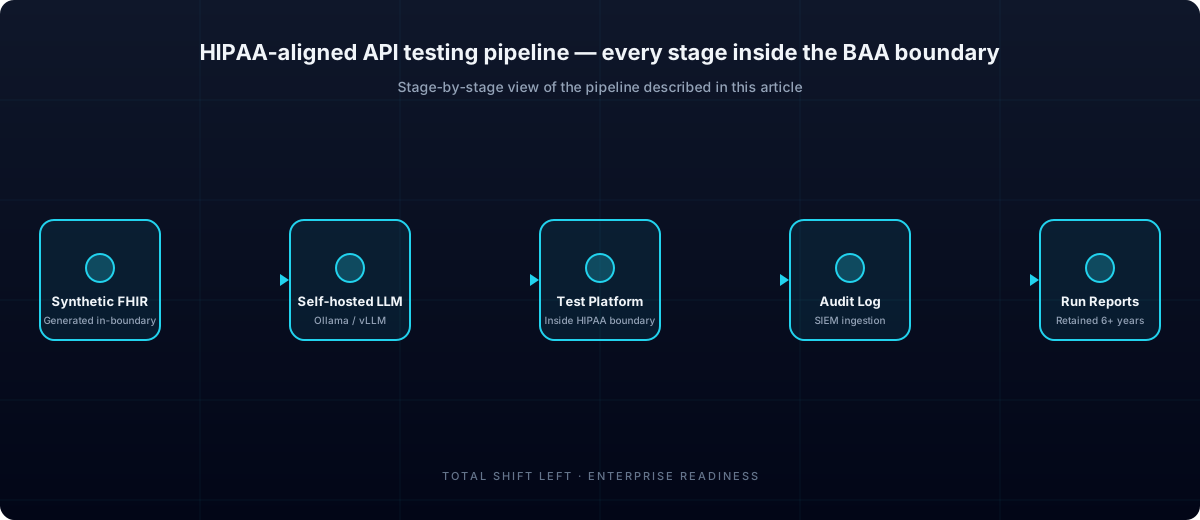
HIPAA-aligned API testing pipeline — every stage runs inside the BAA boundary.
Why API testing for HIPAA matters at enterprise scale
OCR enforcement actions in 2024-2025 increasingly cite missing API testing evidence as a contributing factor in HIPAA settlements — the average cost of a healthcare data breach climbed past $10.9M (IBM Cost of a Data Breach Report 2024), and a meaningful share of those breaches involve API endpoints that did not have documented validation of access-control or audit-log behavior. Healthcare organizations that ship a documented API testing program reduce average breach cost by an estimated 20-30% on the same report's "security AI and automation" segment.
API testing for HIPAA tools compared
A practical view of the tool categories that scale across enterprise testing programs in this area:
| Category | Example tools |
|---|---|
| Schema validation | OpenAPI / FHIR validators, Total Shift Left contract tests |
| PHI masking pipelines | In-boundary tools: Synthea (synthetic), DataVeil, ARX Anonymization |
| Self-hosted LLM runtimes | Ollama, vLLM, LM Studio — for AI test generation inside the BAA |
| Audit log capture | Splunk, Elastic, Datadog with HIPAA-eligible configurations |
| CI/CD with audit trail | Jenkins, GitHub Actions, GitLab CI with retained build artifacts |
Tool selection is secondary to architecture. The patterns above hold regardless of which specific vendor you adopt.
API testing for HIPAA in practice: a worked example
A representative deployment pattern from an enterprise rollout in this area:
Problem. A regional health-information exchange operating 60+ FHIR APIs across patient access, lab results, and care coordination services failed an interim HIPAA evaluation — the auditor asked for documented evidence of access-control testing on PHI-bearing endpoints and could not be produced for 70% of the surface.
Solution. The platform team adopted a self-hosted API testing platform with a self-hosted LLM (vLLM running Llama 3 70B inside the existing HIPAA boundary). Synthetic FHIR Bundles replaced production-derived fixtures. Per-release audit logs flowed into the existing SIEM. Negative authorization tests were added to every PHI-bearing endpoint as a CI quality gate.
Results. PHI-endpoint test coverage moved from ~30% to 96% within four months. The follow-up evaluation closed without findings. PHI-related production incidents on the tested surface dropped to zero across the next 12 months. Engineering velocity was unchanged — tests were generated from FHIR profiles in minutes rather than hand-written.
Free PDF guide (12 pages)
Top 50 API Testing Mistakes
50 real-world API testing mistakes organized by category — from authentication to performance — each with a concrete fix strategy.
Download Free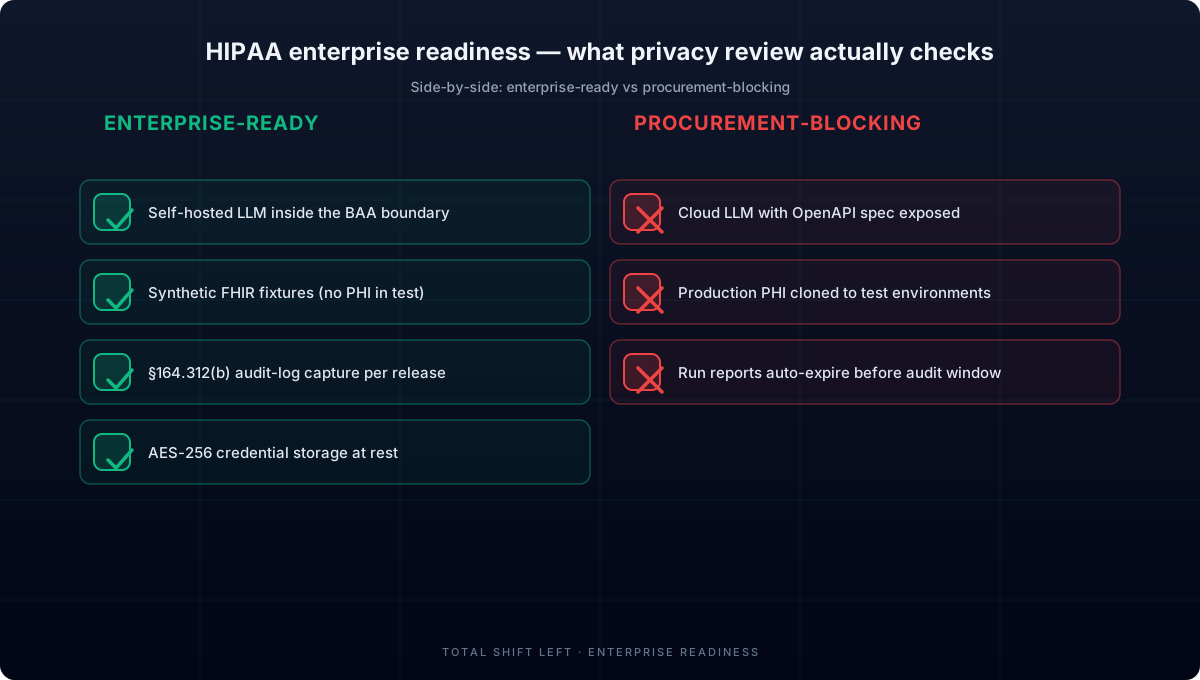
HIPAA-aligned API testing — enterprise readiness checklist.
Reference architecture
A working HIPAA-aligned API testing architecture has six load-bearing components, each scoped to the BAA boundary the covered entity already maintains. The test platform runs on Linux infrastructure inside the boundary with TLS-only ingress, AES-256 credential storage, and integration with the existing identity provider (Azure AD, Okta, or equivalent). The self-hosted LLM runs on dedicated GPU infrastructure — Ollama with Llama 3 70B is the most common starting configuration, with vLLM substituted when throughput requirements scale past a small team. The synthetic data generator produces FHIR R4 / HL7 v2 / X12 fixtures inside the boundary; production-data cloning, when used, runs through a masking pipeline that never crosses the boundary. Source-controlled test definitions live in an internal git instance with branch protection. CI/CD runs on internal runners — never GitHub-hosted — with the test platform integration calling internal endpoints only. Run report retention uses object storage with retention policy aligned to the audit window, typically 6-7 years for HIPAA. The architecture inherits the boundary's authorization rather than introducing new vendor relationships.
API testing for HIPAA metrics that matter
Four metrics demonstrate program health to executive sponsors. PHI-endpoint test coverage — percentage of in-scope endpoints with documented authorization, audit-log, and transmission-security tests — is the headline metric for engineering leadership; the floor for a defensible program is 90%+. Audit evidence completeness per release — percentage of releases with retained run reports — should sit at 100% for the audit window; anything less is a CC8/§164.312 finding waiting to happen. PHI-related production incidents on the tested surface — measured monthly — is the lagging indicator that proves the program reduces real risk. Privacy-officer exception requests — count of "we need to deviate from the standard" requests per quarter — should trend toward zero as the synthetic-first patterns stabilize. Track all four; report on a quarterly cadence to engineering and privacy leadership.
API testing for HIPAA rollout playbook
A 12-week rollout works for most healthcare engineering teams. Weeks 1-2: foundation. Stand up the self-hosted platform and self-hosted LLM. Validate AES-256 credential storage. Integrate with the identity provider. Confirm SIEM captures test-environment access at production fidelity. Weeks 3-4: pilot. Onboard one product team (typically a patient-portal or scheduling team) onto the platform. Generate tests from a representative FHIR API. Confirm the audit trail meets §164.312(b). Weeks 5-8: rollout. Onboard the remaining PHI-bearing API teams in priority order — patient access, claims integrations, EHR adapters. Establish the synthetic-first default; document the masking-pipeline exception process. Weeks 9-12: governance. Add coverage-floor quality gates to CI. Wire the audit interface to the SIEM. Run the first end-to-end audit-evidence query and validate against the auditor's expected sampling format. Most teams reach steady state by week 14-16; coverage typically clears 90% by month 6.
API testing for HIPAA challenges and how to solve them
Privacy office resists AI test generation citing PHI exposure risk. Run inference on a self-hosted LLM inside the BAA boundary. Document the data flow in the privacy review. The objection usually evaporates once the privacy officer sees the spec never leaves the perimeter.
EHR integration teams use shared service accounts that can't represent role-based test scenarios. Provision per-test-suite identities with scoped FHIR consent envelopes. Audit log entries tag the test run, not a person, so the chain to the test artifact is clean.
Legacy HL7 v2 integrations don't fit OpenAPI tooling. Treat HL7 v2 as a separate test surface with its own contract validators (e.g., NIST HL7 v2 validators). Aggregate evidence into the same audit interface as REST/FHIR for unified reporting.
Audit evidence retention conflicts with PHI minimization principles. Retain run reports stripped of PHI — pass/fail, coverage, gate decisions — and reference the underlying captured payloads only via internal pointers if needed. The audit trail meets §164.312(b) without expanding PHI footprint.
API testing for HIPAA best practices
- Generate synthetic FHIR Bundles in-boundary; never copy production PHI into a test environment
- Run AI test generation against a self-hosted LLM (Ollama / vLLM / LM Studio) inside the BAA
- Treat negative authorization tests on every PHI-bearing endpoint as a CI quality gate
- Tag tests by HIPAA control area (§164.312(a), §164.312(b), §164.312(e)) for audit-mapped reporting
- Retain stripped-down run reports (no PHI) for the full audit window
- Source-control test definitions; require code review for test changes touching PHI-handling APIs
- Verify the SIEM captures test-environment access at the same fidelity as production
API testing for HIPAA checklist
A pre-flight checklist enterprise teams can run against their current state:
- ✔ API testing tool runs inside the existing HIPAA authorization boundary
- ✔ AI inference path is fully self-hosted; no outbound LLM API calls
- ✔ Test fixtures are synthetic or masked; no real PHI ever enters the test environment
- ✔ Every PHI-bearing endpoint has documented negative-authorization test coverage
- ✔ Per-release run reports are retained for the audit window in a HIPAA-eligible store
- ✔ Audit log captures who ran which test against which environment
- ✔ Test definitions are source-controlled with branch protection and review
- ✔ A documented mapping from test artifacts to §164.308 / §164.312 controls exists
See also: jwt authentication in our learn hub for the underlying concept.
Prove PHI never leaves the boundary it is allowed in
The Security Rule questions an assessor will ask map cleanly onto assertions: is PHI encrypted in transit, is it excluded from logs and error bodies, and is every access recorded.
# tests/test_phi_handling.py
import re, requests

PHI_PATTERNS = [
    re.compile(r"\b\d{3}-\d{2}-\d{4}\b"),          # SSN
    re.compile(r"\bMRN[-: ]?\d{6,}\b", re.I),        # medical record number
    re.compile(r"\b\d{4}-\d{2}-\d{2}\b"),          # date of birth
]

def test_error_bodies_never_echo_phi(auth_headers):
    r = requests.post(f"{API}/v1/patients",
                      json={"ssn": "123-45-6789", "mrn": "MRN-889231"},
                      headers=auth_headers)
    assert r.status_code == 422
    for p in PHI_PATTERNS:
        assert not p.search(r.text), f"PHI echoed back in the error body: {p.pattern}"

def test_phi_endpoints_are_tls13_only():
    import ssl, socket
    ctx = ssl.SSLContext(ssl.PROTOCOL_TLS_CLIENT)
    ctx.maximum_version = ssl.TLSVersion.TLSv1_2      # force a downgrade attempt
    ctx.load_default_certs()
    try:
        with socket.create_connection(("api.example.com", 443)) as s:
            ctx.wrap_socket(s, server_hostname="api.example.com")
        raise AssertionError("TLS 1.2 was accepted on a PHI endpoint")
    except ssl.SSLError:
        pass

def test_every_phi_read_is_audit_logged(auth_headers, audit_client):
    before = audit_client.count(action="patient.read")
    requests.get(f"{API}/v1/patients/1", headers=auth_headers)
    assert audit_client.count(action="patient.read") == before + 1
Sources and further reading
- HHS HIPAA Security Rule — the safeguards that govern PHI in test environments.
- NIST SP 800-53 Rev. 5 — the control catalogue FedRAMP baselines are drawn from.
- HashiCorp Vault documentation — secret storage and dynamic credentials for test runs.
Key takeaways
- HIPAA-compliant API testing is no longer optional — it is the most credible evidence covered entities can produce that the technical safeguards in §164.312 actually operate.
- The architecture is well-understood: self-hosted platform, self-hosted LLM, in-boundary synthetic data, audit-mapped evidence retention.
- Healthcare engineering teams that adopt this pattern in 2026 reduce both audit risk and breach cost meaningfully — and free their privacy officers from continuous exception-request workflows around AI tooling.
API testing for HIPAA FAQ
Does HIPAA explicitly require API testing?
HIPAA does not name "API testing" as a control. The Security Rule does require covered entities to evaluate the effectiveness of technical safeguards (§164.308(a)(8)), and that obligation extends to the APIs carrying PHI between systems. Documented API testing — particularly around access control, audit logging, and transmission security — is how most healthcare organizations satisfy that evaluation requirement in practice.
Can I send my OpenAPI spec to a cloud LLM for AI test generation?
Not without a Business Associate Agreement covering that LLM provider and a careful review of what the spec reveals about PHI fields. In practice, most healthcare organizations require API testing tools to run against a self-hosted LLM (Ollama, vLLM, LM Studio) inside the same boundary as the test environment. This keeps the schema and any captured payloads inside the BAA scope you already maintain.
What test data should I use for HIPAA-scope APIs?
Synthetic data generated in-boundary, or production data that has been masked using format-preserving techniques that retain referential integrity. The Security Rule does not forbid using PHI for testing, but most organizations restrict or forbid it via internal policy because the privacy-officer downside outweighs the marginal test fidelity gain.
How do API tests provide HIPAA audit evidence?
Per-release test execution logs, the test definitions stored in version control, and exportable run reports together demonstrate that material API changes were validated before reaching production. Auditors reviewing §164.308(a)(8) (evaluation) and §164.312(b) (audit controls) typically want to see a paper trail linking change → test run → result → release approval.
Does the API testing tool itself need a BAA?
Yes, if it processes PHI or PHI-adjacent data — including captured request and response payloads from a test run against a production- like environment. Self-hosted deployment avoids the need for a vendor BAA because the tool runs entirely inside your authorization boundary; only the platform license / support relationship is with the vendor.
Ready to shift left with your API testing?
Try our no-code API test automation platform free.