
Data Masking for Test Environments: PII, PHI, PCI (2026)
Quick answer
Data masking for testing environments irreversibly transforms sensitive production data — PII, PHI, PCI — so it keeps its format and statistical structure while becoming non-identifiable, letting teams test with realistic data without exposing real customers. Core techniques include substitution, format-preserving encryption, shuffling, and variance; deterministic masking preserves referential integrity across tables, which regulators accept as satisfying GDPR and HIPAA anonymization requirements.
Reviewed by Sushant Joshi

Data masking for testing environments is the process of transforming sensitive production data — personally identifiable information (PII), protected health information (PHI), and payment card data (PCI) — so it retains its structure, format, and statistical utility while becoming non-identifiable. Masked data enables realistic testing without exposing real customer information outside production systems.
Data masking testing practices have become non-negotiable for any organization handling personal data. In 2025, GDPR enforcement actions exceeded $2.1 billion globally, with test environment data exposure cited in 18% of cases. The pattern is consistent: organizations invest heavily in production security but leave non-production environments — staging, QA, development, training — as compliance blind spots containing full copies of unprotected customer data.
Non-production environments are the largest unmanaged attack surface in most organizations. A typical enterprise maintains 5-10 copies of production data across development, QA, staging, training, and analytics environments. Each copy contains the same sensitive data as production — customer names, email addresses, Social Security numbers, credit card numbers, medical records — but without the security controls, access restrictions, and monitoring that protect the production copy.
The risk is not theoretical. Data breaches originating from non-production environments are disturbingly common. A developer's laptop with a local copy of the staging database gets stolen. A contractor with access to the QA environment exfiltrates customer records. An unpatched staging server is compromised because it was not included in the security patch schedule that protects production.
Data masking eliminates this risk by ensuring that sensitive data never exists in non-production environments. Production data is transformed before it leaves the production boundary — names become plausible but fictional, email addresses point to non-existent domains, Social Security numbers become structurally valid but unissued sequences. The result is data that looks and behaves like production data for testing purposes while containing zero actual customer information.
This guide covers data masking comprehensively — from techniques and tools to architecture patterns and compliance frameworks. Whether you are implementing masking for the first time or optimizing an existing process, effective data masking is a critical component of test data management that protects your organization and your customers.
In this guide
- What Is Data Masking for Testing?
- Why Data Masking Matters
- Key Masking Techniques
- Data Masking Architecture
- Tools for Data Masking
- Data masking in practice: a worked example
- Data masking challenges and how to solve them
- Data masking best practices
- Data masking checklist
- Mask on the way out of production, not in the test environment
- Data masking FAQ
What Is Data Masking for Testing?
Data masking is the irreversible transformation of sensitive data values into realistic but non-identifiable substitutes. Unlike encryption (which can be reversed with the correct key), properly implemented masking is one-way — the original values cannot be recovered from the masked output.
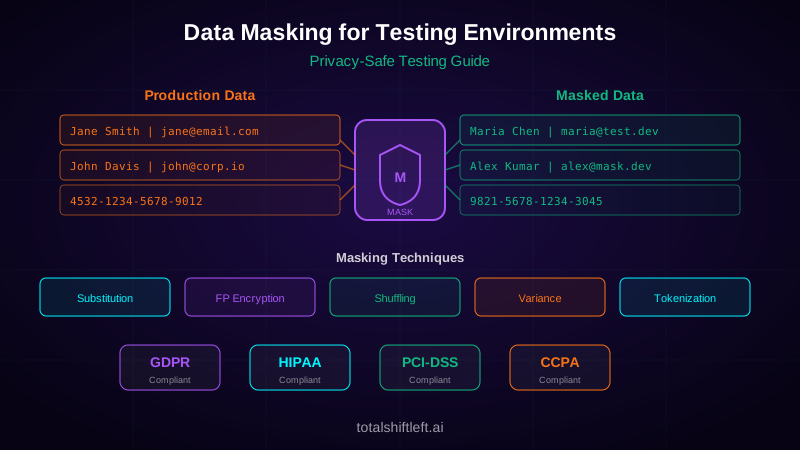
Masking operates at the field level. Each database column classified as sensitive receives a masking rule appropriate to its data type. A name column might be masked through substitution (replacing "Jane Smith" with "Maria Chen"). A credit card column might be masked through partial redaction (replacing "4532-1234-5678-9012" with "4532-XXXX-XXXX-9012"). A date-of-birth column might be masked through variance (shifting the date by a random offset of +/- 30 days).
The key distinction from synthetic data generation is that masking starts from real data. The production database is the input; the masked database is the output. This means masked data inherits the structural complexity, relationship patterns, and volume of production data — which is both its strength (high realism) and its challenge (privacy risk if masking is incomplete or reversible).
For testing environments, masking must satisfy three requirements simultaneously. It must preserve utility — masked data must be usable for testing, meaning correct formats, valid relationships, and realistic distributions. It must eliminate identifiability — no individual should be identifiable from the masked data, even through combination of quasi-identifiers. And it must be automated and repeatable — masking must run as a scheduled or on-demand pipeline, not as a manual one-time operation.
For the generation step specifically, see API test data generation.
Why Data Masking Matters
Regulatory Compliance
GDPR, CCPA, HIPAA, and PCI-DSS all restrict the use of personal data outside its original collection purpose. Testing is not the original purpose. Without masking, every non-production environment containing production data is a compliance violation — one reason teams pair masking with platform-level HIPAA and GDPR compliance controls for API testing. GDPR Article 5 requires data minimization — using full production copies in 10 test environments violates this principle. Masking satisfies regulators by demonstrating that personal data is anonymized before leaving production.
Breach Surface Reduction
Every copy of production data is an attack surface. Non-production environments typically have weaker security: shared credentials, broader access, less monitoring, fewer patches. Masking eliminates the value of these targets — a breach of a masked staging environment exposes no real customer data. This transforms a potential data breach into a non-event from a regulatory notification perspective.
Developer and Tester Enablement
Paradoxically, masking enables broader data access. Without masking, organizations restrict non-production data access to minimize exposure — creating bottlenecks where developers wait for DBA approval to access test environments. With masking, organizations can grant broader access because the data is non-sensitive. Developers get the realistic data they need for effective testing without compliance gatekeeping.
Audit Readiness
Compliance audits increasingly examine non-production environments. Auditors check staging databases for unmasked PII, review data flow documentation, and verify masking effectiveness. Organizations with automated masking pipelines and documented policies pass audits efficiently. Those without masking spend weeks remediating findings and face repeat audits.
Key Masking Techniques
Substitution
Substitution replaces sensitive values with realistic but fictional alternatives from a lookup table or generator. "Jane Smith" becomes "Maria Chen." "jane.smith@gmail.com" becomes "maria.chen@maskdomain.test." Substitution produces the most realistic output because replacement values are drawn from curated dictionaries of plausible data. It is the preferred technique for names, addresses, and other string fields where format realism matters.
Format-Preserving Encryption (FPE)
FPE cryptographically transforms values while maintaining the original format and length. A 16-digit credit card number becomes a different 16-digit number. A 9-digit SSN becomes a different 9-digit number. FPE is deterministic (same input always produces same output) and maintains Luhn check validity for credit card numbers. It is ideal for fields where downstream systems validate format — payment processors, tax systems, and legacy applications with fixed-width field expectations.
Shuffling
Shuffling rearranges values within a column. Employee A's salary is swapped with Employee B's salary. The distribution of values is perfectly preserved (the same set of salaries exists in the column), but the association between salary and employee is broken. Shuffling is useful for numeric fields where distribution preservation is critical for statistical testing — average salary, sum of transactions, and similar aggregate queries produce the same results as production.
Variance
Variance applies random offsets to numeric and date values. A date of birth is shifted by -15 to +15 days. A transaction amount is multiplied by a factor between 0.9 and 1.1. Variance preserves approximate distributions and ranges while changing individual values. It is useful for dates (where exact birth dates are sensitive but approximate ages are needed for testing) and financial amounts (where exact values are sensitive but realistic ranges are needed).
Nulling and Redaction
Nulling replaces sensitive values with null, empty strings, or placeholder constants ("REDACTED"). This is the simplest technique but the least useful for testing — null values may break application logic that expects populated fields. Use nulling only for fields that tests do not read or process — audit comments, internal notes, and free-text fields that are not part of test assertions.
Ready to shift left with your API testing?
Try our no-code API test automation platform free. Generate tests from OpenAPI, run in CI/CD, and scale quality.
Tokenization
Tokenization replaces sensitive values with non-sensitive tokens that map back to the originals through a secure token vault. Unlike masking, tokenization is reversible (with vault access). It is used when some operations require de-tokenization — for example, a support team that needs to look up the real customer for a masked test record. For testing, tokenization is overkill; irreversible masking is preferred because it eliminates the risk of reversal entirely.
Data Masking Architecture
A production-grade masking architecture operates as an automated pipeline between production data sources and non-production consumption points, with governance controls at every stage.
The pipeline begins with data discovery and classification. Before you can mask data, you must know where sensitive data exists. Discovery tools scan database schemas, profile column contents, and classify fields using pattern matching (SSN patterns, email formats), metadata analysis (column names like "first_name," "ssn"), and machine learning (identifying sensitive data in unstructured columns). This classification becomes the masking rule input.
The masking engine applies technique-specific transformations to classified fields. It reads the classification-to-technique mapping (e.g., "PII-name" -> substitution, "PCI-card" -> FPE, "PHI-dob" -> variance) and transforms every row. Critical requirements for the engine are determinism (same input produces same output across runs for referential integrity), performance (masking terabyte-scale databases in reasonable timeframes), and completeness (no cla
ssified field skipped).
The output feeds into non-production data stores: containerized databases for CI/CD pipeline runs, virtual database clones for developer workstations, and refreshed staging environments for QA teams. Each consumption pattern has different requirements — pipelines need fast provisioning, developers need self-service access, and QA needs stable long-lived environments.
Governance and audit wrap the entire pipeline. Every masking run is logged: what data was processed, which rules were applied, where the output was delivered, and who triggered the operation. These logs satisfy auditor requirements for demonstrating that masking is consistently applied and that no unmasked data reaches non-production environments. This governance layer integrates with the broader test data management practice.
Tools for Data Masking
| Tool | Type | Best For | Open Source |
|---|---|---|---|
| Delphix | Virtualization + Masking | Database virtualization with integrated deterministic masking | No |
| Informatica PDM | Enterprise Masking | Compliance-driven masking with discovery and audit workflows | No |
| Broadcom TDM | Full TDM + Masking | Mainframe-to-cloud masking with data lineage tracking | No |
| Datprof | Masking + Profiling | Combined masking, profiling, and discovery in one platform | No |
| Tonic.ai | Synthetic + De-ID | Hybrid synthetic generation and de-identification from production | No |
| PostgreSQL Anonymizer | Extension | Native PostgreSQL masking with declarative rules | Yes |
| ARX | Desktop Tool | Research-grade anonymization with k-anonymity and l-diversity | Yes |
| DataVeil | Masking Tool | SQL Server and Oracle masking with FK-aware transformations | No |
| Accutive Data Discovery & Masking | Cloud SaaS | Cloud-native discovery and masking for multi-cloud databases | No |
| IRI FieldShield | Masking Engine | High-performance masking with broad database connectivity | No |
For teams beginning their masking journey, Delphix provides the fastest path to value — database virtualization (thin clones that provision in minutes) combined with integrated masking eliminates two bottlenecks simultaneously. For PostgreSQL-centric environments, the PostgreSQL Anonymizer extension offers a zero-cost starting point. For enterprise environments with mainframe and multi-platform requirements, Broadcom and Informatica provide the broadest coverage.
Data masking in practice: a worked example
Problem: A European e-commerce platform maintained 7 non-production environments (3 development, 2 QA, 1 staging, 1 training) that all contained full production database copies. A GDPR audit identified unmasked customer PII in all 7 environments — approximately 4.2 million customer records exposed. The finding required remediation within 90 days and triggered executive-level reporting to the Data Protection Officer. Meanwhile, developers needed realistic data for API integration testing, and the QA team relied on production data patterns for regression testing.
Solution: The team deployed Delphix to create a masked golden copy of the production database. They defined masking rules for 47 sensitive columns across 12 tables: substitution for names and addresses, FPE for payment card numbers, variance for dates, and nulling for free-text notes. Referential integrity was maintained through deterministic masking — the same customer ID masked identically across orders, payments, shipping, and audit tables. The masked golden copy fed all 7 environments through thin virtual clones that provisioned in under 10 minutes each.
Results: All 7 environments were remediated within 45 days (half the deadline). The GDPR audit finding was closed with documented evidence of automated masking. Storage costs decreased by 78% because virtual clones replaced full database copies. Environment provisioning time dropped from 6 hours to 8 minutes. Developers gained self-service access to masked environments without DBA tickets — improving velocity while maintaining compliance. The DPO signed off on the approach, and subsequent audits passed without findings.
Data masking challenges and how to solve them
Maintaining Referential Integrity Across Tables
A customer's masked ID must match across every table that references it — orders, payments, shipments, audit logs, and potentially cross-database foreign keys. Non-deterministic masking breaks these relationships, producing databases where orders reference non-existent customers. Solution: Use deterministic masking algorithms where the same input always produces the same output. All tools listed above support deterministic mode. Validate referential integrity post-masking with automated constraint checks.
Masking Unstructured and Semi-Structured Data
Sensitive data does not always live in neatly typed columns. Customer names appear in free-text comments, email bodies, log files, and JSON blobs stored in text columns. Schema-based masking rules miss this embedded PII. Solution: Implement pattern-based scanning for unstructured fields. Use NLP-based detection (Informatica, Tonic.ai) that identifies names, addresses, and identifiers in free-text. For JSON columns, parse the structure and apply field-level masking before re-serializing.
Performance at Scale
Masking a multi-terabyte database can take hours or days. For organizations that need fresh masked data daily, this creates scheduling constraints. Solution: Use incremental masking that processes only changed records since the last run, reducing daily masking time by 80-90%. Alternatively, use Delphix's virtualization approach where the base masked copy is created once and thin clones share it — eliminating the need to re-mask for each environment.
Preventing Re-identification Through Quasi-Identifiers
Individual masked fields may be safe, but combinations of quasi-identifiers (zip code + age + gender) can uniquely identify individuals. A masked database might contain a unique combination of zip code 90210, age 34, and gender female that maps to only one person in the original data. Solution: Apply k-anonymity principles — ensure every combination of quasi-identifiers maps to at least k individuals. Generalize quasi-identifiers (age ranges instead of exact ages, 3-digit zip codes instead of 5-digit) or apply variance masking to break uniqueness.
Testing Masking Effectiveness
How do you verify that masking actually works? That no real data leaked through? That deterministic masking is consistent across all tables? Solution: Implement automated masking validation: compare masked output against production to confirm no exact matches remain in sensitive fields, validate referential integrity with FK constraint checks, and run re-identification risk assessments using quasi-identifier analysis. Run these validations after every masking pipeline execution.
Handling Legacy Systems Without API Access
Legacy databases (mainframes, proprietary systems) may not support modern masking tools. Data extraction, transformation, and loading back requires custom ETL processes. Solution: Use Broadcom Test Data Manager for mainframe environments. For other legacy systems, build extract-mask-load pipelines using standard ETL tools with masking logic injected at the transform stage. Prioritize legacy systems in the masking roadmap — they often contain the oldest and most sensitive data.
Free PDF + code examples
OpenAPI to Test Generation Template Pack
Go from OpenAPI spec to full test coverage. Includes sample specs, example generated tests, edge case patterns, and CI/CD integration guides.
Download FreeData masking best practices
- Mask at the source. Apply masking before data leaves the production boundary. Never copy unmasked data to a non-production environment and mask it there — the unmasked copy exists during transit and is a compliance risk.
- Use deterministic masking by default. Same input produces same output across all tables, databases, and masking runs. This preserves referential integrity without complex cross-table coordination logic.
- Classify before you mask. Run data discovery and classification before defining masking rules. You cannot mask what you have not identified. Re-run discovery quarterly to catch new sensitive columns added by development.
- Automate the masking pipeline. Masking should run on schedule (nightly or weekly) and on demand (provisioning requests) without human intervention. Manual masking processes will be skipped under deadline pressure.
- Validate masking effectiveness. After every masking run, validate: no exact matches between masked and production data in sensitive fields, referential integrity intact across all foreign keys, data format validity preserved (masked emails are valid emails, masked dates are valid dates).
- Combine masking with synthetic data. Use masking for scenarios that need production realism (regression testing, UAT) and synthetic generation for scenarios that need control and speed (unit tests, API tests, performance tests). Both approaches are stronger together.
- Address unstructured data. Do not limit masking to structured database columns. Scan and mask free-text fields, JSON columns, log files, and document stores that may contain embedded PII.
- Minimize what you copy. Apply data subsetting alongside masking. If your production database is 5TB, your test environment probably does not need all 5TB. Subset to a representative slice, then mask the subset — reducing storage, masking time, and exposure simultaneously.
- Document your masking rules. Every masked field should have a documented rule: what technique is applied, why that technique was chosen, and what validation confirms effectiveness. This documentation satisfies auditors and enables team onboarding.
- Monitor for masking regression. New database columns added by developers may contain sensitive data but lack masking rules. Implement CI checks that compare the current schema against the masking rule set and alert when unmasked sensitive columns are detected.
- Test your application with masked data. Some masking transformations break application logic — a masked email that does not pass the application's email validation, a masked phone number in the wrong format. Run a smoke test suite against masked data to catch these issues early.
Data masking checklist
- ✔ Conduct data discovery across all databases used in testing — identify every sensitive column
- ✔ Classify all fields by sensitivity level (PII, PHI, PCI, internal-confidential, non-sensitive)
- ✔ Select masking techniques appropriate for each field type and classification
- ✔ Implement deterministic masking to preserve referential integrity across tables
- ✔ Configure format-preserving transformations so masked data passes application validation
- ✔ Build automated masking pipeline triggered by schedule and on-demand provisioning
- ✔ Apply data subsetting to reduce volume before masking (right-size for testing needs)
- ✔ Implement masking validation: no exact matches, FK integrity, format correctness
- ✔ Address unstructured data: scan and mask free-text, JSON, and log fields
- ✔ Assess re-identification risk using quasi-identifier analysis (k-anonymity)
- ✔ Integrate masking into CI/CD pipeline for automated test environment provisioning
- ✔ Document all masking rules with technique, rationale, and validation criteria
- ✔ Set up monitoring for new sensitive columns that lack masking rules (schema drift)
- ✔ Conduct quarterly compliance reviews of all non-production environments
- ✔ Run smoke tests against masked data to verify application compatibility
See also: validation errors in our learn hub for the underlying concept.
Mask on the way out of production, not in the test environment
Masking after the copy lands is a race you lose once. Mask during extraction so unmasked values never exist outside production — and keep the mapping deterministic so referential integrity survives:
-- masked extract: joins still work because the mask is a stable function of the key
CREATE OR REPLACE VIEW export.customers_masked AS
SELECT
  id,
  -- deterministic pseudonym: same input always yields the same output
  encode(hmac(email, current_setting('app.mask_key'), 'sha256'), 'hex')
    || '@example.test'                              AS email,
  'User ' || substr(md5(id::text), 1, 8)            AS full_name,
  regexp_replace(phone, '\d(?=\d{2})', 'X', 'g')    AS phone,
  date_trunc('year', date_of_birth)                 AS date_of_birth,  -- generalised
  '***-**-' || right(ssn, 4)                        AS ssn,
  country_code,                                     -- kept: needed for residency tests
  tier, created_at
FROM public.customers;
Then assert the masking held. A masking job that silently stops is indistinguishable from one that works, until an audit:
# tests/test_masking.py — runs against the refreshed lower environment
import re, psycopg

FORBIDDEN = [
    (re.compile(r"\b\d{3}-\d{2}-\d{4}\b"), "unmasked SSN"),
    (re.compile(r"@(?!example\.test)[\w.-]+\.\w+"), "real email domain"),
]

def test_no_real_pii_in_staging(staging_dsn):
    with psycopg.connect(staging_dsn) as c, c.cursor() as cur:
        cur.execute("SELECT email, ssn, phone FROM customers LIMIT 5000")
        for row in cur:
            for value in row:
                for pattern, label in FORBIDDEN:
                    assert not pattern.search(str(value)), f"{label} found in staging"
Data masking FAQ
What is data masking for testing environments?
Data masking for testing environments is the process of transforming sensitive data (PII, PHI, PCI) in production database copies so the data retains its format, structure, and statistical properties while becoming non-identifiable. This allows teams to test with realistic data without exposing real customer information in non-production environments.
What are the main data masking techniques?
The main data masking techniques are substitution (replacing values with realistic fake data), shuffling (rearranging values within a column), encryption (cryptographically transforming values), nulling (replacing with null/empty), number variance (adjusting numeric values by random offsets), and format-preserving encryption (encrypting while maintaining the original format and length).
How does data masking support GDPR and HIPAA compliance?
Data masking supports compliance by ensuring personal data is anonymized before leaving production systems. GDPR requires data minimization and purpose limitation — masking satisfies both for testing. HIPAA requires PHI protection in all environments — masking de-identifies records. Both regulations accept properly masked data as anonymized, removing it from most regulatory scope.
What is referential integrity in data masking?
Referential integrity in data masking means that masked values remain consistent across all tables and databases that reference the same entity. If customer ID 12345 is masked to 99887, it must be masked to 99887 everywhere — in orders, payments, shipping, and audit logs. This is achieved through deterministic masking algorithms that produce the same output for the same input.
What tools are used for data masking in testing?
Leading data masking tools include Delphix for database virtualization with integrated masking, Informatica Persistent Data Masking for enterprise compliance workflows, Broadcom Test Data Manager for mainframe-to-cloud masking, Datprof for masking with built-in profiling, and open-source options like PostgreSQL Anonymizer and ARX for smaller-scale implementations.
Can data masking be fully automated in CI/CD pipelines?
Yes, data masking can be fully automated in CI/CD pipelines. Enterprise tools like Delphix and Informatica expose REST APIs that pipelines call to trigger masking jobs, create masked database clones, and provision masked environments on demand. The typical pattern is: pipeline triggers masking job, masked data is loaded into a containerized database, tests run, environment is destroyed.
Sources and further reading
- GDPR full text — the articles that constrain personal data in test systems.
- HHS HIPAA Security Rule — the safeguards that govern PHI in test environments.
- PCI DSS v4.0 document library — the requirement text behind cardholder-data testing.
Key takeaways
- Data masking for testing environments is not optional in 2026 — it is a regulatory requirement, a security imperative, and a testing enabler.
- Organizations that continue running non-production environments with unmasked production data face escalating compliance risk, breach exposure, and the ironic situation where security controls restrict the data access that developers and testers need for effective quality assurance.
- The path forward is systematic: discover where sensitive data lives, classify it by type and regulation, apply appropriate masking techniques, automate the pipeline, validate effectiveness, and monitor continuously.
- Start with the highest-risk environments (those with the most users, the weakest access controls, or the most sensitive data) and expand systematically.
- Masking works best as part of a broader test data management strategy that combines masked production data for realism-dependent scenarios with synthetic data generation for privacy-by-default scenarios.
- Together, these approaches deliver test data that is realistic, compliant, and available on demand.
Ready to accelerate your API testing with privacy-safe data? Start your free trial of Shift-Left API and experience AI-powered test generation that creates comprehensive test suites without requiring production data access.
Related: Test Data Management Complete Guide | Synthetic Test Data vs Production Data | Best Practices for TDM | Test Data Generation Tools | DevOps Testing Best Practices | What Is Shift Left Testing
For regulated teams: see API testing for HIPAA compliance, API testing for PCI-DSS compliance, data residency under GDPR / Schrems II, and how this fits across regulated industries.
Ready to shift left with your API testing?
Try our no-code API test automation platform free.