
Test Data Management Best Practices for Enterprise Teams (2026)
Quick answer
Test data management means producing, refreshing, and isolating data sets for every testing environment without leaking production data or breaking parallel test runs. The four practices that scale for any team: synthetic generation from the API schema, environment-aware data factories, automatic cleanup between runs, and never copying production data into lower environments — period. Teams handling PII, PHI, or cardholder data add a fifth requirement on top: masking or tokenizing any field sourced from production before it reaches a non-production environment, to satisfy GDPR, HIPAA, and PCI-DSS.
Reviewed by Sushant Joshi

Test data management best practices are proven strategies and techniques for creating, provisioning, governing, and maintaining test data across enterprise software delivery pipelines. They encompass automation, synthetic data generation, masking, governance, and CI/CD integration to ensure fast, reliable, and compliant testing at scale.
Enterprise organizations face a unique test data challenge. They operate dozens of applications across multiple technology stacks, handle regulated data subject to GDPR, HIPAA, and PCI-DSS, run thousands of tests daily across multiple pipelines, and must coordinate data across teams that may span continents. The World Quality Report 2025 found that test data management best practices adoption separates high-performing delivery organizations from the rest — teams with mature TDM practices release 3.2x faster than those without.
Enterprise testing operates at a scale where individual developer practices do not suffice. A single enterprise application might have 30 development teams, 12 test environments, 5 database technologies, and regulatory requirements spanning 4 jurisdictions. Test data management at this scale requires organizational practices — not just technical solutions.
Most enterprise organizations have invested significantly in test automation frameworks, CI/CD pipeline infrastructure, and shift-left testing adoption. Yet many still manage test data through manual processes: developers filing tickets for data refresh, DBAs spending days provisioning environments, and shared staging databases where teams step on each other's data constantly.
This guide distills the test data management best practices that enterprise organizations need — not theoretical principles, but specific, actionable practices with implementation guidance. Each practice is contextualized for the complexity, scale, and regulatory requirements that enterprise environments demand.
In this guide
- What Are Test Data Management Best Practices?
- Why Best Practices Matter in Enterprise Testing
- Key Components of Enterprise TDM
- TDM Architecture for Enterprise
- Tools Supporting Enterprise TDM
- Test data management in practice: a worked example
- Test data management challenges and how to solve them
- Test data management best practices
- Test data management checklist
- Generate the data from the schema instead of maintaining fixtures
- Test data management FAQ
What Are Test Data Management Best Practices?
Test data management best practices are the organizational, technical, and governance disciplines that ensure test data supports — rather than hinders — software delivery. They address every phase of the test data lifecycle: planning what data tests need, creating that data through generation or transformation, provisioning it to the right environments at the right time, maintaining its quality and currency, and retiring it when no longer needed.
In enterprise contexts, these practices extend beyond the technical into the organizational. They include governance policies that define who owns test data, how sensitive data is classified and handled, and what compliance standards apply. They include process practices like self-service provisioning that eliminates ticket-based workflows. And they include measurement practices that track TDM effectiveness through KPIs like provisioning time, data-related flaky test rates, and compliance posture.
The distinction between ad hoc test data creation and managed TDM is analogous to the distinction between ad hoc deployments and CI/CD: both deliver software to environments, but only the managed approach does so reliably, repeatably, and at scale. Test data management best practices bring the same discipline to data that CI/CD brought to deployments.
The generation step itself — Faker, json-schema-faker and schema-derived payloads — is covered in how to generate test data for API testing.
Why Best Practices Matter in Enterprise Testing
Eliminating the Data Bottleneck
In enterprise environments, test data provisioning is frequently the longest step in the delivery pipeline. Teams report 2-5 day waits for fresh test data — waits that nullify the speed gains from automated testing and CI/CD investment. Best practices transform provisioning from a multi-day manual process to a minutes-long automated operation.
Enabling Parallel Team Execution
Enterprise delivery involves multiple teams working in parallel on the same application. Without proper TDM, these teams compete for shared staging environments and shared data — one team's test data modifications break another team's tests. Best practices provide isolated data for each team and each pipeline run, enabling true parallel delivery.
Maintaining Regulatory Compliance
Enterprises in regulated industries face consequences for mishandling data in test environments — GDPR fines up to 4% of global revenue, HIPAA penalties up to $1.5 million per violation, PCI-DSS audit failures that revoke payment processing privileges. Best practices ensure that production data is masked before it leaves production, synthetic data is used where possible, and governance tracks all data flows — the same controls that underpin HIPAA and GDPR compliance for API testing.
Reducing Test Maintenance Cost
Data-related test failures consume disproportionate debugging effort because the root cause — stale data, shared data mutation, schema drift — is not visible in test logs. A test that fails with "expected 5 items, got 3" could be a code bug or a data issue. Best practices eliminate data-related failures, letting teams focus debugging effort on actual defects.
Key Components of Enterprise TDM
Data Classification and Governance
Enterprise TDM starts with knowing what data you have and how sensitive it is. Data classification tags every field across every database as PII, PHI, PCI, confidential, or non-sensitive. These classifications drive masking rules, access controls, and audit requirements. Without classification, compliance is guesswork.
Centralized Data Provisioning Platform
A centralized platform replaces ticket-based workflows with self-service APIs. Teams request data scenarios through an API or portal, and the platform assembles, provisions, and delivers data automatically. The platform serves as the single point of governance — all data flows through it, ensuring masking, logging, and compliance controls are consistently applied.
Automated Masking Pipeline
Production-to-lower-environment data flows pass through an automated masking pipeline that applies deterministic, format-preserving transformations to sensitive fields. The pipeline is triggered by schedule (nightly refresh) or on demand (environment provisioning). Masking rules are centrally managed and auditable.
Synthetic Data Generation Framework
A generation framework provides synthetic data for test types that do not require production realism — unit tests, integration tests, performance tests. The framework includes base generators (Faker, Mockaroo), domain-specific providers (industry-specific data types), and orchestration logic (multi-entity scenario creation).
Data Quality Monitoring
Continuous monitoring validates that test data meets quality standards: correct schemas, valid constraints, complete relationships, and appropriate distributions. Monitoring catches data degradation (stale references, broken foreign keys, schema drift) before it causes test failures, reducing false-negative debugging time.
Ready to shift left with your API testing?
Try our no-code API test automation platform free. Generate tests from OpenAPI, run in CI/CD, and scale quality.
Environment Management Integration
TDM integrates with environment management to coordinate data provisioning with infrastructure provisioning. When a pipeline spins up a containerized test environment, the TDM platform automatically provisions the appropriate data. When the environment is destroyed, associated data is cleaned up.
TDM Architecture for Enterprise
Enterprise TDM architecture operates as a service mesh that connects data sources, transformation engines, and consumption endpoints through a centralized governance layer.
The governance layer sits at the center, enforcing data classification policies, masking rules, access controls, and audit logging. Every data request — whether for synthetic generation, production masking, or data subsetting — flows through this layer. It validates that the requestor has appropriate access, applies required transformations, and logs the transaction.
Upstream of governance sit three source systems: a synthetic data engine (GenRocket, Tonic.ai, or custom Faker frameworks), a masked data repository (Delphix or Informatica virtualized copies of production), and a data subset library (pre-built representative slices for common scenarios).
Downstream sit the consumption endpoints: CI/CD pipelines requesting data via API, developer workstations provisioning local environments, QA teams setting up manual test scenarios, and performance test infrastructure loading high-volume data sets. Each endpoint consumes data through the same governance layer, ensuring consistent controls regardless of how data is used.
This architecture mirrors the API testing patterns for microservices — de
coupled services communicating through well-defined interfaces, with cross-cutting concerns (governance, logging, security) handled at the infrastructure layer rather than in each consumer.
Tools Supporting Enterprise TDM
| Tool | Type | Best For | Open Source |
|---|---|---|---|
| Delphix | Virtualization & Masking | Database virtualization with thin clones and integrated masking | No |
| Informatica TDM | Full TDM Suite | Enterprise masking, subsetting, and compliance workflows | No |
| Broadcom Test Data Manager | Full TDM Suite | Mainframe-to-cloud data with complex lineage tracking | No |
| GenRocket | Model-Based Generation | Complex multi-entity synthetic data with business rules | No |
| Tonic.ai | Synthetic + Masking | Privacy-safe synthetic data from production schemas | No |
| Faker (Python/JS/Java) | Library | Developer-driven synthetic data in test code | Yes |
| Mockaroo | SaaS Generation | Visual data design with API access for CI/CD | Freemium |
| Datprof | Masking & Generation | Masking with built-in data profiling and discovery | No |
| K2View | Data Fabric | Entity-centric data delivery across distributed systems | No |
| Windocks | Database Cloning | SQL Server and Oracle thin clones for fast provisioning | Freemium |
Enterprise environments typically deploy a combination: an enterprise platform (Delphix or Informatica) for governed production data flows and masking, a generation tool (GenRocket or Tonic.ai) for synthetic data, and developer libraries (Faker) embedded in test automation frameworks.
Test data management in practice: a worked example
Problem: A Tier 1 retail bank ran 200+ daily builds across 12 application teams. Test data was managed through a ticketing system — developers submitted requests to a DBA team that manually provisioned data. Average wait time was 3.5 days. The bank's compliance team flagged 47 instances of unmasked customer PII in staging environments during an audit. Flaky tests attributed to data issues consumed 22% of QA capacity.
Solution: The bank implemented a three-phase TDM transformation. Phase 1 (months 1-3): deployed Delphix for database virtualization, creating thin clones that provisioned in minutes instead of days, with integrated masking that eliminated PII from all non-production environments. Phase 2 (months 4-6): built a self-service provisioning portal backed by APIs that CI/CD pipelines consumed, eliminating the ticketing workflow entirely. Phase 3 (months 7-9): implemented GenRocket for synthetic data generation, providing each team with dedicated data generators for unit and API tests that ran independently of production data.
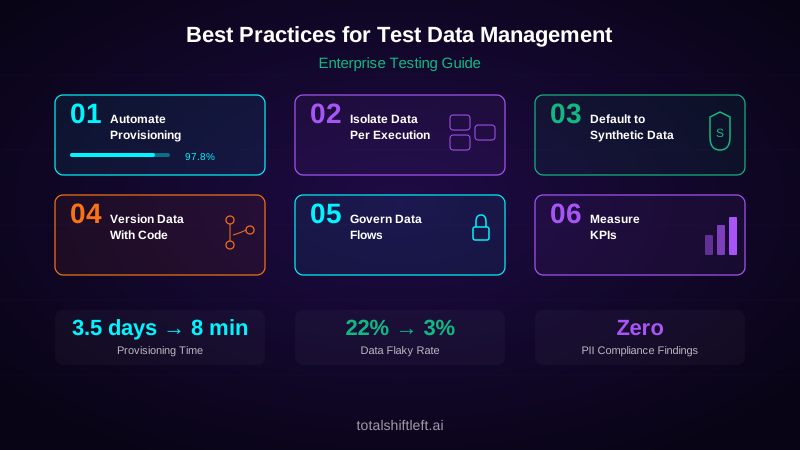
Results: Data provisioning time dropped from 3.5 days to 8 minutes (97.8% reduction). Compliance findings for non-production PII dropped to zero. Flaky test rate attributed to data issues fell from 22% to 3%. Developer satisfaction (measured quarterly) increased by 34 points on internal NPS. Total delivery cycle time improved by 41% — with TDM improvement being the single largest contributor.
Test data management challenges and how to solve them
Organizational Resistance to Centralization
Teams accustomed to managing their own data resist centralized TDM platforms. They fear loss of autonomy and added bureaucracy. Solution: Position centralization as self-service enablement, not control. The central platform eliminates tickets and wait times. Teams get faster access with less effort — the governance happens automatically in the background.
Legacy Database Complexity
Enterprise environments include legacy databases (mainframes, proprietary formats, decades-old schemas) that modern TDM tools do not natively support. Solution: Use Broadcom Test Data Manager for mainframe environments and build custom adapters for proprietary databases. Start TDM modernization with the most frequently tested databases and expand incrementally.
Cross-Team Data Dependencies
In enterprise applications, one team's service consumes data produced by another team's service. Creating isolated test data requires coordinating across team boundaries. Solution: Build shared data contracts that define the structure and content of cross-service test data. Implement a centralized provisioning orchestrator that creates coordinated data across all services in a single operation.
Measuring ROI for TDM Investment
Enterprise TDM tools require significant investment (licensing, infrastructure, implementation effort). Justifying this investment requires concrete metrics. Solution: Baseline current costs before implementation: developer wait time for data (hours x hourly rate), compliance finding remediation cost, flaky test debugging time, and environment storage costs. Track these metrics through implementation to demonstrate ROI.
Data Freshness vs. Stability
Enterprise teams need data that reflects current production patterns (fresh) but does not change during a test run (stable). These goals conflict when tests run continuously. Solution: Implement a dual-track approach: refresh masked production data on a defined schedule (weekly or nightly) for the base data set, and generate scenario-specific synthetic data on demand for each test run. The base set provides freshness; the on-demand generation provides stability.
Scaling Across Geographies
Global enterprises need test data that reflects regional requirements — European PII masking, US healthcare compliance, and Asian data residency rules. Solution: Implement policy-based data handling where regional tags drive masking rules, residency controls, and compliance workflows automatically. A single data request from an EU-based team automatically applies GDPR-compliant masking without requiring the team to specify it.
Test data management best practices
- Establish data ownership. Assign every data domain (customers, orders, payments, products) to a specific team or role. Owners are responsible for data model definition, masking rule maintenance, and generation rule accuracy.
- Automate provisioning completely. Zero manual steps in the provisioning workflow. Developers and pipelines request data through APIs and receive it in minutes. No tickets, no DBA involvement, no waiting.
- Default to synthetic data. Make synthetic data generation the standard approach. Require explicit business justification for using production data copies in non-production environments.
- Classify every field. Tag every database field with its sensitivity classification (PII, PHI, PCI, non-sensitive). Drive masking rules from classifications so new fields are automatically handled based on their type.
- Isolate data per execution. Each pipeline run gets its own data. No shared mutable data between teams, test suites, or pipeline stages. Use containerized databases, thin clones, or per-run synthetic generation to achieve isolation.
- Version data with code. Store data definitions, generation scripts, masking rules, and scenario libraries in the same repository as application code. Data changes go through the same review process as code changes.
- Monitor data quality continuously. Run automated validation checks on all test data stores. Alert on schema drift, broken relationships, stale data, and constraint violations before they cause test failures.
- Build scenario libraries. Create named, reusable data scenarios that encode common business workflows. Teams provision by scenario name rather than by specifying individual records.
- Measure and report KPIs. Track provisioning time, data-related flaky test rate, compliance findings, and self-service adoption. Report these metrics alongside standard delivery metrics.
- Implement data cleanup. Every provisioning operation has a corresponding cleanup. Automated teardown prevents data accumulation that degrades performance and increases storage costs.
- Govern production data flows. Every flow of production data to a non-production environment passes through the automated masking pipeline. No exceptions, no manual workarounds, no "temporary" unmasked copies.
- Train teams on TDM practices. Invest in developer and QA training on proper test data usage — how to request data, when to use synthetic vs. production, and how to report data issues.
Free PDF + code examples
OpenAPI to Test Generation Template Pack
Go from OpenAPI spec to full test coverage. Includes sample specs, example generated tests, edge case patterns, and CI/CD integration guides.
Download FreeTest data management checklist
- ✔ Audit all test environments for unmasked production data — remediate immediately
- ✔ Classify all database fields by sensitivity (PII, PHI, PCI, non-sensitive)
- ✔ Deploy automated masking for all production-to-lower-environment data flows
- ✔ Implement synthetic data generators for unit and integration test scenarios
- ✔ Build self-service provisioning APIs consumable by CI/CD pipelines and developers
- ✔ Establish data ownership for every domain across the organization
- ✔ Create reusable scenario libraries for the top 20 business workflows
- ✔ Configure isolated data provisioning per pipeline run (no shared mutable data)
- ✔ Version test data definitions alongside application code in source control
- ✔ Set up data quality monitoring with automated alerting for drift and degradation
- ✔ Define and track TDM KPIs: provisioning time, data flaky rate, compliance findings
- ✔ Implement automated data cleanup and environment teardown procedures
- ✔ Establish governance policies for data classification, masking, access, and retention
- ✔ Conduct quarterly compliance reviews of all non-production data stores
- ✔ Train all development and QA teams on TDM practices and self-service tools
See also: validation errors in our learn hub for the underlying concept.
Generate the data from the schema instead of maintaining fixtures
Hand-maintained fixtures are the reason test data breaks on every schema change. Generating from the schema means the data is valid by construction and refreshes itself when the contract moves:
# conftest.py — deterministic, schema-valid data with no fixture files
import pytest, yaml
from faker import Faker
from jsonschema import validate

fake = Faker()
Faker.seed(20260819)          # deterministic across runs and machines

SPEC = yaml.safe_load(open("openapi.yaml"))
CUSTOMER = SPEC["components"]["schemas"]["Customer"]

@pytest.fixture
def customer_payload():
    payload = {
        "name":  fake.name(),
        "email": fake.unique.email(domain="example.test"),   # never a real domain
        "phone": fake.numerify("+1-###-###-####"),
        "tier":  fake.random_element(["free", "pro", "enterprise"]),
    }
    validate(payload, CUSTOMER)   # fails loudly when the schema moves
    return payload
Reset state between runs rather than accumulating it — a suite that depends on data left behind by the previous run is not a suite, it is a sequence:
# .github/workflows/api-tests.yml
- name: Seed a clean database
  run: |
    psql "$TEST_DATABASE_URL" -c 'DROP SCHEMA public CASCADE; CREATE SCHEMA public;'
    alembic upgrade head
    python scripts/seed.py --profile ci --seed 20260819
Test data management FAQ
What are the most important test data management best practices?
The most important test data management best practices are: automating data provisioning end-to-end, isolating test data per execution to eliminate flakiness, defaulting to synthetic data for privacy compliance, versioning data alongside schemas, implementing governance with clear ownership, and measuring provisioning time as a pipeline KPI.
How do you implement test data management in enterprise environments?
Implement enterprise test data management by establishing a TDM center of excellence, deploying a centralized data provisioning platform with self-service APIs, implementing policy-based masking for all production data flows, integrating provisioning into CI/CD pipelines, and defining governance policies for data classification, access control, and retention.
What is the biggest mistake in enterprise test data management?
The biggest mistake is treating test data as an afterthought rather than a first-class engineering concern. This manifests as shared mutable staging environments, unmasked production data in non-production environments, manual data provisioning through tickets, and no version control for test data definitions — all of which cause flaky tests, compliance risk, and slow delivery.
How does test data management reduce flaky tests?
Test data management reduces flaky tests by providing isolated, deterministic data for each test execution. When tests share mutable data, one test's modifications can cause another test to fail unpredictably. Proper TDM provisions fresh, independent data sets for each pipeline run using synthetic generation or containerized data stores, eliminating cross-test data contamination.
What governance framework is needed for test data management?
A test data governance framework requires: data classification policies (PII, PHI, PCI sensitivity tags), masking rules mapped to classification levels, access control policies for non-production environments, data retention and purge schedules, audit trails for production data usage, ownership assignment for data domains, and regular compliance reviews.
How do you measure test data management effectiveness?
Measure TDM effectiveness with these KPIs: data provisioning time (target under 5 minutes), percentage of tests with isolated data (target 100%), flaky test rate attributed to data issues (target under 2%), compliance audit findings for non-production PII (target zero), and self-service provisioning adoption rate (target over 80% of requests automated).
Sources and further reading
- Faker (Python) — locale-aware fake data generation.
- GDPR full text — the articles that constrain personal data in test systems.
- json-schema-faker — generates payloads directly from a JSON Schema.
Key takeaways
- Test data management best practices are not optional luxuries for enterprise testing — they are foundational requirements that determine whether your automation investment delivers returns.
- Organizations that treat test data as an afterthought will continue to struggle with multi-day provisioning waits, data-related flaky tests consuming QA capacity, compliance findings creating legal exposure, and teams competing for shared staging environments.
- The path forward is clear: automate provisioning, default to synthetic data, isolate data per execution, govern production data flows, and measure everything.
- Start with the practice that addresses your highest-pain issue — if compliance is the risk, deploy masking first; if speed is the bottleneck, automate provisioning first; if flakiness is the cost, implement data isolation first.
- Enterprise TDM is a journey, not a project. Begin with one application team, prove the value with measurable results, and expand systematically.
- The organizations that master test data management will be the ones that deliver software at the speed the business demands — reliably, compliantly, and at scale.
Ready to accelerate your enterprise API testing? Start your free trial of Shift-Left API and experience AI-powered test generation that eliminates manual data setup.
Related: Test Data Management Complete Guide | Synthetic Test Data vs Production Data | Test Data Generation Tools | Data Masking for Testing | DevOps Testing Best Practices | Automated Testing in CI/CD
For regulated teams: see the enterprise testing strategy guide (covers test data patterns at enterprise scale), API testing for HIPAA compliance, API testing data residency under GDPR / Schrems II, and the regulated industries overview.
Ready to shift left with your API testing?
Try our no-code API test automation platform free.