
OAuth 2.0 Negative Testing for Enterprise IdPs (2026)
Quick answer
OAuth 2.0 negative testing for enterprise IdPs verifies that Okta, Azure AD/Entra ID, and Ping Identity correctly reject malicious or malformed flows — missing/tampered state, PKCE mismatches, redirect URI tampering, authorization code replay, scope escalation, and refresh token reuse. The eight RFC 9700-aligned patterns are IdP-agnostic, but each vendor differs at the edges: Azure AD enforces stricter exact-match redirect URIs, Okta's PKCE enforcement varies by application type, and Ping's code-reuse policy is configurable per client.
Reviewed by Smeet Gohel
How to design OAuth 2.0 negative test suites that catch real-world auth vulnerabilities across enterprise IdPs. PKCE mismatch, token reuse, scope escalation, and redirect-URI tampering with worked examples for Okta, Azure AD / Entra ID, and Ping Identity.
In this guide
- What is OAuth negative testing?
- The key components of OAuth negative testing
- Why OAuth needs negative testing
- Eight test patterns
- IdP-specific quirks
- How to run these tests automatically
- Mapping to RFC 9700 and OWASP API Top 10
- Why OAuth negative testing matters at enterprise scale
- OAuth negative testing tools compared
- OAuth negative testing in practice: a worked example
- OAuth negative testing reference architecture
- OAuth negative testing metrics that matter
- OAuth negative testing rollout playbook
- OAuth negative testing challenges and how to solve them
- OAuth negative testing best practices
- OAuth negative testing checklist
- The negative cases an IdP integration has to fail correctly
What is OAuth negative testing?
OAuth 2.0 negative testing is the practice of running automated test patterns that assert the OAuth implementation correctly rejects malicious or malformed authorization flows — missing state, tampered state, PKCE mismatches, redirect URI tampering, authorization code replay, scope escalation, refresh token reuse. The 2026 enterprise pattern uses RFC 9700 (OAuth 2.0 Security BCP) as the test catalog and parameterizes IdP-specific quirks (Okta, Azure AD / Entra ID, Ping Identity) in a small adapter layer.
The key components of OAuth negative testing
Each enterprise program in this area has the same load-bearing components, regardless of vendor. The components separate cleanly into governance, enforcement, and evidence layers.
Per-IdP test tenants
Dedicated Okta / Azure AD / Ping test tenants holding test users, test clients, and configured policies that mirror production. Tests run against the real IdP and assert correct enforcement of the negative paths.
IdP-agnostic test logic
The eight RFC 9700 patterns implemented once, with parameterized assertions. IdP-specific quirks live in an adapter layer per IdP — Okta's PKCE configurability, Azure AD's strict redirect URI matching, Ping's configurable code-reuse policy.
Mock OAuth servers
Hydra or Keycloak running locally for fast PR-stage tests. Mock servers eliminate the IdP dependency for the bulk of tests; periodic integration tests against real IdPs catch vendor-specific drift.
CI quality gates
Negative OAuth tests run as mandatory CI quality gates on every OAuth-using surface. Failures block merge. The eight patterns cover most of the OAuth 2.0 security threat surface.
OWASP / RFC mapping
Each test pattern mapped to RFC 9700 sections and OWASP API Top 10 items (API2 — Broken Authentication, API5 — Broken Function Level Authorization). Reports filter by mapping for security-team visibility.
Periodic real-IdP drift detection
Quarterly integration tests against production IdP tenants catch behavioral changes — vendor configuration defaults shift, IdP error responses evolve, new edge cases emerge. Adapter layer is updated when drift is detected.
Why OAuth needs negative testing
OAuth 2.0 is a framework, not a protocol. The positive flows — authorization code, client credentials, refresh token — are well-specified and well-tested by IdP vendors. The vulnerabilities live in the negative paths:
- A client that doesn't validate the
stateparameter is vulnerable to CSRF. - A server that doesn't enforce PKCE on public clients is vulnerable to authorization code interception.
- A redirect URI matched too loosely lets attackers exfiltrate tokens.
- An authorization code reused after exchange opens session-fixation paths.
- A refresh token not rotated lets stolen tokens persist.
Most production OAuth bugs are on these negative paths. The original integrator tested the happy flow because that's what the IdP vendor's docs show. The malicious flows weren't tested because there's no documentation saying "send a request with a tampered state parameter and confirm the server rejects it."
Negative testing exists to fill that gap.
Eight test patterns
Eight patterns cover most of the OAuth 2.0 security threat surface:
| # | Pattern | What it asserts |
|---|---|---|
| 1 | Missing state | Server rejects the callback when no state is present |
| 2 | Tampered state | Server rejects the callback when state doesn't match the request |
| 3 | PKCE missing on public client | Server rejects auth requests without code_challenge for SPA / mobile clients |
| 4 | PKCE mismatch | Server rejects token exchange when code_verifier doesn't match code_challenge |
| 5 | Redirect URI mismatch | Server rejects callbacks to a redirect URI not exactly matching the registered list |
| 6 | Authorization code replay | Server rejects a second use of an already-exchanged code |
| 7 | Scope escalation in token exchange | Server rejects a token request asking for scopes broader than the authorization granted |
| 8 | Refresh token reuse after rotation | Server invalidates the old refresh token after a rotation |
Each pattern is testable as a request that the server should reject with a specific error. The test asserts the error code and verifies the rejection happens before any token is issued.
IdP-specific quirks
The patterns above are spec-compliant; the IdPs differ in how they implement them.
Okta. PKCE enforcement is configurable per application type. SPAs and mobile apps require PKCE by default; web apps are configurable. Tests have to know the application's type to assert the right behavior. Okta's redirect URI matching is exact-match only, no wildcards.
Azure AD / Entra ID. Redirect URI matching is stricter than the OAuth spec — Azure AD requires exact match including scheme, host, port, and path. The error response on mismatch is a generic invalid_request rather than a specific code; tests have to match on the error description text or the IdP's tracking ID.
Ready to shift left with your API testing?
Try our no-code API test automation platform free. Generate tests from OpenAPI, run in CI/CD, and scale quality.
Ping Identity. Authorization code reuse behavior is configurable per OAuth client; some installations allow code reuse within a short window for legacy reasons. Tests have to be configured to know which behavior the client is supposed to enforce.
A working enterprise pattern is to write the test logic IdP-agnostically and parameterize the assertions — IdP-specific quirks live in a small adapter layer per IdP.
How to run these tests automatically
Negative OAuth tests fit naturally into automated test pipelines:
- No human interaction needed. Most negative tests use the authorization code flow with mocked / pre-captured authorization endpoints; the user-consent step doesn't have to run.
- Fast. Each test is one or two HTTP requests against the token endpoint or authorization endpoint. Whole suites complete in seconds.
- CI-friendly. No special infrastructure beyond credentials for the test IdP tenant.
Two integration patterns work well:
Exercising these flows repeatedly is far less painful when the token grants live in reusable OAuth, JWT, and API-key auth profiles rather than being reconstructed in every negative test.
- Per-environment IdP test tenant. A dedicated Okta / Azure AD / Ping tenant for testing, with test users and clients. Tests run against the real IdP and assert the IdP enforces correctly.
- Mock IdP plus integration tests. A mock OAuth server (e.g. Hydra, Keycloak) for fast PR-stage tests, with periodic integration tests against the real IdP.
For deeper background on enterprise IdP-specific testing patterns including JWT validation, see JWT authentication testing for enterprise IdPs: Okta, Azure AD, Ping.
Mapping to RFC 9700 and OWASP API Top 10
The eight patterns map cleanly to standards:
| Pattern | RFC 9700 section | OWASP API Top 10 (2023) |
|---|---|---|
| Missing / tampered state | 4.7 (CSRF) | API8 — Security Misconfiguration |
| PKCE missing / mismatch | 2.1.1 / 4.5 (Code injection) | API2 — Broken Authentication |
| Redirect URI mismatch | 4.1 (Redirect URI manipulation) | API2 — Broken Authentication |
| Authorization code replay | 4.6 (Code injection) | API2 — Broken Authentication |
| Scope escalation | 4.10 (Privilege escalation) | API5 — Broken Function Level Authorization |
| Refresh token reuse | 4.13 (Refresh token replay) | API2 — Broken Authentication |
A test suite covering these eight patterns gives the security function defensible coverage of OAuth-specific OWASP Top 10 risks for the IdPs in scope. For broader coverage of OWASP enterprise mitigations, see OWASP API Top 10 for enterprise teams.
OAuth 2.0 negative testing is one of the highest-leverage security investments an enterprise team can make. Eight patterns, IdP-aware adapters, fast CI integration. The teams that run these systematically catch the auth vulnerabilities the integrator didn't think to test — which is where most production OAuth incidents start.
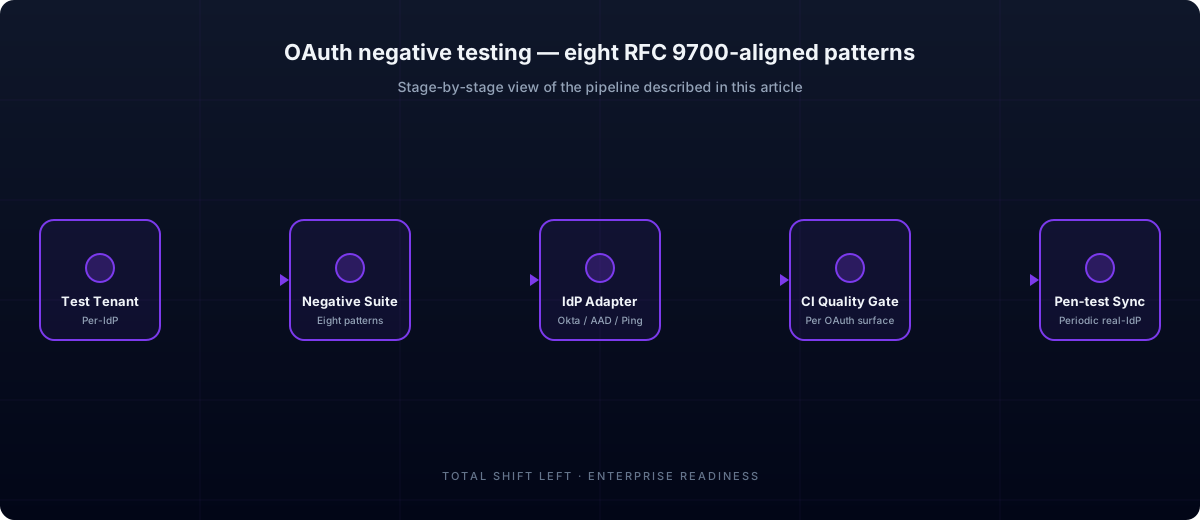
OAuth 2.0 negative testing pipeline — eight RFC 9700-aligned patterns.
Why OAuth negative testing matters at enterprise scale
IETF's 2024 OAuth 2.0 Security Best Current Practice (RFC 9700) explicitly enumerated negative-test patterns for the most common OAuth implementation bugs. Security firms tracking OAuth-related breaches in 2024-2025 (Salt, Akamai, Cloudflare) consistently found that 80%+ of breaches exploited negative paths the original implementer never tested. The defense is mechanical — write the eight tests — but enterprise teams routinely don't.
OAuth negative testing tools compared
A practical view of the tool categories that scale across enterprise testing programs in this area:
| Category | Example tools |
|---|---|
| IdP test tenants | Okta dev tenants, Azure AD test tenants, Ping demo tenants |
| Mock OAuth servers | Hydra, Keycloak, OAuth2 Mock Server for fast PR-stage tests |
| Test frameworks | Pact (contract), Postman (API), Total Shift Left negative test generation |
| JWT validation | jose libraries (Python, Node.js, Go), jwt.io for inspection |
| CI integration | GitHub Actions / GitLab CI with IdP credentials in secret store |
Tool selection is secondary to architecture. The patterns above hold regardless of which specific vendor you adopt.
OAuth negative testing in practice: a worked example
A representative deployment pattern from an enterprise rollout in this area:
Problem. A B2B SaaS shipped a customer-portal OAuth integration without negative testing. A pen-test six months later found that the redirect_uri parameter was matched too loosely, allowing token exfiltration to attacker-controlled domains. The vulnerability had been live for 8 months.
Solution. The team added the eight RFC 9700-aligned negative tests as CI quality gates. Tests ran against per-environment IdP test tenants. IdP-specific quirks (Okta PKCE config, Azure AD redirect URI matching) were parameterized.
Results. No further OAuth-related findings in the next four pen-test cycles. The negative test suite was extended to two more OAuth-using surfaces. The team's OAuth code reviews dropped from 2 hours to 20 minutes — the tests caught what reviewers used to look for.
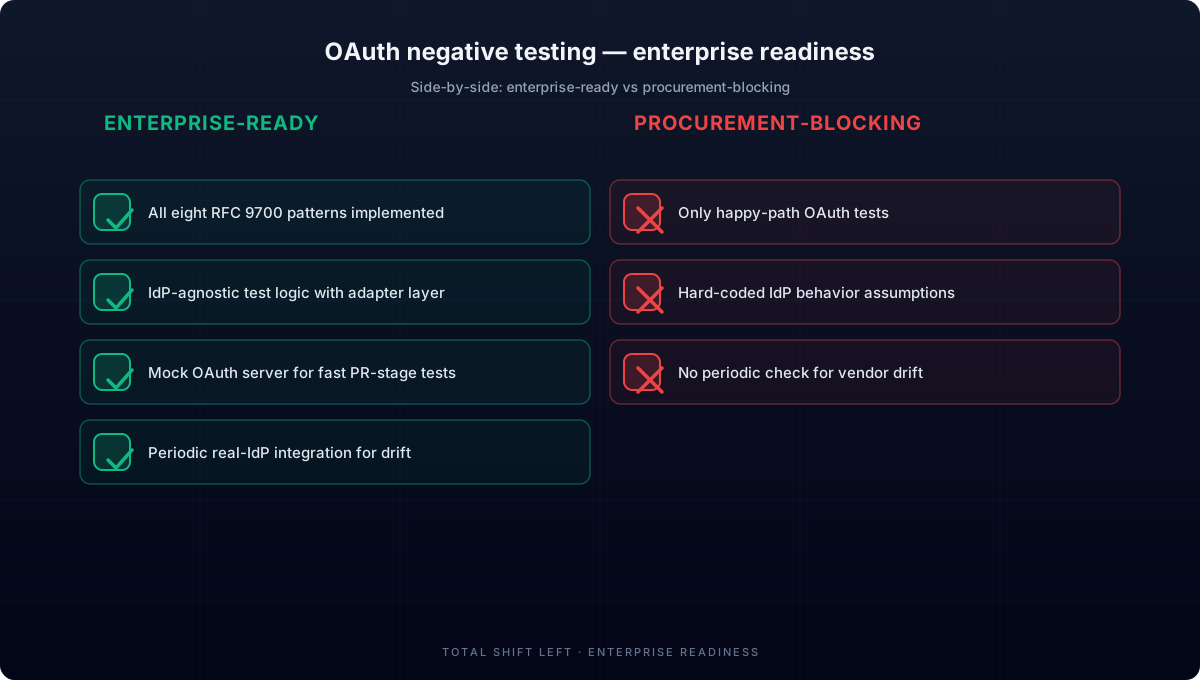
OAuth negative testing — readiness checklist.
OAuth negative testing reference architecture
An OAuth negative testing architecture has three layers. IdP test infrastructure — per-environment test tenants for each IdP family (Okta, Azure AD, Ping). Test tenants hold test users, test clients, and configured policies that mirror production. Test framework — IdP-agnostic test logic with parameterized assertions. IdP-specific quirks (Okta PKCE config, Azure AD redirect URI matching, Ping code-reuse policy) live in a small adapter layer per IdP. Mock OAuth servers — Hydra or Keycloak for fast PR-stage tests; periodic integration tests against real IdPs catch vendor-specific drift. CI integration — eight RFC 9700-aligned test patterns run as quality gates on every OAuth-using surface. The architecture deliberately separates pattern logic from IdP-specific behavior so adding a new IdP requires only an adapter, not a new test suite.
Free PDF guide (12 pages)
Top 50 API Testing Mistakes
50 real-world API testing mistakes organized by category — from authentication to performance — each with a concrete fix strategy.
Download FreeOAuth negative testing metrics that matter
Three metrics establish OAuth program health. OAuth pen-test findings — count of findings per pen-test cycle citing OAuth implementation issues — is the lagging indicator of program effectiveness; well-run programs trend toward zero. Test pattern coverage — percentage of OAuth-using surfaces with all eight patterns implemented — is the operational metric. IdP-quirk drift detection — count of behavioral changes detected in periodic real-IdP integration tests per quarter — flags when vendor changes need adapter updates. Report on a quarterly cadence to security and engineering leadership.
OAuth negative testing rollout playbook
OAuth negative-test rollout takes 6-8 weeks per surface, parallelized across surfaces. Weeks 1-2: foundation. Provision IdP test tenants. Stand up mock OAuth server (Hydra or Keycloak). Weeks 3-4: pattern implementation. Implement the eight RFC 9700 patterns as IdP-agnostic test logic. Build the IdP adapter layer. Weeks 5-6: surface onboarding. Onboard the first OAuth-using surface. Validate tests catch known-bad configurations. Weeks 7-8: CI integration. Wire tests into CI as quality gates. Configure periodic real-IdP integration tests. Each subsequent OAuth surface takes 1-2 weeks to onboard once the framework is in place.
OAuth negative testing challenges and how to solve them
IdP-specific quirks make tests hard to write. Parameterize the IdP-specific layer; keep test logic IdP-agnostic. Adapter per IdP, shared assertions.
Test IdP tenants are expensive. Use mock OAuth servers (Hydra, Keycloak) for fast PR-stage tests; periodic integration tests against real IdP catch vendor-specific drift.
Tests fail intermittently due to network or IdP issues. Treat IdP test tenant outages as test infrastructure issues, not test failures. Retry with backoff. Distinguish from genuine failures.
Engineering doesn't know which patterns to test. Use the RFC 9700 patterns directly. Eight tests cover the main threat surface. Extending beyond the eight is incremental.
OAuth negative testing best practices
- Implement all eight RFC 9700-aligned negative test patterns
- Parameterize IdP-specific behavior; keep test logic IdP-agnostic
- Use mock OAuth servers for fast PR-stage tests; periodic integration with real IdP
- Treat negative tests as mandatory CI quality gates, not optional
- Map each test to OWASP API Top 10 items for control-mapped reporting
- Extend tests to every OAuth-using surface, not just the customer portal
- Review IdP-specific behavior quarterly — vendors change defaults
OAuth negative testing checklist
A pre-flight checklist enterprise teams can run against their current state:
- ✔ All eight RFC 9700 negative test patterns are implemented
- ✔ Tests run as CI quality gates on every OAuth-using surface
- ✔ IdP-specific quirks are parameterized in adapter layer
- ✔ Mock OAuth server is operational for fast PR-stage tests
- ✔ Real-IdP integration tests run periodically (e.g., nightly)
- ✔ Tests are mapped to OWASP API Top 10 items for reporting
- ✔ IdP behavior changes are reviewed quarterly
- ✔ Negative tests are extended to every OAuth surface, not just one
Take the next step. See how security testing for regulated industries applies these ideas to your workflow, or explore enterprise security for the broader picture.
See also: jwt authentication in our learn hub for the underlying concept.
The negative cases an IdP integration has to fail correctly
Positive-path OAuth tests pass on day one and prove very little. These are the cases that separate an integration that is configured from one that is merely working:
# tests/test_oauth_negative.py
import time, jwt, pytest, requests

API = "https://api.example.com"

def bearer(tok): return {"Authorization": f"Bearer {tok}"}

def test_expired_token_is_rejected(expired_token):
    r = requests.get(f"{API}/v1/orders", headers=bearer(expired_token))
    assert r.status_code == 401
    assert 'error="invalid_token"' in r.headers.get("WWW-Authenticate", "")

def test_alg_none_is_rejected(claims):
    forged = jwt.encode(claims, key="", algorithm="none")
    assert requests.get(f"{API}/v1/orders", headers=bearer(forged)).status_code == 401

def test_token_from_another_tenant_is_rejected(other_tenant_token):
    # correct signature, correct issuer, wrong audience
    assert requests.get(f"{API}/v1/orders", headers=bearer(other_tenant_token)).status_code in (401, 403)

def test_wrong_issuer_is_rejected(token_signed_by_test_idp):
    assert requests.get(f"{API}/v1/orders",
                        headers=bearer(token_signed_by_test_idp)).status_code == 401

def test_missing_scope_is_403_not_401(read_only_token):
    r = requests.post(f"{API}/v1/orders", json={"sku": "A-1", "qty": 1},
                      headers=bearer(read_only_token))
    assert r.status_code == 403     # authenticated, not authorized

def test_clock_skew_tolerance_is_bounded(claims, sign):
    future = sign({**claims, "iat": int(time.time()) + 600})   # 10 minutes ahead
    assert requests.get(f"{API}/v1/orders", headers=bearer(future)).status_code == 401
Run the PKCE case too — a public client that still accepts an authorization code without a matching verifier is the finding most enterprise IdP integrations ship with:
VERIFIER=$(openssl rand -base64 60 | tr -d '=+/' | cut -c1-64)
CHALLENGE=$(printf '%s' "$VERIFIER" | openssl dgst -sha256 -binary | openssl base64 | tr '+/' '-_' | tr -d '=')

# ... user authorizes with code_challenge=$CHALLENGE, returns ?code=AUTH_CODE ...

# exchanging with the WRONG verifier must fail with invalid_grant
curl -s -XPOST "$IDP/oauth2/token" \
  -d grant_type=authorization_code -d code="$AUTH_CODE" \
  -d client_id="$CLIENT_ID" -d code_verifier="wrong-verifier" | jq .error
Sources and further reading
- OAuth 2.0 Security Best Current Practice — the IETF list of OAuth attacks and required mitigations.
- RFC 6749 — The OAuth 2.0 Authorization Framework — the normative OAuth 2.0 flows.
- Okta developer documentation — flow-level reference for one of the common enterprise IdPs.
Key takeaways
- OAuth 2.0 negative testing is one of the highest-leverage security investments an enterprise team can make.
- Eight patterns, IdP-aware adapters, fast CI integration. The teams that run these systematically catch the auth vulnerabilities the integrator didn't think to test — which is where most production OAuth incidents start.
OAuth negative testing FAQ
Why negative testing for OAuth specifically?
OAuth's positive paths are well-tested by IdP vendors. The vulnerabilities show up in the negative paths — what happens when a malicious client manipulates a parameter, replays a code, or tampers with a redirect URI. Most production OAuth bugs are on the negative paths the original integrator didn't test.
How do tests differ across Okta, Azure AD, and Ping?
The OAuth flows are standardized but the IdP-specific behavior on edge cases differs. Azure AD's handling of redirect URI matching is stricter than the spec; Okta's PKCE enforcement varies by application type; Ping has configurable behavior on token reuse. Tests have to be IdP-aware to catch the deltas.
Should negative tests run in CI on every change?
Yes for the auth-flow code paths. Negative tests are typically fast (no human interaction; client_credentials and ROPC flows for the bulk; mocked authorization-code responses for the rest). They belong in the PR or integration stage of the pipeline.
How does this relate to RFC 9700 (OAuth 2.0 Security BCP)?
RFC 9700 enumerates known OAuth threats and recommended mitigations. The test patterns in this article map directly to several of its recommendations — particularly around PKCE enforcement, redirect URI matching, and authorization code injection.
Ready to shift left with your API testing?
Try our no-code API test automation platform free.