
Authentication & Authorization Testing for APIs (2026)
Quick answer
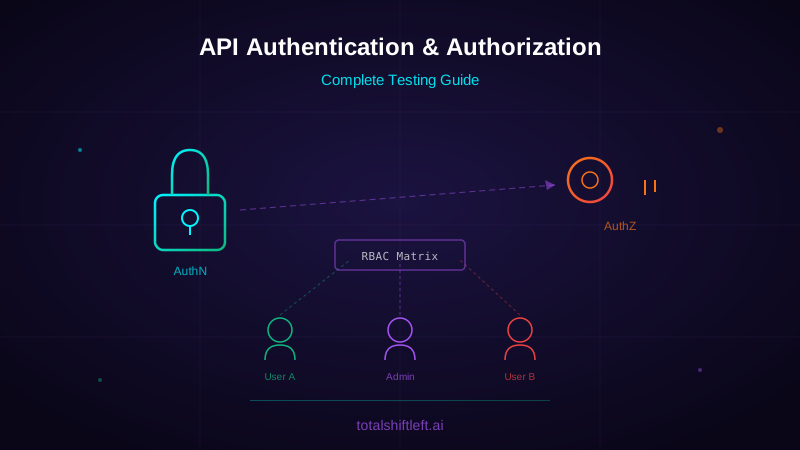
Authentication and authorization testing for APIs means validating two separate questions per endpoint: authentication ("who are you?" — test missing/invalid/expired credentials, all expecting 401) and authorization ("what are you allowed to do?" — test BOLA by requesting another user's resource ID with your own token, expecting 403; test BFLA by calling an admin-only endpoint as a regular user, expecting 403; test RBAC by running every endpoint against every role). Generate these test cases from your OpenAPI security schemes so every new endpoint inherits the full matrix automatically.
Reviewed by Sushant Joshi

API authentication testing is the process of validating that an API correctly verifies user identity through mechanisms like tokens, API keys, OAuth, and JWTs before granting access, while API authorization testing verifies that authenticated users can only access the resources and operations their permissions allow. Together, they form the most critical layer of API security testing.
Authentication and authorization vulnerabilities are responsible for the two most critical entries in the OWASP API Security Top 10 (our full breakdown here): API1 (Broken Object-Level Authorization) and API2 (Broken Authentication). Together, these categories account for over 40% of API security incidents reported in bug bounty programs and breach disclosures through 2025.
The failure pattern is predictable. Development teams implement authentication on the main login flow and test it manually. They add authorization checks to the most obvious endpoints. But they miss the edge cases — the admin endpoint that lacks a role check, the resource endpoint that validates the token but not the resource ownership, the password reset flow that does not rate-limit guesses, the JWT token that accepts "none" as the algorithm.
These gaps persist because authentication and authorization testing is tedious to do manually and requires systematic coverage that human testers struggle to maintain across hundreds of endpoints. The solution is structured, automated auth testing that runs on every deployment, covering every endpoint with every relevant auth scenario. This guide shows you how to build that capability.
In this guide
- What Is API Authentication and Authorization Testing?
- Why Auth Testing Is Critical for API Security
- Key Components of Auth Testing
- How Authentication and Authorization Testing Works
- Test Case Examples: BOLA, BFLA, RBAC, and Token Expiry
- Tools for Auth Testing
- Authentication and authorization testing in practice: a worked example
- Authentication and authorization testing challenges and how to solve them
- Authentication and authorization testing best practices
- Auth Testing Checklist
- Authentication and authorization testing FAQ
What Is API Authentication and Authorization Testing?
API authentication and authorization testing validates the two fundamental access control questions every API must answer correctly:
Authentication testing verifies that the API correctly answers "Who are you?" It tests the mechanisms that prove user identity — login flows, token validation, session management, multi-factor authentication, and credential handling. The goal is to confirm that no request can impersonate a user or bypass identity verification.
Authorization testing verifies that the API correctly answers "What are you allowed to do?" It tests the rules that determine what authenticated users can access — resource ownership (horizontal authorization), role-based permissions (vertical authorization), and function-level access controls. The goal is to confirm that authenticated users cannot exceed their granted permissions.
These are distinct but complementary disciplines. An API can have perfect authentication — correctly identifying every user — while having broken authorization that lets any authenticated user access any other user's data. Conversely, an API can have strong authorization logic that is useless if the authentication can be bypassed entirely.
Comprehensive auth testing covers:
- Credential validation: Login flows, password policies, MFA enforcement
- Token lifecycle: Issuance, validation, expiration, refresh, and revocation
- Session management: Session creation, timeout, concurrent session handling
- Object-level authorization (BOLA): User A cannot access User B's resources
- Function-level authorization: Regular users cannot access admin functions
- Role-based access control (RBAC): Each role has appropriate permissions
- Field-level authorization: Users cannot modify fields beyond their permission level
Getting test credentials without leaving a static token in the pipeline is its own problem — SSO and secret management for API testing covers the OIDC-to-vault pattern.
For the scanner landscape behind this, see API security testing tools compared on OSS, pricing and CI integration.
For how much of your existing API testing transfers to a model-called interface, see MCP vs REST APIs for testers.
Why Auth Testing Is Critical for API Security
Authentication Bypasses Have Maximum Impact
A broken authentication mechanism compromises every user account and every piece of data the API protects. When an attacker can forge tokens or bypass login entirely, the entire API is effectively unprotected. Authentication is the single point of failure — if it breaks, everything behind it is exposed.
Authorization Flaws Are the Most Common API Vulnerability
BOLA (Broken Object-Level Authorization) is ranked API1 in the OWASP API Security Top 10 because it is the most frequently discovered and exploited API vulnerability. Bug bounty platforms report BOLA findings across industries — healthcare, fintech, e-commerce, SaaS — because the flaw pattern is universal: APIs that validate tokens but not resource ownership.
Auth Bugs Are Hard to Detect Without Systematic Testing
Authorization vulnerabilities are invisible to functional testing. A GET /api/orders/123 returns 200 with correct data whether the authenticated user owns order 123 or not — the response looks identical. Only systematic testing with multiple user contexts reveals that the authorization check is missing. This is why automated, multi-context auth testing is essential.
Compliance Requires Demonstrable Auth Testing
Every major compliance framework — PCI DSS, HIPAA, SOC 2, GDPR — requires access control testing. Auditors expect evidence that authentication mechanisms are validated, authorization boundaries are tested, and access control failures are detected and remediated. Automated auth test suites provide continuous compliance evidence.
Key Components of Auth Testing
Authentication Mechanism Testing
Test every authentication mechanism the API supports: API keys, Bearer tokens, OAuth 2.0 flows, basic authentication, and custom schemes. For each mechanism, validate that the API rejects missing credentials (expect 401), invalid credentials (expect 401), expired credentials (expect 401), and malformed credentials (expect 400 or 401). Managing these through reusable OAuth, API key, JWT, and AWS SigV4 auth profiles keeps credential setup consistent across every test in the suite. Verify that successful authentication returns appropriate tokens with correct claims.
Token Security Testing
Tokens are the currency of API authentication. Test that tokens are generated with sufficient entropy (not sequential or predictable), that they expire within acceptable timeframes, that revoked tokens are immediately rejected, and that token refresh flows do not extend session duration indefinitely. For JWTs specifically, verify signature validation, algorithm enforcement, and claim validation. See our JWT authentication testing guide for deep coverage.
Horizontal Authorization Testing (BOLA)
Horizontal authorization testing verifies that users at the same privilege level cannot access each other's resources. For every endpoint that accepts a resource identifier (user ID, order ID, document ID), authenticate as User A and attempt to access User B's resources. The API must return 403 Forbidden. Build a test data matrix mapping users to their owned resources and automate cross-user access tests.
Vertical Authorization Testing (BFLA / Privilege Escalation)
Vertical authorization testing verifies that users cannot perform operations above their privilege level. Map all endpoints by required role, then systematically test each endpoint with every role. Regular users should get 403 on admin endpoints. Read-only users should get 403 on write operations. Verify that role escalation through parameter manipulation (e.g., sending role: "admin" in a request body) is impossible.
Ready to shift left with your API testing?
Try our no-code API test automation platform free. Generate tests from OpenAPI, run in CI/CD, and scale quality.
Session Management Testing
Test session lifecycle: creation, timeout enforcement, concurrent session limits, and session invalidation on logout and password change. Verify that session tokens are regenerated after privilege changes. Test that session fixation attacks fail — pre-set session IDs should not be accepted by the server.
Rate Limiting and Brute Force Protection
Authentication endpoints are prime targets for brute-force and credential stuffing attacks. Test that login endpoints enforce rate limits (expect 429 after threshold), that lockout mechanisms activate after repeated failures, and that rate limits cannot be bypassed by rotating IP addresses, user agents, or request headers.
How Authentication and Authorization Testing Works
A comprehensive auth testing pipeline operates in layers, each catching different categories of vulnerabilities:
Layer 1 — Specification Analysis: Parse OpenAPI specifications to identify which endpoints require authentication (security schemes), what authorization levels are expected, and which parameters are resource identifiers. Th
is analysis drives test generation — every secured endpoint gets authentication tests, every resource endpoint gets BOLA tests.
Layer 2 — Authentication Test Execution: For each secured endpoint, execute the authentication test matrix: no credentials, invalid credentials, expired credentials, credentials for a different scope, and valid credentials. This layer catches endpoints that are missing authentication entirely or that accept invalid tokens.
Layer 3 — Authorization Test Execution: For each endpoint that handles user-specific resources, execute cross-user access tests with pre-configured test accounts. For role-restricted endpoints, test access with every role. This layer catches BOLA vulnerabilities and privilege escalation flaws.
Layer 4 — Business Logic Auth Testing: Manual and semi-automated testing of complex auth flows: multi-step authentication, token exchange sequences, delegated authorization, and auth state transitions. This layer catches logic flaws that pattern-based automated testing misses.
Layer 5 — Continuous Monitoring: Runtime monitoring detects auth anomalies in production: unusual token usage patterns, authorization failures from legitimate accounts (potential compromise), and authentication attempts from suspicious sources.
Test Case Examples: BOLA, BFLA, RBAC, and Token Expiry
BOLA (Broken Object-Level Authorization) — User A's token must not access User B's resource:
# Authenticate as User A, then try to fetch an order owned by User B
curl -s -o /dev/null -w "%{http_code}\n" \
  -H "Authorization: Bearer $USER_A_TOKEN" \
  https://api.example.com/orders/$USER_B_ORDER_ID
# Expected: 403 (not 200, and not 404 — a 404 usually means the ID just
# doesn't exist, which masks the authorization gap you're testing for)
# pytest — same check, parametrized across every resource-owning endpoint
import pytest
import requests

RESOURCE_ENDPOINTS = ["orders", "invoices", "documents", "shipments"]

@pytest.mark.parametrize("resource", RESOURCE_ENDPOINTS)
def test_bola_cross_user_access_denied(resource, user_a_token, user_b_resource_id, base_url):
    resp = requests.get(
        f"{base_url}/{resource}/{user_b_resource_id}",
        headers={"Authorization": f"Bearer {user_a_token}"},
    )
    assert resp.status_code == 403, (
        f"{resource}/{user_b_resource_id} returned {resp.status_code}, expected 403 (BOLA)"
    )
BFLA (Broken Function-Level Authorization) — a regular user must not reach admin-only functions:
def test_bfla_regular_user_cannot_delete_account(member_token, other_org_account_id, base_url):
    resp = requests.delete(
        f"{base_url}/admin/accounts/{other_org_account_id}",
        headers={"Authorization": f"Bearer {member_token}"},
    )
    assert resp.status_code == 403, f"expected 403, got {resp.status_code} (BFLA)"
RBAC matrix — run every endpoint against every role in one parametrized suite:
ROLES = ["admin", "manager", "member", "viewer", "guest"]
ENDPOINTS = [("GET", "/orders"), ("POST", "/orders"), ("DELETE", "/orders/{id}")]
EXPECTED = {  # (role, method, path) -> expected status
    ("guest", "POST", "/orders"): 403,
    ("viewer", "DELETE", "/orders/{id}"): 403,
    ("admin", "DELETE", "/orders/{id}"): 200,
    # ... full matrix generated from your role-endpoint spec
}

@pytest.mark.parametrize("role", ROLES)
@pytest.mark.parametrize("method,path", ENDPOINTS)
def test_rbac_matrix(role, method, path, tokens_by_role, base_url):
    expected = EXPECTED.get((role, method, path))
    if expected is None:
        pytest.skip("not in matrix")
    resp = requests.request(method, f"{base_url}{path}", headers={"Authorization": f"Bearer {tokens_by_role[role]}"})
    assert resp.status_code == expected
Token expiry — an expired token must be rejected, not silently accepted:
# EXPIRED_TOKEN was issued with a 1-second TTL and is now stale
sleep 2
curl -s -o /dev/null -w "%{http_code}\n" \
  -H "Authorization: Bearer $EXPIRED_TOKEN" \
  https://api.example.com/orders
# Expected: 401
Generate this full matrix automatically from your OpenAPI security schemes rather than hand-writing it per endpoint — every new endpoint that declares a security requirement should inherit authentication, BOLA/BFLA, and RBAC tests without a human writing new test code.
Tools for Auth Testing
| Tool | Type | Best For | Open Source |
|---|---|---|---|
| OWASP ZAP | DAST | Automated auth vulnerability scanning | Yes |
| Burp Suite Pro | DAST | Manual auth flow testing and interception | No |
| Postman | Functional | Auth flow test collections | No (Free tier) |
| Total Shift Left | Automated | Generating auth tests from OpenAPI specs | No |
| jwt.io | Utility | JWT token inspection and debugging | Yes |
| Nuclei | DAST | Template-based auth vulnerability checks | Yes |
| Authz0 | Authorization | Automated authorization testing | Yes |
| Keycloak | IdP Testing | Testing against a standard OAuth/OIDC provider | Yes |
OWASP ZAP includes authentication and session handling modules that can log in to APIs, maintain session tokens, and scan while authenticated. Its forced browsing module tests authorization by attempting to access resources without proper permissions.
Burp Suite Professional excels at manual auth testing with its intercepting proxy. Testers can modify tokens, replay requests across user contexts, and use the Autorize extension to automatically test authorization on every intercepted request.
For CI/CD integration, Total Shift Left generates auth test suites from OpenAPI security definitions, creating tests for every authentication scenario and generating BOLA tests for all resource endpoints. These run automatically on every build, providing continuous auth coverage with no manual maintenance.
Authentication and authorization testing in practice: a worked example
Problem: A B2B SaaS platform with 180 API endpoints and five user roles (admin, manager, member, viewer, guest) relied on manual testing for authorization coverage. A penetration test revealed that 23 of their 180 endpoints had BOLA vulnerabilities — any authenticated user could access any organization's data by modifying the organization ID in the URL path. Additionally, 8 admin-only endpoints were accessible to regular members.
Solution: The team built a systematic auth testing program:
- Mapped all 180 endpoints with their authentication requirements, authorization levels, and resource identifier parameters
- Created test accounts for all five roles across three test organizations
- Generated automated BOLA tests for all 94 endpoints that accept resource identifiers, testing cross-organization and cross-user access with each role
- Built role-matrix tests that call every endpoint with every role, verifying appropriate 403 responses for unauthorized access
- Integrated the test suite into their CI/CD pipeline with a quality gate that fails builds if any auth test fails
- Added OWASP ZAP authenticated scanning to their staging deployment pipeline
Results:
- Fixed all 23 BOLA vulnerabilities and 8 privilege escalation flaws within two weeks
- Auth test suite now covers all 180 endpoints across 5 roles — 900+ authorization test cases running on every build
- New BOLA vulnerabilities are caught in the CI pipeline within minutes of introduction, before they reach staging
- Authorization regression rate dropped from 2-3 incidents per quarter to zero in six months
- Auth testing added 6 minutes to their 40-minute build pipeline — less than 15% overhead for complete auth coverage
Free PDF guide (12 pages)
Top 50 API Testing Mistakes
50 real-world API testing mistakes organized by category — from authentication to performance — each with a concrete fix strategy.
Download FreeAuthentication and authorization testing challenges and how to solve them
Managing Test Accounts Across Environments
Auth testing requires multiple test accounts with different roles and resource ownership, and these accounts must be consistent across development, staging, and production environments.
Solution: Create a dedicated test data management system that provisions test accounts with deterministic credentials and resource ownership. Use environment-specific configuration files that map test users to their roles and owned resources. Automate test account provisioning as part of environment setup.
Testing Complex OAuth Flows
OAuth 2.0 flows involve multiple redirects, authorization codes, token exchanges, and scope validations that are difficult to automate in standard test frameworks.
Solution: Use OAuth testing libraries that handle the flow automation (token acquisition, refresh, revocation). For CI/CD, pre-provision OAuth tokens using the client credentials grant or resource owner password grant, and test the authorization code flow separately in dedicated integration tests.
Testing Auth for AI Agents and MCP Clients
An MCP server that exposes tools over HTTP authenticates its callers the same way any API does, but the caller is now an LLM agent rather than a human-driven client — which means the usual authorization code flow (built around a browser redirect) does not apply directly. Test that the server enforces PKCE and audience-restricted tokens so a token issued for one MCP server cannot be replayed against another (the confused-deputy risk that motivated OAuth 2.1's stricter requirements), and that dynamic client registration, where supported, does not silently grant a new client broader scopes than it requested. See how to test MCP servers for the full protocol-level test suite this fits into.
Authorization Logic Spread Across Services
In microservices architectures, authorization logic may be distributed across an API gateway, individual services, and a centralized authorization service, making it unclear where access control decisions are made and tested.
Solution: Test authorization at the API gateway level (the boundary that clients interact with) regardless of where the logic lives internally. This black-box approach validates the behavior users experience. Supplement with unit tests inside individual services for defense-in-depth.
Scaling BOLA Tests as APIs Grow
With hundreds of endpoints and dozens of resource types, the BOLA test matrix grows exponentially, leading to long test execution times.
Solution: Generate BOLA tests from OpenAPI specifications so new endpoints automatically get auth tests. Prioritize critical resources (financial data, personal data, admin functions) for comprehensive cross-user testing, and use sampling for lower-risk resources. Run the full matrix in nightly builds and a prioritized subset in CI.
Token Expiration During Test Runs
Long-running auth test suites may encounter token expiration mid-execution, causing false failures unrelated to actual auth vulnerabilities.
Solution: Implement token refresh middleware in the test framework that transparently refreshes tokens before expiration. Set test tokens with slightly longer expiration than the expected test suite duration. For JWT-based auth, generate test tokens with configurable expiration.
Authentication and authorization testing best practices
- Test every endpoint with every auth scenario: No credentials, invalid credentials, expired credentials, and wrong-scope credentials — automate this matrix for every endpoint
- Maintain a role-endpoint authorization matrix: Document which roles should have access to which endpoints and generate tests from this matrix
- Automate BOLA testing for all resource endpoints: Every endpoint that accepts a resource identifier needs cross-user access tests with automated test data
- Test token lifecycle completely: Issuance, validation, refresh, expiration, and revocation — each stage has distinct failure modes
- Verify auth state transitions: Password changes should invalidate existing sessions, role changes should take effect immediately, account lockout should prevent all access
- Test negative auth paths thoroughly: Authentication failures (401, 403) deserve as much test coverage as success paths — they are the security boundary
- Run auth tests on every build: Auth regressions are critical security issues — catch them in CI, not in production
- Separate authentication and authorization tests: Test that unauthenticated requests are rejected (authentication) separately from testing that authorized requests are restricted (authorization)
- Use realistic test data: Test with resource IDs that exist and belong to other users, not random IDs that would produce 404s and mask authorization failures
- Test auth in the API layer, not the UI: UI-level access controls can be bypassed by calling APIs directly — test authorization at the API boundary where it must be enforced
- Include auth tests in code review gates: Pull requests that modify auth-related code should trigger the full auth test suite before merge
Auth Testing Checklist
- ✔ Map all endpoints with their authentication requirements and authorization levels
- ✔ Create test accounts for every role with known resource ownership
- ✔ Test all endpoints with missing authentication (expect 401)
- ✔ Test all endpoints with expired tokens (expect 401)
- ✔ Test all endpoints with invalid/malformed tokens (expect 401)
- ✔ Test BOLA on all resource endpoints: User A accessing User B's resources (expect 403)
- ✔ Test vertical authorization: low-privilege users accessing admin endpoints (expect 403)
- ✔ Test role-based access: every endpoint with every role to verify the authorization matrix
- ✔ Verify rate limiting on login and authentication endpoints
- ✔ Test session invalidation on logout, password change, and role change
- ✔ Validate token refresh flows do not allow indefinite session extension
- ✔ Verify error responses do not distinguish between "user not found" and "wrong password"
See also: oauth2 client credentials in our learn hub for the underlying concept.
Authentication and authorization testing FAQ
What is API authentication testing?
API authentication testing validates that an API correctly verifies user identity before granting access. It tests scenarios including missing credentials, invalid tokens, expired sessions, brute-force protection, and multi-factor authentication to ensure only legitimate users can authenticate.
What is the difference between authentication and authorization testing?
Authentication testing verifies identity — confirming the API correctly identifies who the user is. Authorization testing verifies permissions — confirming the API correctly restricts what an authenticated user can access. Authentication asks 'who are you?' while authorization asks 'what are you allowed to do?'
How do you test API authorization for BOLA vulnerabilities?
Test BOLA by authenticating as User A, capturing a valid request with User A's resource ID, then replaying the request with User B's resource ID. The API should return 403 Forbidden. Automate this for every endpoint that accepts resource identifiers by maintaining a test data matrix of users and their owned resources.
How do you automate API authentication testing in CI/CD?
Automate API authentication testing in CI/CD by creating test suites that send requests with no credentials (expect 401), expired tokens (expect 401), invalid tokens (expect 401), and valid credentials (expect 200). Generate tests from OpenAPI security schemes and run them on every build with quality gates that fail on authentication bypass findings.
How do you test authentication for AI agents and MCP servers?
An MCP server's callers are LLM agents, not browser-driven users, so the standard authorization code flow doesn't apply directly. Test that the server enforces PKCE and audience-restricted tokens so a token issued for one MCP server cannot be replayed against another, and that dynamic client registration doesn't silently grant a client broader scopes than it requested.
What are common API authentication vulnerabilities?
Common API authentication vulnerabilities include missing authentication on endpoints, weak token generation, lack of token expiration, missing rate limiting on login endpoints, insecure password reset flows, JWT signature bypass, and session fixation. These are covered under API2 (Broken Authentication) in the OWASP API Security Top 10.
How do you test role-based access control (RBAC) in APIs?
Test RBAC by creating test accounts for every role in the system, then systematically testing every endpoint with each role. Verify that role-restricted endpoints return 403 for unauthorized roles, that role escalation is impossible through parameter manipulation, and that role changes take effect immediately without requiring re-authentication.
Sources and further reading
- OWASP API Security Top 10 (2023) — the reference list of API risk categories.
- RFC 6749 — The OAuth 2.0 Authorization Framework — the normative OAuth 2.0 flows.
- OpenID Connect Core 1.0 — the identity layer enterprise IdPs implement.
Key takeaways
- Authentication and authorization testing is the foundation of API security.
- Without systematic coverage of every endpoint, every role, and every resource ownership boundary, you are leaving the most frequently exploited API vulnerabilities undetected.
- Automated auth testing in CI/CD transforms security from a periodic audit into a continuous guarantee.
Start testing your API authentication and authorization today. Try Total Shift Left free to automatically generate comprehensive auth tests from your OpenAPI specifications and catch BOLA, privilege escalation, and authentication bypasses before they reach production.
Related: API Testing: The Complete Guide | API Security Testing: Complete Guide | OWASP API Security Top 10 Explained | JWT Authentication Testing Guide | OAuth API Testing Best Practices | REST API Testing Best Practices | What Is Shift-Left Testing
Ready to shift left with your API testing?
Try our no-code API test automation platform free.