
JWT Authentication Testing: Test Cases, Tools & Examples (2026)
Quick answer
JWT testing validates that an API correctly verifies token signatures, enforces every standard claim (exp, nbf, iss, aud), rejects the "none" algorithm, and rejects algorithm confusion (RS256 re-signed as HS256 with the public key). Test with a real attack matrix — modified payload, wrong key, expired/future tokens, wrong issuer/audience, tampered claims — not just the happy path, and automate it in CI so every deploy is checked.
Reviewed by Smeet Gohel

JWT authentication testing is the systematic validation of JSON Web Token implementation in APIs, verifying that tokens are correctly signed, claims are properly enforced, expiration is validated, algorithms are securely configured, and tokens cannot be forged or tampered with to gain unauthorized access to protected resources.
JSON Web Tokens have become the dominant authentication mechanism for modern APIs. Their stateless nature, compact format, and built-in signature verification make them ideal for distributed systems and microservices architectures. But JWTs are also one of the most commonly misconfigured security mechanisms — and a misconfigured JWT implementation is worse than no authentication at all, because it creates a false sense of security.
Auth0 reported that over 30% of JWT implementations they audited in 2025 had at least one critical vulnerability: accepting unsigned tokens, using weak secrets that could be brute-forced in minutes, or failing to validate token expiration. These are not theoretical risks — they are the vulnerabilities that attackers actively scan for and exploit.
The challenge is that JWT vulnerabilities are subtle. A JWT with a modified payload looks identical to a valid one until the signature is verified. A token with the algorithm set to "none" appears normal to developers reviewing logs. These flaws require systematic, security-focused testing that goes beyond checking whether the happy path works. This guide covers every aspect of JWT authentication testing, from basic signature validation to advanced attack pattern testing.
In this guide
- What Is JWT Authentication Testing?
- Why JWT Testing Is Critical
- Key Components of JWT Testing
- How JWT Authentication Testing Works
- Tools for JWT Testing
- JWT testing in practice: a worked example
- JWT testing challenges and how to solve them
- JWT testing best practices
- JWT Testing Checklist
- JWT testing FAQ
What Is JWT Authentication Testing?
JWT authentication testing validates the complete lifecycle of JSON Web Token implementation in an API: token issuance, signature verification, claim validation, expiration enforcement, refresh handling, and revocation. It is a specialized subset of API authentication testing focused on the specific attack surface that JWT introduces.
A JSON Web Token consists of three Base64-encoded parts separated by dots:
- Header: Specifies the signing algorithm (e.g., RS256, HS256) and token type
- Payload: Contains claims — user identity, roles, permissions, expiration time, and issuer
- Signature: Cryptographic signature computed over the header and payload using a secret key
JWT testing validates that the API:
- Issues tokens correctly — with appropriate claims, reasonable expiration, and strong signing
- Validates tokens rigorously — checking the signature, algorithm, issuer, audience, and expiration on every request
- Rejects tampered tokens — modified payloads, forged signatures, and algorithm manipulation
- Enforces token lifecycle — expiration, refresh, and revocation work as designed
- Protects token secrets — signing keys are strong, rotated, and not exposed
Unlike opaque session tokens that are validated by looking up a server-side session, JWTs are self-contained — the token itself carries the user's identity and permissions. This means a forged JWT with valid-looking claims will be accepted if signature validation fails. The self-contained nature makes rigorous testing essential.
Why JWT Testing Is Critical
JWT Vulnerabilities Lead to Full Authentication Bypass
A JWT implementation that accepts unsigned tokens (the "none" algorithm attack) or that fails to validate signatures allows any attacker to create tokens with any claims — effectively choosing their own identity and permissions. This is a complete authentication bypass that compromises every protected resource.
JWT Misconfigurations Are Extremely Common
The flexibility of JWT libraries creates a wide configuration surface. Developers must correctly configure signing algorithms, key management, claim validation, and expiration handling. Each misconfiguration creates a distinct vulnerability. The permissive default configurations of many JWT libraries compound the problem — what works in development may be insecure in production.
Stateless Nature Means No Safety Net
With server-side sessions, a compromised session can be invalidated by deleting the session record. With JWTs, a token remains valid until it expires unless the API implements an explicit revocation mechanism (which most do not). A stolen JWT with a 24-hour expiration gives an attacker 24 hours of access with no way to revoke it.
Token Claims Drive Authorization Decisions
Many APIs extract authorization information (roles, permissions, organization membership) directly from JWT claims. If an attacker can modify claims without detection (through signature bypass), they can escalate privileges, change their organization context, or grant themselves admin access — all within the OWASP API Security Top 10 risk categories.
Key Components of JWT Testing
Signature Validation Testing
Signature validation is the most critical JWT security mechanism. Test by taking a valid JWT, modifying a claim in the payload (e.g., changing the user ID), re-encoding the payload without re-signing, and sending the modified token. The API must reject it with 401. Also test with tokens signed by a different key entirely — this catches APIs that skip signature validation.
Algorithm Confusion Testing
The algorithm confusion attack exploits APIs that trust the algorithm specified in the JWT header. If an API is configured for RS256 (asymmetric), an attacker can change the header to HS256 (symmetric) and sign the token using the public key as the HMAC secret. Since the public key is often available, this creates a valid signature the server accepts. Test by changing the alg header to HS256 and signing with the public key.
"None" Algorithm Testing
The "none" algorithm is a valid JWT algorithm that specifies no signature. Some JWT libraries accept tokens with "alg": "none" and an empty signature section if not explicitly configured to reject them. Test by creating a token with the algorithm set to "none", removing the signature, and verifying the API rejects it.
Claim Validation Testing
JWT claims carry critical security information. Test that the API validates:
exp(Expiration): Tokens past expiration are rejectediat(Issued At): Tokens issued in the future are rejectednbf(Not Before): Tokens used before their activation time are rejectediss(Issuer): Only tokens from expected issuers are acceptedaud(Audience): Only tokens intended for this API are acceptedsub(Subject): The subject maps to a valid user in the system
Token Expiration and Refresh Testing
Test that expired tokens receive 401 responses, that refresh tokens can obtain new access tokens within the refresh window, that refresh tokens are single-use (a used refresh token cannot be reused), and that both tokens are invalidated on logout. Verify that refresh flows do not allow indefinite session extension by checking that refresh tokens also have maximum lifetimes.
Key Rotation Testing
APIs should support JWT key rotation without downtime. Test that when a new signing key is deployed, tokens signed with the old key are still valid during the transition period (grace period) and that eventually old keys are rejected. Verify that the API uses the kid (Key ID) header to select the correct verification key.
Ready to shift left with your API testing?
Try our no-code API test automation platform free. Generate tests from OpenAPI, run in CI/CD, and scale quality.
How JWT Authentication Testing Works
JWT testing follows a structured approach that validates each layer of the token implementation:
Phase 1 — Token Issuance Analysis:
Obtain a valid JWT and decode it (using jwt.io or programmatically). Analyze the header for the algorithm and key ID. Examine the payload for claim completeness — are exp, iss, aud, and sub present? Check token lifetime — is expiration reasonable (minutes to hours, not days or weeks)?
Phase 2 — Signature Manipulation: Create a matrix of signature
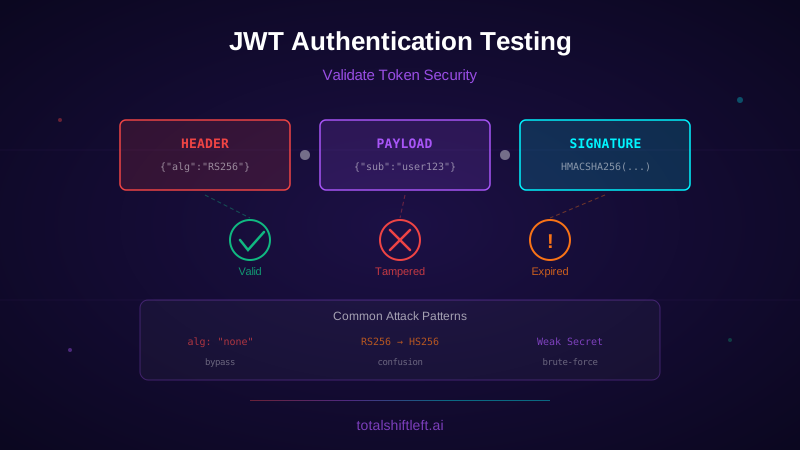
attacks: modify the payload without re-signing, change the algorithm to "none", attempt algorithm confusion (RS256 to HS256), and sign with a different key. Execute each attack against protected endpoints. Any successful request with a manipulated token is a critical finding.
The three core attacks, built with jose (Node.js) as test fixtures:
import { SignJWT, importPKCS8 } from 'jose';

// 1. "none" algorithm attack — server should reject this
const noneAlgToken = [
  Buffer.from(JSON.stringify({ alg: 'none', typ: 'JWT' })).toString('base64url'),
  Buffer.from(JSON.stringify({ sub: 'attacker', role: 'admin' })).toString('base64url'),
  '', // empty signature
].join('.');

// 2. Algorithm confusion — sign with the PUBLIC key as an HMAC secret
const forgedToken = await new SignJWT({ sub: 'attacker', role: 'admin' })
  .setProtectedHeader({ alg: 'HS256' })
  .sign(Buffer.from(RS256_PUBLIC_KEY_PEM)); // treating an RSA public key as an HMAC secret

// 3. Tampered payload without re-signing — decode, edit, reassemble the original signature
const [header, , signature] = validToken.split('.');
const tamperedPayload = Buffer.from(JSON.stringify({ ...decodedPayload, role: 'admin' })).toString('base64url');
const tamperedToken = [header, tamperedPayload, signature].join('.');

// Each of noneAlgToken, forgedToken, tamperedToken should get a 401 from every protected endpoint.
for (const token of [noneAlgToken, forgedToken, tamperedToken]) {
  const res = await fetch(`${baseUrl}/protected`, { headers: { Authorization: `Bearer ${token}` } });
  assert.equal(res.status, 401, `Expected 401 for forged token, got ${res.status}`);
}
Phase 3 — Claim Boundary Testing: Test each claim at its boundaries: tokens one second before and after expiration, tokens with different issuer values, tokens with audience values for different services, and tokens with modified role/permission claims. This phase validates that claim checks are precise, not approximate.
Phase 4 — Lifecycle Testing: Walk through the complete token lifecycle: issuance, usage, refresh, and revocation. Test that refresh tokens work correctly, that logout invalidates tokens, and that token revocation (if implemented) takes effect immediately. Verify that long-lived refresh tokens cannot be used after the user's account is disabled.
Phase 5 — Integration Testing: Test JWT handling across the entire API surface. Verify that every protected endpoint validates tokens (not just the endpoints tested during development), that token claims are used consistently for authorization decisions, and that error responses for invalid tokens do not leak implementation details.
Tools for JWT Testing
| Tool | Type | Best For | Open Source |
|---|---|---|---|
| jwt.io | Utility | Decoding and inspecting JWT structure | Yes |
| jwt_tool | Penetration Testing | Comprehensive JWT attack testing | Yes |
| Burp Suite + JWT Extension | DAST | Interactive JWT manipulation and scanning | No |
| OWASP ZAP | DAST | Automated JWT vulnerability scanning | Yes |
| Postman | Functional | JWT flow testing and automation | No (Free tier) |
| Total Shift Left | Automated | JWT test generation from API specs | No |
| jose (npm) | Library | Programmatic JWT creation for test suites | Yes |
| AuthAnalyzer (Burp) | Authorization | Testing JWT-protected authorization boundaries | Yes |
jwt_tool by ticarpi is the most comprehensive dedicated JWT testing tool. It automates the full attack matrix: "none" algorithm, algorithm confusion, key brute-forcing, claim tampering, and header injection. It can generate attack payloads that integrate into automated test suites.
jwt.io is essential for debugging — paste a JWT and instantly see the decoded header, payload, and signature verification status. Use it during test development to understand the token structure before writing test cases.
For continuous testing in CI/CD pipelines, combine programmatic JWT manipulation libraries (like jose for Node.js or PyJWT for Python) with your API test framework to create self-contained JWT security test suites that run on every build. Managing token issuance across environments is easier when your tests can reference reusable OAuth, JWT, and API-key auth profiles instead of hardcoding credentials into each case.
How Total Shift Left does this: AI-generated test suites include Critical-severity negative and edge-case tests for auth-protected endpoints — missing tokens, malformed values, and boundary conditions — generated directly from your OpenAPI spec. Reusable auth profiles (OAuth 1.0a/2.0 with automatic token refresh, Bearer/API key, AWS Signature V4) let every JWT-protected endpoint share the same credential configuration instead of hardcoding tokens into each test.
JWT testing in practice: a worked example
Problem: A multi-tenant SaaS platform used JWTs for all API authentication across 12 microservices. A security researcher reported through their bug bounty program that the API accepted tokens with the algorithm changed from RS256 to HS256, signed with the publicly available RSA public key. This algorithm confusion vulnerability allowed any external user to forge tokens with any tenant ID, user ID, and role — including admin access to any tenant's data.
Solution: The team implemented a comprehensive JWT security testing program:
- Fixed the immediate vulnerability by configuring all JWT validation to reject HS256 and only accept RS256 with key ID matching
- Created an automated JWT attack test suite covering: "none" algorithm, algorithm confusion (RS256 to HS256), payload modification without re-signing, expired tokens, tokens from wrong issuer, and tokens with modified tenant/role claims
- Added signature validation tests to their CI pipeline — every microservice's test suite includes JWT security tests that run on every build
- Implemented JWT key rotation with
kidheader support, along with tests that verify rotation works correctly - Added token revocation using a Redis-backed deny list for immediately invalidating compromised tokens
- Deployed runtime monitoring that alerts on JWT validation failures exceeding baseline rates
Results:
- Algorithm confusion vulnerability fixed within 4 hours of discovery
- JWT security test suite covers 47 attack scenarios across all 12 microservices
- Caught 3 additional JWT vulnerabilities in the first week: one service was not validating
expclaims, one service accepted tokens from any issuer, and one service had a race condition in token refresh - Key rotation now tested automatically with zero-downtime verification on every deployment
- Mean time to detect JWT misconfigurations reduced from "until a security researcher finds it" to under 15 minutes in the CI pipeline
Free PDF guide (12 pages)
Top 50 API Testing Mistakes
50 real-world API testing mistakes organized by category — from authentication to performance — each with a concrete fix strategy.
Download FreeJWT testing challenges and how to solve them
Testing Asymmetric Algorithms (RS256/ES256)
Testing algorithm confusion and key-related attacks requires access to the public key and knowledge of the signing infrastructure, which may not be available to QA teams.
Solution: Include the public key (not the private key) in the test configuration alongside test JWTs. Create a test key pair specifically for testing — the test private key generates valid tokens and the test public key allows crafting algorithm confusion attacks. Never use production keys in test environments.
Token Expiration Timing in Tests
JWT expiration tests require precise timing — sending a request exactly when a token expires is non-deterministic and can cause flaky tests.
Solution: Generate tokens with very short expiration (5-10 seconds) for expiration tests, then add a deliberate wait before sending the request. For non-expiration tests, generate tokens with long expiration (1 hour) to avoid timing-related failures. Use a dedicated token generation utility in your test framework.
Testing Revocation Without a Revocation Mechanism
Many JWT implementations have no token revocation capability, making it impossible to test what should happen when a token needs to be invalidated.
Solution: Document the absence of revocation as a security finding. Recommend implementing a deny list (Redis or similar) for critical revocation scenarios: user logout, password change, account compromise. Test that this mechanism works when implemented — revoked tokens should receive 401 immediately.
Maintaining Test Coverage Across Microservices
In microservices architectures, each service may have its own JWT validation logic, and a misconfiguration in any one service compromises that service's security.
Solution: Create a shared JWT security test library that each service imports and executes as part of its test suite. The shared library contains the standard attack matrix, and each service adds its own claim-specific tests. This ensures consistent JWT security coverage across all services.
JWT testing best practices
- Enforce algorithm whitelisting: Configure JWT validation to accept only specific algorithms (e.g., RS256 only), never trust the algorithm specified in the token header
- Test the "none" algorithm attack: Even if your library claims to reject it, verify with an actual test — library updates or configuration changes could re-enable it
- Validate every standard claim:
exp,iss,aud,nbf, andsubshould all be checked on every request, not just during initial authentication - Use short-lived access tokens: Access tokens should expire in minutes (15-60), not hours or days, to limit the window of exploitation if tokens are compromised
- Implement and test token refresh: Refresh tokens should be single-use, stored securely, and have their own expiration — test all of these properties
- Never store sensitive data in JWT payloads: JWT payloads are Base64-encoded, not encrypted — anyone can read them. Test that no sensitive data (passwords, secrets, PII) appears in token payloads
- Test with manipulated claims: Modify user IDs, roles, tenant IDs, and permissions in token claims to verify the API validates claims against the actual database, not just token content
- Include
kidin all tokens: Key ID headers enable safe key rotation — test that key rotation works without rejecting valid tokens during the transition - Monitor JWT validation failures: Spikes in signature validation failures indicate potential attack activity — test that monitoring alerts fire correctly
- Test cross-service token usage: In microservices, verify that a token issued for Service A is not accepted by Service B unless explicitly intended
- Automate the JWT attack matrix in CI: The standard JWT attacks (none, algorithm confusion, signature modification) should run on every build, not just during penetration tests
JWT Testing Checklist
- ✔ Decode and inspect JWT structure: verify header algorithm, payload claims, and signature presence
- ✔ Test signature validation: modified payload without re-signing must be rejected (401)
- ✔ Test "none" algorithm: token with
alg: "none"and empty signature must be rejected (401) - ✔ Test algorithm confusion: RS256 token re-signed as HS256 with public key must be rejected (401)
- ✔ Test expired tokens: tokens past
expclaim must be rejected (401) - ✔ Test future tokens: tokens with
nbfin the future must be rejected (401) - ✔ Test wrong issuer: tokens with incorrect
issclaim must be rejected (401) - ✔ Test wrong audience: tokens with incorrect
audclaim must be rejected (401) - ✔ Test modified role/permission claims: escalated privileges must be rejected (403)
- ✔ Test token refresh: verify single-use, expiration, and logout invalidation
- ✔ Verify no sensitive data in JWT payload (passwords, secrets, full PII)
- ✔ Test key rotation: old keys accepted during grace period, rejected after
- ✔ Test
kidheader injection: akidvalue pointing at a file path, a SQL injection string, or another tenant's key ID must not be resolved or used - ✔ Test clock skew tolerance: tokens a few seconds past
expor beforenbfshould follow your documented skew allowance (typically 0-60s), not an undocumented one - ✔ Test cross-service token reuse: a token issued for Service A must not be accepted by Service B unless explicitly scoped to both
- ✔ Test the
subclaim maps to a real, active user — not just a well-formed string
See also: jwt authentication in our learn hub for the underlying concept.
JWT testing FAQ
What is JWT authentication testing?
JWT authentication testing is the process of validating that APIs correctly issue, verify, and enforce JSON Web Tokens. It tests signature validation, claim verification, expiration enforcement, algorithm security, and token revocation to ensure JWTs cannot be forged, tampered with, or abused to gain unauthorized access.
What are the most common JWT vulnerabilities?
The most common JWT vulnerabilities are: algorithm confusion attacks (changing RS256 to HS256), the 'none' algorithm bypass where the server accepts unsigned tokens, weak signing secrets that can be brute-forced, missing expiration enforcement, lack of token revocation mechanisms, and sensitive data exposure in unencrypted JWT payloads.
How do you test JWT signature validation?
Test JWT signature validation by modifying the payload of a valid token without re-signing it and sending it to the API — the API should reject it with 401. Also test with tokens signed by a different key, tokens with the algorithm changed to 'none', and tokens with the algorithm switched from RS256 to HS256 using the public key as the HMAC secret.
Should JWT tokens be stored in localStorage or cookies?
JWTs should be stored in HTTP-only, secure, SameSite cookies rather than localStorage. localStorage is accessible to any JavaScript running on the page, making it vulnerable to XSS attacks. HTTP-only cookies cannot be read by JavaScript and provide built-in CSRF protection with the SameSite attribute.
How do you test JWT expiration and refresh flows?
Test JWT expiration by sending requests with tokens past their 'exp' claim — the API should return 401. Test refresh flows by verifying that refresh tokens are single-use, that expired access tokens can be refreshed within the refresh window, and that both access and refresh tokens are invalidated on logout.
Sources and further reading
- RFC 7519 — JSON Web Token — the JWT claim set and validation rules.
- jwt_tool — a toolkit for JWT attack testing (alg confusion, kid injection).
- OAuth 2.0 Security Best Current Practice — the IETF list of OAuth attacks and required mitigations.
Key takeaways
- JWT authentication is only as secure as its implementation, and implementation flaws are alarmingly common.
- Systematic JWT testing — covering signature validation, algorithm enforcement, claim verification, and lifecycle management — transforms JWT from a potential liability into a reliable security mechanism.
- Automate the standard JWT attack matrix in your CI/CD pipeline so every deployment is validated.
Start testing your JWT implementation today. Try Total Shift Left free to automatically generate JWT security tests from your OpenAPI specifications and catch token vulnerabilities before they reach production.
Related: API Testing: The Complete Guide | API Security Testing: Complete Guide | OWASP API Security Top 10 | How to Test API Authentication and Authorization | OAuth API Testing Best Practices | REST API Testing Best Practices | Automated Testing in CI/CD
For regulated teams: see OAuth 2.0 negative testing for enterprise IdPs, JWT secret leakage controls, and the platform security & trust center.
Continue learning
Go deeper in the Learning Center
Hands-on lessons with runnable code against our live sandbox.
JWTs pack auth and user context into a signed string. Simple on the surface, full of traps underneath.
Short-lived access tokens need graceful refresh. Three common patterns, one big pitfall.
Ready to shift left with your API testing?
Try our no-code API test automation platform free.