
10 Best API Security Testing Tools for Enterprise Teams (2026)
Quick answer
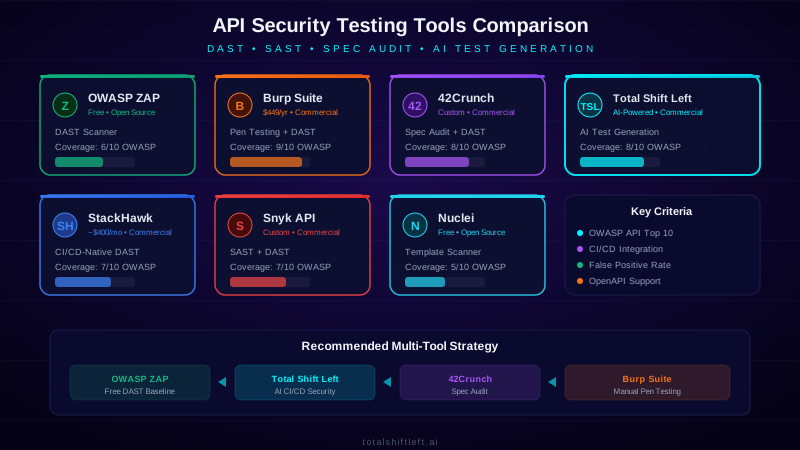
The best API security testing tool for your team in 2026 depends on whether you need shift-left scanning in CI (StackHawk or Total Shift Left), expert-driven penetration testing (Burp Suite Professional), or specification auditing (42Crunch). Mature programs use a layered stack: OWASP ZAP for free baseline DAST, a specialised commercial tool for CI integration, and periodic manual pen testing.
Reviewed by Sushant Joshi

API security testing tools are software platforms that automatically detect security vulnerabilities in APIs through dynamic scanning, specification auditing, and automated test generation. The best tools for 2026 combine OWASP API Top 10 coverage, CI/CD integration, OpenAPI specification awareness, and low false-positive rates to enable continuous API security validation throughout the development lifecycle.
The API security testing tools market has exploded. In 2025, over 40 tools claimed API security testing capabilities, ranging from open-source scanners to enterprise platforms costing six figures annually. For engineering and security teams, this abundance creates a paradox of choice — more options, but less clarity about which tools actually deliver results for their specific needs.
The stakes of choosing poorly are real. A tool that generates excessive false positives wastes developer time and erodes trust in the security process. A tool that misses critical vulnerability categories gives a false sense of security. A tool that cannot integrate into your CI/CD pipeline becomes shelfware that gets run quarterly instead of continuously. According to industry research, 60% of organizations report that their API security tools fail to detect the vulnerabilities that actually cause breaches.
This comparison guide evaluates the leading API security testing tools for 2026 across the criteria that matter: vulnerability detection accuracy, OWASP API Top 10 coverage, CI/CD integration depth, false positive rates, and total cost of ownership. Whether you are building your first API security program or replacing underperforming tools, this guide provides the data to make an informed decision — aligned with the shift-left testing philosophy of integrating security into the development workflow, not bolting it on afterward.
In this guide
- What Are API Security Testing Tools?
- Why Choosing the Right Tool Matters
- Key Evaluation Criteria
- How API Security Testing Tools Work
- The API Security Testing Tool Market
- API security testing tools compared
- API security testing tools in practice: a worked example
- API security testing tools challenges and how to solve them
- API security testing tools best practices
- API security testing tools checklist
- How to evaluate API security testing tools
- What each tool looks like on the command line
- API security testing tools FAQ
What Are API Security Testing Tools?
API security testing tools are software platforms designed to identify security vulnerabilities in APIs through automated analysis. They fall into several categories based on their testing methodology:
DAST (Dynamic Application Security Testing) tools test running APIs by sending HTTP requests with malicious payloads and analyzing responses. They simulate attacker behavior by injecting SQL, XSS, and other payloads into API parameters, testing authentication bypass techniques, and probing for data exposure. OWASP ZAP and Burp Suite are the most well-known DAST tools.
API Specification Auditing tools analyze OpenAPI, Swagger, or GraphQL schemas for security misconfigurations without sending any requests. They detect overly permissive schemas, missing authentication requirements, excessive data exposure in response definitions, and insecure default configurations. 42Crunch pioneered this approach with their API Firewall and Audit capabilities.
AI-Powered Test Generation tools use machine learning to automatically generate security test cases from API specifications. They create comprehensive test suites covering positive, negative, and security scenarios based on the API's specific endpoints, parameters, and data types. Total Shift Left represents this category, turning an OpenAPI or Swagger spec into a full security-focused test suite without manual authoring.
How Total Shift Left does this: Generated tests include severity-rated negative and edge-case scenarios — injection payloads (SQL injection, XSS, path traversal) in string parameters, boundary violations, and other security-sensitive inputs — derived directly from your OpenAPI spec's schema constraints, not from a separate DAST scan. For regulated teams, this generation can run against a self-hosted LLM (Ollama, LM Studio, or vLLM) so specs and prompts never leave your infrastructure.
Composite Tools combine multiple approaches. Modern platforms increasingly merge DAST scanning with specification analysis, adding CI/CD pipeline integration and developer-friendly reporting. The trend is toward all-in-one platforms that cover the complete API security testing lifecycle.
For the token-level cases, see JWT testing.
Why Choosing the Right Tool Matters
Detection Accuracy Varies Dramatically
Independent benchmarks show that API security testing tools detect between 25% and 85% of OWASP API Top 10 vulnerabilities. A tool that misses Broken Object Level Authorization (the #1 API vulnerability) provides incomplete protection regardless of how well it detects injection attacks. Your tool choice directly determines your vulnerability coverage.
Developer Adoption Depends on Integration
The most accurate security tool is worthless if developers do not use it. Tools that require separate logins, manual configuration, or context-switching away from the development workflow see adoption rates below 30%. Tools that integrate natively into CI/CD pipelines and provide results within pull requests achieve adoption rates above 80%.
False Positive Rates Impact Productivity
A tool with a 40% false positive rate on an API with 100 endpoints generates dozens of invalid alerts per scan. Development teams quickly learn to ignore security findings, creating alert fatigue that causes real vulnerabilities to be dismissed. The best tools maintain false positive rates below 10% through specification-aware analysis.
Total Cost of Ownership Includes Hidden Costs
The sticker price of a security tool is only part of the cost. Factor in setup and configuration time, ongoing maintenance, training for developers and security teams, time spent triaging false positives, and integration engineering for your specific CI/CD pipeline. A $5,000/year tool that requires 200 hours of annual maintenance costs more than a $15,000/year tool that is self-configuring.
Key Evaluation Criteria
OWASP API Top 10 Coverage
The OWASP API Security Top 10 is the industry-standard framework for API vulnerabilities. Evaluate each tool against all ten categories: Broken Object Level Authorization (BOLA), Broken Authentication, Broken Object Property Level Authorization, Unrestricted Resource Consumption, Broken Function Level Authorization, Unrestricted Access to Sensitive Business Flows, Server Side Request Forgery, Security Misconfiguration, Improper Inventory Management, and Unsafe Consumption of APIs.
CI/CD Integration Depth
Surface-level CI/CD integration (running a CLI command) is different from deep integration (blocking pull requests, annotating code, tracking vulnerability trends). Evaluate how the tool reports findings, whether it supports quality gates that block deployments, and how it handles false positive management within the developer workflow.
API Specification Support
Tools that understand your OpenAPI specification generate more targeted tests with fewer false positives. Evaluate support for OpenAPI 3.0/3.1, Swagger 2.0, GraphQL schemas, gRPC proto files, and the ability to discover undocumented endpoints that are not in the specification.
Authentication Support
APIs use diverse authentication mechanisms: API keys, OAuth 2.0, JWT, mTLS, custom headers, and multi-factor authentication. Evaluate whether the tool can handle your specific authentication flow, including token refresh, multi-step authentication, and testing across different authorization roles.
Reporting and Remediation Guidance
Raw vulnerability findings without remediation guidance create work without direction. Evaluate the quality of remediation recommendations, whether reports include code-level fix suggestions, compliance mapping (PCI DSS, SOC 2, HIPAA), and executive summary capabilities for non-technical stakeholders.
Scalability
An API portfolio grows over time. Evaluate how the tool handles 10 APIs vs. 500 APIs, whether pricing scales linearly or offers volume discounts, and whether scan times remain reasonable as the number of endpoints increases.
How API Security Testing Tools Work
API security testing tools follow a common workflow with variations based on their testing methodology. The process begins with API discovery — the tool ingests your OpenAPI specification, crawls a running API, or imports a Postman collection to build a map of all endpoints, parameters, and authentication requirements.
Next, the tool generates test cases based on its vulnerability database. A DAST tool creates requests with injection payloads (SQL injection, command injection, XSS), authentication bypass attempts (missing tokens, expired tokens, tokens from other users), and authorization testing (accessing resources belonging to other users). A specification auditing tool analyzes the schema for security anti-patterns without generating runtime requests.
The test execution phase sends these requests to the target API and analyzes responses. The tool looks for indicators of vulnerability: SQL error messages in responses (indicating injection), successful access to other users' resources (indicating BOLA), sensitive data i
Ready to shift left with your API testing?
Try our no-code API test automation platform free. Generate tests from OpenAPI, run in CI/CD, and scale quality.
n responses that should be filtered, and missing security headers.
Results are classified by severity, deduplicated, and filtered against false positive rules. The most advanced tools correlate findings across multiple test cases — for example, confirming that a suspected injection vulnerability is actually exploitable rather than just triggering an error message. Results are then reported through the configured channels: CI/CD pipeline results, dashboard, JIRA tickets, or Slack notifications.
The key differentiator between tools is the sophistication of each step. Basic tools generate generic payloads and rely on simple pattern matching. Advanced tools generate context-aware payloads based on the specific parameter type and use multi-step verification to confirm exploitability before reporting a finding.
The API Security Testing Tool Market
The market splits into four categories, and most enterprise buyers end up owning tools from at least two of them rather than picking a single winner:
- DAST scanners (OWASP ZAP, StackHawk, Qualys API Security) — probe a running API with live requests, the closest analog to how an attacker actually operates.
- Spec/design-time auditors (42Crunch, Spectral) — analyze the OpenAPI spec itself before a single request is sent, catching missing auth schemes or overly permissive schemas at design time.
- Manual/expert-driven platforms (Burp Suite Professional) — the deepest coverage, bounded by analyst hours rather than automation, and still the standard for pre-release penetration tests in regulated industries.
- API-testing-platform-native security (Total Shift Left, Snyk API) — security checks generated alongside functional tests from the same OpenAPI spec, trading some scanner-specific depth for zero extra tooling and native CI gating.
The trend shaping purchasing in 2026 is consolidation: teams that ran a DAST scanner, a separate spec linter, and a separate functional-testing platform are increasingly collapsing two of the three into one tool, because the maintenance and false-positive-triage overhead of three disconnected security surfaces outweighs any single tool's marginal coverage advantage.
API security testing tools compared
| Tool | Type | OWASP API Top 10 Coverage | CI/CD Integration | False Positive Rate | Open Source | Pricing |
|---|---|---|---|---|---|---|
| OWASP ZAP | DAST | 6/10 | CLI + Docker | Medium-High | Yes | Free |
| Burp Suite Pro | DAST + Manual | 9/10 | Limited | Low | No | ~$449/user/yr |
| 42Crunch | Spec Audit + DAST | 8/10 | Native | Low | No | Custom |
| StackHawk | DAST | 7/10 | Native (excellent) | Medium | No | ~$400/mo |
| Snyk API | SAST + DAST | 7/10 | Native | Medium | No | Custom |
| Total Shift Left | AI Test Gen | 8/10 | Native | Low | No | Competitive |
| Nuclei | Template Scanner | 5/10 | CLI | Medium | Yes | Free |
| Postman | API Testing | 4/10 | Newman CLI | Low | Partial | Free-$49/mo |
| Qualys API Security | DAST | 7/10 | API-based | Medium | No | Custom |
| Akto | API Discovery + DAST | 7/10 | Native | Medium | Partial | Free-Custom |
Best for manual penetration testing: Burp Suite Professional offers the deepest manual testing capabilities with its Intruder, Repeater, and Scanner modules specifically tuned for API testing.
Best free option: OWASP ZAP provides solid DAST capabilities at zero cost, making it ideal for teams starting their API security testing journey.
Best for CI/CD-native testing: StackHawk and Total Shift Left are purpose-built for developer workflows with native pipeline integration and pull request annotations.
Best for specification-first security: 42Crunch excels at auditing OpenAPI specifications and enforcing security standards before any code is written.
API security testing tools in practice: a worked example
Problem: A mid-sized healthcare company with 150 API endpoints used only OWASP ZAP for security testing, running manual scans quarterly. The scans produced 300+ findings per run, with an estimated 45% false positive rate. The security team spent two weeks per quarter triaging results, and developers had lost confidence in the findings. Meanwhile, a compliance audit revealed that their API security testing did not adequately cover BOLA vulnerabilities — the top OWASP API risk — because ZAP's automated mode struggled with their complex OAuth 2.0 authentication flow.
Solution: The company implemented a multi-tool strategy. They kept OWASP ZAP for broad DAST coverage but added Total Shift Left for AI-powered test generation from their OpenAPI specifications, which natively handled their OAuth 2.0 flow and generated BOLA-specific tests for every endpoint. They integrated both tools into their GitHub Actions CI/CD pipeline, with Total Shift Left running on every PR and ZAP running nightly. They also engaged Burp Suite Professional for quarterly manual penetration testing focused on business logic.
Results: Combined false positive rate dropped from 45% to 8%. OWASP API Top 10 coverage increased from 6/10 to 9/10 categories. Developer trust in security findings improved dramatically — 82% of findings were now remediated within the sprint, up from 23%. The compliance audit passed with the multi-layered testing evidence. Total tool spend increased by $12,000/year, but the time saved on false positive triage alone recovered that cost within two months.
API security testing tools challenges and how to solve them
Challenge: Tool Sprawl
Teams accumulate multiple security tools over time, each covering partial functionality. The result is overlapping coverage in some areas, gaps in others, and no single source of truth for API security posture. Solution: Map your tools against the OWASP API Top 10 to identify overlaps and gaps. Consolidate where possible, keeping tools that are best-in-class for their specific category rather than maintaining mediocre tools that partially overlap.
Challenge: Authentication Configuration
Most API security tools struggle with complex authentication — multi-step OAuth 2.0 flows, JWT with rotating keys, mTLS, and custom authentication headers. Misconfigured authentication causes the tool to test unauthenticated access rather than authenticated API behavior. Solution: Choose tools that natively support your authentication mechanism. Test the authentication configuration separately before running full security scans. Use tools that accept pre-configured authentication tokens if dynamic authentication setup is too complex.
Challenge: GraphQL and gRPC Support
Many API security tools were built for REST APIs and have limited support for GraphQL and gRPC. GraphQL's single-endpoint architecture and introspection system require different testing approaches than REST. Solution: Evaluate GraphQL and gRPC support specifically if your API portfolio includes these technologies. Tools like Burp Suite and 42Crunch have improved their GraphQL support significantly. For gRPC, consider tools that support proto file ingestion.
Challenge: Keeping Up with New Vulnerability Types
The threat landscape evolves faster than most tools update their vulnerability databases. New attack techniques like Server-Side Request Forgery (SSRF) via API parameters and GraphQL query complexity attacks emerged recently and are not covered by all tools. Solution: Supplement automated scanning with periodic manual testing using updated penetration testing techniques. Evaluate how frequently each tool updates its vulnerability rules and whether it covers the latest API vulnerabilities.
Challenge: Developer-Friendly Reporting
Security tools traditionally report findings in security terminology that developers do not understand or act on. A finding titled "CWE-89: SQL Injection" without context does not help a developer fix the issue. Solution: Prioritize tools that provide code-level remediation guidance, map findings to specific API endpoints and parameters, and integrate into developer workflows (IDE plugins, PR comments, JIRA integration).
API security testing tools best practices
- Use a multi-tool strategy — No single tool covers all API security testing needs. Combine a DAST scanner, a specification auditing tool, and periodic manual penetration testing for complete coverage.
- Prioritize CI/CD integration — Choose tools that integrate natively into your development pipeline over tools with better features but manual-only workflows. Continuous testing beats quarterly scanning.
- Evaluate with your actual APIs — Run proof-of-concept evaluations against your real API specifications and endpoints. Detection rates vary significantly based on API complexity and authentication mechanisms.
- Measure false positive rates — Track the percentage of findings that are false positives for each tool. A tool generating 50% false positives costs more in triage time than it saves in vulnerability detection.
- Map coverage to OWASP API Top 10 — Document which tools cover which OWASP categories. Ensure every category has at least one tool providing coverage, especially BOLA (#1) and Broken Authentication (#2).
- Automate triage workflows — Configure tools to auto-close known false positives, auto-assign findings to the right team based on the affected API, and integrate with your issue tracker.
- Budget for training — Allocate time for developers and security engineers to learn each tool. An underutilized tool provides less value than a simpler tool used consistently.
- Review tool effectiveness quarterly — Track vulnerability escape rate (vulns found in production that tools should have caught) to measure whether your tool stack is actually effective.
- Start with free tools, then upgrade — Begin with OWASP ZAP and Nuclei to establish baselines, then invest in commercial tools to close specific coverage gaps.
- Keep specifications up to date — Tools that rely on OpenAPI specifications produce the best results when specs are accurate and complete. Invest in spec hygiene to improve tool effectiveness.
Free PDF guide (12 pages)
Top 50 API Testing Mistakes
50 real-world API testing mistakes organized by category — from authentication to performance — each with a concrete fix strategy.
Download FreeAPI security testing tools checklist
- ✔ API security testing tools mapped against OWASP API Top 10 categories
- ✔ At least one DAST tool integrated into CI/CD pipeline
- ✔ Authentication configuration tested and verified for each tool
- ✔ False positive rate measured and tracked for each tool
- ✔ Specification auditing tool validates OpenAPI specs before deployment
- ✔ Manual penetration testing tool available for periodic deep assessments
- ✔ Tool findings integrated with issue tracker (JIRA, Linear, GitHub Issues)
- ✔ Quality gates configured to block deployments on critical findings
- ✔ Coverage gap analysis documented across tool portfolio
- ✔ Developer training completed for all security testing tools
- ✔ Tool evaluation criteria documented for future tool procurement
- ✔ Quarterly tool effectiveness review scheduled
See also: jwt authentication in our learn hub for the underlying concept.
How to evaluate API security testing tools
Picking from the matrix above is the easy half. The harder half is running an evaluation that survives procurement — which needs explicit dimensions, explicit weights, and disqualifiers applied before anyone books a demo.
The twelve evaluation dimensions
A complete API security testing evaluation in 2026 covers twelve dimensions. Not every dimension is critical for every buyer, but every dimension should be deliberately scored — including the ones you decide to weight at zero.
| # | Dimension | Why it matters |
|---|---|---|
| 1 | OWASP API Top 10 coverage depth | The minimum bar for credible security testing |
| 2 | Authentication & authorization testing | Most production breaches start here |
| 3 | AI test generation quality | Productivity multiplier; depth varies hugely between vendors |
| 4 | Multi-protocol coverage (REST/SOAP/GraphQL) | Realistic enterprise integration surface |
| 5 | CI/CD integration depth | Tests that don't run in CI don't test anything |
| 6 | Deployment posture (SaaS / on-prem / air-gapped) | Often the disqualifier for regulated buyers |
| 7 | AI inference path (cloud / self-hosted) | Most common AI-policy review issue |
| 8 | Data residency control | GDPR / Schrems II / sovereign-cloud fit |
| 9 | RBAC and audit logging | Required for any in-scope authorization |
| 10 | Evidence retention and export | Audit-readiness; Type II SOC 2; FedRAMP CA-7 |
| 11 | Vendor support model | Time-to-resolution on production-impacting issues |
| 12 | Total cost of ownership | License + ops + integration + procurement |
A buyer's guide isn't a ranking. It's a framework that produces your ranking based on your weights.
Weighted scoring framework
A practical weighting pattern for regulated enterprise buyers in 2026:
| Dimension | Weight (regulated) | Weight (non-regulated) |
|---|---|---|
| Deployment posture | 15% | 5% |
| AI inference path | 12% | 4% |
| OWASP API Top 10 coverage | 10% | 12% |
| Authentication / authorization testing | 10% | 10% |
| CI/CD integration | 9% | 14% |
| AI test generation quality | 8% | 12% |
| Multi-protocol coverage | 8% | 6% |
| RBAC + audit logging | 7% | 8% |
| Data residency control | 7% | 4% |
| Evidence retention / export | 6% | 8% |
| Vendor support | 4% | 8% |
| TCO | 4% | 9% |
Weights vary substantially by industry. A bank weights deployment posture differently than a B2B SaaS startup. The point is to make the weights explicit and reviewed by stakeholders before scoring vendors — not to argue about scoring after the fact.
Disqualifier dimensions
Three dimensions can disqualify a vendor regardless of how strong they score elsewhere:
Deployment posture for regulated buyers. A SaaS-only tool with no on-prem or self-hosted option is almost always disqualified by procurement at regulated organizations — look for a tool that can run tests entirely behind your firewall. Don't waste deep evaluation cycles on tools that fail this gate.
AI inference path for AI-policy-reviewed buyers. A tool that can only generate tests via a cloud LLM API will fail AI policy review. The fallback question is whether the tool supports self-hosted LLM as a first-class option or as a workaround.
Audit evidence for regulated buyers. A tool that doesn't produce queryable, exportable, retainable run reports cannot demonstrate the controls required for SOC 2 Type II, FedRAMP CA-7, HIPAA evaluation, or PCI-DSS Requirement 11.
If a vendor fails any of the three for your specific posture, score them out before deep evaluation. It saves weeks.
Vendor questions worth asking
Five questions that separate marketing from operational reality:
"Can we run this without any outbound network connections from your platform?" Answers vary from "yes, fully air-gapped" to "the platform itself is on-prem but it phones home for license and updates." Map the answer against your air-gap requirement.
"What happens if your hosted LLM endpoint is unreachable?" The right answer is "we fail closed and surface an error." Wrong answers include "we fall back to OpenAI" or "we cache and retry with telemetry." This is the AI-policy review answer.
"Show me the network connections during a test run." Vendors that can produce this clearly are usually clean. Vendors that struggle have undocumented data flows.
"What's your roadmap for SOC 2 / FedRAMP / your compliance need?" Get a year-honest answer. Soft commitments slip; written ones less often.
"Who is on the support escalation path and where are they located?" Material for data-residency requirements (Schrems II), SLA evaluation, and time-zone fit.
Common evaluation pitfalls
Three patterns that lead to bad enterprise buys:
Listicle anchoring. Starting evaluation from a third-party "best tools" list usually skips the disqualifiers. The list-author's weights aren't yours.
Demo-driven decisions. Vendor demos optimize for visual impact. Six months of operation, integration with your CI, and sustainable test maintenance look very different.
Underweighting the AI inference path. In 2024 this was a footnote. In 2026 it's often the #1 procurement-blocking dimension. Score it explicitly.
For complementary content see the API security testing tools comparison and on-prem API testing platforms buyer checklist.
What each tool looks like on the command line
The categories are easier to tell apart from their invocations than from their marketing. A DAST scanner crawls a running target:
# DAST — scans a deployed API, spec-guided
docker run --rm -t ghcr.io/zaproxy/zaproxy:stable zap-api-scan.py \
  -t https://staging.example.com/openapi.yaml -f openapi -r zap-report.html

# spec-conformance / fuzzing — derives cases from the contract itself
schemathesis run openapi.yaml --url https://staging.example.com --checks all

# static API audit — scores the spec before anything is deployed
docker run --rm -v "$PWD:/w" 42crunch/scan:latest audit /w/openapi.yaml
Only the first needs a running environment, only the second needs an accurate spec, and only the third runs on a pull request that has not been deployed yet — which is why most mature programmes run all three at different pipeline stages.
API security testing tools FAQ
What is the best API security testing tool in 2026?
The best API security testing tool depends on your use case. OWASP ZAP is the best free option with solid DAST capabilities. Burp Suite Professional is the gold standard for manual penetration testing. For CI/CD integration, StackHawk and Total Shift Left lead the market. 42Crunch excels at OpenAPI specification auditing. Most mature teams use a combination of tools for complete coverage.
Is OWASP ZAP good enough for API security testing?
OWASP ZAP is excellent for basic DAST scanning and is free, making it a strong starting point. However, it has limitations for API-specific testing: it requires manual configuration for API endpoints, has limited support for complex authentication flows, and produces more false positives than commercial alternatives. For comprehensive API security testing, complement ZAP with tools that understand OpenAPI specifications natively.
What is the difference between DAST and SAST for API security?
DAST (Dynamic Application Security Testing) tests running APIs by sending real HTTP requests and analyzing responses for vulnerabilities. SAST (Static Application Security Testing) analyzes source code or API specifications without running the application. DAST finds runtime vulnerabilities like injection and broken authentication. SAST finds code-level issues like hardcoded secrets and insecure patterns. Both are needed for complete API security.
How much do API security testing tools cost?
API security testing tools range from free (OWASP ZAP, Nuclei) to $50,000+ per year for enterprise platforms. Burp Suite Professional costs approximately $449/user/year. StackHawk starts around $400/month. 42Crunch and Snyk API pricing varies by API count and features. Total Shift Left offers competitive pricing with AI-powered test generation. Most commercial tools offer free tiers or trials for evaluation.
Can API security testing tools replace manual penetration testing?
No. Automated API security testing tools excel at finding known vulnerability patterns (OWASP Top 10, injection, broken auth) consistently and at scale. However, they cannot discover business logic flaws, complex chained attacks, or novel vulnerability types that require human creativity. Use automated tools for continuous scanning and manual penetration testing for periodic deep analysis.
Which API security testing tools integrate with CI/CD pipelines?
StackHawk, Total Shift Left, 42Crunch, OWASP ZAP (via Docker/CLI), Snyk API, and Nuclei all offer CI/CD integration. StackHawk and Total Shift Left are purpose-built for CI/CD with native GitHub Actions, GitLab CI, and Jenkins plugins. OWASP ZAP requires more configuration but works in any pipeline via its Docker image and CLI.
Sources and further reading
- OWASP API Security Top 10 (2023) — the reference list of API risk categories.
- OWASP ZAP documentation — the open-source DAST scanner.
- 42Crunch documentation — OpenAPI-driven API security auditing and conformance scanning.
Key takeaways
- Choosing the right API security testing tools is not about finding a single perfect solution — it is about assembling a tool portfolio that provides complete OWASP API Top 10 coverage, integrates into your development workflow, and maintains developer trust through low false positive rates.
- The best API security programs combine automated CI/CD-integrated scanning for continuous coverage with periodic manual penetration testing for deep adversarial analysis, all guided by accurate OpenAPI specifications.
Ready to add AI-powered API security test generation to your tool portfolio? Start your free trial of Total Shift Left and see how automated security tests generated from your API specifications compare to your current tooling.
Related: API Testing: The Complete Guide | API Penetration Testing vs Security Testing | Common API Security Vulnerabilities | API Security Testing in CI/CD | Top API Testing Tools 2026 | REST API Testing Best Practices
For regulated teams: see the enterprise API security testing buyer's guide, the platform security & trust center, and how procurement evaluates self-hosted vs SaaS deployment.
Ready to shift left with your API testing?
Try our no-code API test automation platform free.