
Risk-Based Test Selection in Enterprise CI/CD (2026)
Quick answer
Risk-based test selection runs only the tests relevant to a given change at PR stage — driven by code-change impact analysis, a risk-weighted always-run set for high-blast-radius surfaces like auth and payments, and AI ranking as a tie-breaker — while the full suite still runs at integration. Enterprise pipelines with 10,000+ tests typically see PR-stage time drop 60-80% while losing less than 1% of regression detection, with documented selection rationale satisfying audit requirements.
Reviewed by Smeet Gohel
How enterprise teams use risk-based test selection to keep CI/CD fast without losing coverage. Code-change impact analysis, AI-driven selection, and the audit story that holds up when you don't run every test on every change.
In this guide
- What is risk-based test selection?
- The key components of risk-based test selection
- Why blanket execution doesn't scale
- The three selection signals
- Where selective testing fits
- Audit framing
- Implementation patterns
- Why risk-based test selection matters at enterprise scale
- Risk-based test selection tools compared
- Risk-based test selection in practice: a worked example
- Risk-based test selection reference architecture
- Risk-based test selection metrics that matter
- Risk-based test selection rollout playbook
- Risk-based test selection challenges and how to solve them
- Risk-based test selection best practices
- Risk-based test selection checklist
- Select the tests a change can actually break
What is risk-based test selection?
Risk-based test selection in enterprise CI/CD is the practice of running only the tests that matter for a given change at PR stage — driven by code-change impact analysis, risk weighting on high-blast-radius surfaces, and AI ranking on historical patterns — while running the full suite at integration. The pattern keeps PR feedback fast at enterprise scale (75% compute reduction is typical) without losing coverage, with audit defensibility coming from documented selection rationale per release.
Picking the runner first? Our comparison of continuous integration testing tools covers the CI systems, languages and licence models side by side.
When generation outruns review capacity, the gate has to move from reading diffs to verifying behaviour — testing AI-generated code covers the four checks that hold.
The key components of risk-based test selection
Each enterprise program in this area has the same load-bearing components, regardless of vendor. The components separate cleanly into governance, enforcement, and evidence layers.
Code-change impact analysis
Coverage data from previous test runs maps each test to the files it exercises. A change to payment-service.ts triggers the tests that previously hit that file. Tests that didn't touch any changed file get deferred to integration stage.
Risk-weighted always-run set
Tests covering high-risk surfaces (auth, payment, PII handling) always run at PR regardless of code-change impact. The risk weights are explicit policy maintained by the security or platform team — quarterly review cadence.
AI / ML ranking
Historical CI data feeding a model that ranks tests by predicted regression-detection probability for a given code change. Used as a tie-breaker among tests of similar predicted relevance, not as the sole decision.
Selection orchestrator
Combines impact + risk + AI ranking into a ranked test set per PR. Picks the top-ranked tests up to a time budget; defers the rest. Outputs the selection rationale for audit.
Full-suite at integration
Tests deferred at PR stage run at integration on merge. Selection only happens at PR; integration always runs the full suite. The pattern fast-feedbacks PR without losing total coverage.
Audit framing
Per-PR selection rationale retained for the audit window. The rationale documents what tests ran, what was deferred, and why — auditors evaluate principled selection but reject opaque skipping.
Why blanket execution doesn't scale
The naive pipeline runs every test on every change. At small scale this works. At enterprise scale — thousands of tests, hundreds of PRs per day — it produces three failure modes:
- PR latency. A 45-minute test suite means developers context-switch waiting for feedback, which is more expensive than the CI compute.
- Flake amplification. Running every test on every change means flaky tests fail somewhere on every change. Either the team disables flaky tests (losing real signal) or the team accepts retries (which doubles compute and still produces noise).
- Compute cost. At scale, CI compute becomes a measurable line item. Most of it is wasted re-running tests against code that didn't change.
The fix is not to write fewer tests. It's to select which tests run when, based on what changed and what's at risk.
The three selection signals
Three signals together drive most enterprise selection logic:
Code-change impact. Which tests cover code that changed in this PR? Code-coverage data from previous test runs maps each test to the files it exercises. A change to payment-service.ts triggers the tests that previously hit that file. Tests that didn't touch any changed file get deferred to integration stage.
Risk weighting. Tests covering high-risk surfaces (auth, payment, PII handling) always run, regardless of code-change impact. The risk weights are explicit policy — usually maintained by the security or platform team — so the audit story is "we always run the security baseline." Grouping these always-run tests into curated risk-weighted test packs keeps the selection set explicit and reviewable.
Historical signal. AI / ML ranking based on which tests historically caught regressions in similar changes. Useful as a tie-breaker among tests of similar predicted relevance. Not used as the sole decision because the historical data is noisy and changes break the model's assumptions.
The combination — impact + risk + history — produces a ranked test set per PR. The selection mechanism picks the top-ranked tests up to a time budget; the rest run at integration stage.
Ready to shift left with your API testing?
Try our no-code API test automation platform free. Generate tests from OpenAPI, run in CI/CD, and scale quality.
For background on risk weighting itself, see risk-based testing strategy for regulated industries.
Where selective testing fits
Selective testing fits at the PR stage of the CD pipeline (see API CD pipeline testing for enterprise) — the stage where developer feedback latency is the binding constraint.
It does not fit at later stages:
- Integration stage. Run the full suite. Compute is cheaper here than at PR; integration is where regressions in deferred tests get caught.
- Pre-prod stage. Run the full security and performance baseline. Risk-based selection at pre-prod is rarely worth the audit complexity.
- Production stage. Synthetic monitoring runs continuously by design.
The point is to fast-feedback the PR stage without losing coverage of the deferred tests over the full pipeline. Tests that don't run at PR still run at integration.
Audit framing
Auditors evaluate selective testing on two questions:
Is the selection mechanism principled? A documented logic — impact analysis + risk weighting + AI augmentation — is principled. Random sampling, time-based sampling, or "we run what's fast" is not. The mechanism has to be explainable.
Is the deferred coverage actually run? Tests skipped at PR have to run at integration or pre-prod, with retained evidence. A pipeline that skips tests at PR and never runs them anywhere is failing.
A defensible audit narrative:
"At PR stage, we run tests selected by code-change impact analysis plus a fixed risk-weighted set covering security, payment, and PII surfaces. The full test suite runs at integration stage on merge. Evidence of both is retained per release."
That narrative satisfies SOC 2 CC8.1 (manage changes), FedRAMP CM-3/CM-4 (configuration change control), and PCI-DSS Requirement 6 (secure development) for most auditors.
Implementation patterns
Three patterns for implementing selective testing:
Coverage-based selection. A coverage tool (Istanbul, Coverlet, etc.) records which tests touched which files. CI consults this map to select tests for a given PR diff. Most cost-effective; works for unit and integration tests. Less effective for end-to-end tests that touch many files.
Test-impact analysis tools. Commercial / open-source tools that integrate with the test runner to track and select. Lower setup cost than building it yourself; some lock-in.
AI-augmented selection. Layer historical-pattern ML ranking on top of coverage selection. Marginal improvement over pure coverage selection in most cases; highest value when test suites are large and code is structured in ways coverage alone misses.
In practice, most enterprises start with coverage-based selection, add risk weighting as policy, and consider AI augmentation only after the basics are working.
For complementary content on test automation strategy at scale, see test automation strategy.
Risk-based test selection in enterprise CI/CD isn't about cutting tests — it's about scheduling them. The pattern that works: principled selection at PR stage based on impact and risk, full coverage at integration stage, audit-friendly documentation of why the selection is defensible. Enterprise pipelines using this pattern stay fast at scale without losing coverage where it matters.
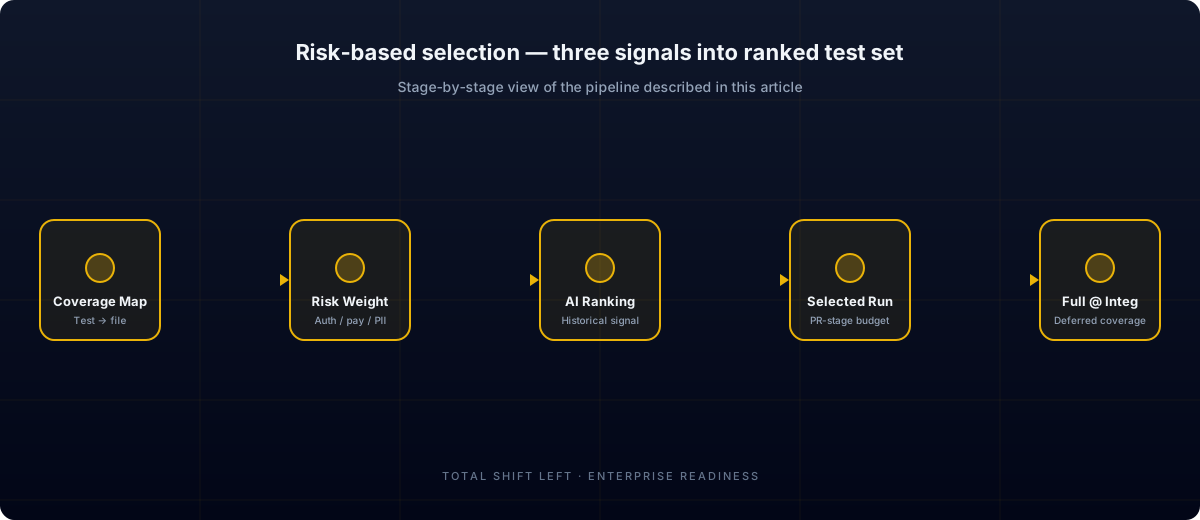
Risk-based test selection — impact + risk weight + AI ranking.
Why risk-based test selection matters at enterprise scale
Google's internal CI data published in their 2024 engineering productivity research showed that risk-based test selection reduced PR-stage compute by 75% while maintaining 99%+ regression detection — and dropped developer wait time by 60% with proportional productivity gains. The pattern is well-validated; what's held back enterprise adoption is audit-defensibility, which 2026 governance frameworks now address explicitly.
Risk-based test selection tools compared
A practical view of the tool categories that scale across enterprise testing programs in this area:
| Category | Example tools |
|---|---|
| Coverage-based selection | Jest projects, pytest-testmon, Mocha test-impact-analysis plugins |
| Commercial impact tools | Microsoft Test Impact Analysis, Launchable, Diffblue |
| AI ranking | Custom ML models on historical CI data; commercial vendors like Launchable |
| CI integration | GitHub Actions, GitLab CI, Jenkins with selection-aware build matrices |
| Audit evidence | Per-PR selection rationale retained; deferred-test execution logged |
Tool selection is secondary to architecture. The patterns above hold regardless of which specific vendor you adopt.
Risk-based test selection in practice: a worked example
A representative deployment pattern from an enterprise rollout in this area:
Problem. A B2B SaaS with a 12,000-test API suite saw PR feedback take 45 minutes. Developers context-switched constantly. Flake rate was 8%. CI compute was a top-10 line item.
Solution. The team adopted impact-based selection at PR (coverage-driven) plus a fixed risk-weighted set covering auth / payment / PII surfaces. Full suite ran at integration. AI ranking augmented selection as a tie-breaker.
Results. PR feedback dropped from 45 min to 9 min. Flake rate dropped to 1.2% (small set, less interaction). CI compute dropped 70% on PR pipelines. Regression escape rate was unchanged — the 1% missed at PR was caught at integration.
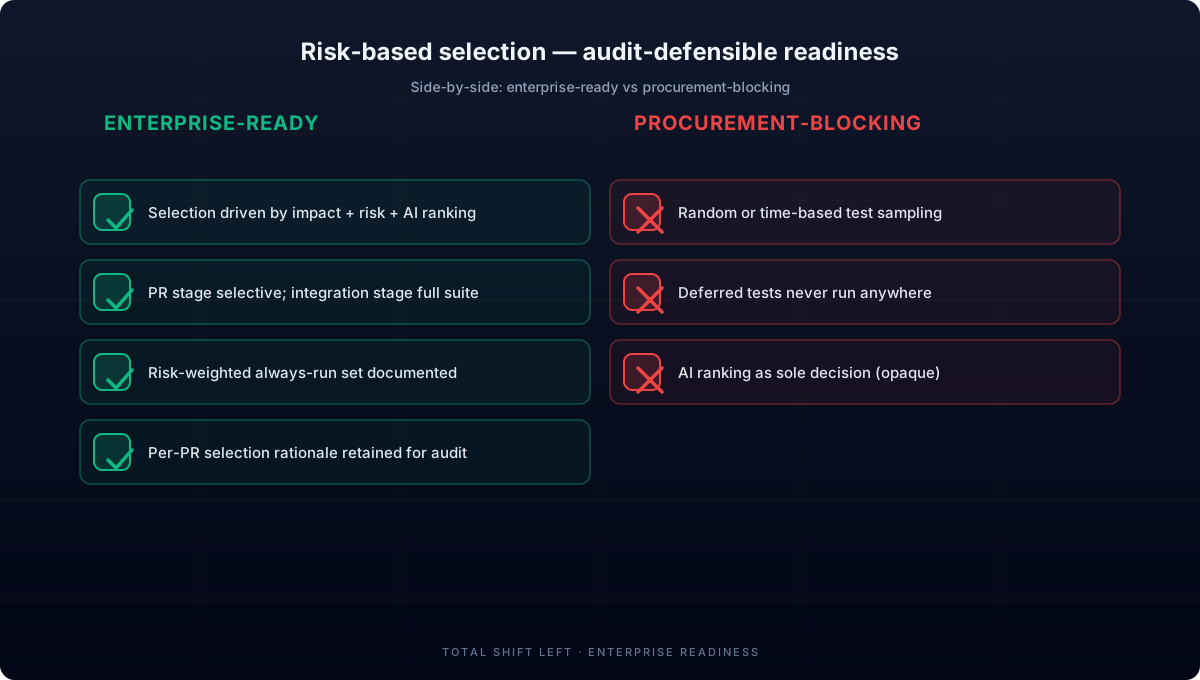
Risk-based selection — readiness checklist.
Risk-based test selection reference architecture
A three-signal selection architecture has four components. Coverage data — test-to-file mapping captured during full-suite runs. Updated incrementally on each test run. Risk-weight registry — declarative policy listing always-run tests for high-blast-radius surfaces (auth, payment, PII handling). Maintained by security and platform teams; reviewed quarterly. AI ranking layer — historical CI data feeding a model that ranks tests by predicted regression-detection probability for a given code change. Augments selection as a tie-breaker. Selection orchestrator — at PR stage, combines coverage-driven impact + risk weighting + AI ranking to produce a ranked test set. Picks the top-ranked up to a time budget; defers the rest to integration stage. The architecture is deliberately principled rather than opaque — auditors can trace any selection decision back to inputs.
Free YAML templates + guide
CI/CD Testing Pipeline Templates
Production-ready CI/CD pipeline templates for GitHub Actions and GitLab CI. Includes API testing, contract testing, and performance testing stages.
Download FreeRisk-based test selection metrics that matter
Three metrics establish selection health. PR feedback latency — minutes from PR open to gate decision — is the headline developer-productivity metric. Regression escape rate to integration — percentage of regressions detected at integration that selection should have caught at PR — is the quality safety net; should be low (<1%). Selection rationale completeness — percentage of PRs with documented selection rationale for audit — is the compliance-facing metric. Report to engineering and compliance leadership on quarterly cadence.
Risk-based test selection rollout playbook
Selection rollout takes 8-10 weeks. Weeks 1-2: coverage capture. Run full suite with coverage tracking. Build the test-to-file map. Weeks 3-4: risk registry. Define the always-run set. Sign off with security and platform teams. Weeks 5-6: orchestrator. Implement selection logic. Wire into CI at PR stage. Weeks 7-8: validation. Run shadow mode where the full suite still runs; compare selected set against full results. Tune. Weeks 9-10: production. Switch to selected set at PR with full suite at integration. Most enterprises reach steady state in 8-10 weeks with sub-1% miss rate.
Risk-based test selection challenges and how to solve them
Impact analysis requires coverage data that doesn't exist. Run a one-time coverage capture on the full suite; persist the test-to-file map. Update incrementally on each test run thereafter.
Auditors question selective testing. Document the selection rationale: impact + risk weighting + AI ranking. Auditors accept principled selection; what they reject is unprincipled skipping.
AI ranking introduces opacity. Use AI as an input, not as the sole decision. Audit trail cites the impact analysis primarily; AI augments tie-breaking among similar tests.
Risk weights drift as the system evolves. Review risk weights quarterly with security and platform teams. Don't set and forget.
Risk-based test selection best practices
- Use risk-based selection only at PR stage; full suite at integration
- Combine impact analysis + risk weighting + AI ranking; don't use any one alone
- Document the selection rationale per PR for audit
- Always run risk-weighted sets (auth, payment, PII) regardless of impact
- Review risk weights quarterly with security and platform teams
- Measure the 1% miss rate at integration; tune selection to keep it below threshold
- Verify deferred tests actually run at integration — never just skip
Risk-based test selection checklist
A pre-flight checklist enterprise teams can run against their current state:
- ✔ Coverage-driven impact analysis is operational
- ✔ Risk-weighted always-run set is defined and maintained
- ✔ AI ranking augments (not replaces) impact analysis
- ✔ Selection rationale is documented per PR
- ✔ Deferred tests run at integration with retained evidence
- ✔ Risk weights are reviewed quarterly
- ✔ 1% miss rate is monitored and tuned
- ✔ Audit framing for selective testing is documented
Take the next step. See how shift-left API testing platform applies these ideas to your workflow, or explore API testing in CI/CD for the broader picture.
See also: contract testing in our learn hub for the underlying concept.
Select the tests a change can actually break
Running the full suite on every commit is the default because selection is hard to get right. The safe version is coverage-based: map which tests execute which files, then run only the tests that touch what changed — with a periodic full run as the backstop:
# scripts/select_tests.py — coverage-map driven selection
import json, subprocess, sys

# coverage-map.json is produced by a nightly full run:
#   pytest --cov=app --cov-context=test && coverage json -o coverage-map.json
cov = json.load(open("coverage-map.json"))

base = sys.argv[1] if len(sys.argv) > 1 else "origin/main"
changed = subprocess.run(["git", "diff", "--name-only", base],
                         capture_output=True, text=True).stdout.split()

selected = set()
for path, data in cov["files"].items():
    if path not in changed:
        continue
    for contexts in data.get("contexts", {}).values():
        selected.update(c.split("|")[0] for c in contexts if c)

# always re-run anything touching the contract or the auth layer
if any(f in changed for f in ("openapi.yaml", "app/auth.py")):
    selected.update(["tests/contract", "tests/test_authorization.py"])

print(" ".join(sorted(selected)) or "tests/smoke")
Gate the shortcut on the branch, so main and the nightly build always run everything and the selection can only ever shorten a pull request:
# .github/workflows/tests.yml
- name: Select and run
  run: |
    if [ "${{ github.ref }}" = "refs/heads/main" ] || [ "${{ github.event_name }}" = "schedule" ]; then
      pytest            # full suite: the safety net that keeps the map honest
    else
      pytest $(python scripts/select_tests.py origin/${{ github.base_ref }})
    fi
Sources and further reading
- Google Testing Blog — Google's engineering write-ups on test sizing and flakiness.
- DORA State of DevOps research — the multi-year dataset behind the four delivery metrics.
- GitHub Actions documentation — workflow syntax, caching and matrix builds.
Key takeaways
- Risk-based test selection in enterprise CI/CD isn't about cutting tests — it's about scheduling them.
- The pattern that works: principled selection at PR stage based on impact and risk, full coverage at integration stage, audit-friendly documentation of why the selection is defensible.
- Enterprise pipelines using this pattern stay fast at scale without losing coverage where it matters.
Risk-based test selection FAQ
Isn't selective testing risky? What about regressions in unselected tests?
It depends entirely on the selection mechanism. Random or time-based selection is risky. Selection driven by code-change impact analysis (which tests cover code that changed) plus risk weighting (which tests cover the highest-blast-radius endpoints) catches the regressions that matter while leaving cheap-to-rerun edge tests for the integration stage.
How do auditors react to selective testing?
Better than to slow pipelines. The audit question is "did the change have appropriate validation before release?" — not "did every test in the suite run on this PR?" A documented selection rationale, retained per release, satisfies the audit story.
What's the actual time savings?
Material at scale. Enterprise pipelines that run 10,000+ tests on every PR commonly see PR-stage time drop 60-80% with impact-driven selection while losing < 1% of regression detection. The integration stage still runs the full suite.
How does AI factor in?
AI ranks tests by predicted regression-detection probability for a given code change, augmenting impact analysis with historical patterns ("when files in this directory change, these tests commonly fail"). Used as input to selection, not as the sole decision; the audit trail still cites the impact analysis.
Ready to shift left with your API testing?
Try our no-code API test automation platform free.