
Risk-Based Testing: Strategy, Matrix & Examples (2026)
Quick answer
Risk-based testing prioritizes test effort by the probability and impact of failure, rather than testing every feature equally. Its main advantage is concentrating limited testing time where defects would be most costly; its main disadvantage is that a flawed risk assessment creates a false sense of coverage in the areas rated low-risk. It works best layered on top of automated regression coverage, not as a replacement for it.
Reviewed by Parveen Kumari

Risk-based testing is a systematic approach that prioritizes test activities based on the likelihood and business impact of failures. It allocates the most testing effort to components with the highest risk—those where defects are most likely to occur and where the consequences of failure are most severe—ensuring that limited testing resources deliver maximum defect detection value.
Every engineering team operates under constraints. There is never enough time, budget, or people to test everything exhaustively. The organizations that achieve the highest quality are not those that test the most—they are those that test the smartest. Risk-based testing is the methodology that makes smart testing possible, and teams that adopt it report finding 60% more critical defects with 30% less testing effort.
Traditional testing strategies treat all parts of an application equally. Every feature gets the same level of test coverage, every module receives the same attention, and every test carries the same weight in the pass/fail decision. This egalitarian approach sounds fair, but it is deeply wasteful. The login authentication system that handles credit card data does not deserve the same testing intensity as the about page that displays static text.
Research from Capers Jones consistently shows that 80% of production defects originate from 20% of application modules. The distribution is not random—defects cluster in areas of high complexity, frequent change, poor documentation, and team unfamiliarity. A risk-based testing strategy exploits this clustering by concentrating testing effort where defects are most likely to exist and most damaging when they escape.
This guide walks through the complete process of implementing a risk-based testing strategy: from risk identification and assessment to test prioritization and continuous recalibration. It is designed for QA leads, engineering managers, and test architects who want to maximize the defect detection power of their testing investment. If you have already built a software testing strategy, risk-based prioritization is the optimization layer that makes it efficient. For teams operating at enterprise scale, this approach integrates directly with an enterprise testing strategy.
In this guide
- What Is Risk-Based Testing?
- Why Risk-Based Testing Matters
- Advantages and Disadvantages of Risk-Based Testing
- Key Components of a Risk-Based Testing Strategy
- Risk Assessment Architecture
- Tools for Risk-Based Testing
- Risk-based testing in practice: a worked example
- Risk-based testing challenges and how to solve them
- Risk-based testing best practices
- Risk-Based Testing Checklist
- Score the risk, then let the score choose the depth
- Risk-based testing FAQ
Once the risk ranking exists, how to write API test cases turns it into cases: which endpoints deserve six and which deserve one, and the boundary and authorization examples worth writing first.
What Is Risk-Based Testing?
Risk-based testing is a testing methodology that uses risk analysis to guide the allocation of testing effort. It is built on a simple formula:
Risk = Likelihood of Failure x Impact of Failure
For every component, feature, or integration point in your application, you assess two dimensions:
- Likelihood: How probable is it that a defect exists here? Factors include code complexity, change frequency, developer experience with the module, dependency count, and historical defect density.
- Impact: If a defect escapes to production, how severe are the consequences? Factors include business revenue impact, user data exposure, regulatory compliance violations, user trust damage, and operational disruption.
Components scoring high on both dimensions receive the most intensive testing—comprehensive automated suites, manual exploratory testing, performance validation, and security scanning. Components scoring low on both dimensions receive minimal testing—perhaps only basic smoke tests and monitoring in production.
Risk-based testing is not about testing less. It is about testing differently. The total testing effort may stay the same or even increase, but it is redistributed from low-value activities to high-value ones. The result is more defects caught before production, fewer escaped defects in critical areas, and a testing team that can articulate exactly why they are testing what they are testing.
This approach aligns naturally with shift-left testing principles because it frontloads testing effort on the components most likely to cause problems, catching critical defects earlier in the development cycle.
Regulated programmes usually need the mapping written down as well as run — the requirements traceability matrix for API testing shows how to generate it from tagged tests instead of a spreadsheet.
For where each test level starts and stops, see unit vs integration vs system testing.
Why Risk-Based Testing Matters
Resource Optimization Under Constraints
No organization has unlimited testing capacity. Even large enterprises with dedicated QA teams must make trade-offs about where to invest their testing effort. Risk-based testing provides a defensible, data-driven framework for making these trade-offs. When a stakeholder asks why a particular feature was not tested more thoroughly, you can point to the risk assessment that allocated effort to higher-priority areas.
Faster Release Cycles Without Quality Sacrifice
Teams moving to continuous deployment cannot afford to run exhaustive test suites on every commit. Risk-based testing enables selective test execution: run all tests for high-risk changes, run a targeted subset for medium-risk changes, and run only smoke tests for low-risk changes. This dramatically reduces pipeline execution time while maintaining confidence in critical areas.
Alignment Between Testing and Business Value
Traditional testing metrics—code coverage, test count, pass rate—measure testing activity without connecting it to business value. Risk-based testing links testing effort directly to business risk, making quality conversations meaningful to product owners, executives, and stakeholders who care about outcomes rather than activities.
Regulatory and Compliance Alignment
Regulated industries require organizations to demonstrate that they have assessed and mitigated quality risks. A documented risk-based testing strategy provides the evidence auditors need: risk assessments, prioritized test plans, and traceability from business risks to specific test activities.
Advantages and Disadvantages of Risk-Based Testing
Advantages:
- Concentrates limited effort where it pays off most. No team has unlimited testing capacity; risk-based testing puts that capacity against the failures that would actually hurt, instead of spreading it evenly across features of wildly different importance.
- Gives testing decisions a defensible rationale. "We tested payments exhaustively and the settings page lightly" is a defensible answer when it's backed by a documented risk score, not a guess.
- Speeds up CI without cutting corners on what matters. High-risk changes run the full suite; low-risk changes run a lighter one — the pipeline gets faster without dropping coverage where it counts.
- Produces audit-ready evidence for regulated industries. A risk register with prioritized test activities is exactly the traceability auditors ask for.
Disadvantages:
- The strategy is only as good as the risk assessment. A component misjudged as low-risk gets under-tested, and that misjudgment doesn't surface until it fails in production — the approach can create false confidence in the areas it deprioritized.
- Risk scoring itself takes real effort and expertise. Workshops, probability/impact scoring, and stakeholder alignment are ongoing work, not a one-time setup task — risk profiles shift as the system and its usage change.
- It can be used to rationalize under-investment in testing overall, if "low risk" becomes a label applied to save time rather than a genuine assessment.
- New and rapidly changing components are hard to score accurately — there's little history to base a probability estimate on, which is exactly when defects are also most likely.
The practical takeaway: risk-based testing is a prioritization layer on top of a baseline of automated regression coverage, not a substitute for having that coverage at all. Teams that use it well still maintain broad automated tests — generated from the API spec, for example — and use risk scoring to decide where to add deeper manual and exploratory testing on top.
Ready to shift left with your API testing?
Try our no-code API test automation platform free. Generate tests from OpenAPI, run in CI/CD, and scale quality.
Key Components of a Risk-Based Testing Strategy
Risk Identification
The first step is identifying what can go wrong. Conduct risk identification workshops with developers, product owners, operations engineers, and QA analysts. Use multiple sources:
- Historical defect data: Which modules have the most production defects in the past 12 months?
- Code complexity metrics: Which modules have the highest cyclomatic complexity, deepest dependency chains, or most code churn?
- Architecture analysis: Which components handle critical data flows, financial transactions, or user authentication?
- Change analysis: Which modules are changing most frequently in current sprints?
- Team knowledge gaps: Which modules are owned by new team members or lack documentation?
Document each identified risk with a description, the component it affects, and an initial severity estimate.
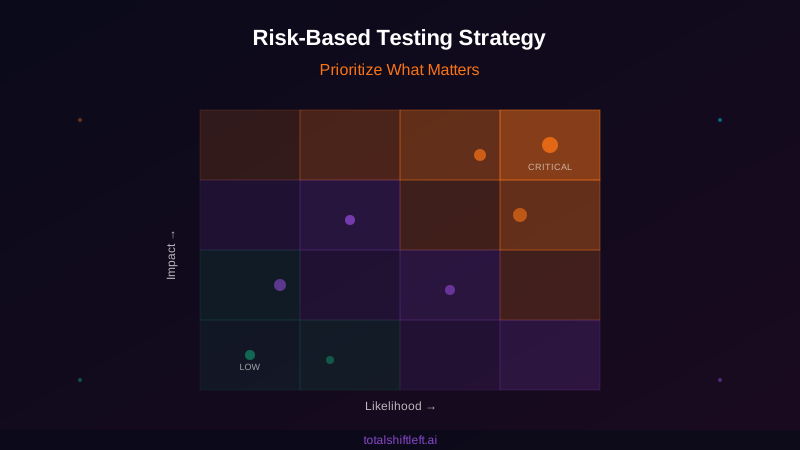
Risk Assessment Matrix
Create a risk assessment matrix that plots likelihood against impact on a scale of 1 to 5:
Likelihood Scale:
- 1 - Very Low: Stable code, rarely changed, well-tested, experienced team
- 2 - Low: Minor changes planned, moderate complexity, decent test coverage
- 3 - Medium: Regular changes, moderate complexity, some knowledge gaps
- 4 - High: Frequent changes, high complexity, new team members, integration points
- 5 - Very High: Major refactoring, new technology, no existing tests, critical dependencies
Impact Scale:
- 1 - Negligible: Cosmetic issues, no business impact
- 2 - Minor: Minor inconvenience, easy workaround available
- 3 - Moderate: Feature degradation, some users affected, manual workaround
- 4 - Major: Feature outage, many users affected, revenue impact, SLA breach
- 5 - Critical: System outage, data loss, security breach, regulatory violation
The resulting risk score (Likelihood x Impact) ranges from 1 to 25 and drives test prioritization.
Test Prioritization Framework
Once the highest-risk endpoints are identified, fanning each requirement out into a prioritized test strategy ensures the critical surfaces receive proportionally deeper coverage. Map risk scores to testing intensity levels:
- Critical Risk (20-25): Full test coverage—automated unit, API, integration, E2E tests plus manual exploratory testing, performance testing, and security scanning. Test before and after every change.
- High Risk (12-19): Comprehensive automated testing at all levels. Performance testing on significant changes. Periodic security scanning.
- Medium Risk (6-11): Automated unit and API tests. Integration tests for major changes. Periodic regression testing.
- Low Risk (1-5): Basic smoke tests. Monitoring in production. Testing only when directly changed.
How Total Shift Left does this: For a critical- or high-risk endpoint, Test Strategy Fan-Out generates a complete test suite across proven design techniques — positive and negative paths, boundary values, equivalence partitioning, decision tables, pairwise combinations, and security-focused checks — from a single endpoint or requirement, so the highest-risk surfaces get deliberate, textbook-deep coverage rather than whatever a person happened to think of. Coverage Gap Detection then tracks Overall and Production-Grade coverage per endpoint, so you can verify those surfaces actually reach full coverage instead of assuming it.
Continuous Risk Reassessment
Risk is not static. A module that was low-risk last quarter may become high-risk after a major refactoring. A high-risk module may become low-risk after extensive hardening. Build risk reassessment into your sprint cadence: review risk scores monthly, after major architectural changes, and a
fter production incidents.
For API testing prioritization, Shift-Left API can automatically identify high-risk endpoints based on complexity, parameter count, and change history, ensuring your API testing effort is always directed at the most critical surfaces.
Traceability and Documentation
Maintain traceability from business risks to test activities. For each identified risk, document:
- The risk description and score
- The test activities allocated to mitigate it
- The test results demonstrating mitigation
- Any residual risk accepted by stakeholders
This traceability is essential for compliance and for defending testing decisions during incident reviews.
Risk Assessment Architecture
The risk assessment process integrates with your development workflow through three feedback loops:
Loop 1: Pre-Sprint Risk Assessment — During sprint planning, assess the risk profile of planned work items. Features touching high-risk components receive additional testing attention in the sprint plan. This is where risk-based testing meets DevOps testing strategy—the pipeline adapts to the risk of each change.
Loop 2: Commit-Level Risk Scoring — Automated risk scoring evaluates each commit based on the files changed, their complexity, their defect history, and their criticality. The CI/CD pipeline selects the appropriate test suite based on the risk score: high-risk commits run the full suite, low-risk commits run only affected tests.
Loop 3: Post-Incident Risk Update — After every production incident, update the risk assessment for the affected component. Components involved in incidents have their likelihood scores increased, triggering expanded test coverage. This creates a learning system that becomes more accurate over time.
The architecture requires integration between your version control system (for change analysis), your issue tracker (for defect history), your CI/CD pipeline (for test selection), and your risk register (for assessment documentation). Most of this integration can be built with scripts and APIs rather than requiring specialized tooling.
Tools for Risk-Based Testing
| Tool | Type | Best For | Open Source |
|---|---|---|---|
| Shift-Left API | API Testing | Risk-prioritized API test generation and execution | No |
| SonarQube | Code Analysis | Complexity metrics and code quality risk indicators | Yes |
| CodeClimate | Code Analysis | Maintainability and technical debt risk scoring | No |
| Jira / Linear | Risk Registry | Tracking and documenting risk assessments | No |
| Git (log analysis) | Change Analysis | Identifying frequently changed files and hotspots | Yes |
| CodeScene | Behavioral Analysis | Social and technical code health risk analysis | No |
| Sentry | Error Tracking | Historical defect density by component | No |
| Playwright | E2E Testing | Risk-targeted end-to-end test execution | Yes |
| k6 | Performance Testing | Load testing high-risk performance paths | Yes |
| OWASP ZAP | Security Testing | Security scanning of high-risk endpoints | Yes |
| Grafana | Dashboards | Visualizing risk scores and testing coverage | Yes |
| pytest-ordering | Test Execution | Priority-based test execution ordering | Yes |
Risk-based testing in practice: a worked example
Problem: An e-commerce platform with 120 microservices was spending 4 hours per deployment on a comprehensive test suite that tested all services equally. Despite the extensive testing, critical defects in the payment and inventory services—which generated 90% of revenue—were escaping to production at the same rate as defects in low-impact services like user preferences and notification formatting.
Solution: They implemented a risk-based testing strategy:
- Scored all 120 services on a likelihood-impact matrix using 12 months of defect data, code complexity metrics, and business impact assessments.
- Classified 15 services as critical risk (payment, inventory, authentication, order management), 35 as high risk, 40 as medium risk, and 30 as low risk.
- Allocated testing effort proportionally: critical services received full-spectrum testing with Shift-Left API generating comprehensive API test suites, performance testing on every deployment, and weekly security scans.
- Reduced end-to-end test scenarios from 800 to 150, focusing on critical business journeys through high-risk services.
- Implemented commit-level risk scoring that selected test suites based on the services affected by each change.
- Low-risk services received only contract tests and production monitoring.
Results: Deployment time dropped from 4 hours to 45 minutes. Critical defect escape rate for payment and inventory services dropped by 85%. Total defect escape rate remained the same (defects shifted from critical services to low-impact services where they caused minimal damage). The team redeployed saved testing time to exploratory testing of high-risk features, uncovering 23 additional edge-case defects in the first quarter.
Free Guided worksheet
Build Your Testing Strategy in 30 Minutes
A structured worksheet that walks you through defining your testing strategy in 30 minutes. Cover architecture, tools, layers, and team responsibilities.
Download FreeRisk-based testing challenges and how to solve them
Challenge: Subjective Risk Assessment
Risk scoring involves human judgment, which introduces bias. Teams tend to underestimate risk in areas they are familiar with and overestimate risk in areas they are not.
Solution: Supplement subjective assessment with objective data. Use code complexity metrics, git log analysis for change frequency, defect tracking data for historical density, and production monitoring data for error rates. Weight data-driven indicators more heavily than opinion-based estimates. Review risk scores as a team to average out individual biases.
Challenge: Stakeholder Pushback on Reduced Testing
Product owners may resist the idea that their feature receives less testing than another team's feature. "Our feature is important too" is a common objection.
Solution: Frame risk-based testing as risk management, not quality reduction. Show stakeholders the risk matrix and explain the objective scoring criteria. Emphasize that reduced testing effort does not mean no testing—low-risk areas still have automated tests and production monitoring. Involve stakeholders in the risk assessment process so they understand and accept the prioritization.
Challenge: Risk Drift Over Time
Risk assessments become stale as the application evolves. A component classified as low-risk six months ago may have undergone significant changes that make it high-risk today.
Solution: Automate risk indicator collection so that risk scores update continuously based on code changes, defect reports, and incident data. Schedule formal risk reviews quarterly and after any major architectural change. Build alerts that flag when a component's risk indicators change significantly.
Challenge: Insufficient Historical Data
New features and greenfield projects lack the historical defect data needed for accurate risk scoring.
Solution: For new components, estimate risk based on architectural analysis (integration points, data sensitivity, technology novelty) and analogous components in the existing system. Start with conservative (higher) risk estimates for new components and adjust as data accumulates. New technology stacks and unfamiliar patterns should default to high risk.
Challenge: Test Suite Maintenance for Risk-Based Selection
Maintaining multiple test suites at different levels of comprehensiveness adds complexity to test infrastructure.
Solution: Use test tagging and filtering rather than separate test suites. Tag each test with its risk level and the components it covers. The CI/CD pipeline selects tests based on the change's risk profile using tag filters. This approach uses test automation strategy principles with a single codebase and dynamic selection.
Risk-based testing best practices
- Base risk assessment on data first, opinion second—code complexity, change frequency, and defect history are more reliable than team intuition
- Involve developers, product owners, and operations engineers in risk identification workshops to capture risks from all perspectives
- Update risk assessments continuously using automated indicators rather than relying on periodic manual reviews
- Map every test to the risk it mitigates—if a test does not reduce a documented risk, question its value
- Use commit-level risk scoring to dynamically select test suites in CI/CD pipelines
- Maintain a baseline of automated tests even for low-risk components—risk assessment can be wrong
- Track risk prediction accuracy by comparing predicted risk levels with actual defect locations
- Communicate risk-based testing decisions transparently to stakeholders using the risk matrix
- Use Shift-Left API to prioritize API testing effort on the highest-risk endpoints automatically
- After every production incident, conduct a risk reassessment for the affected component and update test coverage accordingly
- Document residual risks—areas where you accept lower testing coverage—and get stakeholder sign-off
- Review and refine the risk model quarterly based on prediction accuracy and coverage gaps
Risk-Based Testing Checklist
- ✔ Conduct risk identification workshops with cross-functional stakeholders
- ✔ Collect objective risk data: code complexity, change frequency, defect history, production error rates
- ✔ Build a risk assessment matrix scoring likelihood and impact for all components
- ✔ Map risk scores to testing intensity levels (critical, high, medium, low)
- ✔ Define test activities for each intensity level
- ✔ Tag all automated tests with risk level and component coverage
- ✔ Implement commit-level risk scoring in CI/CD pipelines
- ✔ Configure dynamic test selection based on risk scores
- ✔ Establish risk traceability from business risks to test activities
- ✔ Set up automated risk indicator collection from code and defect data
- ✔ Schedule monthly risk reassessment reviews
- ✔ Document and get sign-off on accepted residual risks
- ✔ Track risk prediction accuracy as a meta-metric
- ✔ Update risk assessments after every production incident
Score the risk, then let the score choose the depth
Risk-based testing stops being a workshop exercise when the score is computed from data you already have — change frequency, defect history, blast radius — and the pipeline reads it:
# scripts/risk_score.py — likelihood x impact, from git and the issue tracker
import subprocess, json, collections

WINDOW = "--since=180.days"

changes = collections.Counter(
    subprocess.run(["git", "log", WINDOW, "--name-only", "--pretty=format:"],
                   capture_output=True, text=True).stdout.split())

defects = collections.Counter(json.load(open("defects.json")))   # path -> bug count

IMPACT = {                       # business impact, set once by the product owner
    "app/payments": 5, "app/auth": 5, "app/orders": 4,
    "app/catalog": 3, "app/reporting": 2, "app/admin": 2,
}

def impact(path):
    return max((v for k, v in IMPACT.items() if path.startswith(k)), default=1)

rows = []
for path, n in changes.items():
    if not path.startswith("app/"):
        continue
    likelihood = min(5, 1 + n // 10 + defects[path])       # churn + history
    rows.append((likelihood * impact(path), likelihood, impact(path), path))

for score, l, i, path in sorted(rows, reverse=True)[:20]:
    depth = "exhaustive" if score >= 16 else "standard" if score >= 8 else "smoke"
    print(f"{score:>3}  L{l} x I{i}  {depth:<11} {path}")
The output is the test plan: the top band gets negative, boundary and security cases on every change; the bottom band gets a smoke test and a nightly sweep. Recompute it monthly — a risk model that is never revised becomes a ranking of last year's risks.
Risk-based testing FAQ
What is risk-based testing?
Risk-based testing is a testing approach that prioritizes test activities based on the likelihood and impact of failures. Rather than testing everything equally, teams allocate more testing effort to high-risk areas—those with the greatest business impact, highest complexity, or most frequent change—and reduce effort on low-risk components.
How do you identify high-risk areas for testing?
Identify high-risk areas by analyzing four factors: business impact (revenue, user trust, regulatory), technical complexity (integration points, algorithmic difficulty), change frequency (how often the code changes), and historical defect density (areas where bugs have been found before). Score each component on these factors to create a risk matrix.
What is a risk assessment matrix in testing?
A risk assessment matrix is a tool that maps the likelihood of a defect occurring against the business impact if it does occur. Components are placed in the matrix based on their scores, creating four quadrants: high-likelihood/high-impact (test extensively), high-impact/low-likelihood (test thoroughly), high-likelihood/low-impact (automate), and low-risk (test minimally).
How does risk-based testing differ from risk-based testing in agile?
In agile environments, risk-based testing is applied iteratively per sprint rather than once per release. Risk assessments are updated as features evolve, test priorities shift based on sprint goals, and automation is progressively built for the highest-risk areas. The core principle—prioritize by risk—remains the same, but the cadence is faster.
Can risk-based testing be automated?
Yes. Risk scoring can be automated using historical defect data, code change frequency, and code complexity metrics from your version control and issue tracking systems. Tools like Shift-Left API can automatically prioritize API tests based on endpoint criticality and change history, ensuring the highest-risk API surfaces are always tested first.
What are the limitations of risk-based testing?
Risk-based testing depends on accurate risk assessment, which can be subjective. It may miss defects in areas classified as low-risk. Teams may underestimate risks in unfamiliar domains. Mitigation includes using data-driven risk scoring, regularly reviewing and updating risk assessments, and maintaining a baseline of automated tests even for low-risk areas.
Sources and further reading
- ISTQB Glossary — the standard vocabulary for test terms.
- DORA State of DevOps research — the multi-year dataset behind the four delivery metrics.
- Google Testing Blog — Google's engineering write-ups on test sizing and flakiness.
Key takeaways
- Risk-based testing is not about testing less. It is about testing smarter.
- By systematically assessing where defects are most likely to occur and where they will cause the most damage, you redirect testing effort from low-value activities to high-value ones.
- The result is fewer critical defects in production, faster deployment pipelines, and a testing team that can demonstrate its value in business terms.
- Start by collecting the data: defect history, code complexity, change frequency.
- Build your risk matrix. Map testing intensity to risk levels. Automate risk scoring in your pipeline.
- Then continuously refine the model based on what it predicts correctly and what it misses.
If you are ready to prioritize your API testing effort based on risk, start your free trial of Shift-Left API and let automated risk analysis guide your API test generation across all your services.
Related: DevOps Testing Complete Guide | Software Testing Strategy for Modern Applications | Enterprise Testing Strategy Guide | Test Automation Strategy | What Is Shift Left Testing? | Future of API Testing
For regulated teams: see risk-based test selection in enterprise CI/CD, the enterprise testing strategy guide, and how this maps across regulated industries.
Ready to shift left with your API testing?
Try our no-code API test automation platform free.