
Testing Non-Deterministic AI Systems: Patterns (2026)
Quick answer
Enterprises test non-deterministic AI systems by replacing exact-match assertions with four patterns — schema validation, property-based assertions, constrained-vocabulary checks, and sparing LLM-as-judge scoring — run against a version-controlled golden set with static and drift thresholds (typically a 95% pass rate). Auditors evaluate the documented evaluation framework, not individual outputs, which is what makes this approach audit-compatible.
Reviewed by Sushant Joshi
How enterprises test APIs and applications backed by non-deterministic AI models. Property-based assertions, statistical thresholds, golden-set evaluation, and the governance pattern that satisfies audit without forcing the model to be deterministic.
In this guide
- What is testing non-deterministic AI systems?
- The key components of testing non-deterministic AI systems
- Why deterministic testing fails
- The four assertion patterns
- Building a golden set
- Statistical thresholds
- Governance and audit framing
- AI-specific security testing
- Why testing non-deterministic AI systems matters at enterprise scale
- Testing non-deterministic AI systems tools compared
- Testing non-deterministic AI systems in practice: a worked example
- Testing non-deterministic AI systems reference architecture
- Testing non-deterministic AI systems metrics that matter
- Testing non-deterministic AI systems rollout playbook
- Testing non-deterministic AI systems challenges and how to solve them
- Testing non-deterministic AI systems best practices
- Testing non-deterministic AI systems checklist
- Assert on properties, not on exact output
What is testing non-deterministic AI systems?
Testing non-deterministic AI systems is the practice of validating AI-backed APIs and applications whose outputs vary across calls — even with the same input — using property-based assertions, statistical thresholds, and golden-set evaluation rather than exact-match tests. The 2026 enterprise model documents an evaluation framework (categories, properties, thresholds, cadence) that auditors evaluate, not individual outputs that auditors usually can't.
If your data cannot leave the network, self-hosted LLM test generation covers running the same generation step on Ollama or vLLM inside your own boundary.
If you are being asked to test an MCP server rather than the API behind it, how to test MCP servers has the handshake, tool-schema and injection cases.
For features with a model in the request path, how to test LLM applications separates the deterministic shell from the part that needs evals.
Scoring quality across a dataset rather than asserting on one response is its own discipline — see the LLM evals guide.
The key components of testing non-deterministic AI systems
Each enterprise program in this area has the same load-bearing components, regardless of vendor. The components separate cleanly into governance, enforcement, and evidence layers.
Schema and structural assertions
Output must match a defined schema (JSON Schema, Pydantic model, etc.). Doesn't depend on output content; catches format breakage. Always cheap to enforce as the floor of any AI evaluation suite.
Property-based assertions
Output must satisfy specific properties — an answer references the document the question was about, a summary stays under a length cap, a translation preserves named entities. Properties are testable without exact match.
Constrained-vocabulary assertions
For classification, scoring, or routing tasks, output must come from a fixed vocabulary. Reduces non-determinism to a manageable choice space and produces deterministic gates on otherwise non-deterministic systems.
LLM-as-judge assertions
A separate model evaluates whether the output meets a quality bar. Useful for free-form outputs where rule-based properties don't capture quality. Used sparingly because the judge introduces its own non-determinism that must be calibrated.
Golden set
A curated, version-controlled collection of representative inputs with documented expected output properties. Source-controlled with branch protection. Updates are deliberate, reviewed changes — not ad-hoc appends.
Statistical thresholds
Static threshold (95% pass rate against the golden set), drift threshold (within X% of the rolling baseline), and per-category thresholds for use cases with mixed criticality. The thresholds are the headline metric for AI system health.
Why deterministic testing fails
Traditional API testing is built on exact-match assertions: "GET /users/123 returns this exact JSON." When the API is backed by a non-deterministic model, exact match becomes meaningless. Two calls with identical input may return different outputs that are both correct.
Three failure modes appear when teams try to apply deterministic patterns to AI systems:
False positives at scale. Tests that assert exact strings or exact JSON shapes fail constantly as the model varies its output. Engineering ignores them; the test suite loses signal.
Brittleness to model updates. A test that passes against model version A may fail against model version B even though both produce correct results. Every model update becomes a test-rewrite event.
Audit-incompatible documentation. When auditors ask "how do you know your AI system works correctly?", the answer "we have 10,000 exact-match tests" is unconvincing — and often false, since the tests are flapping anyway.
The pattern that scales is to assert properties of outputs, not exact matches.
The four assertion patterns
Four patterns cover most non-deterministic AI testing needs:
Schema and structural assertions. Output must match a defined schema (JSON Schema, Pydantic model, etc.). Doesn't depend on output content; catches format breakage. Always cheap to enforce.
Property-based assertions. Output must satisfy specific properties — e.g., "answer must reference the document the question was about," "summary must be shorter than 200 words," "translation must preserve the named entities from the input." Properties are testable without exact match.
Constrained-vocabulary assertions. For classification, scoring, or routing tasks, output must come from a fixed vocabulary. Reduces non-determinism to manageable choice space.
LLM-as-judge assertions. A separate model evaluates whether the output meets a quality bar. Useful for free-form outputs where rule-based properties don't capture quality. Requires its own validation that the judge is reliable. Running the judge across multiple AI providers rather than a single model also guards against systematic bias from any one vendor's model.
Most enterprise AI test suites combine all four: schema for format, property-based for behavioral correctness, constrained vocabulary where the use case allows, and LLM-as-judge sparingly for the cases that genuinely need free-form evaluation.
Ready to shift left with your API testing?
Try our no-code API test automation platform free. Generate tests from OpenAPI, run in CI/CD, and scale quality.
Building a golden set
A golden set is the foundation of AI system regression testing. It's a curated, version-controlled collection of representative inputs with documented expected output properties.
A working golden set has:
- Diverse coverage. Represents the categories of input the system handles in production, not just the easy cases.
- Hard cases explicitly included. Edge cases, ambiguous inputs, adversarial inputs that exercise known weaknesses.
- Output properties, not exact outputs. The expected behavior, not the expected text.
- Version control with provenance. Each entry has a creation date, an author, and a rationale.
- Update governance. Adding to the golden set is a deliberate change with review, not an ad-hoc append.
The golden set runs as part of CI on every model change, prompt change, retrieval change, or upstream component change. Pass rate against the golden set becomes the headline metric for AI system health.
Statistical thresholds
Because non-deterministic systems don't pass-or-fail on a single run, the right metric is statistical: pass rate against the golden set above a defined threshold.
Three patterns:
Static threshold. "95% of golden set entries pass on this run." Simple; works for most use cases. Threshold is set deliberately, justified by the use case's tolerance.
Drift threshold. "Pass rate is within X% of the previous baseline." Catches regressions even when the new system is still above the static threshold but worse than what was deployed.
Per-category threshold. Different thresholds for different input categories. Useful when some categories are critical and others are best-effort.
The static threshold is the legible single number for executives. The drift threshold is the early warning. The per-category threshold is what surfaces specific quality regressions to the model owners.
For complementary content see testing strategy for AI-powered applications.
Governance and audit framing
Auditors increasingly expect AI system testing to be documented as an evaluation framework, not as a list of test cases. The framework typically includes:
- The categories of input the system handles in scope
- The output properties required for each category
- The threshold of pass rate that's acceptable
- The cadence of evaluation (per change, scheduled, continuous)
- The escalation path for threshold violations
- The retention policy for evaluation results
The framework is auditable. Individual outputs usually are not — and don't need to be. What auditors want is evidence that you have a defensible evaluation process and that you're following it.
AI-specific security testing
AI APIs introduce threat surfaces that traditional API security testing doesn't cover:
- Prompt injection. Inputs that override the system's intended behavior.
- Jailbreaks. Inputs that bypass safety constraints.
- Data exfiltration. Inputs that extract training data, retrieved documents, or system prompts.
- Resource exhaustion. Inputs that produce expensive outputs (huge tokens, expensive tool calls).
Each has corresponding test patterns: red-team prompt corpora, jailbreak benchmarks, exfiltration probes, resource-budget tests. Most existing OWASP API Top 10 enterprise mitigations still apply on top — auth, rate limiting, input validation, output filtering — they just have to extend to handle the AI-specific threats.
Enterprise programs typically run AI security tests on both the AI surface itself and the wrapping API surface. Treating only one as in scope leaves the other unprotected.
Testing non-deterministic AI systems at enterprise scale is fundamentally about replacing exact-match assertions with property-based assertions, statistical thresholds, and a governed evaluation framework. The teams that get this right ship AI capabilities with audit-ready evidence. The teams that don't — that try to force determinism or skip evaluation entirely — usually pay for it later in production incidents or audit findings.
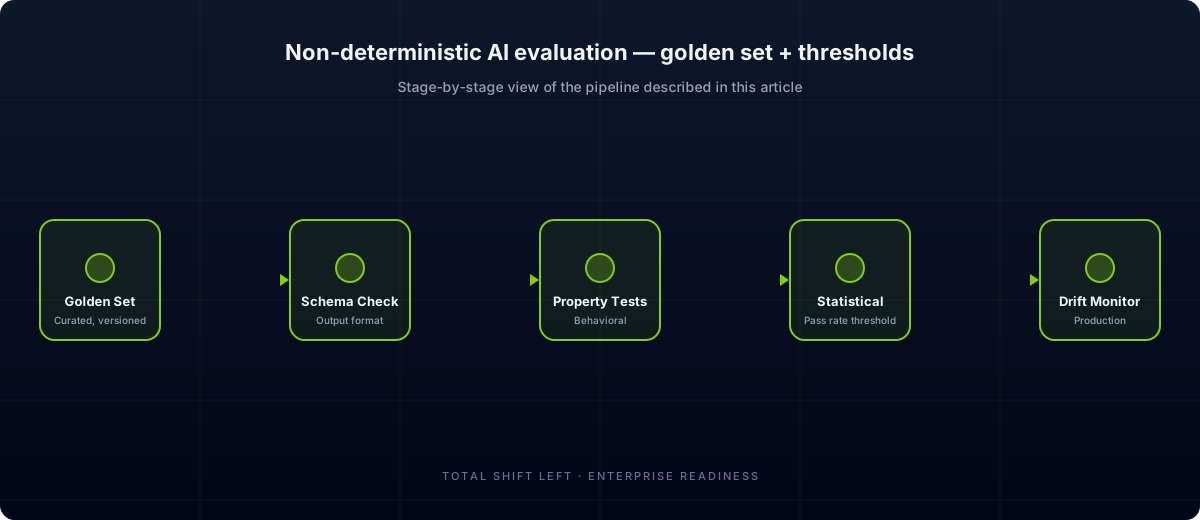
Non-deterministic AI testing pipeline — property-based, statistical, governed.
Why testing non-deterministic AI systems matters at enterprise scale
OpenAI's 2024 Evals framework data and Anthropic's Constitutional AI evaluation papers both surfaced the same finding: organizations testing AI systems with property-based assertions and statistical thresholds detect regressions 5-7x faster than organizations relying on exact-match tests. With AI system regulation increasing (EU AI Act, U.S. state AI laws), defensible evaluation is moving from a quality concern to a compliance one.
Testing non-deterministic AI systems tools compared
A practical view of the tool categories that scale across enterprise testing programs in this area:
| Category | Example tools |
|---|---|
| Evaluation frameworks | OpenAI Evals, LangSmith, Helicone, Promptfoo, Anthropic Evaluations |
| Property-based testing | Hypothesis (Python), fast-check (TypeScript), QuickCheck (multiple languages) |
| Golden-set management | Source-controlled YAML/JSON; LangSmith datasets; custom curation tools |
| LLM-as-judge | OpenAI / Anthropic / local models with structured-output prompts |
| Drift monitoring | Evidently AI, Arize, WhyLabs for production drift detection |
Tool selection is secondary to architecture. The patterns above hold regardless of which specific vendor you adopt.
Testing non-deterministic AI systems in practice: a worked example
A representative deployment pattern from an enterprise rollout in this area:
Problem. A retail bank shipped an AI-powered customer support API that summarized account activity for users. Initial deployment used exact-match assertions on test outputs; the suite flapped constantly as model temperature drove output variation. Engineering disabled the suite. A regression in PII handling slipped to production for two weeks before discovery.
Solution. The team rebuilt evaluation around four assertion patterns: schema (output must be valid JSON), property-based (no PII patterns in output, length within bounds), constrained vocabulary (sentiment classification only from fixed set), LLM-as-judge sparingly. Golden set of 250 curated inputs ran on every model / prompt change.
Results. Suite stability moved from 60% pass rate (flake) to >98%. PII regressions caught pre-production. Engineering velocity on AI features increased — they had a tool they could trust. The framework was extended to two more AI-powered APIs.
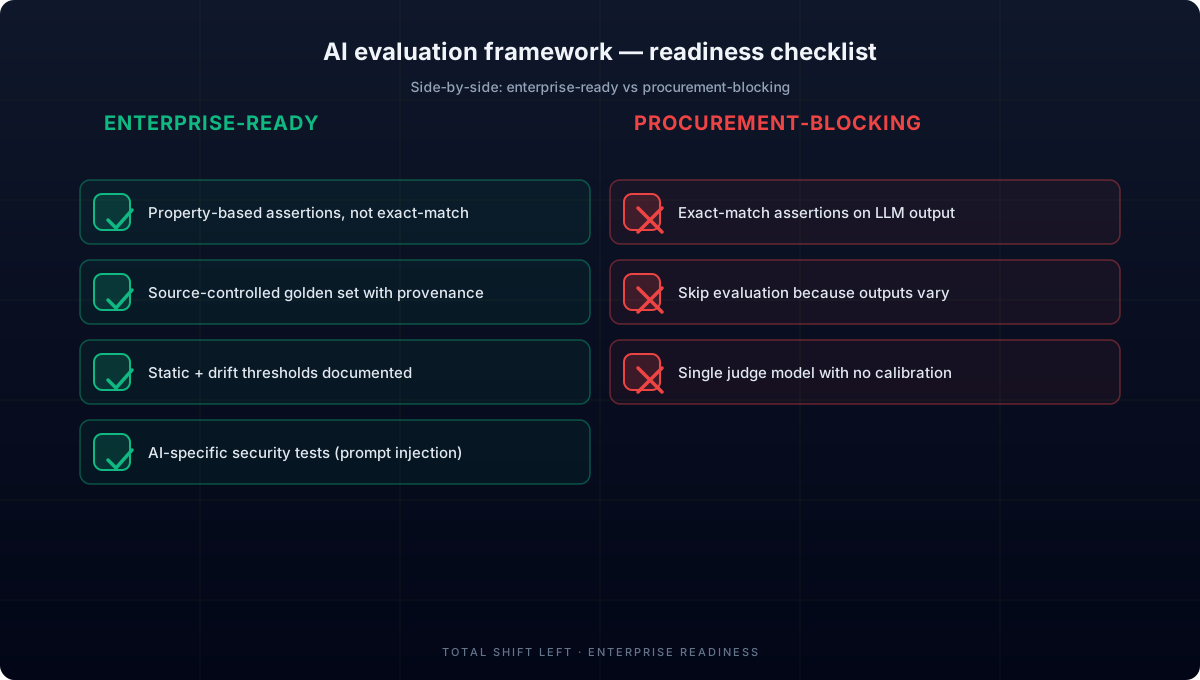
AI system evaluation framework — readiness checklist.
Testing non-deterministic AI systems reference architecture
An evaluation architecture for non-deterministic AI systems has five components. Golden set — curated, version-controlled collection of representative inputs with documented expected output properties. Source-controlled with branch protection. Assertion library — schema validators (JSON Schema, Pydantic), property-based test runners (Hypothesis, fast-check), constrained-vocabulary checkers, optional LLM-as-judge with structured-output prompts. CI integration — golden set runs on every model / prompt / retrieval change. Pass rate computed against the static and drift thresholds. Production drift monitoring — Evidently AI, Arize, or WhyLabs watching for distribution drift on live inputs and output distributions. Audit trail — evaluation framework documented; pass-rate history retained; threshold violations logged with escalation. The architecture is deliberately framework-driven rather than test-case-driven — auditors evaluate frameworks at this scale, not individual outputs.
Free PDF + code examples
OpenAPI to Test Generation Template Pack
Go from OpenAPI spec to full test coverage. Includes sample specs, example generated tests, edge case patterns, and CI/CD integration guides.
Download FreeTesting non-deterministic AI systems metrics that matter
Three metrics dominate AI system evaluation. Golden-set pass rate — measured per CI run — is the headline metric; the static threshold (typically 95%) is the gate. Drift threshold compliance — count of runs within X% of the rolling baseline — catches regressions even when above the static threshold. Production-drift detection latency — minutes from drift onset to alert — is the operational metric for live AI systems. Report on a per-deploy cadence to engineering and on a quarterly cadence to compliance and product leadership.
Testing non-deterministic AI systems rollout playbook
A non-deterministic-AI evaluation rollout takes 8-12 weeks. Weeks 1-2: golden set. Curate 100-300 representative inputs. Document expected output properties per category. Source-control. Weeks 3-4: assertion patterns. Implement schema validators, property-based assertions, constrained-vocabulary checkers. Validate against historical runs. Weeks 5-7: CI integration. Wire the golden set into CI on model / prompt / retrieval changes. Set static and drift thresholds. Weeks 8-10: production monitoring. Deploy drift detection. Configure alerting and escalation. Weeks 11-12: audit framing. Document the framework. Run a mock audit-style review. Most teams reach steady state in 3 months; ongoing investment is golden-set curation as the system evolves.
Testing non-deterministic AI systems challenges and how to solve them
Engineers want deterministic outputs. Set temperature low for tests where determinism helps, but design assertions that don't depend on it. The use cases that matter usually require non-zero variance.
Golden set becomes stale as the system evolves. Treat golden set updates as deliberate, reviewed changes. Track update cadence. Stale golden sets fail to catch new failure modes.
LLM-as-judge introduces a second non-deterministic system. Use sparingly, validate the judge separately, set high thresholds for cases where the judge's reliability matters.
Auditors don't know how to evaluate AI testing. Document the evaluation framework explicitly. Auditors evaluate frameworks, not individual outputs. Frameworks pass when they're defensible and consistently applied.
Testing non-deterministic AI systems best practices
- Use property-based assertions instead of exact-match for non-deterministic outputs
- Maintain a curated golden set with documented update governance
- Combine schema, property-based, constrained-vocabulary, and LLM-as-judge patterns
- Set statistical thresholds (static + drift) rather than pass/fail per run
- Treat AI-specific security testing (prompt injection, jailbreaks) as a first-class concern
- Document the evaluation framework — auditors evaluate frameworks, not individual outputs
- Monitor drift in production; the eval framework should extend to live systems
Testing non-deterministic AI systems checklist
A pre-flight checklist enterprise teams can run against their current state:
- ✔ Test suite uses property-based assertions, not exact-match
- ✔ Golden set is source-controlled with documented update governance
- ✔ Statistical thresholds (static and drift) are documented and enforced
- ✔ AI-specific security testing covers prompt injection and jailbreak surfaces
- ✔ Schema, property-based, constrained-vocabulary, and LLM-as-judge patterns combine
- ✔ Production drift monitoring exists for in-scope AI systems
- ✔ Evaluation framework is documented for audit
- ✔ Test suite stability (pass rate on baseline) is >95%
Take the next step. See how AI API testing platform applies these ideas to your workflow, or explore automate testing with AI for the broader picture.
See also: generate tests from openapi in our learn hub for the underlying concept.
Assert on properties, not on exact output
A non-deterministic system cannot be tested with equality. What it can be tested with is invariants — properties every valid output must hold, whatever the wording:
# tests/test_llm_invariants.py
import json, pytest, jsonschema

SCHEMA = json.load(open("schemas/extraction.json"))

@pytest.mark.parametrize("run", range(5))          # same input, five samples
def test_output_always_satisfies_the_contract(llm, fixture_invoice, run):
    out = llm.extract(fixture_invoice)

    # 1. structural: parses and validates, every time
    jsonschema.validate(out, SCHEMA)

    # 2. grounding: no value that is not present in the source document
    assert out["total"] in fixture_invoice.text, "hallucinated total"
    assert out["vendor"].lower() in fixture_invoice.text.lower()

    # 3. bounds: numbers are plausible, not just well-formed
    assert 0 < float(out["total"]) < 1_000_000

    # 4. safety: the model never emits the fields it was told to redact
    assert not {"ssn", "card_number"} & set(out)

def test_refusal_is_stable_across_samples(llm):
    """Behaviour that must be deterministic, has to be tested as deterministic."""
    outs = [llm.extract(PROMPT_INJECTION_DOC) for _ in range(5)]
    assert all(o.get("refused") for o in outs), "refusal is not reliable"
Then score the fuzzy part separately, with a threshold rather than an assertion — an eval suite that reports a distribution is the honest way to gate a probabilistic system:
# evals/run_eval.py — a gate on aggregate quality, not on any single response
import statistics

results = [score(llm.extract(case.doc), case.expected) for case in GOLDEN_SET]
mean, p10 = statistics.mean(results), statistics.quantiles(results, n=10)[0]

print(f"mean {mean:.3f}  p10 {p10:.3f}  n={len(results)}")
assert mean >= 0.92, f"quality regression: mean {mean:.3f} < 0.92"
assert p10 >= 0.80, f"tail regression: p10 {p10:.3f} < 0.80"
Sources and further reading
- OWASP Top 10 for LLM Applications — the risk list for AI-backed features.
- NIST AI Risk Management Framework — the reference framework for governing AI systems.
- Google Testing Blog — Google's engineering write-ups on test sizing and flakiness.
Key takeaways
- Testing non-deterministic AI systems at enterprise scale is fundamentally about replacing exact-match assertions with property-based assertions, statistical thresholds, and a governed evaluation framework.
- The teams that get this right ship AI capabilities with audit-ready evidence.
- The teams that don't — that try to force determinism or skip evaluation entirely — usually pay for it later in production incidents or audit findings.
Testing non-deterministic AI systems FAQ
Why can't we just set temperature=0?
Temperature=0 reduces variance but doesn't eliminate it; many production LLM APIs still produce different outputs across calls, across model versions, and across hardware backends. More importantly, the use cases where AI output adds value usually depend on some non-zero variance. The right approach is to test properties of outputs, not exact match.
How do auditors evaluate AI system testing?
Increasingly, auditors expect a documented evaluation framework: what categories of input the system handles, what output properties are required, what threshold of pass rate is acceptable, and how the threshold is monitored over time. The framework is auditable; the individual outputs typically aren't.
What's a golden set?
A curated, version-controlled collection of representative inputs with documented expected output properties. Used as the regression baseline for AI system changes — model updates, prompt changes, retrieval changes. Auditors increasingly expect to see one for any AI system in scope.
How does this affect API security testing?
AI APIs add a new threat surface — prompt injection, jailbreaks, data exfiltration via crafted inputs. The testing patterns are different from traditional API security testing: red-team prompts, jailbreak corpora, and behavioral assertions on outputs. Most existing OWASP API Top 10 controls still apply on top.
Ready to shift left with your API testing?
Try our no-code API test automation platform free.