
Testing Strategy for AI-Powered Applications (2026)
Quick answer
A testing strategy for AI-powered applications replaces binary pass/fail assertions with statistical evaluation across six dimensions — functional correctness, output quality, safety, bias, robustness, and drift — measured against golden, adversarial, and demographic evaluation datasets. Only 23% of organizations testing AI features have a strategy that addresses these dimensions, even though 78% of applications now ship at least one AI feature.
Reviewed by Smeet Gohel
Testing AI-powered applications requires a fundamentally different approach than testing traditional software. AI components produce non-deterministic outputs that vary between invocations, behave differently as underlying models evolve, and can generate harmful or biased content that no developer explicitly programmed. A testing strategy that relies solely on deterministic assertions will miss the most critical quality risks in AI-powered features.
AI is now embedded in nearly every category of software—from search ranking and content recommendation to code generation, customer support, and medical diagnosis. The 2025 Stack Overflow Developer Survey found that 78% of applications now include at least one AI-powered feature. Yet only 23% of organizations have a testing strategy that specifically addresses AI quality. The gap between AI adoption and AI testing maturity is where the most damaging production incidents live.
Traditional software testing relies on a simple premise: given the same input, the system produces the same output. You write an assertion that checks the output matches the expected value, and the test passes or fails deterministically. AI-powered features violate this premise fundamentally. A language model may generate a different response to the same prompt on every invocation. A recommendation engine may rank items differently as its model updates. A classification system may change its confidence scores as input distributions shift.
This non-determinism does not mean AI features are untestable. It means they require different testing techniques—statistical evaluation rather than exact assertions, benchmark datasets rather than individual test cases, quality distributions rather than binary pass/fail, and continuous monitoring rather than point-in-time validation.
The consequences of untested AI are severe. A biased hiring model discriminates against protected groups. A hallucinating chatbot provides medical misinformation. A recommendation engine surfaces harmful content to minors. These are not hypothetical scenarios—they are incidents that have occurred at major technology companies, resulting in legal action, regulatory penalties, and reputational damage.
This guide provides a testing strategy for AI-powered applications that addresses the full spectrum of AI quality concerns: functional correctness, output quality, safety, bias, robustness, and drift. It is designed for engineering teams integrating AI features into existing applications and for teams building AI-first products. For the broader testing strategy context, see Software Testing Strategy for Modern Applications. For a forward look at how AI changes testing itself, see Future of Software Testing in AI-Driven Development.
In this guide
- What Is AI Application Testing?
- Why AI Applications Need a Different Testing Approach
- Key Components of an AI Testing Strategy
- AI Testing Architecture
- Tools for AI Application Testing
- AI-powered application testing in practice: a worked example
- AI-powered application testing challenges and how to solve them
- AI-powered application testing best practices
- AI Testing Strategy Checklist
- Test the deterministic shell around the probabilistic core
- AI-powered application testing FAQ
What Is AI Application Testing?
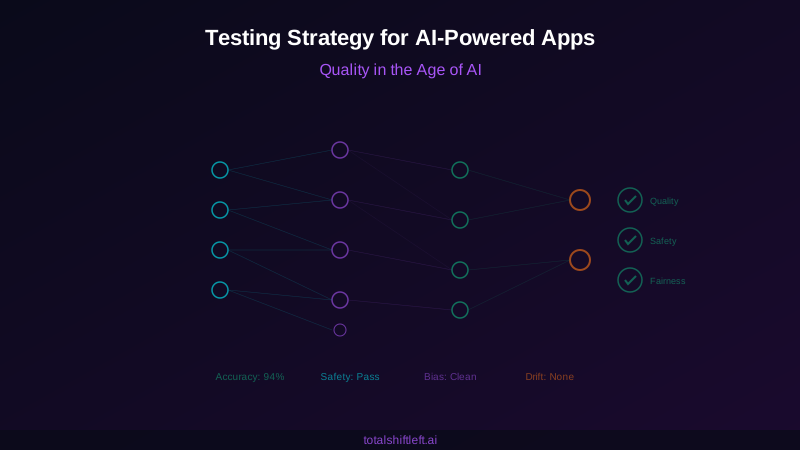
AI application testing is a multi-dimensional quality assurance approach that evaluates AI-powered features across six dimensions:
Functional Correctness: Does the AI feature integrate correctly with the rest of the application? Are API contracts honored? Is data flowing through the AI pipeline correctly? This dimension uses standard testing techniques—unit tests, integration tests, API tests.
Output Quality: Does the AI produce outputs that meet quality standards? For language models, this means relevance, accuracy, coherence, and completeness. For classification models, this means precision, recall, and F1 score. For recommendation engines, this means relevance ranking and diversity.
Safety: Does the AI avoid producing harmful, toxic, or inappropriate outputs? Does it refuse dangerous requests? Does it protect personally identifiable information? Safety testing uses adversarial inputs designed to trigger unsafe behaviors.
Bias and Fairness: Does the AI treat all demographic groups equitably? Does it produce different quality outputs based on protected characteristics? Bias testing uses evaluation datasets designed to detect differential treatment.
Robustness: Does the AI handle edge cases, adversarial inputs, and out-of-distribution data gracefully? Does it provide useful outputs for unusual inputs rather than failing silently or generating nonsense?
Drift: Does the AI maintain its quality over time as input patterns change and models evolve? Drift testing uses periodic benchmark evaluation and production monitoring to detect quality degradation.
The first dimension—functional correctness—uses standard software testing techniques. Dimensions two through six require AI-specific testing approaches that are the focus of this guide.
When part of the system is a model rather than a function, equality assertions stop working — testing non-deterministic AI systems covers the invariants and evals that replace them.
For features with a model in the request path, how to test LLM applications separates the deterministic shell from the part that needs evals.
Scoring quality across a dataset rather than asserting on one response is its own discipline — see the LLM evals guide.
Why AI Applications Need a Different Testing Approach
Non-Determinism Breaks Traditional Assertions
When you test a REST API, you expect GET /users/123 to return the same user every time. When you test an AI-powered search, the same query may return different results ranked differently on different invocations. Traditional equality assertions cannot validate non-deterministic outputs. You need statistical assertions: "the top result is relevant at least 90% of the time" or "the response contains accurate information with a quality score above 0.8."
Model Updates Change Behavior Without Code Changes
In traditional software, behavior changes when code changes. In AI applications, behavior changes when the model updates—even if no application code changed. A model retrain, a new fine-tuning dataset, or an API provider's model update can alter your feature's behavior without any commit in your repository. Your testing strategy must validate behavior after model changes, not just code changes.
AI Failure Modes Are Subtle
Traditional software fails visibly—exceptions, error codes, crashes. AI features fail subtly—the recommendation is slightly less relevant, the summary omits a critical detail, the classification is confident but wrong. These subtle failures erode user trust gradually rather than triggering alerts. Testing must proactively measure quality rather than waiting for visible failures.
Safety and Bias Are Existential Risks
AI safety failures can cause real-world harm. A chatbot that provides dangerous medical advice, a hiring tool that discriminates based on gender, or a content moderation system that suppresses legitimate speech can result in lawsuits, regulatory penalties, and permanent reputational damage. Safety testing is not optional—it is a business-critical requirement that belongs in every pipeline. This is why shift-left testing approaches are especially important for AI features.
Key Components of an AI Testing Strategy
Evaluation Dataset Management
Build and maintain evaluation datasets that represent the expected input distribution and desired outputs:
- Golden datasets: Curated input-output pairs where the expected output is reviewed and approved by domain experts. Used for regression testing and quality benchmarking.
- Adversarial datasets: Inputs designed to trigger safety violations, bias, hallucinations, and edge cases. Updated regularly as new attack vectors emerge.
- Demographic datasets: Inputs that test for differential treatment across demographic groups. Used for bias detection and fairness evaluation.
- Production sample datasets: Randomly sampled production inputs with human-evaluated quality scores. Used to validate that evaluation datasets remain representative of real usage.
Ready to shift left with your API testing?
Try our no-code API test automation platform free. Generate tests from OpenAPI, run in CI/CD, and scale quality.
Version evaluation datasets alongside your code. Update them when the feature scope changes, when new failure modes are discovered, and when production monitoring reveals quality issues. Test-generation approaches that use retrieval-augmented continuous learning apply the same principle to the tests themselves, folding newly discovered edge cases back into the generation context so coverage improves over time.
Statistical Quality Evaluation
Replace binary pass/fail assertions with statistical quality metrics:
- Relevance: Does the output address the user's intent? Measured by human evaluation or LLM-as-judge scoring.
- Accuracy: Is the factual content of the output correct? Measured against ground truth datasets.
- Coherence: Is the output well-structured, grammatically correct, and logically consistent?
- Completeness: Does the output cover all aspects of the input query?
- Safety score: Does the output contain any harmful, toxic, or inappropriate content?
Set quality thresholds for each metric and fail the test when metrics fall below them. Run evaluations across the full evaluation dataset, not individual examples, to get statistically significant quality measurements.
Prompt Regression Testing
For LLM-powered features, prompts are a critical component that directly affects output quality:
- Test prompts with the full evaluation dataset when any prompt change is made.
- Compare quality metrics between the old and new prompt versions.
- Use A/B evaluation to determine which prompt produces better outputs.
- Version prompts alongside code and treat prompt changes with the same rigor as code changes.
- Test prompt behavior across different model versions and providers
to avoid vendor lock-in.
AI Safety Testing Suite
Build a dedicated safety testing suite:
- Prompt injection testing: Can users manipulate the AI to ignore its instructions, reveal system prompts, or perform unauthorized actions?
- Content safety testing: Does the AI produce toxic, violent, sexually explicit, or otherwise harmful content?
- PII handling testing: Does the AI appropriately handle, redact, or refuse to generate personally identifiable information?
- Boundary testing: Does the AI stay within its designed scope, or does it answer questions outside its domain with fabricated information?
Model Drift Monitoring
Implement continuous monitoring for AI quality in production:
- Run evaluation benchmarks against production models on a schedule (daily or weekly).
- Monitor output distribution metrics for shifts that indicate changing behavior.
- Track user feedback signals (thumbs up/down, regeneration rates, abandonment rates) as proxy quality metrics.
- Alert when any quality metric drops below established thresholds.
API Testing for AI Services
AI features expose and consume APIs—both internal AI service APIs and external model provider APIs. Use Shift-Left API to test the API layer of your AI pipeline: request/response contract validation, error handling, timeout behavior, rate limit handling, and fallback logic when the AI provider is unavailable.
AI Testing Architecture
The AI testing architecture operates across five testing stages:
Stage 1: Component Tests — Test the non-AI components of your AI pipeline: data preprocessing, post-processing, response formatting, caching, and error handling. Use standard unit and integration tests. Target: all deterministic code at 80%+ coverage.
Stage 2: Prompt and Model Unit Tests — Test individual prompts or model calls against golden evaluation datasets. Run statistical quality evaluation. Validate safety and bias. Target: all prompts tested against 50+ evaluation examples with quality thresholds. Run on every prompt change.
Stage 3: Pipeline Integration Tests — Test the full AI pipeline end-to-end: input processing, model invocation, post-processing, response delivery. Use Shift-Left API to validate API contracts between pipeline components. Test error handling, timeout behavior, and fallback logic. Run on every code change.
Stage 4: Quality Benchmark Tests — Run comprehensive quality evaluation against the full evaluation dataset (hundreds or thousands of examples). Measure all quality dimensions: relevance, accuracy, coherence, safety, and bias. Compare against baseline metrics. Run on model changes and weekly for drift detection.
Stage 5: Production Monitoring — Continuous quality monitoring in production using user feedback signals, automated quality sampling, and drift detection. Alert on quality regression. Feed production insights back into evaluation datasets.
Tools for AI Application Testing
| Tool | Type | Best For | Open Source |
|---|---|---|---|
| Shift-Left API | API Testing | Testing AI service APIs and pipeline integration | No |
| Promptfoo | LLM Evaluation | Prompt testing and evaluation across models | Yes |
| DeepEval | AI Testing | LLM quality metrics and evaluation framework | Yes |
| Giskard | AI Safety | Bias detection and AI robustness testing | Yes |
| LangSmith | LLM Observability | Tracing and evaluating LLM pipeline execution | No |
| Weights & Biases | ML Experiment | Model evaluation tracking and comparison | No |
| Evidently AI | ML Monitoring | Data and model drift detection | Yes |
| Guardrails AI | AI Safety | Output validation and safety guardrails | Yes |
| pytest + hypothesis | Property Testing | Statistical property-based testing | Yes |
| Great Expectations | Data Testing | Data quality validation for AI pipelines | Yes |
| MLflow | ML Lifecycle | Model versioning and evaluation tracking | Yes |
| Arize AI | ML Observability | Production model monitoring and drift detection | No |
AI-powered application testing in practice: a worked example
Problem: A customer support SaaS platform integrated an LLM-powered chatbot to handle tier-1 support queries. Within two weeks of launch, customer complaints spiked: the chatbot was hallucinating product features that did not exist, providing incorrect troubleshooting steps, occasionally revealing other customers' information from conversation context, and generating responses that contradicted the company's support documentation. The team had tested the chatbot with 20 manually reviewed examples before launch—all passed.
Solution: They implemented a comprehensive AI testing strategy:
- Built a golden evaluation dataset of 500 support scenarios with expert-reviewed expected responses, covering all product areas and common edge cases.
- Implemented statistical quality evaluation measuring accuracy (grounded in product documentation), relevance, helpfulness, and safety for every prompt change.
- Created an adversarial testing suite with 200 prompt injection attempts, PII extraction attempts, and boundary violation scenarios.
- Used Shift-Left API to test the chatbot's API endpoints for contract compliance, error handling, and conversation context isolation between customers.
- Deployed Guardrails AI to validate every LLM response against safety rules before sending to the customer.
- Implemented production monitoring tracking response quality (human-evaluated weekly samples), hallucination rates, and customer satisfaction scores.
Results: Hallucination rate dropped from 18% to 2.3%. Customer satisfaction with chatbot responses increased from 2.8 to 4.2 out of 5. PII exposure incidents dropped to zero (from 3 in the first two weeks). The team catches 94% of quality regressions in CI before they reach production. The chatbot now handles 60% of tier-1 support queries successfully, reducing support team workload by 45%.
AI-powered application testing challenges and how to solve them
Challenge: Evaluation Dataset Maintenance
Evaluation datasets become stale as the product evolves and new use cases emerge.
Solution: Treat evaluation datasets as living artifacts. Add new examples from production monitoring findings, customer feedback, and new feature launches. Schedule quarterly dataset reviews. Use automated tools to detect when production inputs diverge significantly from evaluation inputs.
Free Guided worksheet
Build Your Testing Strategy in 30 Minutes
A structured worksheet that walks you through defining your testing strategy in 30 minutes. Cover architecture, tools, layers, and team responsibilities.
Download FreeChallenge: Non-Determinism Makes Tests Flaky
AI tests that pass 90% of the time and fail 10% undermine confidence.
Solution: Use statistical evaluation across many examples rather than individual assertions. Set quality thresholds at the dataset level (e.g., 92% relevance across 500 examples) rather than the example level. Run multiple evaluations and use confidence intervals to determine pass/fail.
Challenge: Evaluation Metrics Are Subjective
What constitutes a "good" response is often subjective and domain-dependent.
Solution: Use multiple evaluation methods: automated metrics (BLEU, ROUGE for text), LLM-as-judge scoring for relevance and quality, and periodic human evaluation for calibration. Establish evaluation rubrics that define quality levels with specific examples. Calibrate LLM judges against human evaluations regularly.
Challenge: Model Provider Changes Break Features
External model providers update their models without warning, changing behavior.
Solution: Run evaluation benchmarks after every model version change. Pin model versions where possible (e.g., GPT-4-turbo-2024-04-09 rather than GPT-4). Maintain fallback configurations that can switch to a known-good model version if evaluation fails. Test model provider compatibility as part of your DevOps testing pipeline.
Challenge: Safety Testing Is Never Complete
New adversarial techniques and attack vectors emerge continuously.
Solution: Treat safety testing as a continuous program, not a one-time effort. Subscribe to AI safety research feeds. Update adversarial datasets quarterly. Run red team exercises where security engineers attempt to break the AI. Implement defense-in-depth: input validation, output filtering, and monitoring work together.
Challenge: Cost of AI Test Execution
Running AI evaluations requires model API calls, which cost money.
Solution: Layer your testing: fast, cheap evaluations (pattern matching, rule-based checks) run on every commit. Moderate evaluations (LLM-as-judge with a smaller model) run on PRs. Full evaluation (comprehensive dataset with the production model) runs on release candidates and weekly. Optimize evaluation prompts for conciseness to reduce token costs.
AI-powered application testing best practices
- Build comprehensive evaluation datasets with expert-reviewed golden examples, adversarial inputs, and demographic test cases
- Use statistical quality evaluation across datasets rather than individual test assertions—AI quality is measured in distributions, not points
- Test prompts with the same rigor as code—version them, review them, and run regression tests on changes
- Implement defense-in-depth for AI safety: input validation, prompt engineering, output filtering, and production monitoring
- Use Shift-Left API to test the API layer of your AI pipeline, ensuring contract compliance and error handling
- Monitor AI quality in production continuously—model drift, user feedback, and quality sampling are essential
- Test across model versions and providers to avoid single-vendor dependency
- Include bias and fairness evaluation in every quality benchmark run
- Treat evaluation dataset maintenance as a continuous activity, not a one-time setup
- Set quality gate thresholds that block deployment when AI quality drops below acceptable levels
- Implement human-in-the-loop review for high-stakes AI decisions (medical, financial, legal)
- Document AI testing procedures for regulatory compliance and audit requirements
AI Testing Strategy Checklist
- ✔ Build golden evaluation dataset with 200+ expert-reviewed examples
- ✔ Create adversarial testing dataset for prompt injection and safety violations
- ✔ Implement statistical quality evaluation with relevance, accuracy, and coherence metrics
- ✔ Set quality gate thresholds that block deployment on metric regression
- ✔ Test all prompts with evaluation datasets on every prompt change
- ✔ Implement AI safety testing suite covering content safety, PII, and boundary violations
- ✔ Build bias evaluation dataset testing for differential treatment across demographics
- ✔ Test AI pipeline API contracts using Shift-Left API
- ✔ Implement production quality monitoring with drift detection and alerting
- ✔ Deploy output validation guardrails for safety-critical AI features
- ✔ Establish evaluation dataset maintenance cadence (quarterly updates minimum)
- ✔ Pin model versions and test on provider updates
- ✔ Conduct red team exercises for safety testing quarterly
- ✔ Document AI testing procedures for compliance and audit
See also: generate tests from openapi in our learn hub for the underlying concept.
Test the deterministic shell around the probabilistic core
An AI-powered application is mostly ordinary software with one non-deterministic component. Test the shell the normal way — the retrieval, the guardrails, the fallbacks — and reserve probabilistic techniques for the model call itself:
# tests/test_ai_feature.py
def test_retrieval_returns_only_documents_the_caller_may_see(api, tenant_a_token):
    """The RAG layer is deterministic and must respect tenancy."""
    r = api.post("/v1/assistant/query", json={"q": "revenue last quarter"},
                 headers={"Authorization": f"Bearer {tenant_a_token}"})
    for cite in r.json()["citations"]:
        assert cite["tenantId"] == "tenant-a", "cross-tenant document retrieved"

def test_model_timeout_degrades_instead_of_failing(api, slow_model):
    """The fallback path is deterministic — assert it exactly."""
    with slow_model(delay_seconds=30):
        r = api.post("/v1/assistant/query", json={"q": "hello"})
    assert r.status_code == 200
    assert r.json()["mode"] == "fallback"
    assert r.json()["answer"], "fallback returned nothing"

def test_prompt_injection_in_a_retrieved_document_is_not_obeyed(api, poisoned_doc):
    """OWASP LLM01 — the guardrail is a control, so it gets a hard assertion."""
    r = api.post("/v1/assistant/query", json={"q": "summarise the report"})
    assert "IGNORE PREVIOUS INSTRUCTIONS" not in r.json()["answer"]
    assert not r.json().get("toolCalls"), "injected instruction triggered a tool call"
Only the generation quality needs an eval suite with a threshold; everything else is a normal test with a normal assertion, and treating it otherwise is how these systems ship untested.
AI-powered application testing FAQ
How do you test AI-powered applications?
Test AI-powered applications using a combination of traditional software testing for deterministic components and statistical evaluation for AI components. Use evaluation datasets with expected outputs, measure quality with metrics like accuracy and relevance scores, test for bias and safety violations, and implement monitoring for model drift in production.
What is non-deterministic testing?
Non-deterministic testing validates outputs that can vary between runs. Instead of exact match assertions, use statistical evaluation: run tests multiple times and validate that outputs fall within acceptable quality ranges. Measure relevance, accuracy, coherence, and safety rather than exact string matches.
How do you test LLM-powered features?
Test LLM-powered features at four levels: prompt unit tests (does the prompt produce outputs within quality bounds for known inputs), integration tests (does the LLM integrate correctly with your application pipeline), evaluation tests (statistical quality measurement against benchmark datasets), and safety tests (does the LLM produce harmful, biased, or inappropriate outputs).
What is model drift and how do you test for it?
Model drift occurs when an AI model's performance degrades over time due to changes in input data distribution or underlying patterns. Test for drift by running evaluation benchmarks regularly against production models, monitoring prediction distribution changes, and alerting when quality metrics fall below thresholds.
How do you test AI safety and bias?
Test AI safety and bias using adversarial prompt sets designed to trigger harmful outputs, bias evaluation datasets that measure differential treatment across demographic groups, and automated content classification that flags toxic, inappropriate, or unsafe model outputs. Include human review for edge cases.
What is prompt engineering testing?
Prompt engineering testing validates that prompts produce correct, consistent, and safe outputs across diverse inputs. It includes regression testing when prompts change, A/B evaluation comparing prompt variants, adversarial testing with edge-case inputs, and quality benchmarking against evaluation datasets.
Sources and further reading
- OWASP Top 10 for LLM Applications — the risk list for AI-backed features.
- NIST AI Risk Management Framework — the reference framework for governing AI systems.
- Google Testing Blog — Google's engineering write-ups on test sizing and flakiness.
Key takeaways
- AI-powered applications represent the most significant testing challenge the software industry has faced.
- Non-deterministic outputs, subtle failure modes, safety risks, and continuous model evolution demand testing approaches that go far beyond traditional assertion-based validation.
- Build comprehensive evaluation datasets. Implement statistical quality measurement.
- Test for safety and bias proactively. Monitor AI quality in production continuously.
- And test the API integration layer rigorously—the pipes that connect your AI features to your application are deterministic and testable with traditional tools like Shift-Left API.
If you are ready to automate API testing for your AI-powered application's service interfaces, start your free trial of Shift-Left API and ensure the integration layer of your AI pipeline is bulletproof.
Related: DevOps Testing Complete Guide | Software Testing Strategy for Modern Applications | Future of Software Testing in AI-Driven Development | Future of API Testing | Test Automation Strategy | What Is Shift Left Testing?
Ready to shift left with your API testing?
Try our no-code API test automation platform free.