
The Future of Software Testing in AI-Driven Development (2026)
Quick answer
AI is shifting software testing from human-authored test cases toward AI-generated, self-healing suites that regenerate automatically as specs and code change — plus predictive quality analytics that flag risky changes before they ship. Best practice for 2026 teams: keep engineers in the review loop for AI-generated tests, invest in spec quality (AI output is only as good as its input), and track AI-assisted regression testing as a distinct, measured practice rather than a black box.
Reviewed by Smeet Gohel
The future of software testing is being reshaped by artificial intelligence, moving from manual script creation and reactive bug detection toward autonomous test generation, self-healing test suites, predictive quality analytics, and AI-assisted exploratory testing — fundamentally changing how teams deliver quality software in 2026 and beyond.
Software testing has always evolved alongside the systems it protects. From manual punch-card verification to automated regression suites, each era brought new tools and techniques to match the complexity of the software being built. Now, with AI-generated code comprising a growing share of production codebases, the testing discipline faces its most significant transformation yet.
The challenge is straightforward: when developers use AI copilots to generate code at unprecedented speed, traditional testing approaches cannot keep pace. Manual test creation becomes a bottleneck. Static test suites miss novel failure modes introduced by AI-generated logic. And the volume of code changes per sprint overwhelms conventional quality gates.
This guide explores what the future of software testing looks like in an AI-driven development landscape. We will examine the technologies reshaping QA, the skills testers need to develop, and the strategic decisions organizations must make to build quality into AI-accelerated delivery. Whether you are building a modern testing strategy from scratch or evolving an existing DevOps testing practice, understanding these shifts is essential for staying ahead.
In this guide
- What Is AI-Driven Software Testing?
- Why the Testing Landscape Is Changing
- Key Trends Shaping the Future
- The Evolving Testing Architecture
- Tools Leading the AI Testing Revolution
- AI-driven software testing in practice: a worked example
- AI-driven software testing challenges and how to solve them
- AI in Software Testing: Best Practices for Preparing Your Team
- Future-Ready Testing Checklist
- Testing code you did not write
- Frequently asked questions about AI-driven software testing
Model-backed features need their own regression suite, which behaves unlike a functional one — the LLM evals guide covers dataset design, judge calibration and where to set a threshold.
What Is AI-Driven Software Testing?
AI-driven software testing applies machine learning, large language models, and intelligent automation to the activities of designing, generating, executing, maintaining, and analyzing software tests. Unlike traditional test automation, which follows explicit human-written scripts, AI-driven testing systems learn from code patterns, user behavior, historical defects, and runtime data to make testing decisions with increasing autonomy.
The spectrum ranges from AI-assisted tools that suggest test cases for human review to fully autonomous agents that explore applications, identify defects, and report findings without manual scripting. Most organizations today operate in the middle of this spectrum, using AI to augment human testers rather than replace them entirely.
Key capabilities that define AI-driven testing include:
- Intelligent test generation — Creating test cases from source code analysis, API specifications, requirements documents, or observed user behavior
- Adaptive maintenance — Automatically updating tests when the application under test changes, eliminating the fragile-test problem
- Risk-based prioritization — Analyzing code changes and historical failure data to determine which tests to run first and which to skip
- Anomaly detection — Identifying unexpected behaviors in test results, performance metrics, and production telemetry
- Natural language interaction — Allowing testers to describe scenarios in plain English that the system translates into executable tests
These capabilities build on the shift-left testing philosophy, pushing quality validation earlier into the development cycle while simultaneously extending it through production monitoring.
When part of the system is a model rather than a function, equality assertions stop working — testing non-deterministic AI systems covers the invariants and evals that replace them.
For features with a model in the request path, how to test LLM applications separates the deterministic shell from the part that needs evals.
When generation outruns review capacity, the gate has to move from reading diffs to verifying behaviour — testing AI-generated code covers the four checks that hold.
Why the Testing Landscape Is Changing
Three converging forces are accelerating the transformation of software testing.
First, AI-generated code is now mainstream. Developer surveys from 2025 show that over 70% of professional developers use AI coding assistants regularly. When a significant portion of production code is generated or suggested by AI, testing must account for the distinct failure patterns that AI-written code introduces — subtle logic errors, hallucinated API calls, and inconsistent error handling that differ from typical human mistakes.
Second, delivery velocity has outpaced testing capacity. Teams practicing continuous delivery push changes to production multiple times per day. Manual testing cycles measured in days or weeks are incompatible with this pace. Even traditional automation struggles when test suites grow to thousands of cases that take hours to execute. Intelligent prioritization and parallel execution become necessities, not luxuries.
Third, system complexity has exploded. Modern applications comprise hundreds of microservices, third-party integrations, API endpoints, event-driven architectures, and multi-cloud deployments. Testing every interaction path is combinatorially impossible. AI-driven approaches use probabilistic models and production traffic analysis to focus testing effort where defects are most likely to occur and most damaging when they do.
These forces mean that organizations clinging to purely manual or script-heavy testing approaches will face growing quality debt, slower releases, and higher defect escape rates.
Key Trends Shaping the Future
Autonomous Test Generation
Autonomous test generation represents the most visible shift in testing practice. AI systems analyze application source code, API schemas, database models, and behavioral specifications to produce executable test cases without human scripting.
Current-generation tools can generate meaningful unit tests, API tests, and integration tests that cover boundary conditions, error paths, and data variations that human testers frequently overlook. The best implementations produce tests that are readable, maintainable, and integrated directly into CI/CD pipelines.
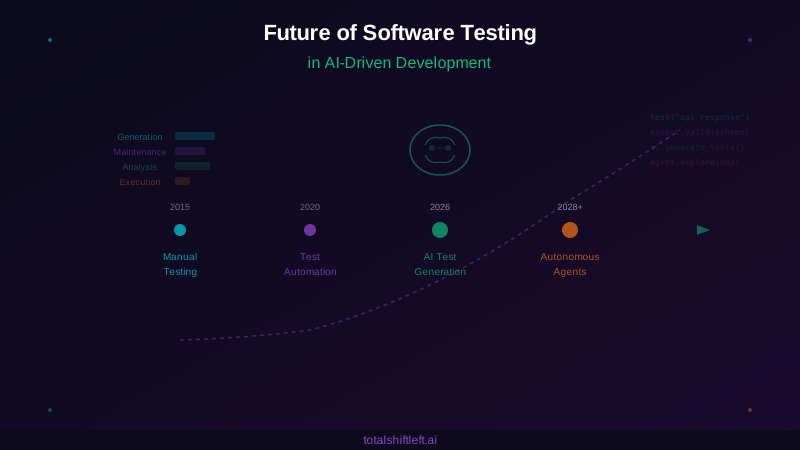
The maturity curve for autonomous test generation follows a clear trajectory. In 2024, tools reliably generated unit tests and basic API tests. By 2026, the most advanced platforms handle multi-step workflow tests and cross-service integration scenarios. By 2028, expect autonomous generation of performance test scenarios, security test cases, and chaos engineering experiments based on production architecture analysis.
The practical impact is substantial: teams report 40-60% reductions in test creation time and 20-30% improvements in code coverage when adopting AI test generation alongside their existing practices.
How Total Shift Left does this today: Total Shift Left's AI reads your OpenAPI or Swagger spec and generates the test suite — happy path, negative, and boundary cases — directly from the schema, typically reaching full functional coverage in under a minute. Generation runs on your choice of 13+ LLM providers, including a fully self-hosted option (Ollama, vLLM, LM Studio), so specs and prompts never have to leave your infrastructure.
Self-Healing Tests
Test maintenance consumes an estimated 30-40% of QA team effort in large organizations. Every UI change, API version update, or data model modification can break dozens of existing tests — not because defects were introduced, but because the tests themselves became outdated.
Self-healing tests solve this problem by detecting when a failure is caused by a non-defect change and automatically repairing the affected test. When a CSS selector changes, the self-healing engine identifies the element through alternative attributes, visual position, or semantic context. When an API response adds a new field, the assertion adapts to validate the original contract while accommodating the extension.
The self-healing workflow operates in three stages. First, the system detects that a test failure is environmental or structural rather than a genuine defect. Second, it generates a repair — an updated locator, modified assertion, or adjusted test data. Third, it applies the repair and flags the change for human review, maintaining an audit trail of every automatic modification. This is exactly the pattern behind AI-assisted repair of failing tests, which proposes the fix and leaves the sign-off with a human.
Ready to shift left with your API testing?
Try our no-code API test automation platform free. Generate tests from OpenAPI, run in CI/CD, and scale quality.
Organizations adopting self-healing tests report 60-80% reductions in test maintenance effort and significantly fewer false-positive pipeline failures. This directly improves developer trust in the test suite, a critical factor in maintaining testing culture within DevOps teams.
Predictive Quality Analytics
Predictive quality analytics uses historical data — defect histories, code change patterns, test results, and production incidents — to forecast where quality risks lie before testing even begins. Rather than testing everything equally, teams focus resources on the modules, services, and code paths that statistical models identify as high-risk.
Practical applications include:
- Change risk scoring — Assigning a risk level to every pull request based on the files changed, the author's historical defect rate, the complexity of the modification, and the test coverage of the affected area
- Test suite optimization — Selecting the minimum set of tests that maximizes defect detection probability for a given change, reducing pipeline execution time by 50-70%
- Release readiness prediction — Estimating the probability of production incidents based on the test results, code quality metrics, and deployment characteristics of a release candidate
- Defect clustering — Identifying patterns in defect occurrence that point to architectural weaknesses, team process issues, or third-party dependency risks
Predictive quality analytics transforms testing from a reactive verification activity into a proactive risk management discipline, aligning closely with the principles of quality engineering.
AI Pair Testing
AI pair testing brings the collaborative model of pair programming to quality assurance. An AI agent works alongside a human tester during exploratory testing sessions, suggesting areas to investigate, generating test data on demand, recording observations, and flagging anomalies that the human might miss.
During a session, the AI pair tester might notice that a tester is focusing on positive paths and suggest negative scenarios. It might detect that response times are degrading under certain input patterns and recommend performance investigation. It might recall that a similar feature in another part of the application had a specific class of defect and suggest checking for the same pattern.
This collaboration amplifies the strengths of both participants. The human brings domain knowledge, intuition, and creative thinking about edge cases. The AI brings exhaustive memory, pattern recognition across the entire codebase, and tireless attention to detail. Together, they find defects that neither would discover alone.
Testing AI Systems
As organizations deploy more AI and ML models into production, testing the AI systems themselves has become a critical discipline. Traditional testing assumes
deterministic behavior — the same input always produces the same output. AI systems are inherently non-deterministic, producing outputs that vary based on model weights, training data, and inference conditions.
Testing AI systems requires new approaches:
- Behavioral testing — Validating that the model behaves correctly across categories of input rather than specific cases
- Fairness and bias testing — Ensuring that model outputs do not discriminate across protected characteristics
- Robustness testing — Verifying that small input perturbations do not cause disproportionate output changes
- Drift monitoring — Detecting when model performance degrades over time as real-world data distributions shift
- Hallucination detection — Identifying cases where generative AI models produce confidently incorrect outputs
Organizations building testing strategies for AI-powered applications must integrate these specialized validation approaches alongside conventional functional testing.
The Evolving Testing Architecture
The architecture of testing systems is shifting from a monolithic test-then-deploy model to a distributed, continuous quality mesh. In this architecture, quality signals are collected from every stage of the software lifecycle and fed into a centralized intelligence layer that orchestrates testing decisions.
The modern testing architecture comprises four layers:
- Development-time validation — AI-generated unit tests, static analysis, and code review bots that catch issues before code is committed
- Pipeline quality gates — Automated integration tests, contract tests, security scans, and performance baselines integrated into CI/CD workflows
- Pre-production verification — Canary deployments, blue-green testing, and synthetic traffic generation that validate changes under production-like conditions
- Production quality monitoring — Real-user monitoring, synthetic checks, anomaly detection, and automated rollback triggers that catch issues that escaped pre-production testing
AI orchestrates across all four layers, determining what to test, when to test it, and how to interpret results. The orchestration layer learns from every test execution, production incident, and code change to continuously improve its decision-making.
Tools Leading the AI Testing Revolution
The AI testing tool landscape is evolving rapidly. Here is how the major categories compare:
| Category | What It Does | Maturity (2026) | Best For |
|---|---|---|---|
| AI Test Generators | Creates test cases from code, specs, or behavior analysis | High | Unit tests, API tests, reducing creation time |
| Self-Healing Platforms | Auto-repairs broken tests from UI/API changes | High | Large regression suites, UI-heavy applications |
| Predictive Analytics | Forecasts defect risk, optimizes test selection | Medium-High | Enterprises with historical data, CI/CD optimization |
| AI Pair Testers | Assists human testers in exploratory sessions | Medium | Complex domains, usability testing |
| Autonomous Testing Agents | End-to-end test execution without human scripting | Medium | Regression testing, smoke testing, new feature exploration |
| AI Performance Testing | Generates load scenarios from production traffic patterns | Medium | Microservices, API-heavy architectures |
| ML Model Testing | Validates AI/ML model behavior, fairness, and robustness | Emerging | Organizations deploying AI models in production |
When evaluating tools, prioritize those that integrate with your existing CI/CD pipeline, support your technology stack, and provide transparent explanations for their testing decisions. The best AI testing tools augment your team's capabilities rather than creating a black-box dependency. Explore the future of API testing for a deeper look at how these tools apply to API-specific workflows.
AI-driven software testing in practice: a worked example
Consider a mid-sized fintech company running 120 microservices with a test suite of 18,000 automated tests. Before adopting AI-driven testing, their CI pipeline took 4 hours to execute the full regression suite. Developers routinely skipped running the complete suite on feature branches, leading to integration defects discovered late in the release cycle. Test maintenance consumed two full-time engineers who spent most of their time updating broken selectors and outdated assertions.
After implementing an AI testing platform, the organization achieved several measurable improvements over six months:
- Pipeline execution time dropped from 4 hours to 45 minutes. Predictive test selection identified the 15-20% of tests relevant to each change, executing only those by default while running the full suite nightly.
- Test maintenance effort fell by 70%. Self-healing capabilities handled routine selector updates and API response changes automatically, with engineers reviewing modifications weekly rather than fixing breakages daily.
- Defect escape rate decreased by 35%. AI-generated tests caught boundary conditions and error paths that the manually written suite missed, particularly in payment processing and authentication flows.
- New feature test coverage improved. Autonomous test generation produced initial test suites for new endpoints within hours of development, rather than the previous pattern of tests lagging features by one or two sprints.
The two engineers previously dedicated to test maintenance transitioned to designing test strategies for AI model validation and improving the organization's quality analytics practice — higher-value work aligned with their skills.
AI-driven software testing challenges and how to solve them
Challenge: AI-generated tests that lack meaningful assertions. Early AI test generators often produce tests that exercise code paths without validating meaningful outcomes. Tests achieve coverage metrics without catching defects.
Free Guided worksheet
Build Your Testing Strategy in 30 Minutes
A structured worksheet that walks you through defining your testing strategy in 30 minutes. Cover architecture, tools, layers, and team responsibilities.
Download FreeSolution: Evaluate AI-generated tests for assertion quality, not just coverage. Establish team guidelines for what constitutes a meaningful assertion. Use mutation testing to validate that your test suite — including AI-generated portions — actually detects injected faults.
Challenge: Over-reliance on AI leading to blind spots. Teams that delegate testing decisions entirely to AI systems may miss categories of defects that the AI has not been trained to detect, particularly domain-specific business logic errors and usability issues.
Solution: Maintain a balanced approach combining AI-generated tests with human exploratory testing. Use AI for breadth coverage and repetitive regression validation. Reserve human testing effort for domain-critical scenarios, usability evaluation, and creative edge-case exploration.
Challenge: Organizational resistance to changing testing roles. QA teams may perceive AI testing tools as threats to their positions, leading to resistance and underutilization of the technology.
Solution: Frame AI testing adoption as role evolution, not replacement. Invest in training programs that help testers develop AI-related skills. Demonstrate how AI handles tedious maintenance tasks so that testers can focus on more engaging and impactful work.
Challenge: Data quality for predictive analytics. Predictive quality models require clean, consistent historical data — test results, defect records, code change metadata — that many organizations lack.
Solution: Start collecting structured quality data now, even before implementing predictive tools. Standardize defect classification, tag test results with metadata, and instrument your pipeline to capture execution metrics. Six months of clean data is often sufficient to train useful predictive models.
AI in Software Testing: Best Practices for Preparing Your Team
Invest in AI literacy for QA professionals. Every tester should understand the basics of how AI models work, what they are good at, and where they fail. This does not mean every tester needs to become a data scientist, but they should be able to evaluate whether an AI-generated test is meaningful and where an AI testing tool might produce unreliable results.
Start with augmentation, not replacement. Introduce AI testing tools that assist existing workflows before attempting full automation. Let testers use AI to generate test suggestions that they review and refine. Build confidence in the tools gradually.
Establish quality metrics that matter. Move beyond vanity metrics like test count and pass rate. Track defect escape rate, mean time to detect, test suite effectiveness (via mutation testing), and the ratio of testing effort to defect prevention. These metrics reveal whether your testing strategy actually improves software quality.
Build feedback loops between production and testing. Connect production monitoring data to your testing intelligence layer. When a production incident occurs, your testing system should learn from it — identifying what tests could have caught the issue and generating those tests for future releases.
Maintain human oversight for critical paths. For business-critical transactions, security-sensitive operations, and regulatory compliance scenarios, keep human testers in the loop. AI should generate and suggest, but humans should validate and approve in domains where the cost of a missed defect is high.
Develop a shift-left testing mindset. AI testing tools are most effective when applied early in the development cycle. Integrate AI test generation into the developer workflow, running generated tests before code review rather than after deployment.
Future-Ready Testing Checklist
Use this checklist to assess your organization's readiness for AI-driven testing:
- ✔ CI/CD pipeline is fully automated with quality gates at each stage
- ✔ Test results, defect data, and code metrics are collected in structured, queryable formats
- ✔ Team has evaluated at least two AI testing tools for your primary technology stack
- ✔ QA professionals have completed training on AI/ML fundamentals and prompt engineering
- ✔ Test strategy distinguishes between AI-automatable tasks and human-essential activities
- ✔ Self-healing or auto-maintenance capabilities are piloted for UI or API test suites
- ✔ Predictive test selection is evaluated or implemented for pipeline optimization
- ✔ Production monitoring data feeds back into testing intelligence and test generation
- ✔ Testing strategy for AI/ML models exists if your organization deploys AI features
- ✔ Metrics track defect escape rate, test effectiveness, and time-to-detect alongside coverage
- ✔ Exploratory testing sessions are scheduled regularly, supplemented by AI pair testing tools
- ✔ Test architecture supports distributed execution and intelligent orchestration
- ✔ Security and performance testing are integrated into CI/CD, not executed as separate phases
- ✔ Team roles and career paths reflect the evolution from test scripting to quality engineering
Take the next step. See how AI API testing platform applies these ideas to your workflow, or explore automate testing with AI for the broader picture.
See also: generate tests from openapi in our learn hub for the underlying concept.
Testing code you did not write
The concrete change AI-assisted development makes to testing is that the volume of generated code outruns human review. The response is to gate on behaviour rather than on reading every diff:
# .github/workflows/generated-code-gate.yml
name: Gate for AI-assisted changes
on: pull_request
jobs:
  verify:
    runs-on: ubuntu-latest
    steps:
      - uses: actions/checkout@v4
        with: { fetch-depth: 0 }

      # 1. the contract must not move silently
      - run: |
          git show origin/${{ github.base_ref }}:openapi.yaml > /tmp/base.yaml
          oasdiff breaking /tmp/base.yaml openapi.yaml --fail-on ERR

      # 2. mutation score, not line coverage — generated tests inflate coverage
      - run: |
          pip install mutmut
          mutmut run --paths-to-mutate app/ --CI
          mutmut results --all false | tee mutation.txt
          python scripts/assert_mutation_score.py --min 60 mutation.txt

      # 3. no new dependency arrives without review
      - run: |
          git diff origin/${{ github.base_ref }} -- requirements.txt package-lock.json \
            | grep -q '^+' && echo '::error::dependency change needs human review' && exit 1 || true
Line coverage is the metric generated tests are best at gaming, which is exactly why a mutation score is the one worth gating on.
Frequently asked questions about AI-driven software testing
How is AI changing software testing?
AI is changing software testing in five major ways: autonomous test generation from code and requirements, self-healing tests that automatically fix broken selectors and assertions, predictive quality analytics that identify high-risk code before testing, intelligent test prioritization that runs the most relevant tests first, and AI pair testers that assist human testers with exploratory testing and test design.
Will AI replace software testers?
AI will not replace software testers but will fundamentally change the role. Repetitive tasks like test script maintenance, regression testing, and basic test data generation will be automated. Testers will shift to higher-value activities: designing test strategies, evaluating AI-generated tests, exploratory testing, risk assessment, and ensuring AI systems themselves are tested properly. The demand for quality engineers who understand AI will increase.
What is autonomous testing?
Autonomous testing is AI-driven test execution that requires minimal human intervention. AI agents explore applications, generate test cases, execute tests, analyze results, and report defects without manual scripting. Current autonomous testing tools can handle 40-60% of regression testing independently, with human oversight for complex scenarios and final validation.
What skills do testers need for AI-driven development?
Testers in AI-driven development need: understanding of AI/ML concepts and limitations, ability to evaluate AI-generated test quality, prompt engineering for AI testing tools, statistical thinking for non-deterministic validation, data analysis skills for quality metrics, and domain expertise that AI cannot replicate. Programming skills become more important for configuring and extending AI testing tools.
What are self-healing tests?
Self-healing tests are automated tests that detect and fix their own failures caused by UI changes, API modifications, or environment differences. When a locator breaks or an assertion fails due to a non-defect change, the self-healing system identifies the change, updates the test automatically, and flags the modification for human review. This reduces test maintenance effort by 60-80%.
What testing trends will dominate 2026-2030?
Key testing trends for 2026-2030 include: AI-generated tests becoming standard in CI/CD pipelines, shift from test automation to test orchestration, quality engineering as a core engineering discipline, production testing and observability-driven quality, autonomous regression testing with human oversight, and testing of AI systems becoming a specialized domain.
Sources and further reading
- DORA State of DevOps research — the multi-year dataset behind the four delivery metrics.
- OWASP Top 10 for LLM Applications — the risk list for AI-backed features.
- NIST AI Risk Management Framework — the reference framework for governing AI systems.
Key takeaways
- The future of software testing is not about choosing between human testers and AI tools.
- It is about designing a testing practice that leverages the strengths of both — using AI for speed, scale, and pattern recognition while relying on human expertise for strategy, domain knowledge, and creative exploration.
- Organizations that begin preparing now — investing in AI literacy, collecting quality data, piloting AI testing tools, and evolving QA roles toward quality engineering — will have a decisive advantage as AI-driven development becomes the norm.
- Those that wait risk accumulating quality debt that compounds with every release.
- The testing discipline has always adapted to match the systems it serves.
- AI-driven development demands the most significant adaptation yet, but for teams that embrace it, the result is not less testing but smarter, faster, and more effective quality assurance.
Start by assessing your readiness against the checklist above, pick one area to pilot — whether that is AI test generation, self-healing tests, or predictive analytics — and build from there. The future of software testing is not a distant possibility. It is happening now.
Related reading: DevOps Testing Complete Guide | Testing Strategy for AI-Powered Applications | Software Testing Strategy for Modern Applications | What Is Shift-Left Testing | Future of API Testing | Quality Engineering vs Traditional QA | API Testing Complete Guide
Ready to shift left with your API testing?
Try our no-code API test automation platform free.