
JWT Secret Leakage in Test Files: Detection & Controls
Quick answer
JWT secret leakage in test files happens when developers copy real signing keys into fixtures or test-config files that get committed to source control. The enterprise fix is three reinforcing layers — pre-commit hooks (git-secrets, TruffleHog) that catch JWT-shaped strings before commit, CI scanning as a backstop for bypassed hooks, and vault integration so test environments fetch ephemeral keys at runtime instead of storing them in fixtures.
Reviewed by Sushant Joshi
How JWT signing keys end up in test files, what the blast radius looks like, and the enterprise controls that prevent it. Pre-commit detection, CI scanning, vault integration, and key rotation patterns that hold up to audit.
In this guide
- What is JWT secret leakage?
- The key components of JWT secret leakage
- How keys end up in test files
- Three blast-radius scenarios
- The three-layer control set
- Pre-commit detection patterns
- CI scanning and vault integration
- Remediation playbook
- Why JWT secret leakage matters at enterprise scale
- JWT secret leakage tools compared
- JWT secret leakage in practice: a worked example
- JWT secret leakage reference architecture
- JWT secret leakage metrics that matter
- JWT secret leakage rollout playbook
- JWT secret leakage challenges and how to solve them
- JWT secret leakage best practices
- JWT secret leakage checklist
- Find the tokens that are already in the repository
What is JWT secret leakage?
JWT secret leakage prevention in test files is the practice of preventing JWT signing keys, OAuth client secrets, and other authentication credentials from being committed to source control or persisted in CI artifacts. The 2026 enterprise model uses three reinforcing layers — pre-commit hooks, CI scanning, and vault integration — to make leakage prevention reliable rather than developer-discipline-dependent. Each layer alone is insufficient; the combination eliminates leaks at the source.
Getting test credentials without leaving a static token in the pipeline is its own problem — SSO and secret management for API testing covers the OIDC-to-vault pattern.
If abuse protection is in scope, how to test API rate limiting has the k6 and Python cases.
The key components of JWT secret leakage
Each enterprise program in this area has the same load-bearing components, regardless of vendor. The components separate cleanly into governance, enforcement, and evidence layers.
Pre-commit hook layer
git-secrets / detect-secrets / TruffleHog / Gitleaks running on every developer's machine via Husky or Lefthook configured at the org level. Catches JWT-shaped strings, RSA / EC private key markers, and high-entropy secrets before they leave the laptop.
CI scanning layer
TruffleHog CI / Gitleaks Actions / native GitHub or GitLab secret scanning running on every PR as a backstop for bypassed pre-commit hooks. Failures block merge regardless of whether pre-commit caught the issue.
Vault integration layer
HashiCorp Vault / AWS Secrets Manager / Azure Key Vault / GCP Secret Manager providing ephemeral signing keys to test environments at runtime. Test fixtures contain no keys; the keys never enter source control.
Mock OAuth/OIDC layer
Hydra or Keycloak for fast unit / integration tests, generating fresh signing keys per test run. The mock server's keys never persist; nothing to leak.
SIEM audit and forensics
Every signed-token issuance logged into the SIEM with key reference, environment, subject. Forensic queries during incident response identify usage of any leaked key during the exposure window.
Periodic git-history audit
Scheduled scans of historical commits on a quarterly cadence to catch any pre-existing leaks. Combined with key rotation as the primary remediation; assume any leak is permanent and mitigate by rotation rather than removal.
How keys end up in test files
The pattern is depressingly consistent across organizations:
- A developer is debugging an auth flow.
- They copy a working JWT from a real environment into a test file as a fixture, intending to remove it later.
- The test file gets committed before they remove the JWT.
- Code review focuses on the test logic, not the fixture content.
- Months later, a security scan or a public repo find surfaces the leak.
Variants:
- The test secrets file (
.env.test,test-config.json) ends up containing real signing keys because someone copied production secrets and "edited what I needed." - The test environment shares an auth server with staging or production, and the test client's signing key is the same one in real use.
- A test fixture includes a JWT that itself contains valid claims (real subject, real audience), and the JWT was signed by a real key — even if the fixture doesn't include the key explicitly, the JWT can be replayed against the issuing server.
All three are leak vectors. All three are preventable.
Three blast-radius scenarios
Three scenarios determine the impact of a leak:
Test-only key, test-only environment. A signing key generated for the test environment, used only in the test environment, leaked. Blast radius: the test environment, which by policy holds no production data. Severity: low. Rotate, fix the control, move on.
Test key reused as staging or production key. The test key turns out to also be in use somewhere that processes real data. Blast radius: every environment that uses the key, every token signed by it during the exposure window. Severity: high. Treat as a real incident.
Real production JWT in a test fixture. The fixture contains a JWT signed by the production key, even though the key itself isn't in the fixture. The JWT can be replayed; whether it's still useful depends on its expiry and the issuing server's revocation behavior. Severity: medium-to-high depending on issuer policy.
The control set has to be tuned for the worst-case scenario, not the best. Assume any leak might be scenario 2.
The three-layer control set
A layered control set:
| Layer | What it does | Where it runs |
|---|---|---|
| Pre-commit | Detects JWT-shaped strings and signing keys before they're committed | Developer machine |
| CI scan | Re-scans on every PR; fails the build on detection | CI pipeline |
| Vault integration | Test environments fetch ephemeral keys at runtime | Test infrastructure |
Each layer alone is insufficient. Pre-commit can be bypassed (--no-verify). CI scans run after the secret may already be public on a pushed branch. Vault integration prevents the leak source but can't fix what's already in history.
Ready to shift left with your API testing?
Try our no-code API test automation platform free. Generate tests from OpenAPI, run in CI/CD, and scale quality.
The combination — pre-commit catches most, CI scan catches the rest, vault eliminates the source — is what actually works at enterprise scale.
Pre-commit detection patterns
Effective pre-commit patterns:
JWT-shape regex. JWTs are recognizable: three base64url-encoded segments separated by dots. A regex like eyJ[A-Za-z0-9_-]+\.[A-Za-z0-9_-]+\.[A-Za-z0-9_-]+ catches most. False positive rate is low because the structure is specific.
Private-key markers. RSA / EC private keys start with predictable markers (-----BEGIN RSA PRIVATE KEY-----, -----BEGIN EC PRIVATE KEY-----). Catch any commit containing these.
Common file-name allowlist. Block commits to filenames matching *secret*, *.key, *.pem unless explicitly allowed via a config file.
Git-secrets / detect-secrets / TruffleHog. Off-the-shelf tools that combine the above patterns and are pre-configured for common secret types. Cheap to adopt; high signal.
A working setup runs one of these tools as a pre-commit hook for every developer, with the hook configured at the org level (not per-repo) via a tool like Lefthook or Husky.
CI scanning and vault integration
CI scanning is a backstop for pre-commit. Run the same patterns in CI and fail the build on detection. The benefit over pre-commit is enforcement: developers can't --no-verify past the CI scan.
Vault integration eliminates the leak source. Patterns:
- Test environments fetch ephemeral signing keys from a vault (HashiCorp Vault, AWS Secrets Manager, equivalent) at startup, using native secret-manager integrations so credentials are pulled at runtime rather than written into source. Test fixtures don't include keys at all; they're injected at runtime.
- Per-test-run keys. Generate a fresh key pair at the start of each test run. The key never persists; nothing to leak.
- Mock IdP for unit tests. Use a mock OAuth/OIDC server that signs with a freshly-generated key per test. No production signing key path involved at all.
The combination — pre-commit + CI scan + vault — eliminates leaks at the source while catching the rare exceptions before they reach production code.
For broader auth-testing context see JWT authentication testing for enterprise IdPs and OAuth 2.0 negative testing for enterprise IdPs.
Remediation playbook
When a leak does happen, the playbook:
- Determine scope. Which key leaked. Where it was used. What data the key authorized access to.
- Rotate immediately. New key pair issued; old key revoked at the issuer. Every dependent system updated.
- Audit log review. Search for use of the old key during the exposure window. Anything anomalous escalates.
- Notify if required. If the key authorized access to regulated data, notification obligations under GDPR, HIPAA, or sector-specific rules may apply.
- Document the incident. Retain in the audit log: who detected, when, scope, remediation taken, control gap that allowed it.
- Fix the control. Add the missing pre-commit pattern, the missing CI scan, or the missing vault integration that would have prevented the leak.
The last step is the highest-leverage. Most leaks are the second of their type — the team had a similar leak before and didn't fix the control gap. Treat the remediation step as a first-class deliverable, not an afterthought.
For more security testing context see API security testing in enterprise SDL & CI/CD and OWASP API Top 10 for enterprise teams.
JWT secret leakage in test files is one of the most common preventable enterprise security incidents. The fix is well-understood — three layers of controls, all available off the shelf — but requires deliberate adoption. The teams that get this right rarely have a leak; the teams that don't, have one every quarter and burn cycles on remediation that the controls would have eliminated.
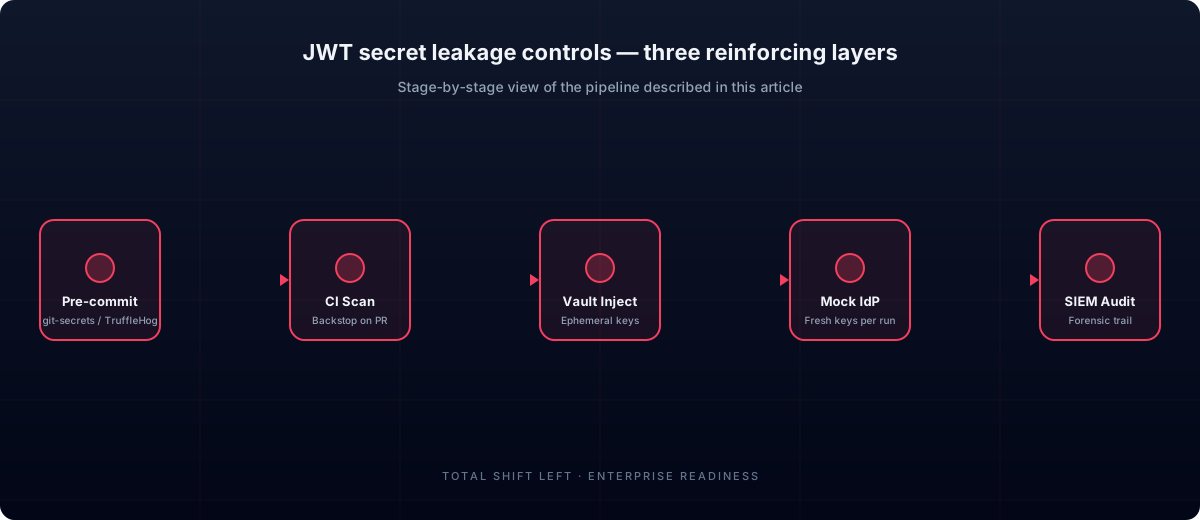
JWT secret leakage controls — pre-commit, CI scan, vault integration.
Why JWT secret leakage matters at enterprise scale
GitGuardian's 2024 State of Secrets Sprawl report found that JWT signing keys were the second-most-leaked secret category in source control after database credentials, with the median leak surviving 327 days before remediation. The blast radius for a leaked production-class signing key extends to every authenticated session signed during the exposure window — a per-incident cost that frequently exceeds $1M when forensic and notification costs are included.
JWT secret leakage tools compared
A practical view of the tool categories that scale across enterprise testing programs in this area:
| Category | Example tools |
|---|---|
| Pre-commit hooks | git-secrets, detect-secrets, TruffleHog, Gitleaks for local enforcement |
| CI scanning | TruffleHog CI, Gitleaks Actions, GitHub secret scanning, GitLab secret detection |
| Vault platforms | HashiCorp Vault, AWS Secrets Manager, Azure Key Vault, GCP Secret Manager |
| Mock OAuth/OIDC | Hydra, Keycloak — generate ephemeral keys per test run |
| Audit / forensics | SIEM with key-usage tracking; logs of every signed-token issuance |
Tool selection is secondary to architecture. The patterns above hold regardless of which specific vendor you adopt.
JWT secret leakage in practice: a worked example
A representative deployment pattern from an enterprise rollout in this area:
Problem. A fintech engineering team committed a .env.test file containing a real signing key from staging — which turned out to be the same key in production. The leak was discovered 11 months later by an automated scan. Forensic review found no evidence of malicious use, but the bank had to rotate the key across every dependent system and notify regulators under the operational-risk reporting requirement.
Solution. The team added pre-commit hooks (git-secrets) at the org level via Husky. CI added TruffleHog scans on every PR. Vault integration was deployed: test environments fetched ephemeral signing keys at startup; fixtures contained no keys.
Results. Zero JWT leak incidents in the next 24 months. The pre-commit hook caught 14 attempted commits across the next year that would have leaked keys without it. CI added a backstop that caught one bypassed pre-commit in the same period.
Free PDF guide (12 pages)
Top 50 API Testing Mistakes
50 real-world API testing mistakes organized by category — from authentication to performance — each with a concrete fix strategy.
Download Free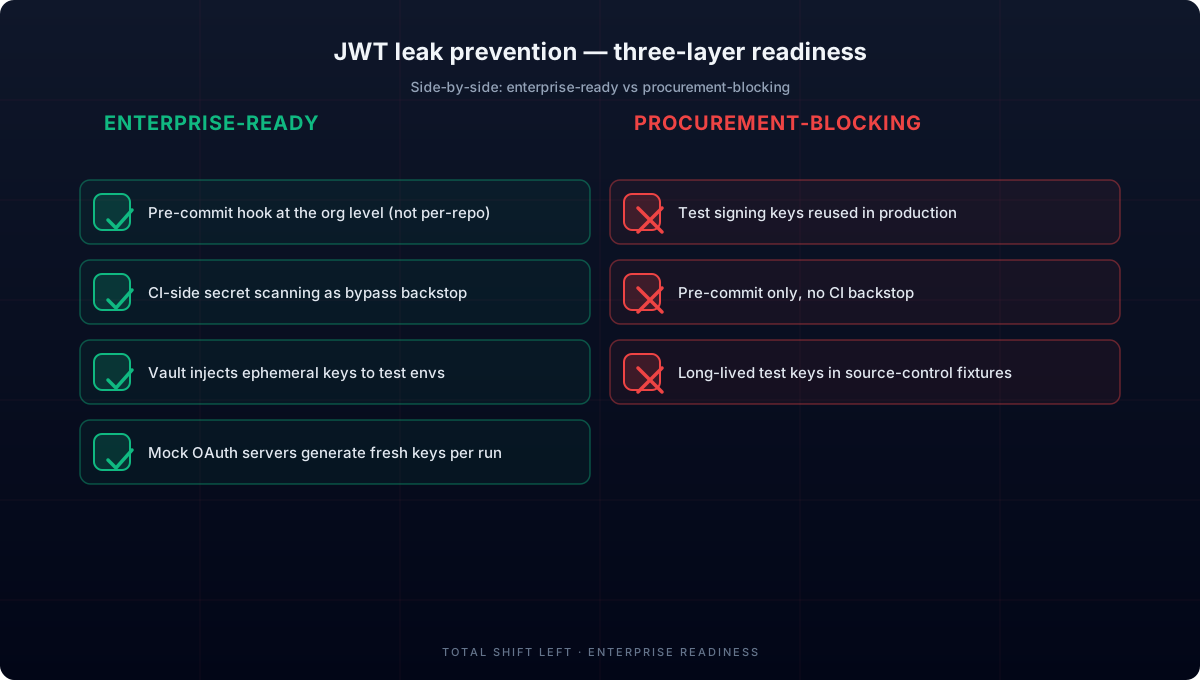
JWT secret leakage — readiness checklist.
JWT secret leakage reference architecture
A three-layer JWT-leak prevention architecture has six components. Pre-commit hook layer — git-secrets / detect-secrets / TruffleHog / Gitleaks running on every developer's machine via Husky or Lefthook configured at the org level. CI scanning layer — TruffleHog CI / Gitleaks Actions / native GitHub or GitLab secret scanning running on every PR as a backstop for bypassed pre-commit. Vault integration layer — HashiCorp Vault / AWS Secrets Manager / Azure Key Vault / GCP Secret Manager providing ephemeral signing keys to test environments at runtime. Mock OAuth/OIDC layer — Hydra or Keycloak for fast unit / integration tests, generating fresh keys per test run. Audit and forensics layer — SIEM with key-usage tracking; logs of every signed-token issuance for forensic queries. Periodic git-history audit — scheduled scans of historical commits on a quarterly cadence to catch any pre-existing leaks. Each layer reinforces the others; pre-commit catches most, CI catches what pre-commit bypasses, vault eliminates the source.
JWT secret leakage metrics that matter
Three metrics establish leak-prevention program health. Caught-leak count — number of attempted leaks caught by pre-commit and CI scans per quarter — is the program effectiveness metric; non-zero means the controls are working as intended. Bypassed-pre-commit count — number of commits CI caught that pre-commit missed (typically via --no-verify) — measures developer compliance with the local hook. Live-key-in-test count — number of test environments where production-class keys are still in use — should trend toward zero as vault integration matures. Report on a quarterly cadence to security and engineering leadership.
JWT secret leakage rollout playbook
A 6-week rollout aligns most enterprises. Weeks 1-2: pre-commit foundation. Deploy git-secrets / TruffleHog at the org level via Husky. Train developers. Weeks 3-4: CI backstop. Add CI-side scanning on every PR. Configure failure modes. Weeks 5-6: vault integration. Deploy vault integration so test environments fetch ephemeral keys. Migrate existing fixtures away from in-source-control keys. Most enterprises reach steady state in 6-8 weeks; ongoing investment is in periodic git-history audits and adapter updates as new code patterns emerge.
JWT secret leakage challenges and how to solve them
Engineers bypass pre-commit hooks with --no-verify. Add CI-side enforcement that runs the same patterns. CI catches what pre-commit bypasses.
Mock IdP servers require keys somewhere. Generate ephemeral keys at test-run startup; never persist. The mock server's keys never enter source control.
Test environments need keys for end-to-end testing. Vault integration: tests fetch keys at startup. Keys never persist in fixtures.
Historical leaks exist in git history. Rotate any potentially leaked keys. Use git-filter-repo to remove from history if practical, but assume the leak is permanent and rotate as the primary mitigation.
JWT secret leakage best practices
- Run pre-commit hooks (git-secrets / TruffleHog / Gitleaks) at the org level
- Add CI-side scanning as a backstop for bypassed pre-commit
- Use vault integration so test environments fetch ephemeral keys at runtime
- Generate fresh keys per test run for mock OAuth servers
- Run periodic audit scans of git history
- Document the remediation playbook before you need it
- Rotate any potentially leaked key — don't debate likelihood
JWT secret leakage checklist
A pre-flight checklist enterprise teams can run against their current state:
- ✔ Pre-commit hooks for secret detection are mandatory at the org level
- ✔ CI-side secret scanning runs on every PR
- ✔ Vault integration provides ephemeral keys to test environments
- ✔ Mock OAuth servers generate fresh keys per test run
- ✔ Periodic git-history audits run on a schedule
- ✔ Remediation playbook is documented and rehearsed
- ✔ Production signing keys are never reused in test environments
- ✔ SIEM captures every signed-token issuance for forensic queries
Take the next step. See how security testing for regulated industries applies these ideas to your workflow, or explore enterprise security for the broader picture.
See also: jwt authentication in our learn hub for the underlying concept.
Find the tokens that are already in the repository
Test fixtures are where JWTs go to be forgotten. Scan history, not just the working tree — a rotated secret that is still in a 2024 commit is still a live secret if it was never actually rotated:
# scan the full history, not just HEAD
docker run --rm -v "$PWD:/repo" zricethezav/gitleaks:latest detect \
  --source=/repo --redact --report-format sarif --report-path gitleaks.sarif

# decode anything that looks like a JWT to see whether it is real and still valid
grep -rEho 'eyJ[A-Za-z0-9_-]+\.[A-Za-z0-9_-]+\.[A-Za-z0-9_-]+' tests/ | sort -u |
while read -r t; do
  payload=$(echo "${t#*.}" | cut -d. -f1 | tr '_-' '/+' | base64 -d 2>/dev/null)
  exp=$(echo "$payload" | jq -r '.exp // empty')
  iss=$(echo "$payload" | jq -r '.iss // "?"')
  if [ -n "$exp" ] && [ "$exp" -gt "$(date +%s)" ]; then
    echo "LIVE TOKEN  iss=$iss  expires=$(date -d "@$exp")"
  fi
done
Then make it impossible to add another one — a pre-commit hook plus a CI gate, so the finding is a blocked commit rather than an incident report:
# .pre-commit-config.yaml
repos:
  - repo: https://github.com/gitleaks/gitleaks
    rev: v8.18.4
    hooks: [{ id: gitleaks }]

# .github/workflows/secret-scan.yml
- uses: gitleaks/gitleaks-action@v2
  env: { GITHUB_TOKEN: ${{ secrets.GITHUB_TOKEN }} }
Sources and further reading
- Gitleaks — secret scanning for repositories and CI.
- RFC 7519 — JSON Web Token — the JWT claim set and validation rules.
- HashiCorp Vault documentation — secret storage and dynamic credentials for test runs.
Key takeaways
- JWT secret leakage in test files is one of the most common preventable enterprise security incidents.
- The fix is well-understood — three layers of controls, all available off the shelf — but requires deliberate adoption.
- The teams that get this right rarely have a leak; the teams that don't, have one every quarter and burn cycles on remediation that the controls would have eliminated.
JWT secret leakage FAQ
How serious is a leaked test JWT signing key?
Depends entirely on whether the test key was reused in production or in any environment that processes real data. Test-only keys in test-only environments are low impact. The serious cases are when the test key turns out to also be the staging key, or when the test environment can call production-issued tokens, or when the leaked key was a copy of a real production key.
Why do test files end up with real keys?
Convenience. A developer copies a working production-ish JWT for a test fixture, doesn't strip the signing key, commits it. Or a test secrets file mirrors a production secrets file too closely and someone fills in real values. Or a test environment uses the same auth server as production and the test client has the same key. All preventable; all common.
What's the right control set?
Three layers. Pre-commit hooks that catch JWT-shaped strings and signing keys before they leave the developer's machine. CI scanning that double-checks against the same patterns and fails the build on detection. Vault integration so test environments can fetch ephemeral test keys at runtime instead of having them in source files.
How do you remediate after a leak?
Treat as an incident. Rotate the affected key in every environment that ever used it. Audit logs for use of the key during the exposure window. Document the remediation for the audit trail. Then fix the control gap that allowed it.
Ready to shift left with your API testing?
Try our no-code API test automation platform free.