
OWASP API Top 10: Enterprise Controls & Audit Evidence
Quick answer
OWASP API Top 10 enterprise controls means documenting each of the ten risks — from BOLA to unsafe consumption of APIs — as a formal SDL control with five fields: primary mitigation, owner, CI gate stage, evidence retention, and a mapping to frameworks like SOC 2, PCI-DSS, and FedRAMP. Unlike a test checklist, a control survives an audit conversation because it proves who owns the mitigation and where the evidence lives.
Reviewed by Smeet Gohel
How enterprise security teams operationalize the OWASP API Security Top 10 (2023) as concrete SDL controls — not just a test checklist. Mitigation patterns, evidence per control, and the program structure that survives procurement and audit review.
In this guide
- What is OWASP API Top 10 controls?
- The key components of OWASP API Top 10 controls
- Why the test-checklist model fails
- The ten controls
- Mitigation patterns
- RACI: who owns each control
- Cross-framework mapping
- Why OWASP API Top 10 controls matters at enterprise scale
- OWASP API Top 10 controls tools compared
- OWASP API Top 10 controls in practice: a worked example
- OWASP API Top 10 controls reference architecture
- OWASP API Top 10 controls metrics that matter
- OWASP API Top 10 controls rollout playbook
- OWASP API Top 10 controls challenges and how to solve them
- OWASP API Top 10 controls best practices
- OWASP API Top 10 controls checklist
- Map each risk to a control and to the test that evidences it
What is OWASP API Top 10 controls?
OWASP API Top 10 enterprise controls is the practice of operationalizing each item in the OWASP API Security Top 10 (2023) as a documented enterprise control — with mitigation, owner, gate stage, evidence retention, and cross-framework mapping — rather than as a test checklist. The pattern bridges engineering vocabulary (OWASP) with auditor vocabulary (SOC 2 / PCI-DSS / FedRAMP / ISO 27001) so the same testing program serves both without parallel work.
AI tool endpoints add a threat model of their own — securing MCP endpoints covers tool poisoning, confused deputy and token passthrough.
The key components of OWASP API Top 10 controls
Each enterprise program in this area has the same load-bearing components, regardless of vendor. The components separate cleanly into governance, enforcement, and evidence layers.
Per-OWASP-item control register
Each of API1 through API10 is documented as a control with five fields — primary mitigation, owner (engineering / security / platform), gate stage (PR / pre-prod / production), evidence retention, framework mapping. The register lives in source control alongside policy.
Negative authorization tests
For API1 (BOLA), API3 (broken object property authorization), API5 (broken function level authorization), and API7 (SSRF) — negative tests asserting unauthorized callers are rejected. Run as CI quality gates on every change.
Schema-driven enforcement
For API3, API8, API9, API10 — schema-aware tests that treat the OpenAPI / WSDL spec as the source of truth. Spec linting, contract diff, configuration scanning, and outbound integration validation all derive from the spec.
Per-tenant scoping
For API4 (unrestricted resource consumption) and API6 (unrestricted access to sensitive flows) — fair-share rate limiting and behavioral monitoring scoped per tenant and per workload class.
Cross-framework mapping
A mapping table from each OWASP item to SOC 2 / PCI-DSS / FedRAMP / ISO 27001 controls it evidences. Auditors query in framework vocabulary; the program responds with OWASP-mapped evidence.
RACI per control
Engineering implements mitigations, security defines policy and threat models, platform operates enforcement, compliance owns framework mapping. Documented per control to prevent the standalone-governance-team failure mode.
Why the test-checklist model fails
Most enterprise teams adopt the OWASP API Security Top 10 as a test checklist: write a test for each item, run them in CI, ship. That works for surface-level coverage but consistently fails three audit conversations:
- "Show me the control, not the test." A test is one part of a control. The control includes the documented mitigation, the owner, the evidence retention, and the gate. A test alone is incomplete.
- "How do these map to my framework?" Auditors think in SOC 2, PCI-DSS, FedRAMP, ISO 27001 — not in OWASP. The mapping has to be documented, not improvised.
- "What happens when a test fails?" The escalation path matters. A failing test that gets silently ignored is worse than no test.
The fix is to operationalize each OWASP item as a control with five fields: mitigation, owner, gate, evidence, and framework mapping.
For background on OWASP risk descriptions, see OWASP API Top 10 (2023) for Enterprise Teams.
The ten controls
A practical control table mapping OWASP API Security Top 10 (2023) to enterprise SDL controls:
| OWASP item | Control summary | Primary mitigation | Gate stage |
|---|---|---|---|
| API1 — BOLA | Object-level authorization on every PHI/PII/CHD-scoped resource | Permission check inside the data layer; tested with negative authorization tests | PR + pre-prod |
| API2 — Broken authentication | OAuth/OIDC negative paths + JWT validation | Negative test suite covering RFC 9700 patterns (see worked examples) | PR + pre-prod |
| API3 — Broken object property authorization | Field-level access on confidential properties | Schema-driven contract tests asserting confidential fields appear only in authorized responses | PR + pre-prod |
| API4 — Unrestricted resource consumption | Per-tenant rate limits + circuit breakers | Rate-limit testing patterns (for multi-tenant SaaS) | Pre-prod + production canary |
| API5 — Broken function level authorization | Role-based gating on every protected operation | Negative authorization tests across all role boundaries | PR + pre-prod |
| API6 — Unrestricted access to sensitive business flows | Risk-scored throttling on multi-step business flows | Behavioral monitoring + per-flow rate budgets | Pre-prod + production |
| API7 — Server-side request forgery | URL allowlist + DNS pinning on outbound requests | Negative tests sending malicious URL parameters | PR + pre-prod |
| API8 — Security misconfiguration | Hardened-baseline scanning + drift detection | Configuration tests + IaC policy enforcement | Pre-prod + continuous |
| API9 — Improper inventory management | API spec inventory + lifecycle tracking | Spec linting + breaking-change detection (API governance) | PR + continuous |
| API10 — Unsafe consumption of APIs | Schema validation + circuit breakers on outbound integrations | Contract tests on every outbound integration | PR + pre-prod |
Each row deserves its own internal runbook. The table above is the control register; the runbook describes how the control operates day-to-day. The "evidence retention" field in each control is where a tamper-evident audit-log trail does the heavy lifting — recording who ran which gate, when, and with what result, in the form auditors expect.
Ready to shift left with your API testing?
Try our no-code API test automation platform free. Generate tests from OpenAPI, run in CI/CD, and scale quality.
Mitigation patterns
Three mitigation patterns appear repeatedly across the ten controls:
Negative testing as policy. API1, API2, API3, API5, and API7 all rely on negative tests that assert the system rejects malformed or unauthorized requests. Treat the negative test corpus as a versioned, owned artifact — not a folder of one-off tests written when an incident happened.
Schema-driven enforcement. API3 (broken object property authorization), API8 (misconfiguration), API9 (inventory), and API10 (unsafe consumption) all benefit from treating the OpenAPI / WSDL spec as the source of truth. Tests, gates, and audit evidence all reference the spec.
Per-tenant scoping. API4 (resource consumption) and API6 (sensitive flows) both scale with the system's tenant model. A single global rate limit is rarely sufficient at enterprise scale; the control has to account for fair-share across tenants and workload classes.
For the underlying threat descriptions on each, see the OWASP API Security Top 10 (2023) project documentation.
RACI: who owns each control
A defensible default RACI for the ten controls:
| Activity | Engineering | Security | Platform | Compliance |
|---|---|---|---|---|
| Implement the mitigation | R / A | C | C | I |
| Author the negative test corpus | R | A | C | I |
| Define the gate threshold | C | A | R | C |
| Operate the gate in CI/CD | I | C | R / A | I |
| Retain audit evidence | I | C | R | A |
| Map to compliance frameworks | I | C | I | R / A |
| Investigate failures | R / A | C | C | I |
Two patterns to avoid: security being R/A on the implementation of mitigations (engineering ownership decays), and engineering being R/A on the audit evidence retention (compliance loses oversight).
Cross-framework mapping
The single most useful artifact for an enterprise OWASP program is the cross-framework mapping. Auditors think in their framework; engineering thinks in OWASP. The mapping bridges them.
| OWASP item | SOC 2 | PCI-DSS v4.0.1 | FedRAMP (NIST 800-53 Rev. 5) |
|---|---|---|---|
| API1 — BOLA | CC6.1 | Req 7 | AC-3, AC-6 |
| API2 — Broken authentication | CC6.1, CC6.2 | Req 8 | IA-2, IA-5 |
| API3 — Broken object property authorization | CC6.1, C1.1 | Req 7 | AC-3, AC-4 |
| API4 — Unrestricted resource consumption | A1.2 | Req 6.5.10 | SC-5 |
| API5 — Broken function level authorization | CC6.1, CC6.3 | Req 7 | AC-3, AC-6 |
| API6 — Unrestricted access to sensitive flows | CC7.2, A1.2 | Req 6, 11 | SC-5, SI-4 |
| API7 — SSRF | CC6.6 | Req 6.5 | SC-7 |
| API8 — Security misconfiguration | CC7.1 | Req 2 | CM-2, CM-6 |
| API9 — Improper inventory management | CC7.1, CC8.1 | Req 6.2 | CM-8, SA-11 |
| API10 — Unsafe consumption of APIs | CC9.1 | Req 6.5 | SA-9, SA-12 |
A real audit response uses this mapping the other direction — auditor asks for SOC 2 CC6.1 evidence; the program produces the OWASP API1 / API3 / API5 control evidence and the mapping table demonstrating fit.
For deeper context per framework see API testing for SOC 2 controls, API testing for PCI-DSS compliance, and API testing for FedRAMP / StateRAMP. For the buyer-side evaluation framework that ties this together, see the API security testing buyer's guide and the platform security & trust center.
OWASP API Security Top 10 is the right starting point for an enterprise program — but only if it's operationalized as ten owned controls with documented mitigations, gates, and audit evidence, mapped across the frameworks the organization is actually audited under. The teams that get this right ship a single API security program that satisfies engineering, security, and compliance. The teams that don't end up running parallel programs that disagree about what's in scope and what passed the gate.
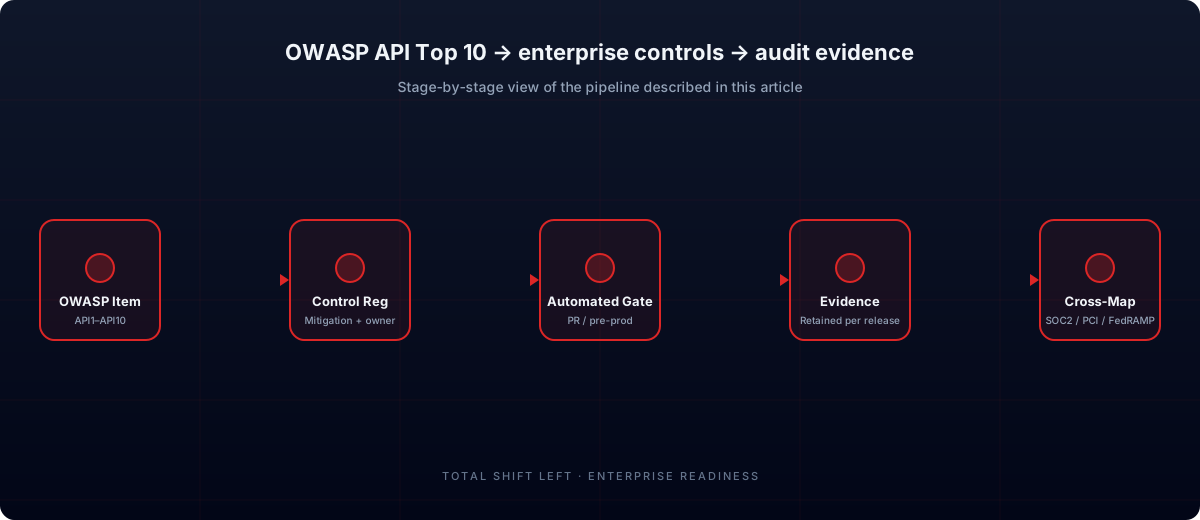
OWASP API Top 10 → enterprise controls → audit evidence chain.
Why OWASP API Top 10 controls matters at enterprise scale
Salt Security's 2024 State of API Security report tracked API attacks across 50+ industries and found OWASP API Top 10 vulnerabilities in 95% of breached APIs. Yet most enterprise programs treat OWASP as a test checklist rather than as a control register. The gap costs measurably: organizations with operationalized controls (not just tests) reported 60% lower API-related incidents and 45% lower remediation time per incident.
OWASP API Top 10 controls tools compared
A practical view of the tool categories that scale across enterprise testing programs in this area:
| Category | Example tools |
|---|---|
| Spec linting (API9) | Spectral with OWASP rulesets, Redocly Lint |
| Contract diff (API9) | oasdiff, Optic for breaking-change detection |
| OWASP-aligned scanning | OWASP ZAP, Burp Suite Enterprise, 42Crunch, Total Shift Left security tests |
| Authn/authz testing | Total Shift Left negative tests, custom Hypothesis property-based suites |
| IaC security (API8) | Checkov, Terrascan, Open Policy Agent for configuration drift |
Tool selection is secondary to architecture. The patterns above hold regardless of which specific vendor you adopt.
OWASP API Top 10 controls in practice: a worked example
A representative deployment pattern from an enterprise rollout in this area:
Problem. A SaaS unicorn had an OWASP API Top 10 test checklist that engineering ran "when they had time." OWASP-mapped audit findings appeared in every quarterly review. API1 (BOLA) and API3 (broken object property authorization) caused two production incidents in a single year.
Solution. The platform team operationalized each OWASP item as a control: documented mitigation, owner, gate stage, evidence retention, framework mapping. Negative authorization tests became mandatory pre-release gates. Cross-framework mapping bridged OWASP to SOC 2 / PCI-DSS evidence requirements.
Results. OWASP-mapped audit findings dropped to zero in the next two cycles. API-related production incidents dropped 80% over 12 months. The same testing program now satisfied SOC 2 CC6 and PCI-DSS Requirement 6 audit requests without parallel work.
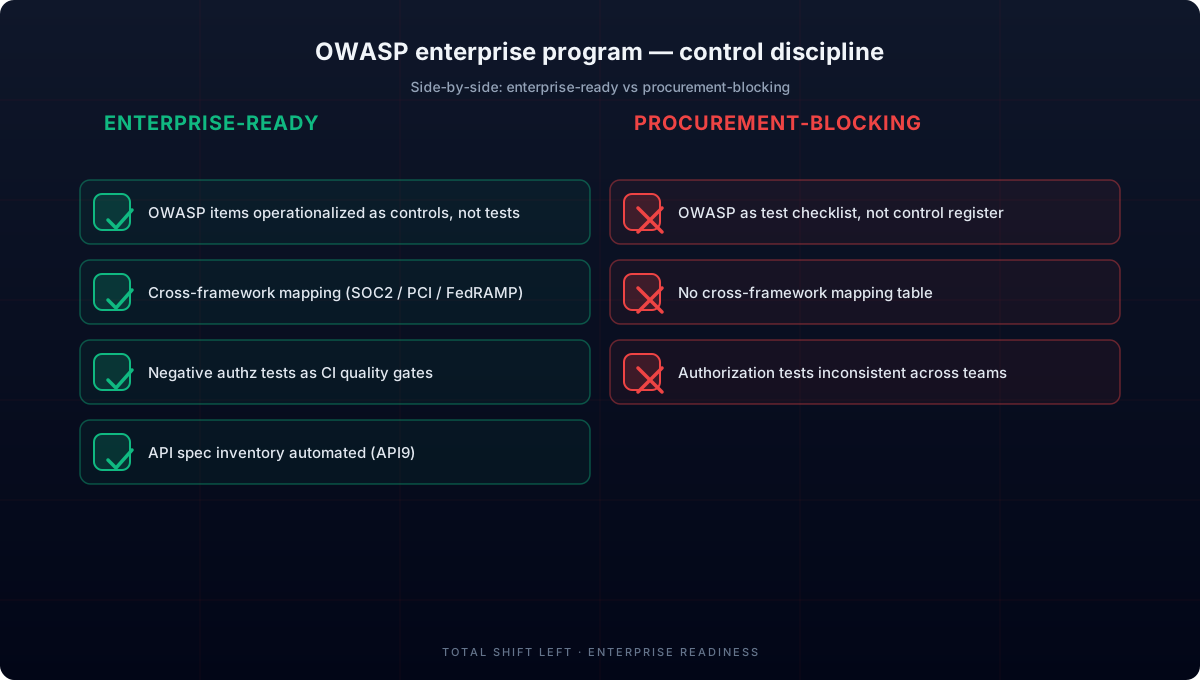
OWASP enterprise program — readiness checklist.
OWASP API Top 10 controls reference architecture
A control-driven OWASP architecture has three layers. Per-control implementation — each OWASP item is operationalized as a documented control with mitigation, owner, gate stage, evidence retention, and framework mapping. The control register (the ten items) sits in source control alongside policy documents. Per-control enforcement — automated gates at PR and pre-prod stages enforce each control. Negative authorization tests for API1 / API3 / API5 / API7. Spec linting and breaking-change detection for API9. Configuration scanning for API8. Cross-framework mapping — a single mapping table bridges OWASP to SOC 2, PCI-DSS, FedRAMP. Auditors query in their framework's vocabulary; the program responds with the OWASP-mapped evidence. The architecture deliberately treats OWASP as a control catalog, not a test checklist — the same evidence serves both engineering and compliance vocabulary without parallel work.
Free PDF guide (12 pages)
Top 50 API Testing Mistakes
50 real-world API testing mistakes organized by category — from authentication to performance — each with a concrete fix strategy.
Download FreeOWASP API Top 10 controls metrics that matter
Three metrics establish OWASP program health. OWASP-mapped audit findings — count of findings citing OWASP API Top 10 items per audit cycle — is the headline metric; well-run programs trend toward zero. Per-control coverage — percentage of in-scope APIs with documented control coverage for each OWASP item — is the operational metric. Cross-framework reuse rate — how often OWASP evidence satisfies SOC 2 / PCI-DSS / FedRAMP audit requests without parallel work — measures architecture leverage. Report on a quarterly cadence to engineering, security, and compliance leadership.
OWASP API Top 10 controls rollout playbook
OWASP-as-controls rollout takes 12-15 months at enterprise scale. Months 1-2: control register. Document each OWASP item with the five fields. Build the cross-framework mapping table. Sign off with security and compliance. Months 3-5: enforcement. Implement automated gates per control. Add negative authorization tests as CI quality gates. Deploy configuration scanning. Months 6-9: rollout. Onboard APIs in priority order — customer-facing, payment, PII-handling first. Phase strict gate enforcement gradually. Months 10-15: maturity. All in-scope APIs covered. Quarterly review with security and compliance. Tune policies based on observed audit cycles. Most programs reach 80% control coverage by month 9 and 95%+ by month 15.
OWASP API Top 10 controls challenges and how to solve them
Engineering treats OWASP as test cases, not as controls. Reframe each OWASP item with five fields: mitigation, owner, gate stage, evidence retention, framework mapping. Tests are one part of a control — not the whole.
OWASP doesn't map to the audit framework. Build the cross-framework mapping table once. Auditors think SOC 2 / PCI-DSS / FedRAMP; engineering thinks OWASP. Same evidence, different vocabulary.
Authorization testing is inconsistent across teams. Make negative authorization tests a CI quality gate. Provide template tests in the golden-path repo. Coverage floor includes authorization-test coverage.
API9 (improper inventory) is hard to enforce at scale. Automate spec inventory + breaking-change detection in the API governance program. Manual inventory tracking decays; automated tracking persists.
OWASP API Top 10 controls best practices
- Operationalize each OWASP item as a control with five fields, not a test checklist
- Maintain a cross-framework mapping (OWASP → SOC 2 / PCI-DSS / FedRAMP)
- Treat negative authorization tests as mandatory CI quality gates
- Automate API inventory and breaking-change detection (API9)
- Run OWASP API Top 10 scans pre-release, not "when there's time"
- Tag tests by OWASP item for control-mapped reporting
- Document the RACI: engineering implements, security policies, platform enforces
OWASP API Top 10 controls checklist
A pre-flight checklist enterprise teams can run against their current state:
- ✔ Each OWASP API Top 10 item is documented as an enterprise control
- ✔ Cross-framework mapping (OWASP → SOC 2 / PCI-DSS / FedRAMP) exists
- ✔ Negative authorization tests are mandatory CI quality gates
- ✔ API spec inventory is automated and maintained
- ✔ OWASP API Top 10 baseline scans run pre-release
- ✔ Tests are tagged by OWASP item for control-mapped reporting
- ✔ RACI is documented for each control
- ✔ Audit requests for OWASP evidence can be served from the aggregation
Take the next step. See how security testing for regulated industries applies these ideas to your workflow, or explore enterprise security for the broader picture.
See also: jwt authentication in our learn hub for the underlying concept.
Map each risk to a control and to the test that evidences it
An enterprise control only survives audit if there is an artifact behind it. Keep the mapping in version control so the test, the control and the framework reference move together:
# controls/owasp-api-top10.yaml
version: "2023"
risks:
  API1:
    name: Broken Object Level Authorization
    control: "Every object read is authorized against the caller's tenant and ownership."
    tests:   ["tests/test_authorization.py::test_bola_other_users_object_is_not_readable"]
    frameworks: { nist80053: [AC-3, AC-4], soc2: [CC6.1], pci: ["7.2"] }
  API2:
    name: Broken Authentication
    control: "All operations require a valid, unexpired, correctly-audienced token."
    tests:   ["tests/test_oauth_negative.py"]
    frameworks: { nist80053: [IA-2, IA-5], soc2: [CC6.1], pci: ["8.3"] }
  API3:
    name: Broken Object Property Level Authorization
    control: "Server-side allow-list on writable properties; no mass assignment."
    tests:   ["tests/test_owasp_api_top10.py::test_api3_mass_assignment"]
    frameworks: { nist80053: [AC-3], soc2: [CC6.1] }
  API4:
    name: Unrestricted Resource Consumption
    control: "Page-size ceiling and per-client rate limit enforced server-side."
    tests:   ["tests/test_rate_limiting.py", "tests/test_owasp_api_top10.py::test_api4_unrestricted_consumption"]
    frameworks: { nist80053: [SC-5], soc2: [A1.1] }
  API5:
    name: Broken Function Level Authorization
    control: "Role checks on every administrative operation, not on the UI route."
    tests:   ["tests/test_owasp_api_top10.py::test_api5_bfla"]
    frameworks: { nist80053: [AC-6], soc2: [CC6.3], pci: ["7.1"] }
Then fail the build when a risk has no test behind it — that is what turns the mapping from documentation into a control:
# scripts/verify_controls.py
import sys, yaml, pathlib
controls = yaml.safe_load(open("controls/owasp-api-top10.yaml"))
missing = [rid for rid, r in controls["risks"].items()
           if not r.get("tests") or not all(
               pathlib.Path(t.split("::")[0]).exists() for t in r["tests"])]
if missing:
    print("controls with no test evidence:", ", ".join(missing)); sys.exit(1)
print("all mapped risks have test evidence")
Sources and further reading
- OWASP API Security Top 10 (2023) — the reference list of API risk categories.
- NIST SP 800-53 Rev. 5 — the control catalogue FedRAMP baselines are drawn from.
- OWASP Application Security Verification Standard — verification requirements you can turn into test cases.
Key takeaways
- OWASP API Security Top 10 is the right starting point for an enterprise program — but only if it's operationalized as ten owned controls with documented mitigations, gates, and audit evidence, mapped across the frameworks the organization is actually audited under.
- The teams that get this right ship a single API security program that satisfies engineering, security, and compliance.
- The teams that don't end up running parallel programs that disagree about what's in scope and what passed the gate.
OWASP API Top 10 controls FAQ
How is this different from the existing OWASP API Top 10 article?
The existing post explains each risk and how to test for it. This post takes the next step — operationalizing each item as a concrete SDL control with documented mitigations, owners, and the audit evidence that demonstrates the control is operating effectively. It's the bridge from "we know about the risks" to "we have a defensible program."
Why map OWASP to SOC 2 / PCI-DSS / FedRAMP?
Auditors ask for control evidence in their framework's vocabulary. Engineering produces evidence in OWASP / ASVS vocabulary. The mapping table is what lets the same testing program serve both without duplicate work.
What does "enterprise control" mean here vs a test case?
A control is a documented, owned, repeatable mitigation with an audit-evidence emission. A test case is one part of how a control operates. The control includes the test, but also the policy, the gate, the owner, and the retained evidence.
Who owns each control?
Most ownership splits between engineering (implementation), security (policy + threat modeling), and platform (gate enforcement). The RACI table in this article is a defensible default; adjust it to your organization's actual structure.
Ready to shift left with your API testing?
Try our no-code API test automation platform free.