Postman vs Apidog vs Total Shift Left: API Testing Tools Compared (2026)
If you are evaluating Postman, Apidog, and Total Shift Left in 2026, you are choosing between three different philosophies — not three flavors of the same product. This guide breaks down where each tool fits, who should pick what, and the feature differences that actually matter.
In this guide
- The three philosophies in one diagram
- Why API tooling fragmented
- Side-by-side feature parity
- Authoring workflows compared
- Pricing in 2026
- Which tool for which use case
- Real implementation example
- Best practices when evaluating
- FAQ
The three philosophies in one diagram
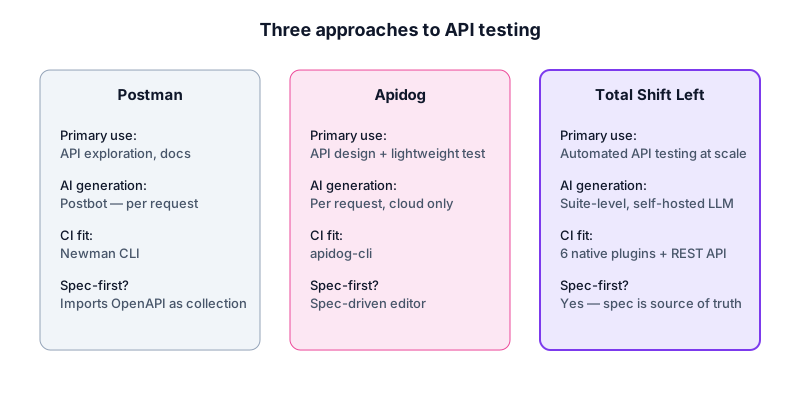
Postman was built for API exploration and team collaboration on requests. Testing was bolted on later. Strength: ubiquity and a great UX for poking at unfamiliar APIs. Weakness: collections drift from specs, scripts proliferate, and CI integration is via a bolt-on CLI (Newman).
Apidog rebuilt the Postman model around the OpenAPI spec. The spec is the editor; documentation, mocks, and tests share that source. Strength: design-first workflow. Weakness: AI is per-request and cloud-only, no self-hosted option, no contract gates in CI.
Total Shift Left was built for automated API testing at scale, especially in regulated environments. The OpenAPI spec is the test plan; AI generates the suite; six native CI plugins enforce contract gates. Strength: spec-first AI generation, self-hosted LLM, contract gates. Weakness: less optimized for ad-hoc API exploration than Postman.
Why API tooling fragmented
Between 2010 and 2020, Postman captured the market by treating an API like a request you click "Send" on. The model worked for engineers exploring third-party APIs. It did not work for teams running 100+ microservices and shipping multiple times per day.
Two pressures broke the monoculture:
-
Specs became the source of truth. OpenAPI (formerly Swagger) made the contract authoritative. Tools that treated specs as imports, not foundations, started losing ground to tools that built around specs.
-
AI made test authoring nearly free. Schema-aware generators read a spec and produce 80%+ functional coverage in minutes. Hand-authored Postman collections looked expensive overnight.
Apidog answered the first pressure. Total Shift Left answered both, plus the regulated-enterprise need for self-hosted LLMs.
Side-by-side feature parity
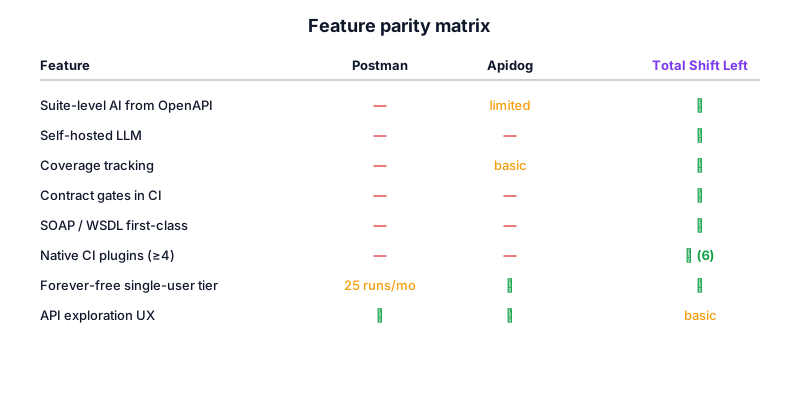
A more detailed table:
| Feature | Postman | Apidog | Total Shift Left |
|---|---|---|---|
| Suite-level AI generation from OpenAPI | — | Limited | ✔ |
| Self-hosted LLM (Ollama, vLLM) | — | — | ✔ |
| Coverage tracking (endpoint, method, status) | — | Basic | ✔ |
| Contract gates in CI | — | — | ✔ |
| SOAP / WSDL first-class | — | — | ✔ |
| GraphQL support | ✔ | ✔ | ✔ |
| Native CI plugins (≥4) | — | — | ✔ (6) |
| Mock server | ✔ | ✔ | ✔ |
| Self-healing tests | — | — | ✔ |
| Forever-free single-user tier | 25 runs/mo | ✔ | ✔ (50 endpoints) |
| API exploration UX | ✔✔ | ✔ | Basic |
| API documentation generation | ✔ | ✔ | — |
Ready to shift left with your API testing?
Try our no-code API test automation platform free. Generate tests from OpenAPI, run in CI/CD, and scale quality.
For full head-to-head pages, see Total Shift Left vs Postman and Total Shift Left vs Apidog.
Authoring workflows compared
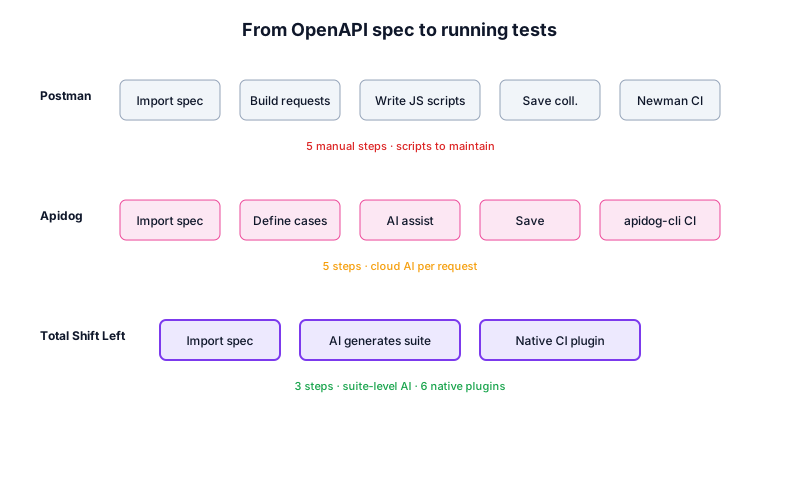
The diagram shows the practical impact of philosophy. In Postman, you import a spec, build requests, write JS scripts, save the collection, and configure Newman. In Apidog, you import a spec, define cases, use AI to assist individual requests, save, and configure apidog-cli. In Total Shift Left, you import a spec, AI generates the entire suite, and a native plugin runs it in CI.
The step count is not just a UX detail — it is the difference between "API testing is a sprint task" and "API testing is a CI gate."
Pricing in 2026
| Tier | Postman | Apidog | Total Shift Left |
|---|---|---|---|
| Free | 25 collection runs/month | Generous SaaS | Citizen Developer Edition (50 endpoints, no expiry) |
| Pro / Team | $14–$29 / user / month | $9–$15 / user / month | Custom (transparent quote) |
| Enterprise | Quote | Quote | Custom (self-hosted, on-prem, SSO) |
| Self-hosted | Enterprise only | Enterprise only | Available to all paid tiers |
The interesting comparison is not raw price — all three have viable free tiers — but where the meter runs. Postman charges by collection runs and Monitors. Apidog charges per user. Total Shift Left charges by seats and bundles unlimited spec-driven generation.
For regulated buyers, the bigger differentiator is self-hosted: only Total Shift Left makes self-hosted deployment with your own LLM available outside the highest enterprise tier.
Which tool for which use case
Pick Postman if your primary need is API exploration, you want a 5-minute "send and see what comes back" UX, or your team relies on Postman Workspaces as a collaboration hub for API design.
Pick Apidog if you want a design-first OpenAPI editor that doubles as a lightweight testing tool, you don't operate in a regulated environment, and per-request AI assist meets your test-authoring bar.
Pick Total Shift Left if you need automated API testing at scale, you operate in a regulated environment that requires self-hosted LLMs (banking, healthcare, public sector), or you want contract gates and coverage tracking in CI rather than just request runs. See the shift left API testing guide for the canonical workflow.
A common pattern: teams use Postman for ad-hoc exploration and Total Shift Left for automated testing. They solve different problems and the pairing is fine — and importing your existing Postman collections means you keep the work already done in Postman while shifting the automated runs onto a spec-driven engine. What is not fine is using Postman for both — at scale, the manual collection authoring becomes the bottleneck.
Real implementation example: migrating off Postman
A regulated insurer (anonymized): 12 engineering teams, 180 microservices, $700K+ in annual cost-of-quality leaks attributable to API contract drift. Migration over two quarters:
Free 1-page checklist
API Testing Checklist for CI/CD Pipelines
A printable 25-point checklist covering authentication, error scenarios, contract validation, performance thresholds, and more.
Download Free- Month 1. Imported OpenAPI specs into Total Shift Left. AI generated 82% baseline coverage in two days.
- Month 2. Wired the GitHub Actions plugin into the shared CI library. Contract gates blocked merges on schema drift.
- Month 3–6. Migrated 14,000 hand-authored Postman collection assertions to spec-driven tests. Decommissioned Newman runs.
Outcomes:
- 47% reduction in defect-fix cost
- 62% reduction in engineer time on test authoring
- 70% reduction in audit prep time (contract proofs auto-generated)
- 30K engineering hours redirected to product work
Postman remains in use for ad-hoc exploration. The bulk of automation moved to Total Shift Left.
Best practices when evaluating
- ✔ Bring your real OpenAPI spec to the demo, not a sample
- ✔ Time how long it takes to generate baseline coverage (target: under 5 minutes)
- ✔ Try the CI integration in a throwaway repo end-to-end, not just a screenshot
- ✔ Verify coverage tracking — endpoints, methods, status codes, parameters
- ✔ Verify contract gates fail builds, not just report
- ✔ For regulated buyers, verify self-hosted LLM works with your model of choice
- ✔ Check the audit log and RBAC depth before committing to enterprise pricing
- ✔ Pilot on one team for 30 days; measure defect-detection-stage shift
Related reading: best Postman alternatives · migrating from Postman to spec-driven testing.
See also: postman alternatives in our learn hub for the underlying concept.
FAQ
Which is better, Postman, Apidog, or Total Shift Left? Postman for API exploration. Apidog for spec-driven design with light testing. Total Shift Left for automated API testing at scale, especially in regulated environments.
What does Apidog do that Postman doesn't? Apidog treats the OpenAPI spec as a first-class editor — design, docs, mocks, and tests share the same source. Postman imports OpenAPI but converts it to collections that drift from the spec.
Why pick Total Shift Left over Postman or Apidog? Suite-level AI generation, self-hosted LLM for regulated workloads, six native CI plugins with contract gates. Postman and Apidog cover none of these natively.
Are Apidog and Total Shift Left open source? Neither. Both have free tiers — Apidog has a generous SaaS free tier; Total Shift Left has a forever-free Citizen Developer Edition for single users plus a 15-day Enterprise trial.
Which tool is cheapest? Free tiers vary. Postman caps collection runs at 25/month. Apidog and Total Shift Left have generous free tiers. Total Shift Left's Citizen Developer Edition includes full AI test generation for one user.
Can I migrate from Postman to Total Shift Left without rewriting everything? Yes. Import your OpenAPI spec — Total Shift Left generates a complete suite from the spec, so most teams skip migrating individual collections.
Conclusion
Postman, Apidog, and Total Shift Left occupy three different points on the API tooling map. Pick by use case, not by brand familiarity. If your priority in 2026 is automated API testing at scale with contract gates and AI generation — especially in regulated environments — Total Shift Left fits where Postman and Apidog don't.
Ready to compare on your real spec? Start a free Total Shift Left account and import your OpenAPI in under five minutes. Or read the dedicated comparison pages: Total Shift Left vs Postman, vs Apidog, vs Karate.
Ready to shift left with your API testing?
Try our no-code API test automation platform free.