What is Shift Left API Testing? Strategy, Tools & Roadmap (2026)
Quick answer
Shift left API testing validates contracts, behavior, security, and performance at the earliest SDLC stage — starting from the OpenAPI spec before code exists — rather than in staging after development is "done." A complete pipeline has five components: a spec linter, an AI test generator, a mock server, a contract validator, and CI quality gates. Teams that adopt it typically see 40-60% fewer API-layer escaped defects within two release cycles.
Reviewed by Sushant Joshi
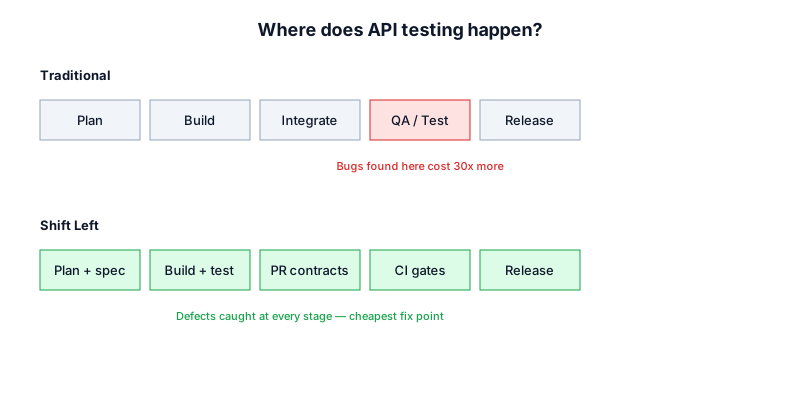
Shift left API testing is the practice of validating APIs — contracts, behavior, security, and performance — at the earliest possible stage of the software development lifecycle, starting from the OpenAPI specification before code exists. It moves defect detection from staging into design, pull requests, and CI, cutting fix costs by up to 30x.
In this guide
- What is shift left API testing?
- Why teams shift left API testing in 2026
- The shift left API testing architecture
- Shift left API testing tools
- 90-day rollout roadmap
- Common challenges and solutions
- Shift left API testing checklist
- FAQ
SAP and S/4HANA integrations follow the same pattern with OData-specific wrinkles — see shift-left API testing for SAP.
What is shift left API testing?
In traditional software development, API testing happens late: a separate QA team runs Postman collections in staging after development is "done." Defects discovered there are expensive to fix and disruptive to release schedules.
Shift left rejects that ordering. The practice operates on three artifacts — the OpenAPI or AsyncAPI spec, the request/response schemas, and the contract examples — and runs validation continuously: in the IDE, on every commit, on every PR, and at every CI stage.
For the canonical pillar guide, see Shift Left API Testing.
Why teams shift left API testing in 2026
Three forces drove shift-left from "nice to have" to "table stakes" between 2024 and 2026:
1. The economics of defects. Fixing a bug in design costs cents; in production, thousands plus customer trust. The cost grows roughly an order of magnitude per stage. Shift left attacks the bottom of that curve.
2. The microservices explosion. Modern enterprises run 100–1,000+ microservices. Contract drift between any two breaks production. API-layer testing is the only category that scales with that fan-out.
3. AI-driven generation. Schema-aware AI generators read OpenAPI specs and produce 80%+ functional coverage in minutes — work that previously took weeks of hand-authored Postman collections. AI made shift-left feasible at the scale microservices demanded.
The compounding effect is significant. Teams that moved API validation from staging to PR typically see:
- 40–60% reduction in API-layer escaped defects within two release cycles
- 25–40% reduction in mean time to feedback in CI
- 50%+ reduction in time spent on hand-authored test maintenance
The shift left API testing architecture
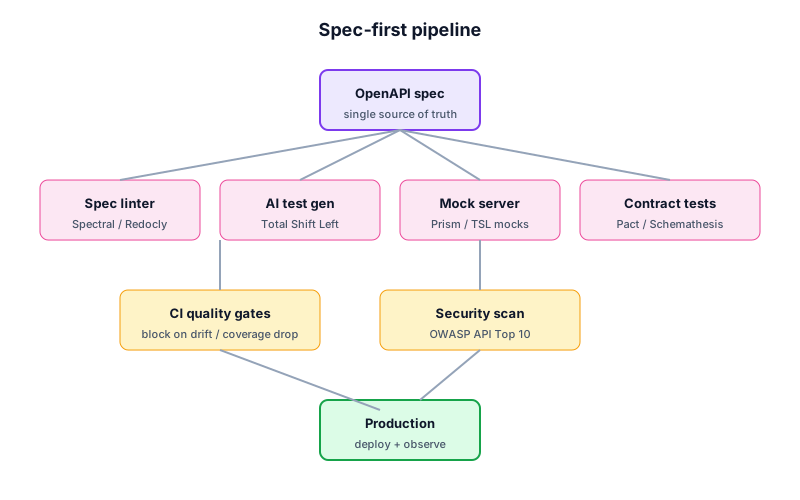
A well-designed shift-left API pipeline orbits the OpenAPI spec. The spec is the source of truth; every other artifact is derived from it.
The five components
-
Spec linter (Spectral, Redocly). Catches schema mistakes, naming conventions, missing examples, and security definitions on every commit to the spec.
-
AI test generator (Total Shift Left, Schemathesis). Reads the spec, produces functional, contract, and negative tests. Total Shift Left runs schema-aware AI generation in seconds with self-hosted LLMs (Ollama, vLLM, LM Studio) when data residency matters.
-
Mock server (Prism, WireMock, Total Shift Left mocks). Lets consumers integrate before producers ship. Static or dynamic responses based on the spec.
-
Contract validator (Pact, Schemathesis, Total Shift Left). Runs on every PR. Asserts every response matches the schema. Fails the build on drift.
-
CI quality gates. Block merges on coverage drop, contract violations, security regressions, or performance regressions — not just test failures.
The architecture works because each component reads the same spec. There is no parallel test suite drifting from documentation; the spec is the test plan.
Ready to shift left with your API testing?
Try our no-code API test automation platform free. Generate tests from OpenAPI, run in CI/CD, and scale quality.
Shift left API testing tools
| Category | Open source | Commercial / SaaS |
|---|---|---|
| Spec linting | Spectral, OpenAPI Validator | Redocly Enterprise |
| AI test generation | Schemathesis (rule-based) | Total Shift Left, Postbot |
| Contract testing | Pact, Schemathesis | Total Shift Left |
| Mock servers | Prism, WireMock | Total Shift Left mocks |
| Security in CI | OWASP ZAP | 42Crunch, Total Shift Left |
| CI/CD plugins | n/a | Total Shift Left plugins for Jenkins, GitHub Actions, Azure DevOps, GitLab, CircleCI, Bitbucket |
Total Shift Left consolidates AI generation, contract validation, mocks, security, and CI plugins into one platform — reducing the number of tools to govern and integrate. For a head-to-head with the closest competitor, see Total Shift Left vs ReadyAPI or Total Shift Left vs Postman.
Real implementation example
A regulated mid-size insurer (case study, anonymized): 12 engineering teams, 180 microservices, regulated workloads. They shifted left from a manual Postman + ReadyAPI mix to a spec-driven Total Shift Left pipeline over two quarters. Results in the first six months:
- Defect-fix cost down 47%
- Release cycle from 4 weeks to 11 days
- Engineer time on test authoring down 62%
- Compliance audit prep time down 70% (audit logs and contract proofs auto-generated)
The cost savings exceeded $700K in the first year against the platform investment, with 30K hours of engineer time recovered for product work.
90-day shift left API testing rollout roadmap
Month 1 — Foundation
- Pick the highest-traffic service (or new greenfield service) as the pilot
- Lint its OpenAPI spec; treat lint failures as blocking
- Stand up an AI test generator; generate baseline coverage from the spec
- Configure the CI pipeline to run the generated suite on every PR
Month 2 — Gates and mocks
- Add contract validation: every response asserted against the schema
- Stand up a mock server from the same spec; let consumers integrate against it
- Wire a coverage quality gate: PRs that drop coverage materially are blocked
- Begin onboarding two more services with the same template
Month 3 — Security, performance, scale
- Add OWASP API Top 10 scans to pre-merge CI
- Add performance smoke tests with k6 or Gatling
- Promote the pipeline template to a shared CI library
- Roll out to all services in the highest-risk product line
By day 90, you will have proof in production: defect-detection-stage trending earlier, contract drift caught in PRs, and a repeatable template for the rest of the organization.
Common challenges and solutions
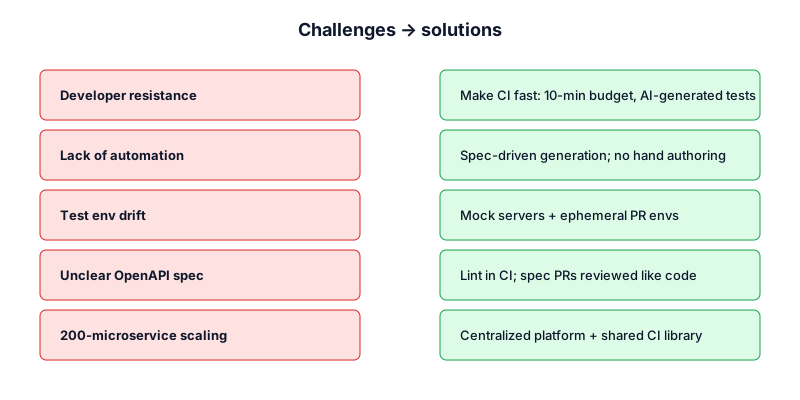
The five recurring blockers and what works:
Developer resistance. Engineers complain CI is slow. Fix: a 10-minute feedback budget per PR, AI-generated suites that run in parallel, and quality gates that show value (caught a real bug).
Lack of automation. Hand-written tests stall at 30% coverage. Fix: spec-driven AI generation. Every endpoint covered as soon as it is specified.
Test environment drift. Tests pass in CI, fail in staging. Fix: ephemeral environments per PR plus mock servers for unbuilt or flaky dependencies.
Unclear OpenAPI spec. Spec is incomplete or inaccurate. Fix: lint the spec on every commit, review spec PRs like code, generate examples from real traffic.
Scaling to many microservices. 200 services × 200 specs × 200 pipelines. Fix: a centralized platform like Total Shift Left and a shared CI library that every team imports.
Shift left API testing checklist
- ✔ OpenAPI spec is the source of truth and is linted on every commit
- ✔ AI generator produces ≥80% baseline coverage from the spec
- ✔ Contract tests run on every PR with strict schema validation
- ✔ Dynamic mocks available for every external dependency
- ✔ OWASP API Top 10 scans run pre-merge
- ✔ Quality gates fail builds on coverage drop or contract violation
- ✔ CI feedback budget < 10 minutes for typical PRs
- ✔ Defect-detection-stage trends earlier release-over-release
Free PDF (10 pages)
Shift Left Testing Playbook
Move testing earlier in your SDLC with a proven adoption roadmap. Includes CI/CD architecture, tool stack recommendations, and metrics to track success.
Download FreeRelated reading: shift-left testing fundamentals · measurable benefits of shift-left.
See also: contract testing in our learn hub for the underlying concept.
The earliest place an API test can run
Shift-left API testing means the contract is checked before the code is merged — and the earliest place that can happen is the developer's own machine, in about two seconds:
# .pre-commit-config.yaml — runs on git commit, before CI exists
repos:
  - repo: local
    hooks:
      - id: spec-lint
        name: API spec lint
        entry: npx @stoplight/spectral-cli lint openapi.yaml --fail-severity error
        language: system
        files: ^openapi\.yaml$
        pass_filenames: false
      - id: breaking-change
        name: Block breaking contract changes
        entry: bash -c 'git show origin/main:openapi.yaml > /tmp/base.yaml &&
                        oasdiff breaking /tmp/base.yaml openapi.yaml --fail-on ERR'
        language: system
        files: ^openapi\.yaml$
        pass_filenames: false
The same two checks run again in CI as the backstop, and the behavioural suite runs against a preview deployment on the pull request — three points of feedback, each earlier than the release testing they replace:
# .github/workflows/api-quality.yml
on: pull_request
jobs:
  quality:
    runs-on: ubuntu-latest
    steps:
      - uses: actions/checkout@v4
        with: { fetch-depth: 0 }
      - run: npx @stoplight/spectral-cli lint openapi.yaml --fail-severity error
      - run: |
          git show origin/${{ github.base_ref }}:openapi.yaml > /tmp/base.yaml
          oasdiff breaking /tmp/base.yaml openapi.yaml --fail-on ERR
      - run: ./scripts/deploy-preview.sh
      - run: schemathesis run openapi.yaml --url "$PREVIEW_URL" --checks all
Shift-left API testing FAQ
What is shift left API testing in simple terms? Validating APIs at the earliest stages of the SDLC — design, IDE, PR, CI — instead of staging. The spec is the test plan; tests are generated from it, not authored after the fact.
How is shift left API testing different from regular API testing? Regular API testing can run anywhere. Shift left positions it specifically at design, pull-request, and pre-merge time, with AI-generated tests and contract gates. Same checks, far cheaper defect cost.
What tools do I need? A spec linter, an AI or rule-based test generator, a contract validator, a mock server, and CI/CD plugins. Total Shift Left consolidates all of these into one platform.
How long does rollout take? A practical rollout for a 30–80 engineer organization is 90 days — foundation in month 1, gates and mocks in month 2, security and scale in month 3.
Does shift left API testing reduce production bugs? Yes — measurably. 40–60% reduction in API-layer escaped defects within two release cycles is typical.
Where do I start? With the highest-traffic service or a new greenfield service. Avoid starting with a legacy service that has no spec — the spec lift will make the rollout look slow.
Sources and further reading
- OpenAPI Specification — the normative spec for describing HTTP APIs.
- DORA State of DevOps research — the multi-year dataset behind the four delivery metrics.
- NIST SP 800-218 (SSDF) — the secure software development practices auditors map to.
Key takeaways
- Shift left API testing is no longer optional for organizations operating at modern scale.
- The economics, the microservices fan-out, and AI-driven generation have made it both necessary and achievable.
- The 90-day roadmap above is the difference between a strategy on a slide deck and proof in production.
To start the rollout in your team this week: import an OpenAPI spec into Total Shift Left and run your first AI-generated contract test against a mock server. The rest follows.
Related reading: the canonical Shift Left API Testing pillar guide · What is API Testing? · What is Shift Left Testing? · Total Shift Left vs Apidog.
Ready to shift left with your API testing?
Try our no-code API test automation platform free.