
Self-Healing API Tests: How They Work and Why They Matter (2026)
Quick answer
Self-healing API tests automatically adapt when your API changes in non-breaking, spec-documented ways — new optional fields, extended enums, new endpoints — by comparing responses against the current OpenAPI spec instead of a hardcoded expected output. They still fail on undocumented changes, breaking changes, and behavioral regressions. This eliminates the test maintenance tax that costs teams 30-40% of their testing time and causes comprehensive suites to get abandoned.
Reviewed by Rishi Gaurav
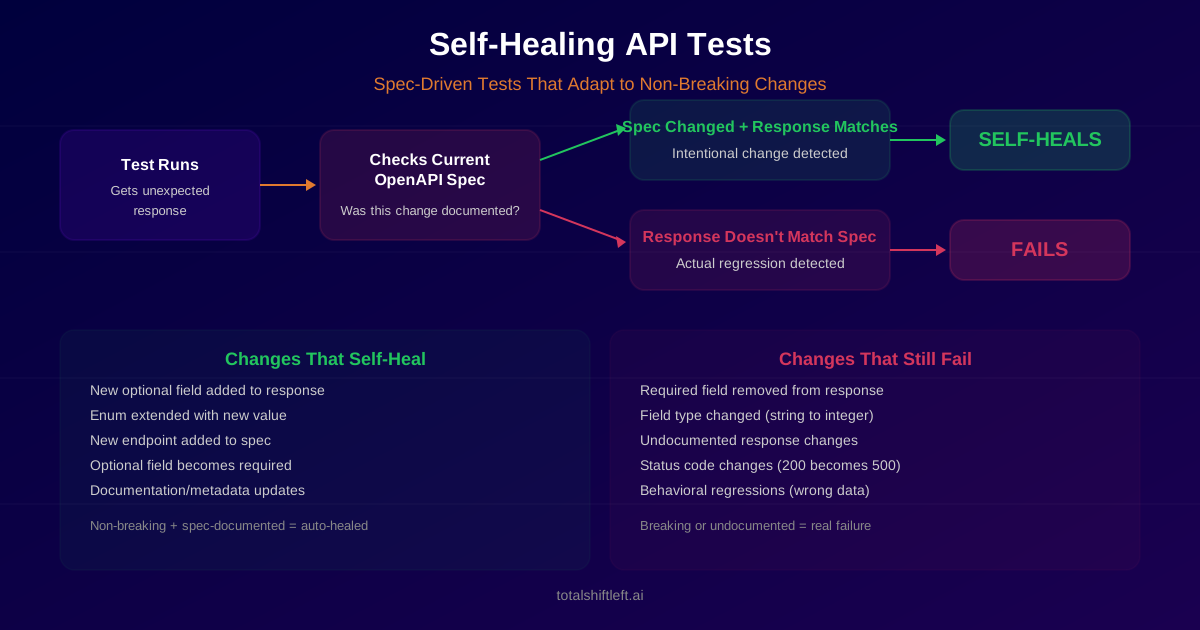
Every team that builds a comprehensive API test suite eventually hits the same wall: test maintenance. Your API changes intentionally -- developers add new fields, extend enums, update validation rules, and deprecate old endpoints. These are planned, documented changes. But your test suite does not know the difference between an intentional change and a regression. It just sees that the response does not match what it expected. So it fails.
Multiply this across 200 endpoints, four HTTP methods each, and multiple status codes per method. A single API update can break dozens of tests. None of them are actual bugs. All of them need manual investigation and updates. This is the test maintenance tax, and it is the primary reason teams abandon comprehensive API test suites.
Self-healing API tests solve this problem by distinguishing between intentional API changes and actual regressions. They compare test expectations against the current API specification, automatically adapting to non-breaking changes while still failing on real bugs. This guide explains how self-healing tests work, when they provide the most value, and how to implement them in your CI/CD pipeline.
In this guide
- The Test Maintenance Problem
- Why Test Maintenance Is the Top Threat to API Test Suites
- Key Components of Self-Healing API Tests
- How Spec-Driven Test Healing Works
- Self-Healing Versus Other Testing Approaches
- Tools for Self-Healing API Tests
- Implementation Example: Self-Healing in Practice
- Common Challenges with Self-Healing Tests
- Best Practices for Self-Healing API Tests
- Self-Healing API Test Checklist
- Frequently asked questions about self-healing API tests
The Test Maintenance Problem
The test maintenance problem is straightforward but devastating at scale. Every time your API changes intentionally, some subset of your tests breaks. Not because there is a bug, but because the test expectations are now stale.
Consider a practical example. Your API team adds a new optional field sku to the product response. The OpenAPI spec is updated to include it. The API now returns:
{ "id": 1, "name": "Widget", "price": 9.99, "sku": "W-001" }
A traditional test suite expected the response to have exactly three fields: id, name, and price. The new sku field causes the test to fail with an "unexpected field" error. The developer who added the field must now update every test that validates the product response. For a busy API with many endpoints, this cascades into hours of test maintenance per release.
The cumulative effect is predictable: teams that spend 30-40% of their testing time on maintenance eventually conclude that comprehensive testing is not worth the cost. They reduce their test suite to a skeleton of happy-path checks, and regressions start escaping to production.
Which version of the spec you are on changes what validators accept — OpenAPI 3.0 vs 3.1 lists every difference.
For the category where the agent decides what to test rather than executing a script, see agentic QA tools and the four questions worth asking any vendor.
Why Test Maintenance Is the Top Threat to API Test Suites
The Scale Problem
A mid-size API with 50 endpoints, four methods each, and three status codes per method has 600 endpoint-method-status combinations. Add parameter variations and you have thousands of test cases. When even 5% of those tests break after a routine API update, that is 30-60 tests that need manual investigation and repair.
The Trust Erosion Cycle
When tests fail frequently for non-bug reasons, teams lose trust in the suite. Developers start assuming failures are false positives and skip investigation. Once that behavior becomes normal, real regressions slip through unnoticed. The test suite becomes noise rather than signal.
The Abandonment Pattern
Industry surveys consistently show that test maintenance is the number one reason API test suites are abandoned. The pattern is the same across organizations: initial investment builds a comprehensive suite, maintenance costs grow with each release, teams cut back on test updates, coverage erodes, and eventually the suite is disabled or ignored.
The Opportunity Cost
Time spent updating tests after intentional changes is time not spent writing new tests for new features, improving coverage on untested paths, or investigating real bugs. The maintenance tax directly reduces the testing team's capacity to improve API quality.
Key Components of Self-Healing API Tests
The API Specification as Source of Truth
Self-healing tests require an API specification -- typically an OpenAPI 3.x or Swagger 2.0 document -- that is treated as the authoritative source of truth for what the API should do. The spec defines every endpoint, method, parameter, response schema, and status code. Tests validate against this spec rather than against hardcoded expected responses.
This is the fundamental difference from traditional testing: instead of comparing responses to a frozen snapshot of expected output, self-healing tests compare responses to the current, living specification.
Spec-Driven Test Generation
Tests must be generated from and validated against the specification. When a test is generated from the spec, it inherits the spec's schema definitions, required fields, data types, and enum constraints. When the spec changes, the test's expectations can update accordingly.
Manual tests with hardcoded expectations cannot self-heal because they have no connection to the spec. Self-healing requires that tests and the spec are linked.
Version-Aware Test Execution
The test runner must be able to compare the current spec with the version the tests were originally generated from. This comparison enables the healing logic: if a response field changed and the new spec documents the change, the test adapts. If the field changed but the spec does not reflect it, the test fails.
Healing Boundary Logic
Not all changes should trigger healing. Self-healing tests implement boundary logic that distinguishes between:
- Non-breaking, spec-documented changes: New optional fields, extended enums, new endpoints, metadata updates. These trigger healing.
- Breaking changes: Removed fields, changed types, renamed required properties. These trigger failure regardless of spec status.
- Undocumented changes: Response changes not reflected in the spec. These always trigger failure because the spec and implementation have drifted.
How Spec-Driven Test Healing Works
The healing process follows a specific decision flow at test execution time.
Traditional tests compare responses to a fixed expected output:
Expected: { "id": 1, "name": "Widget", "price": 9.99 }
Actual:   { "id": 1, "name": "Widget", "price": 9.99, "sku": "W-001" }
Result:   FAIL (unexpected field "sku")
The test fails because it expected an exact response shape. The API team added sku as a new optional field, documented in the updated spec. It is not a bug.
Self-healing tests compare responses to the current specification:
Spec says: response has required fields [id, name, price] and optional field [sku]
Actual:    { "id": 1, "name": "Widget", "price": 9.99, "sku": "W-001" }
Result:    PASS (response matches current spec)
The test validates against the specification, not against a hardcoded expected response. When the spec evolves, the tests evolve with it -- automatically and without manual intervention. Not every tool adapts tests this way. Shift-Left API, for example, does not change tests when the spec changes; its AI test-fixing starts after a test fails, reads the spec, the requirement and the run, and proposes the update as a before/after diff, so an engineer reviews and accepts the change instead of patching each test by hand.
What Self-Heals (Non-Breaking Changes)
- New optional fields added to responses: A new
created_atfield appears. The spec includes it as optional. Tests continue passing. - Enum extensions: A
statusfield gains a new value"archived". The spec defines it. Tests that do not depend on exhaustive enum matching continue passing. - New endpoints added: Your API gains a
/v2/usersendpoint. Existing tests for/v1/usersare unaffected. New tests are generated for the new endpoint. - Optional field becomes required: A field that was optional is now required. The spec is updated. Tests that already included the field continue passing.
- Description and documentation changes: Metadata changes in the spec do not affect test behavior.
Ready to shift left with your API testing?
Try our no-code API test automation platform free. Generate tests from OpenAPI, run in CI/CD, and scale quality.
What Still Fails (Breaking Changes and Regressions)
- Required field removed from response: A field consumers depend on disappears. Tests fail because removal is a breaking change.
- Type changes: A field changes from string to integer. Tests fail because type changes break consumers.
- Undocumented changes: The response changes but the spec was not updated. Tests fail because the response does not match the spec.
- Status code changes: An endpoint returns 500 instead of 200. Tests fail regardless of spec changes.
- Behavioral regressions: The response shape is correct but the data is wrong -- a filter returns all records instead of filtered results.
Self-Healing Versus Other Testing Approaches
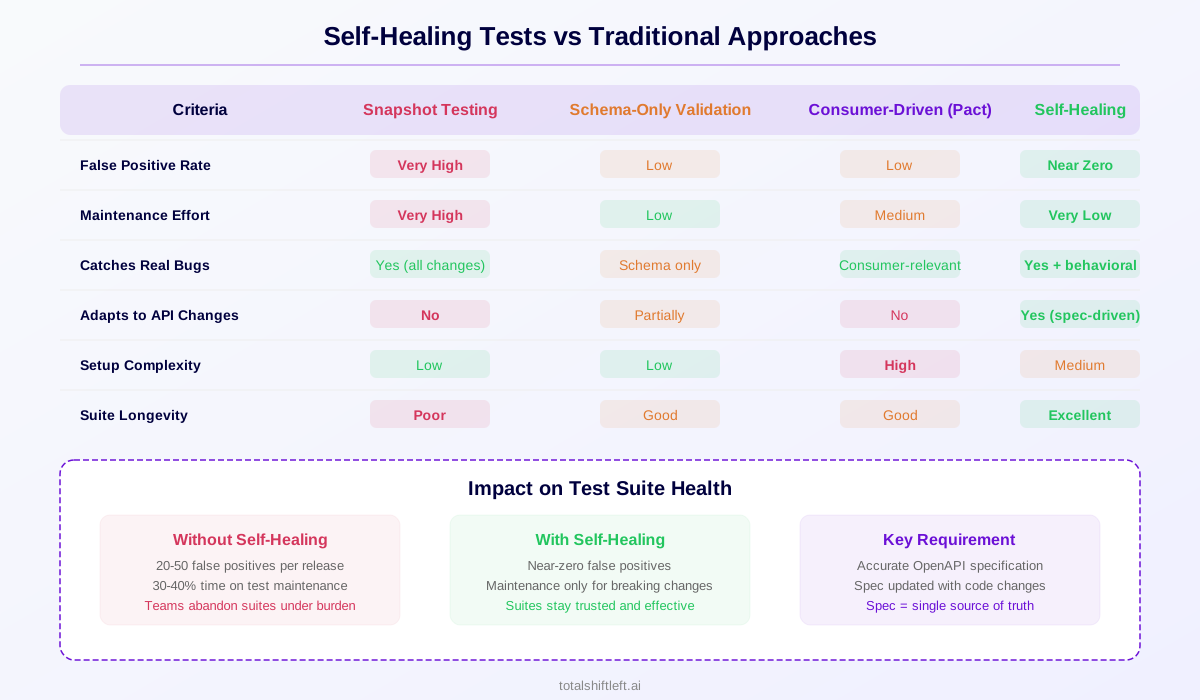
Understanding how self-healing compares to alternative approaches helps you evaluate where it fits in your testing strategy.
Versus Snapshot Testing
Snapshot tests capture the exact API response and fail on any difference. They catch every change but produce massive false positive rates. Teams spend more time updating snapshots than investigating real failures. Self-healing tests are the opposite: they only fail on meaningful changes, reducing false positives to near zero.
Versus Schema-Only Validation
Schema validation checks that responses match the OpenAPI schema -- correct types, required fields present, no undocumented fields. But it does not test specific values, business logic, or behavioral expectations. Self-healing tests validate schema compliance AND specific behaviors. They heal on schema-level changes but still enforce behavioral expectations.
Versus Consumer-Driven Contract Tests
Consumer-driven tests like Pact validate only what each consumer depends on. They are precise but require maintaining contracts for every consumer, which is its own maintenance burden. Self-healing spec-driven tests validate against the provider's specification. They are easier to maintain but test from the provider's perspective. Many teams combine both: spec-driven self-healing for the provider side, consumer-driven for critical consumer contracts. Learn more about the trade-offs in our guide on API contract testing.
Tools for Self-Healing API Tests
| Tool | Self-Healing Mechanism | Spec Support | CI/CD Integration | Best For |
|---|---|---|---|---|
| Total Shift Left | Not spec-adaptive: spec changes classified as breaking or non-breaking at import and versioned on approval; failing tests get AI fixes proposed with cited evidence for a person to accept | OpenAPI 3.x, Swagger 2.0, plus WSDL and GraphQL | Azure DevOps, Jenkins, GitHub Actions | Reviewed repair combined with test generation, coverage and failed-run analysis |
| Schemathesis | Schema-aware property testing | OpenAPI 3.x, GraphQL | CLI-based, any CI | Property-based testing with schema awareness |
| Dredd | Spec compliance (not adaptive) | OpenAPI 2.0/3.0 | CLI-based, any CI | Basic spec validation without healing |
| Postman | Manual collection updates | OpenAPI import | Newman CLI | Teams willing to manually maintain collections |
| Custom implementation | Build your own healing logic | Any spec format | Custom integration | Teams with specific requirements |
Total Shift Left combines several of these mechanisms: tests are generated from your OpenAPI spec and validated against the current spec on every run, spec changes are classified as breaking or non-breaking when you re-import the spec, with every changed endpoint and field listed, and repairs to failing tests are proposed rather than applied silently.
How Shift-Left API handles spec changes and repairs today
Shift-Left API does not implement the spec-adaptive healing described above. When a re-imported spec differs from the project, each change is classified as breaking or non-breaking and the change set waits for approval; approved changes become new endpoint versions, and existing tests are not rewritten. Repair happens after a test fails: the Fix with AI button proposes a change, and nothing is applied until a person accepts it. The Fix button reads the spec, the linked requirement, the test's intent and the run analysis, and cites the evidence behind each proposal. Two guardrails address the risk this article keeps returning to — healing that hides a real bug. A product bug is never "fixed" by changing the test to accept it, and a negative test is never weakened into one that cannot fail.
Repair also starts from a better diagnosis. A failed run is grouped into a handful of causes, each with a verdict — test defect, data issue, environment problem, or suspected product bug — and it reads what the server actually said, so a gateway error page or an expired sign-in is not mistaken for a contract change. Every test sharing a cause can be fixed in one step. Passing runs are examined too: would this test notice a regression, and does the response still match its documentation? Suggestions from that check only ever add assertions. Over time the platform learns from your API's real behaviour to produce more accurate expected results. See run failure analysis and continuous learning.
Implementation Example: Self-Healing in Practice
Illustrative scenario, not a customer example. It shows how spec-adaptive self-healing is meant to behave. Shift-Left API reviews spec changes instead, as described above.
Here is a practical scenario showing how self-healing tests work across a real development cycle.
The scenario: A team manages a product catalog API with 25 endpoints. They have a spec-driven test suite of 200 tests generated from their OpenAPI specification. The team ships updates weekly.
Week 1: New optional field added
A developer adds a sku field to the product response. The OpenAPI spec is updated to include sku as an optional string field. The developer commits both the code change and the spec update in the same pull request.
CI runs the test suite. Twenty tests validate the product response. All 20 encounter the new sku field. The self-healing engine checks the current spec, confirms that sku is a documented optional field, and all 20 tests pass without any manual updates.
Without self-healing, those 20 tests would fail, requiring manual investigation and updates before the PR could merge.
Week 2: Enum extension
The team adds a new product status value "discontinued" to the existing enum of ["active", "draft", "archived"]. The spec is updated to include the new value.
Tests that verify product status against the enum automatically accept the extended set because the spec documents it. No failures, no maintenance.
Week 3: Actual regression
A developer refactors the pricing logic and accidentally changes the price field type from a number to a string in certain edge cases. The spec was not updated because the change was unintentional.
The self-healing engine detects that the response does not match the spec (spec says number, response contains a string). The test fails. The developer investigates and finds the real bug. This is exactly the kind of failure that should happen -- an undocumented, breaking change.
Week 4: Breaking change (intentional)
The team decides to remove the deprecated legacy_id field from all responses. The spec is updated to remove it. Tests that validated legacy_id fail because removing a field is a breaking change that affects consumers.
This failure is also correct. The team reviews the failures, confirms the intentional removal, updates the affected tests, and notifies consumers about the breaking change with a migration timeline.
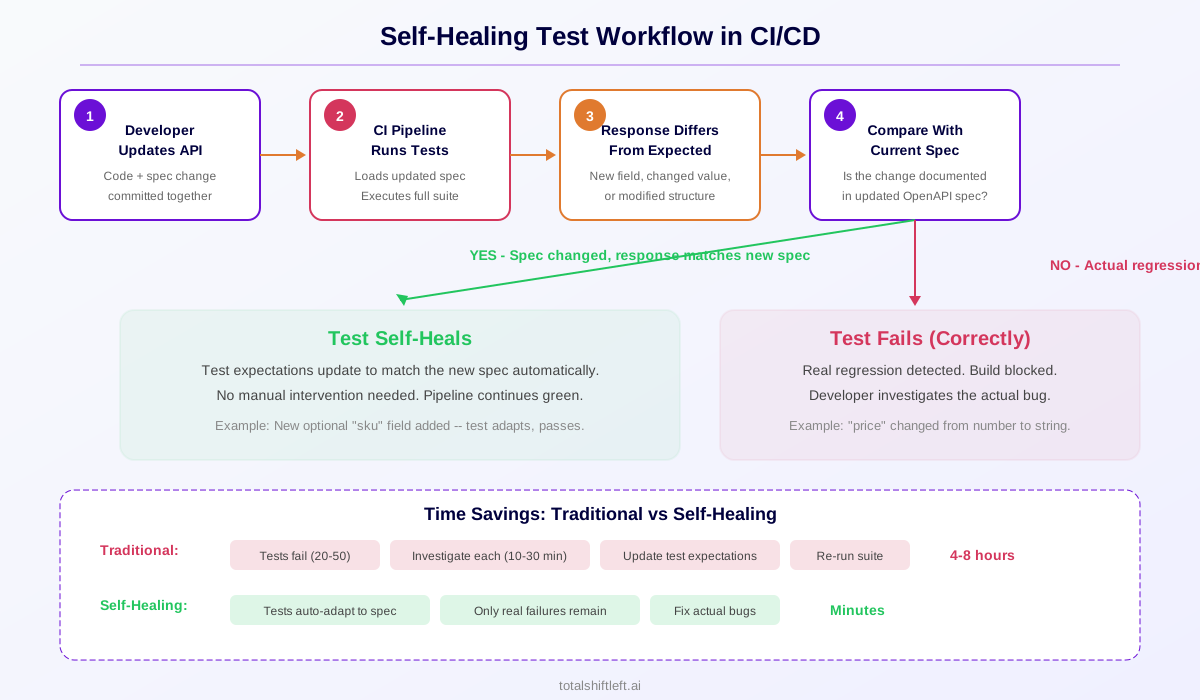
Results over four weeks: In this scenario the team makes four API changes. A spec-adaptive tool would absorb the two additive changes (weeks 1 and 2), flag the regression (week 3) and flag the intentional breaking change that needs consumer communication (week 4). Only the breaking change needs manual test updates. Without an adaptive layer, each change would need manual test work.
Free 1-page checklist
API Testing Checklist for CI/CD Pipelines
A printable 25-point checklist covering authentication, error scenarios, contract validation, performance thresholds, and more.
Download FreeCommon Challenges with Self-Healing Tests
Spec Accuracy Is the Foundation
Self-healing tests are only as reliable as the API specification. If the spec drifts from the actual API behavior, the healing logic validates against a fiction. Tests that should fail will pass (when the spec says the old behavior is still correct), and tests that should pass will fail (when the implementation is correct but the spec is stale).
Solution: Treat the spec as code. Store it alongside the API code, review changes in pull requests, and add spec validation to your CI pipeline that detects drift between spec and implementation. This discipline is the same one required for effective API contract testing.
Behavioral Regressions Beyond Schema
Self-healing tests heal on schema changes, but behavioral regressions -- correct schema, wrong data -- are not caught by schema validation alone. A filter endpoint that returns all records instead of filtered results has the correct response shape but the wrong behavior.
Solution: Combine self-healing spec tests with targeted behavioral tests. Self-healing handles the structural layer. Manual tests cover business logic assertions that the spec cannot describe (correct calculations, proper filtering, accurate aggregations).
Over-Reliance on Healing
If the team becomes complacent and assumes all spec-documented changes are safe, they may miss breaking changes that are technically documented but functionally impactful. For example, changing a field from optional to required is documented in the spec but breaks consumers that do not send the field.
Solution: Implement breaking change detection that flags not just undocumented changes, but also documented changes that are semantically breaking (field removals, type changes, required field additions). Alert the team when these occur even if the spec reflects them.
Initial Setup Investment
Self-healing requires a spec-driven test generation workflow, which is a different approach from manual test writing. Teams accustomed to hand-coding tests need to shift their workflow to spec-first development.
Solution: Start with a pilot. Import your existing OpenAPI spec, generate a self-healing test suite alongside your manual tests, and compare maintenance costs over two or three release cycles. The maintenance savings typically justify the workflow change within the first month.
Coverage Gaps in Generated Tests
Spec-driven test generation produces comprehensive structural coverage but may not cover all business logic scenarios. Teams that rely solely on generated tests can miss validation logic, calculation accuracy, and workflow-dependent behavior.
Solution: Use generated self-healing tests as the baseline for structural and schema coverage. Add manual tests for business-critical logic. Track coverage across both layers using API test coverage metrics to ensure no gaps.
Best Practices for Self-Healing API Tests
-
Keep the specification accurate and current. Self-healing depends on the spec being the source of truth. Update the spec alongside every code change. Add spec drift detection to your CI pipeline.
-
Commit spec and code changes together. When a developer modifies an API endpoint, the spec update should be in the same pull request. This ensures the healing engine always has the correct spec version at test time.
-
Combine self-healing with manual behavioral tests. Self-healing covers structural validation automatically. Add targeted manual tests for business logic that the spec cannot describe. Do not rely exclusively on either approach.
-
Monitor false positive trends. Track how many test failures are false positives (test issues, not real bugs) versus genuine regressions. Self-healing should push false positive rates below 2%. If it does not, investigate spec accuracy.
-
Implement breaking change alerts. Even with self-healing, breaking changes need attention. Configure alerts for field removals, type changes, and required-field additions so the team can assess consumer impact before shipping.
-
Run self-healing tests in CI/CD on every commit. Self-healing tests provide the most value when they run continuously. Configure them as quality gates in your pipeline. Learn more about integrating API tests into CI/CD.
-
Track maintenance time before and after adoption. Measure the time your team spends updating tests after API changes. Compare this metric before and after adopting self-healing. The improvement is typically dramatic -- from hours per release to minutes.
-
Use self-healing tests for continuous deployment. If every commit triggers a deployment pipeline, test failures that require manual investigation slow everything down. Self-healing keeps the pipeline flowing for non-breaking changes while still blocking on real regressions.
Self-Healing API Test Checklist
Use this checklist to evaluate your readiness for self-healing API tests:
- ✔ OpenAPI specification exists and accurately represents the current API
- ✔ Specification is stored in version control alongside the API code
- ✔ Spec updates are committed in the same PR as code changes
- ✔ Tests are generated from the specification (spec-driven, not manually coded)
- ✔ Test runner validates responses against the current spec version on every execution
- ✔ Non-breaking, spec-documented changes trigger healing (not failure)
- ✔ Breaking changes and undocumented changes still trigger test failures
- ✔ Behavioral tests cover business logic beyond schema validation
- ✔ False positive rate is monitored and maintained below 2%
- ✔ Self-healing tests run in CI/CD as quality gates on every commit
See also: generate tests from openapi in our learn hub for the underlying concept.
Frequently asked questions about self-healing API tests
What are self-healing API tests? Self-healing API tests automatically adapt when your API changes in non-breaking ways. Instead of failing because a new optional field appeared in a response or an enum gained a new value, the tests recognize that the change is documented in the updated spec and adjust their expectations accordingly. They still fail on actual regressions -- undocumented changes or breaking changes.
Do self-healing tests miss real bugs? No. Self-healing tests only adapt to changes that are documented in the API specification and are non-breaking (adding optional fields, extending enums, adding new endpoints). Undocumented changes, breaking changes (removing fields, changing types), and behavioral regressions still cause test failures. The goal is to eliminate false positives from intentional changes, not to suppress real failures.
How are self-healing API tests different from self-healing UI tests? Self-healing UI tests use heuristics like visual similarity or DOM proximity to find renamed elements -- they guess. Self-healing API tests compare responses against the updated API specification -- they verify against an authoritative source. API test healing is more reliable because the spec provides an objective definition of what the API should do.
What is the test maintenance tax? The test maintenance tax is the ongoing cost of updating test expectations after intentional, non-breaking API changes. Teams report spending 30-40% of their testing time on this maintenance. A single API update can break dozens of tests -- none of which are actual bugs. Self-healing tests eliminate this cost for non-breaking, spec-documented changes.
What prerequisites do self-healing API tests require? Self-healing tests require three things: an API specification (OpenAPI 3.x or Swagger 2.0) that is kept in sync with the actual API, spec-driven test generation where tests are generated from and validated against the spec, and version-aware test execution where the test runner compares responses against the current spec version.
Sources and further reading
- OpenAPI Specification — the normative spec for describing HTTP APIs.
- oasdiff — breaking-change detection between two OpenAPI documents.
- Google Testing Blog — Google's engineering write-ups on test sizing and flakiness.
Key takeaways
- Self-healing API tests solve the maintenance problem that causes teams to abandon comprehensive test suites.
- By comparing test expectations against the current API specification, they automatically adapt to non-breaking changes -- new optional fields, extended enums, added endpoints -- while still failing on actual regressions and undocumented changes.
- The result is a test suite that stays green through routine API evolution, so teams trust it.
- When it fails, they investigate because they know the failure is real.
- This trust is what separates test suites that survive long-term from those that are abandoned under maintenance pressure.
- Start with your OpenAPI spec. Generate spec-driven tests. Configure your CI/CD pipeline to validate against the current spec on every commit.
The maintenance savings are immediate and compound with every release.
Ready to eliminate the test maintenance tax? Start a free 15-day trial with Total Shift Left -- import your OpenAPI spec and see spec changes flagged for approval and repair proposals for failing tests, with you approving each change. Solo developer? Get the free Citizen Developer Edition — single-user. See pricing for team and enterprise plans.
Ready to shift left with your API testing?
Try our no-code API test automation platform free.