
How to Measure API Test Coverage: 4 Metrics That Matter
Quick answer
Measure API test coverage across four independent dimensions, not one blended number: endpoint coverage (tested endpoint-method combos ÷ total in the spec, target 100%), schema coverage (responses validated against the OpenAPI schema ÷ total responses, target 90%+), scenario coverage (positive/negative/boundary/auth cases exercised ÷ cases implied by the spec, target 70%+ on critical endpoints), and contract coverage (published contract obligations actively verified ÷ total obligations, target 100% on partner-facing endpoints). Report each dimension separately — a single blended score hides which one is actually failing. A usable coverage report also lists the uncovered operations and the change against the base branch, not just the percentages.
Reviewed by Sushant Joshi
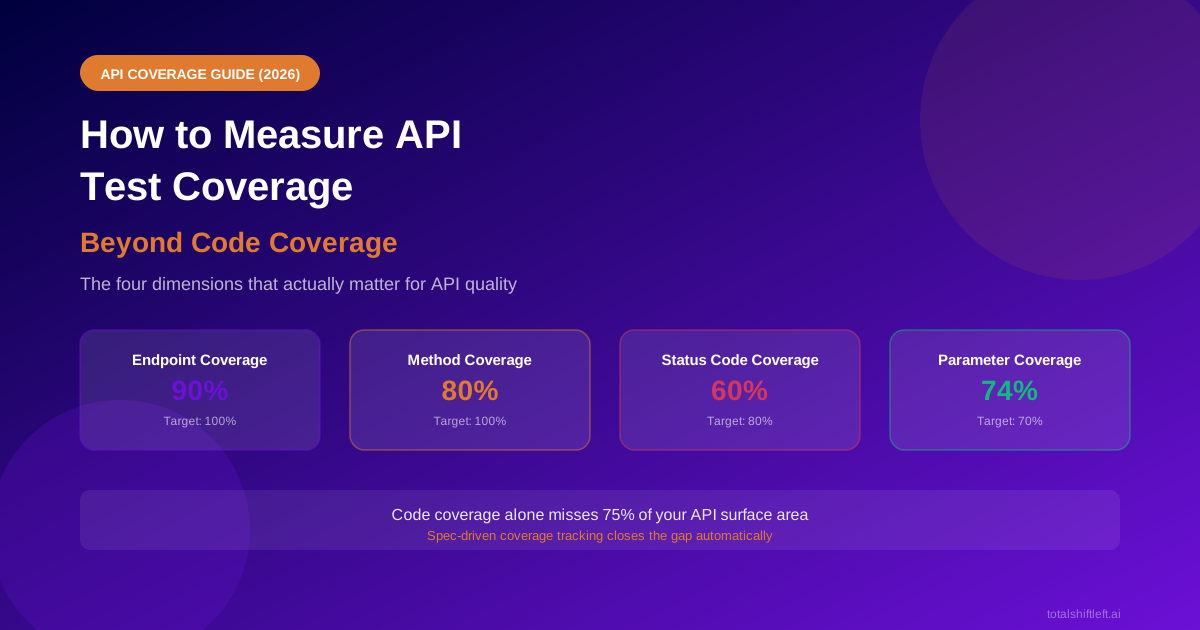
API test coverage is the measurable percentage of an API's external surface — endpoints, HTTP methods, schemas, parameters, status codes, scenarios, and published contracts — that is exercised and verified by an automated test suite. Unlike code coverage, which reports which source lines ran, API test coverage reports which parts of the interface your consumers actually depend on have been proven to work.
The stakes are rising. The World Quality Report 2025 found that 67% of production outages in API-driven systems trace back to untested response paths, schema drift, or contract changes that never triggered a test. DORA's 2025 Accelerate research correlates high coverage discipline with 4.2x faster mean time to recovery. And IBM Systems Sciences Institute and NIST continue to put the cost of a bug escaping to production at 30–100x the cost of catching it at the pull request. Measuring API test coverage is not a vanity exercise — it is the instrumentation layer that makes shift-left testing enforceable.
When a platform team is asked "how well is our API tested?", the honest answer for most organizations is "we don't know." The suite passes and deploys happen, but nobody can say which of 340 endpoints have tests, which response codes are verified, or which required fields are asserted without a week of spreadsheet work.
API test coverage metrics fix this. Instead of a single pass/fail, coverage gives leaders a dashboard across endpoint, schema, scenario, and contract dimensions — each with thresholds and trends. That dashboard turns testing into a measurable discipline and is the foundation on which shift-left AI-first API testing platforms enforce quality in CI/CD. This guide covers the four dimensions, the architecture required to track them, realistic thresholds, and the reporting patterns that survive contact with engineering leadership. See also the API Learning Center, API test coverage, and API contract testing.
In this guide
- What Is API Test Coverage?
- Why API test coverage matters in 2026
- Key Components of API Test Coverage
- Coverage Formulas and a Sample Report
- What an API test coverage report should contain
- API test coverage reference architecture
- API test coverage tools compared
- API test coverage in practice: a worked example
- API test coverage challenges and how to solve them
- API test coverage best practices
- API test coverage checklist
- API test coverage FAQ
What Is API Test Coverage?
API test coverage is the proportion of an API's externally observable surface that is exercised and verified by an automated test. The surface is defined by the API's contract — typically OpenAPI 3.x or Swagger 2.0 — and includes every endpoint, every HTTP method, every documented status code, every parameter (path, query, header, body), every schema property with its constraints, and every scenario implied by those constraints.
Code coverage and API test coverage answer different questions. Code coverage asks which source code ran? API coverage asks which consumer-visible behaviors were verified? A middleware-heavy REST service can show 85% code coverage while 18 of 50 endpoints have zero tests — middleware runs on every request regardless of which endpoints are actually targeted. For primers see what is an API and request/response anatomy.
The modern formulation splits coverage into four dimensions — endpoint, schema, scenario, contract — because each fails independently. A suite can have 100% endpoint coverage and 0% schema coverage. It can have 90% schema coverage and 0% scenario coverage. A single blended number hides these failure modes; reporting the four dimensions separately exposes them.
For the reporting layer above this — which numbers to put in front of engineering leadership and which ones get gamed — see API quality metrics that matter.
To measure how much of the spec your suite actually touches, the OpenAPI test coverage guide sets out endpoint, response-code and schema coverage and how to compute each.
For the spec-version differences behind this, see OpenAPI 3.0 vs 3.1.
Why API test coverage matters in 2026
Microservice sprawl, release-cadence compression, and the 2026 reality of AI-generated code have made coverage measurement a prerequisite for shipping safely. Four forces are converging.
Surface area is exploding. A mid-sized SaaS now operates 200–500 internal APIs. Manual coverage tracking in spreadsheets is untenable past roughly 20 services. Without automated measurement, coverage decays silently as new endpoints ship without tests — a pattern DORA flagged as a leading predictor of deployment failure rates.
Release cadence has compressed. Weekly and daily deploys leave no room for a 48-hour QA sign-off. Coverage metrics must live inside the pull request, gating merges based on thresholds. See API test automation with CI/CD and our API testing CI/CD guide for wiring patterns.
AI-generated code needs proportional AI-generated test coverage. When engineers ship AI-authored code, the volume of production code increases faster than manual test authoring can match. AI test generation — see AI-driven API test generation — closes that gap only if coverage instrumentation confirms the generated tests actually cover the new surface.
Contract drift is a top incident driver. When a backend silently changes a required field or returns a new status code the consumer doesn't handle, the first signal is a production error. Schema drift detection and contract testing are the direct countermeasures, and contract coverage is how you prove they are working.
IBM, NIST, DORA, and the World Quality Report all converge on the same conclusion: teams that measure and enforce multi-dimensional API coverage release faster with fewer incidents. Teams that don't, firefight.
Key Components of API Test Coverage
Endpoint Coverage
The foundational dimension. For every endpoint defined in the OpenAPI spec, does at least one test exercise it? The denominator is the total number of endpoint-method combinations in the spec; the numerator is the count of those combinations hit by at least one test. An endpoint at /orders supporting GET, POST, PUT, DELETE represents four endpoint-method combinations. Target: 100%. An untested endpoint is an unverified contract. See generate tests from OpenAPI for the automated baseline.
Method Coverage
Within a covered endpoint, method coverage asks whether every HTTP verb supported by the spec has at least one test. Different methods exercise distinct authorization, validation, and persistence paths, so GET coverage tells you nothing about DELETE safety. Method coverage is usually expressed per endpoint and then rolled up. Target: 100% for all documented methods.
Status Code Coverage
For each endpoint-method pair, does the suite verify every documented response code — including 4xx client errors and relevant 5xx server errors where the spec defines them? Many suites focus only on 200/201 and ignore 400, 401, 403, 404, and 409, which is precisely where regressions hide. Target: 80%+ with priority on 2xx and primary 4xx codes. See validation errors for the categories that matter most.
Parameter Coverage
Path, query, header, and body parameters each need coverage across valid values, missing-required scenarios, invalid types, boundary values, and null/empty cases. Parameter coverage is typically the lowest-scoring dimension in manual suites because it is the most tedious to author by hand. Target: 70%+ on critical endpoints.
Schema Coverage
Schema coverage measures whether response bodies — and request bodies where applicable — are validated against the OpenAPI schema. Full schema coverage includes field presence, type correctness, format conformance (e.g., date-time, email), enum membership, and constraint satisfaction (minLength, maximum, pattern). Without schema validation, a test that hits an endpoint and checks only the status code misses the entire payload. Target: 90%+ on 2xx and 4xx responses.
Scenario Coverage
Scenario coverage tracks business-logic breadth: positive happy paths, negative paths (invalid inputs, missing auth), boundary conditions, authorization variants (owner vs. other-user vs. admin), idempotency where relevant, and pagination edges. Scenario coverage is where AI-assisted negative testing contributes most — see AI-assisted negative testing. Target: 70%+ on business-critical endpoints.
Contract Coverage
Contract coverage is the most business-critical dimension for APIs consumed by external partners or mobile clients. It measures whether the running API still satisfies the published OpenAPI contract at every committed version — in effect, what percentage of consumer-visible contract obligations are actively monitored by a test. See the API contract testing page and what is API contract testing. Target: 100% for any endpoint in a published contract.
Authentication and Authorization Coverage
A hidden dimension in many suites. For endpoints behind OAuth2, JWT, API keys, or mTLS, coverage should include valid-token paths, expired-token paths, insufficient-scope paths, and cross-tenant paths where applicable. See JWT authentication, OAuth2 client credentials, and token refresh patterns. Target: 100% on auth flows; partial coverage here is the single most common cause of IDOR and privilege-escalation incidents.
Coverage Formulas and a Sample Report
Each dimension is a fraction. Knowing the exact numerator and denominator is what separates a defensible metric from a vibe:
| Dimension | Formula | Target |
|---|---|---|
| Endpoint coverage | tested endpoint-method combinations ÷ total endpoint-method combinations in the spec | 100% |
| Status code coverage | documented status codes with at least one asserting test ÷ total documented status codes | 80%+ |
| Schema coverage | responses validated against the full OpenAPI schema ÷ total 2xx/4xx responses | 90%+ |
| Parameter coverage | parameter value classes tested (valid, invalid, missing, boundary) ÷ total value classes implied by constraints | 70%+ |
| Scenario coverage | business scenarios exercised (positive, negative, boundary, auth variants) ÷ scenarios implied by the spec and domain rules | 70%+ |
| Contract coverage | published contract obligations actively verified by a test ÷ total contract obligations | 100% on partner-facing endpoints |
A coverage report generated from these formulas is typically machine-readable first, human-readable second — CI reads the JSON to enforce gates, and a dashboard renders it for people:
Ready to shift left with your API testing?
Try our no-code API test automation platform free. Generate tests from OpenAPI, run in CI/CD, and scale quality.
{
  "spec_version": "orders-api-v2.3.0",
  "commit": "a1b2c3d",
  "generated_at": "2026-08-19T04:00:00Z",
  "dimensions": {
    "endpoint": { "covered": 47, "total": 50, "pct": 94.0 },
    "status_code": { "covered": 132, "total": 165, "pct": 80.0 },
    "schema": { "covered": 88, "total": 96, "pct": 91.7 },
    "scenario": { "covered": 210, "total": 340, "pct": 61.8 },
    "contract": { "covered": 42, "total": 42, "pct": 100.0 }
  },
  "gate_status": "FAIL",
  "failing_gates": ["scenario_coverage_below_70pct"],
  "top_risk_gaps": [
    { "endpoint": "DELETE /orders/{id}", "reason": "no test for 409 conflict on in-progress order", "daily_traffic": 1840 },
    { "endpoint": "POST /payments/refund", "reason": "no negative test for partial-refund boundary", "daily_traffic": 640 }
  ]
}
Before any of these formulas mean anything, the spec itself has to actually document the error responses, security requirements, and request schemas the denominators depend on — an incomplete spec quietly inflates every percentage above. Our free, no-signup OpenAPI test-readiness scorer checks exactly that: paste a spec and it flags missing error responses, security requirements, and request body schemas before you compute a single coverage number against them.
What an API test coverage report should contain
Most teams already produce a test report. It is usually JUnit XML, and it answers a different question: which tests ran and whether they passed. JUnit has no field for which endpoint, status code or schema a test verified, so a suite can be entirely green in JUnit and still leave half the spec untested. A coverage report is a second artifact, measured against the spec rather than against the list of tests.
A report that people act on carries six things:
| Field | Why it matters |
|---|---|
| Spec version or hash, and commit | Coverage measured against a stale spec has the wrong denominator — that is not a small error |
| Covered and total counts per dimension | Counts survive scrutiny; "94%" alone hides whether that is 47 of 50 or 470 of 500 |
| The uncovered operations and status codes, listed | This is what a developer actually needs: the next test to write |
| Change against the base branch | A pull request that adds POST /refunds with no test should read as a regression even if the overall percentage barely moves |
| Assertion depth | Whether responses were schema-validated, so shallow tests cannot pass as coverage |
| Scope per service | A portfolio-wide number lets one untested service hide behind nine well-tested ones |
Publishing the report from CI
The pattern that holds up is three outputs per pipeline run:
- JUnit XML for pass/fail, so the CI system's native test view keeps working.
- A JSON coverage file named after the commit, uploaded as a build artifact and retained. The trendline leadership asks for is simply these files over time.
- A pull-request comment with the delta only, not the whole report:
**API coverage** vs `main` — orders-api spec v2.4.0

| Dimension   | main    | this PR   |
|-------------|---------|-----------|
| Endpoint    | 47/50   | 48/51     |
| Status code | 132/165 | 132/168 ⚠ |
| Schema      | 88/96   | 89/97     |

New without tests: `409` and `422` on `POST /refunds`, `404` on `GET /refunds/{id}`
The comment names the three untested status codes, which is why they get fixed in the same pull request. A link to a dashboard gets looked at next quarter.
Two levels worth separating
Coverage is easier to act on as two levels. Basic coverage asks whether each status code, parameter and request body in the spec is exercised at all. Production-grade coverage asks whether the tests would catch a real regression: schema and contract validation of the response, correct HTTP semantics, authentication and authorization depth, performance thresholds, and validation of error bodies. A suite can score well on the first level and poorly on the second, and it is the second that predicts incidents.
How Total Shift Left reports this: coverage is tracked per endpoint at both levels — Overall (status codes, parameters, request body) and Production-Grade (schema and contract validation, HTTP semantics, auth depth, performance SLAs, error body validation) — with the specific gaps listed and a "Generate tests for gaps" action to close them. A Coverage dashboard shows what is tested and where the gaps are across the project, and when tests are generated from requirement documents as well as the spec, the requirements traceability matrix attributes each uncovered requirement to an endpoint and offers a one-click gap fill. In CI, the runner writes JUnit XML and a JSON run summary for your pipeline's reporting and gates the build on pass rate. See coverage gap detection.
API test coverage reference architecture
A coverage measurement system is a pipeline. Source artifacts feed an instrumentation layer, which feeds an aggregation engine, which feeds reporting and CI/CD gates.
At the source layer sit the artifacts that define the surface: the OpenAPI specification (the authoritative denominator), the live service for introspective discovery of undocumented endpoints, and the test suite — scripts, generated tests, and contract tests — that provides the numerator. Any coverage system is only as accurate as the completeness of its source spec.
The instrumentation layer intercepts test execution. For every request a test issues, it records the resolved endpoint path (mapped back to the spec template), the HTTP method, the status code returned, the parameters sent with their value classes (valid, invalid, missing, boundary), and — critically — whether the response was schema-validated. Instrumentation runs as a middleware layer in the test runner or as a proxy between tests and the target service.
The aggregation engine ingests instrumentation events, compares them against the spec-derived inventory, and computes the four dimensions at endpoint, service, and portfolio scope. It deduplicates repeated executions, tracks distinct scenario signatures, and emits a coverage report linked to the git SHA of the spec and the commit of the test suite. This is where a shift-left AI-first platform — see the platform overview — performs the heaviest lifting.
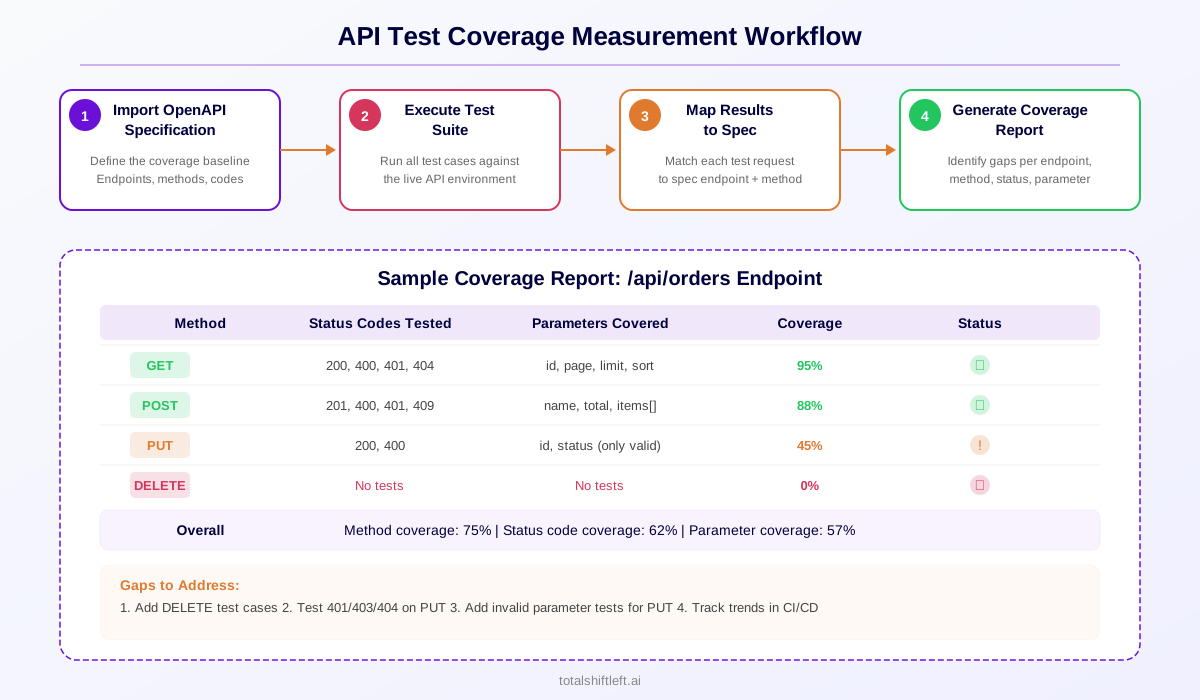
The reporting layer surfaces results where they are actionable: PR annotations for developers, dashboards for engineering managers, and trend charts for leadership. Reports should highlight the top-10 highest-risk gaps ranked by production traffic, not just raw percentages. Our analytics and monitoring page shows how this lands in practice.
The enforcement layer is the CI/CD gate. Configured thresholds (endpoint ≥ 100%, schema ≥ 90%, contract ≥ 100% on published APIs) compare against the current PR's coverage and block merges that regress. This is what converts coverage from a report into an engineering control.
API test coverage tools compared
| Platform | Coverage Dimensions | Spec Support | CI/CD Integration | Best For |
|---|---|---|---|---|
| Total Shift Left | Overall (status codes, parameters, request body) and production-grade (schema, HTTP semantics, auth depth, performance, error bodies), per endpoint; requirement coverage in a traceability matrix | OpenAPI 3.0, Swagger 2.0, WSDL, GraphQL, plus requirement documents | GitHub Actions, Jenkins and Azure DevOps integrations, plus a CI runner and REST API for any other pipeline | Per-endpoint and per-requirement coverage gaps, with AI-generated tests to close them |
| Schemathesis | Endpoint, method, status, schema | OpenAPI 3.x, GraphQL | CLI, any CI | Property-based fuzzing from spec |
| Dredd | Endpoint, method, status | OpenAPI 2.0/3.0 | CLI, any CI | Basic spec-compliance checks |
| Pact | Contract | Pact broker format | Broker + CI | Consumer-driven contract testing |
| ReadyAPI (SmartBear) | Endpoint, method, status, schema | OpenAPI, WSDL | Native integrations | Enterprise SOAP + REST with load testing |
| Apidog | Endpoint, method, status | OpenAPI 3.x | Cloud runner | Design-first teams standardizing on spec |
| Postman + Newman | Endpoint (manual) | OpenAPI import | Newman CLI | Teams already in the Postman ecosystem |
| API gateway analytics | Endpoint, method (production traffic) | N/A | Dashboard | Supplementing test coverage with production data |
| OpenAPI Test-Readiness Scorer (free) | Spec quality, not test coverage | OpenAPI 3.x, Swagger 2.0 | Browser-only, no CI | Checking spec completeness before you measure coverage against it |
For deeper tool comparisons see best API test automation tools compared, best AI API testing tools 2026, ReadyAPI vs Shift Left, Apidog vs Shift Left, and our Postman alternative page. The category splits between narrow tools that measure one dimension well (Pact for contracts, Schemathesis for schema fuzzing) and integrated platforms that measure all four in one pipeline.
API test coverage in practice: a worked example
Illustrative scenario: a composite example, not a named customer's measured results.
Problem: A mid-sized e-commerce platform operated 340 internal and partner-facing endpoints across 24 microservices. The QA team reported "85% coverage" based on a code-coverage tool. In a single quarter, three production incidents traced to untested error paths: a payment endpoint returning 500 instead of 402 when a card was declined, an orders endpoint accepting a malformed address because the required field check was a client-only validation, and a mobile-app breakage when a response field silently changed type from string to number. Each incident passed the existing CI pipeline with green checks.
Solution: The platform team replaced code-coverage-as-proxy with multi-dimensional API coverage using a shift-left AI-first platform integrated with GitHub Actions. They ingested the OpenAPI specs for all 24 services, auto-generated baseline tests, and configured CI gates: 100% endpoint coverage required on any PR that added an endpoint, 90% schema coverage on all 2xx and 4xx responses, 100% contract coverage on the 42 partner-facing endpoints, and drift-detection against the last-published spec on every merge to main. The team also added scenario coverage targets on the 60 highest-traffic endpoints using AI-generated negative tests.
Results: In a scenario like this, measured endpoint coverage comes out lower than the code-coverage figure first reported, and rises as the suite fills the gaps. Schema and partner-contract coverage rise, drift is caught at PR time, and incidents from untested error paths fall. Triage gets faster because failures can be checked against a coverage diff. See API regression testing for the related discipline.
API test coverage challenges and how to solve them
Incomplete OpenAPI specifications inflate scores
Free 1-page checklist
API Testing Checklist for CI/CD Pipelines
A printable 25-point checklist covering authentication, error scenarios, contract validation, performance thresholds, and more.
Download FreeIf the spec documents only 200 responses but the API actually returns 400, 401, and 404, the coverage tool will compute 100% status-code coverage while error paths remain untested. The denominator is wrong. Solution: Lint specs with Spectral as a PR check, require documentation of all response codes and error schemas, and periodically reconcile the spec against production traffic logs from the API gateway. A shift-left AI-first platform can introspect the running service and surface endpoints or codes present in traffic but absent from the spec.
Coverage inflation from shallow assertions
A test that sends a request and only asserts status !== 500 technically increments endpoint coverage but verifies nothing useful. Over time, these shallow tests create a false sense of safety. Solution: Track assertion depth alongside raw coverage. Require schema validation on response bodies, required-field assertions on key payloads, and explicit status-code assertions. Configure the gate to reject new endpoint coverage that arrives without schema validation. See contract testing for deeper assertion patterns.
In Shift-Left API, passing runs are examined for exactly this problem: for a green test it asks whether the test would notice a regression, whether the linked requirement was actually verified, and whether the response still matches its documentation. The suggestions it makes only ever add checks — they never loosen an existing one. See run failure analysis.
Parameter coverage is hard to measure manually
Sending page=1 and page=2 is the same parameter class; sending page=1 and page=-1 is different. Manually categorizing parameter values across hundreds of endpoints does not scale. Solution: Use spec-driven generation that categorizes values automatically by parameter constraints (type, format, min, max, enum). AI-generated tests produce boundary and invalid-type cases without manual authoring — see AI-assisted negative testing.
Coverage decays silently as the API evolves
A new endpoint ships without tests. A new required field is added without schema assertion. A new status code becomes possible without a negative test. The overall coverage percentage can still look acceptable while new gaps accumulate. Solution: CI/CD gates that measure delta, not absolute. Any PR that introduces a new endpoint-method combination must include at least one test; any PR that reduces schema coverage must be explicitly approved. This is the core of a shift-left AI-first CI/CD pattern — see CI/CD integration.
Contract coverage breaks across environments
Tests that pass in staging may fail in production because of feature flags, config differences, or data that only exists in one environment. Contract coverage reported against staging does not guarantee production-equivalent coverage. Solution: Run contract validation against production-equivalent environments with deterministic test data. For externally-consumed APIs, run a synthetic contract-validation suite against the production edge on a schedule — not just against staging in CI.
Reporting 'one number' misleads leadership
A single blended coverage percentage hides the four-dimension failure modes. A 92% blended score can mask 0% scenario coverage. Solution: Report the four dimensions separately on every dashboard. Add the drift-caught-pre-merge count, the percent of PRs blocked by coverage gates, and the top-10 highest-risk untested combinations. Trendlines beat snapshots. See analytics and monitoring for dashboard patterns.
API test coverage best practices
- Treat the OpenAPI spec as the authoritative denominator. Every coverage metric is a fraction whose denominator is defined by the spec. Invest in spec completeness first — lint on every PR, require examples on every schema, document every response code. The ROI exceeds almost any other investment in the testing stack.
- Measure the four dimensions separately. Endpoint, schema, scenario, and contract coverage fail independently. A single blended score hides the failure modes. Report each dimension with its own threshold and trendline.
- Set thresholds as CI/CD gates, not dashboards. Dashboards without enforcement decay. Block merges that regress coverage, add endpoints without tests, or reduce schema validation. See API testing in CI/CD.
- Prioritize error-path coverage on high-traffic endpoints. 4xx and 5xx paths are where most production regressions hide. Cover the top-20 endpoints by traffic for all documented error codes before broadening to long-tail endpoints.
- Use AI generation for the mechanical coverage floor. Spec-driven generation produces endpoint, method, schema, and basic scenario coverage automatically. Reserve hand-authored tests for business-logic edges AI cannot infer. See AI-driven API test generation.
- Combine test coverage with production-traffic analytics. A 0%-covered endpoint with 10,000 daily requests is materially different from a 0%-covered internal admin endpoint. Rank gaps by blast radius, not alphabetical order.
- Enforce assertion depth, not just hits. Coverage must include schema validation, required-field checks, and explicit status-code assertions. A test that hits an endpoint without validating the response is not coverage — it is theater.
- Re-baseline coverage when the spec evolves. When a new endpoint is added, generate at least a baseline test for it; when a schema changes, have the tooling propose updates to the affected tests and review the diff before accepting it — a test that silently rewrites itself to match the new response can no longer detect a breaking change. See AI test maintenance.
- Measure contract coverage separately from internal coverage. For APIs consumed by external partners or mobile clients, contract coverage must be 100%. Drift detection against the published spec must run on every build — see API schema validation: catching drift.
- Track trend, not snapshot. A 78% score this quarter means nothing without last quarter's number. Trendlines surface the rate of decay or improvement, which is what leadership needs to act on.
- Invest in failure-triage UX. When a coverage gate fails a PR, the developer must see a clean diff: which endpoint, which dimension, which threshold, how to fix. Without this, teams disable gates. See test execution.
- Align QA capacity behind coverage, not scripting. Redirect QA engineers from hand-authoring to coverage strategy, threshold ownership, exploratory testing of low-coverage areas, and risk modeling. This is the shift-left economic win.
API test coverage checklist
- ✔ Audit the current OpenAPI specification for completeness — every endpoint, method, status code, parameter, and response schema documented
- ✔ Lint all specs with Spectral (or equivalent) as a PR check and require examples on every schema
- ✔ Reconcile the spec against production-gateway traffic to surface undocumented endpoints and codes
- ✔ Select a coverage tool that measures all four dimensions — endpoint, schema, scenario, contract — against the spec
- ✔ Ingest the spec and run a baseline coverage report to establish the current state per dimension
- ✔ Publish the baseline numbers and set improvement targets per quarter per dimension
- ✔ Configure AI-generated baseline tests to close endpoint and method coverage gaps to 100%
- ✔ Add schema validation to every existing test so response bodies are verified against the spec
- ✔ Add negative-scenario tests for 400, 401, 403, 404, and 409 on the top-20 endpoints by traffic
- ✔ Define contract-coverage targets at 100% for every externally-consumed endpoint
- ✔ Wire the coverage tool into CI/CD (GitHub Actions, GitLab, Azure DevOps, Jenkins)
- ✔ Configure PR gates: endpoint coverage must not regress, new endpoints must include tests, schema coverage must not drop
- ✔ Enable schema drift detection against the last-published spec on every merge to main
- ✔ Set up a coverage dashboard reporting the four dimensions separately with trendlines
- ✔ Publish a JSON coverage report per commit and post the coverage delta, with the list of new gaps, on every pull request
- ✔ Rank top-10 highest-risk untested combinations by production traffic and prioritize them
- ✔ Integrate failure notifications for coverage-gate failures into Slack or Microsoft Teams
- ✔ Establish KPIs: endpoint coverage, schema coverage, contract coverage, drift-caught-pre-merge, PR-blocked-by-gate rate
- ✔ Review coverage metrics in quarterly engineering business reviews against the baseline
- ✔ Redirect QA capacity from hand-authoring to coverage strategy, exploratory testing, and risk modeling
API test coverage FAQ
What is API test coverage and how is it different from code coverage?
API test coverage measures how thoroughly your tests exercise the external interface of an API — endpoints, HTTP methods, request and response schemas, status codes, parameters, and business scenarios. Code coverage, by contrast, tracks which lines or branches of source code execute during tests. A team can achieve 80% code coverage while leaving entire endpoints untested and every error path unverified, because code coverage is blind to the shape of the interface consumers actually depend on.
What are the four dimensions of API test coverage?
The four practical dimensions are endpoint coverage (does every documented endpoint and HTTP method have at least one test), schema coverage (do tests validate request and response bodies against the OpenAPI schema, including required fields, types, formats, and constraints), scenario coverage (are positive, negative, boundary, and authorization scenarios exercised), and contract coverage (does the running API still honor the published contract that consumers depend on).
What are realistic coverage thresholds for API testing?
Target 100% endpoint and method coverage, 90% or higher schema coverage on 2xx and 4xx responses, 80% or higher status code coverage including primary client errors (400, 401, 403, 404, 409), 70% or higher parameter and scenario coverage on critical endpoints, and 100% contract coverage for any endpoint consumed by an external partner. These levels are defensible under audit and balanced against diminishing returns.
How do you report API test coverage to engineering leadership?
Report a small set of trendable metrics: overall endpoint coverage percentage, per-dimension breakdown (schema, scenario, contract), drift-caught-pre-merge count, percent of PRs blocked by coverage gates, and top-10 highest-risk untested combinations ranked by production traffic. Trends beat snapshots — a single number in isolation tells leadership nothing about whether the practice is improving.
What should an API test coverage report include?
The spec version and commit it was measured against, covered and total counts for each dimension, the list of uncovered operations and status codes, the change against the base branch, and whether responses were schema-validated. A percentage without the list of gaps tells a developer that something is missing but not what to test next.
How do coverage thresholds work as CI/CD quality gates?
CI/CD quality gates compare the current pull request's coverage metrics against configured thresholds and fail the build when any dimension drops below its floor. Typical gates include blocking merges that introduce a new endpoint without at least one test, blocking PRs that reduce schema coverage, and failing builds where contract drift is detected against the published OpenAPI spec.
Can AI-generated tests inflate coverage metrics without real value?
Yes — a test that simply hits an endpoint and asserts the response is not a 500 technically increases endpoint coverage but verifies almost nothing. Guard against inflation by measuring assertion depth alongside coverage: track whether response bodies are schema-validated, whether required fields are asserted, and whether negative scenarios trigger and verify the correct status code and error payload.
Sources and further reading
- OpenAPI Specification — the normative spec for describing HTTP APIs.
- Schemathesis documentation — property-based testing driven straight from an OpenAPI spec.
- Google Testing Blog — Google's engineering write-ups on test sizing and flakiness.
Key takeaways
- API test coverage is the instrumentation layer that turns testing from a gut-feel activity into a measurable engineering discipline.
- A single blended number is marketing; four dimensions — endpoint, schema, scenario, contract — with explicit thresholds, CI/CD enforcement, and trend reporting is engineering.
- The organizations catching drift before partners, preventing new endpoints from shipping without tests, and redirecting QA capacity to strategic work are the ones that treat coverage as a pipeline control, not a quarterly slide.
- The path forward is staged. Audit the OpenAPI spec for completeness, establish a baseline across the four dimensions, set thresholds as CI/CD gates, and prioritize closing gaps by production blast radius rather than alphabetical order.
- Use AI generation for the mechanical coverage floor and reserve hand-authoring for business-logic edges.
- Report the dimensions separately. Enforce the gates. Watch incidents from untested paths collapse and release cadence accelerate.
If you want to see multi-dimensional API test coverage instrumented end to end — spec ingestion, AI-generated baselines, schema and contract drift detection, and CI/CD gates on every PR — explore the Total Shift Left platform, start a free trial, or book a demo. First coverage report in under 10 minutes.
Related: What Is API Contract Testing | API Regression Testing Complete Guide | How to Generate API Tests from OpenAPI | API Schema Validation: Catching Drift | API Test Automation with CI/CD | Best API Test Automation Tools Compared | Shift-Left AI-First API Testing Platform | AI-Driven API Test Generation | API Learning Center | API Test Coverage Platform | Total Shift Left Home | Start Free Trial
Ready to shift left with your API testing?
Try our no-code API test automation platform free.