
Shift-Left API Testing for SAP and S/4HANA (2026)
Quick answer
Shift-left API testing for SAP validates OData, CDS-exposed REST, SOAP, and RFC/BAPI interfaces in CI/CD before transports promote from DEV to QAS to PRD, rather than waiting for end-of-cycle UAT. Composite benchmarks show 50-65% fewer UAT defects and 30-40% shorter transport cycles. Total Shift Left covers OData, REST, and SOAP natively; RFC/BAPI needs a function-module-aware tool like Tosca alongside it.
Reviewed by Parveen Kumari
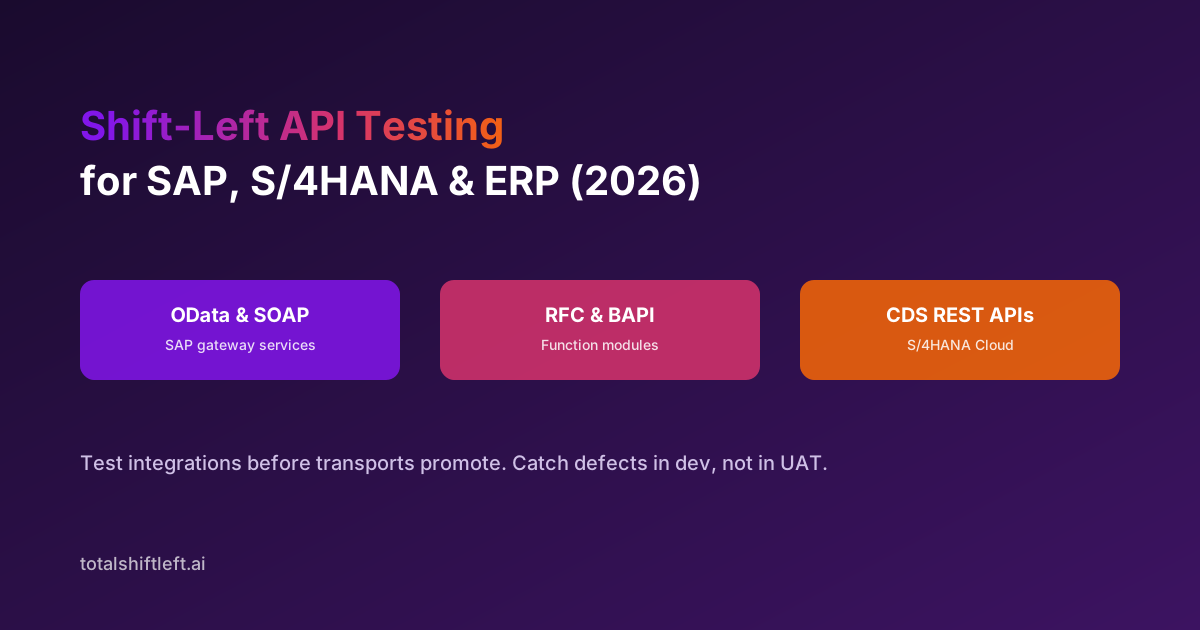
Shift-left API testing for SAP environments validates OData, REST, SOAP, RFC, and BAPI integrations on every commit — before transports promote into UAT or production. Done right, it cuts UAT defect cycles by more than half, shortens S/4HANA migration timelines, and gives audit teams the controlled evidence trail they need for compliance.
This guide walks through the practical pattern: which SAP protocols to test, where shift-left fits in the SAP SDLC, what test data approach works, and how to wire the whole thing into a CI/CD pipeline that respects SAP's transport-based release model.
In this guide
- Why SAP integrations need shift-left in 2026
- What is shift-left API testing for SAP?
- The SAP API surface: OData, REST, SOAP, RFC, BAPI
- The defect cost curve in SAP projects
- Shift-left pipeline architecture for SAP
- Test data management for SAP
- Tools and platforms
- Real implementation example: an S/4HANA migration
- Common challenges
- Shift-left API testing for SAP best practices
- Shift-left for SAP checklist
- Testing an OData service the same way as any other API
- Frequently asked questions about shift-left API testing for SAP
Why SAP integrations need shift-left in 2026
Three forces are reshaping how enterprises test SAP integrations.
S/4HANA migrations have multiplied integration surface area. Every customer moving from ECC to S/4HANA — and there are tens of thousands — is rewriting integration patterns. Old IDoc and RFC paths are being replaced by OData and REST. New non-SAP systems are entering the integration topology faster than QA teams can build test coverage manually.
Cloud-first ERP has shortened release cycles. S/4HANA Cloud customers receive quarterly upgrades whether they're ready or not. Annual UAT-driven QA cycles cannot keep pace. Teams need automated, CI/CD-native validation that runs on every transport.
Audit and compliance pressure has tightened. SOX, GDPR, HIPAA, and industry-specific mandates require demonstrable, repeatable test evidence for every change to financial, customer, and patient-data flows. Manual SAP testing produces audit trails that auditors increasingly reject.
The shift-left answer is simple in concept: validate every API interaction the moment it changes, before it has a chance to break a downstream consumer or land in front of a real user. The challenge in SAP environments is that the API surface is heterogeneous, the transport model is sequential, and the test data carries unusually high regulatory weight.
For the broader shift-left context, start with our shift-left API testing pillar guide.
What is shift-left API testing for SAP?
Shift-left API testing for SAP applies the shift-left principle — test the earliest you can, where it's cheapest to fix — to the SAP integration layer specifically. Concretely, it means:
- Validating OData, REST, SOAP, RFC, and BAPI specifications on every ABAP commit
- Running contract tests against a sandbox SAP client before transport promotion
- Executing AI-generated functional and negative test suites against mocks or sandbox tiers
- Gating transport movement (DEV → QAS → PRD) on green CI builds
- Surfacing failed tests in the pull request or change request, not in UAT
This is the opposite of the traditional SAP QA model, where QA runs end-to-end test scripts on a stable QAS client after development is "done." That model worked when SAP releases were annual. It breaks in S/4HANA Cloud cadences and in any environment running more than one or two integrations per quarter. For estates where the SAP landscape sits behind a corporate firewall, running validation through an on-prem, air-gapped shift-left agent keeps every request inside the network perimeter while still gating transports on green builds.
The SAP API surface: OData, REST, SOAP, RFC, BAPI
A complete SAP shift-left strategy covers five interface technologies, each with its own testing pattern.
OData services. The default modern SAP API protocol — used by SAPUI5, Fiori, and most S/4HANA-Cloud integrations. Specs are exposed as $metadata documents that map cleanly onto OpenAPI for testing tools. Validate query options, batch operations, and deep entity expansions.
CDS-exposed REST APIs. Newer S/4HANA pattern using ABAP CDS (Core Data Services) to project entities as REST endpoints. These benefit most from spec-driven testing because the CDS annotations directly produce the API contract.
SOAP web services. Still pervasive in ECC, PI/PO, and many on-prem S/4HANA deployments. WSDL-driven validation, often combined with XSD schema testing.
RFC and BAPI. Function-module-level calls, typically used for batch and legacy integrations. Test via SAP NetWeaver RFC SDK or through SAP-supplied adapters in CI tools.
IDoc and event-driven messaging. Async patterns via SAP Event Mesh, Kafka adapters, or older ALE/IDoc paths. Test contract conformance and downstream impact rather than synchronous response.
Total Shift Left covers OData, REST, and SOAP natively — the three modern paths that most S/4HANA programs prioritize. For RFC/BAPI-heavy estates, pair it with a function-module-aware tool (Tricentis Tosca or a custom SAP RFC adapter).
The defect cost curve in SAP projects
The economic case for shift-left is stark in SAP because the cost-of-defect curve is unusually steep. SAP changes typically cross multiple clients, transports, and approval gates before reaching production — every gate that catches a defect is cheaper than the gate after.
Ready to shift left with your API testing?
Try our no-code API test automation platform free. Generate tests from OpenAPI, run in CI/CD, and scale quality.
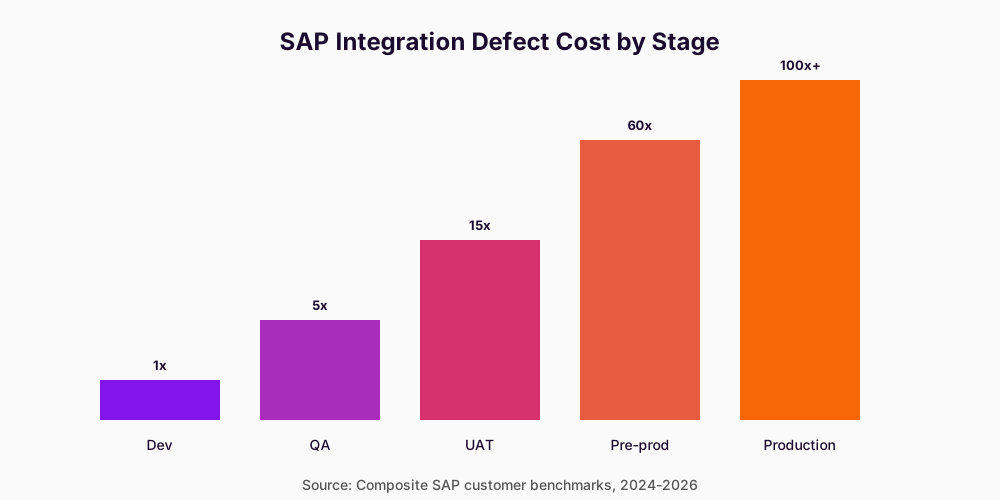
A defect caught in development costs roughly 1x in engineering time to fix. The same defect caught in QA costs 5x because the transport has already moved and dependent integrations may have built on the broken contract. By UAT, the cost is 15x — business users are now blocked and rollbacks may require re-running data loads. In pre-production it's 60x. In production, especially after cutover on a major S/4HANA program, defects can cost 100x or more once you factor in incident response, customer impact, and regulatory exposure.
Shift-left's value is not theoretical here. It is the difference between a 12-week UAT defect cycle and a 4-week one.
Shift-left pipeline architecture for SAP
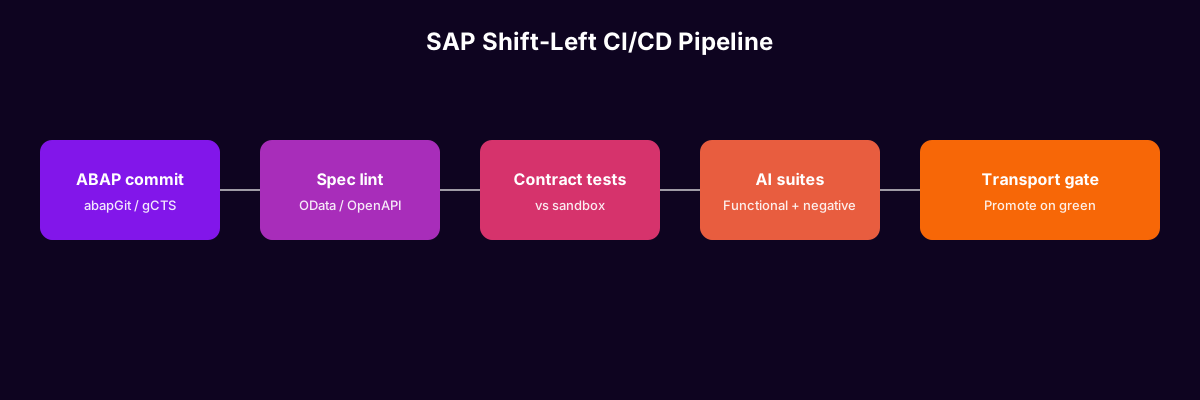
A typical SAP shift-left CI/CD pipeline runs five stages on every commit or transport request.
-
ABAP commit via abapGit or gCTS. Source control of ABAP development is the precondition for shift-left. Without versioned code, automated validation has no anchor.
-
Specification linting. OData metadata, OpenAPI documents, WSDLs — each linted for backward compatibility, naming conventions, and breaking-change risk.
-
Contract tests against sandbox client. Tests assert that responses conform to the declared schema. Schema drift surfaces in the PR.
-
AI-generated functional and negative suites. Total Shift Left generates hundreds of request variations per endpoint, covering happy paths, boundary conditions, malformed inputs, authentication failures, and SAP-specific edge cases (locked clients, transport conflicts).
-
Transport gate. Promotion from DEV → QAS only proceeds if the test suite is green. Failed runs become attached evidence on the transport request, satisfying audit requirements.
For pipeline templates compatible with Jenkins, GitHub Actions, Azure DevOps, and GitLab CI, see our API testing in CI/CD guide.
Test data management for SAP
SAP test data is uniquely sensitive: financial records, customer master data, HR data — all under varying regulatory regimes. Shift-left requires this data to be available per PR, which is incompatible with the traditional "refresh client 200 quarterly" model.
The practical pattern combines three approaches:
- Synthetic data generated from OData / OpenAPI / WSDL specs for the bulk of test scenarios. Schema-driven, refreshes automatically when contracts change.
- Masked SAP client samples for edge cases that synthesis can't anticipate, sourced from a sanitized "client 999" or equivalent.
- Isolated per-PR client copies for end-to-end transactional flows, typically implemented via CCMS or third-party tools that snapshot and reset clients on demand.
See Test Data Management Best Practices for API Testing for the deeper pattern. For regulated industry guidance — banking, insurance, healthcare — see regulated industries.
Tools and platforms
| Category | Tool | SAP fit |
|---|---|---|
| Spec-driven API testing | Total Shift Left | OData, REST, SOAP — strong |
| Model-based end-to-end | Tricentis Tosca | UI + API + RFC — strong; high cost |
| SOAP/REST suite | SmartBear ReadyAPI | SOAP heritage, weaker shift-left |
| Open-source contract | Schemathesis, Pact | OData/REST only |
| RFC/BAPI testing | SAP ABAP Unit, Tosca SAP | Function-module level |
| Transport management | SAP Solution Manager, gCTS | Orchestration |
| Test data | Total Shift Left + Tonic + client snapshot tooling | Hybrid synthesis + masking |
For organizations comparing Total Shift Left vs Tricentis Tosca, the typical pattern is: Tosca for end-to-end UI-driven SAP scenarios, Total Shift Left for fast, CI/CD-native API gates on every transport.
Real implementation example: an S/4HANA migration
A European insurance carrier we'll call Lumen Re was 18 months into an S/4HANA migration. The integration layer — 240 OData services, 60 SOAP services, 110 RFC calls — was the program's largest risk. Annual SAP releases had previously gone live with 80-120 integration defects discovered in the first month post-cutover. Cutover for the new platform was non-negotiable: 9 months out.
The shift-left intervention took 14 weeks:
Weeks 1-3. Specifications onboarded into Total Shift Left. AI generated initial test suites: ~6,800 tests across the OData and REST surface. Baseline coverage report shared with audit.
Weeks 4-8. CI pipeline integrated with abapGit and gCTS. Every transport request now triggers contract tests against a dedicated sandbox client. Failed transports return rich diagnostic reports.
Weeks 9-12. AI-generated negative tests added: malformed payloads, authentication edge cases, OData query-option fuzzing. SOAP services covered via WSDL-driven generation. RFC calls covered via a Tosca-based supplementary suite.
Weeks 13-14. Audit walkthrough; transport gate formalized in the release management process; UAT script automation reduced by 60%.
Outcome at cutover: 31 integration defects in the first month, down from a historical 90-defect baseline. UAT cycle compressed from 12 weeks to 5. Audit signoff on the testing evidence trail in the first review.
Common challenges
Challenge: ABAP code isn't under version control. Solution: introduce abapGit or gCTS first. Without source control, shift-left has nothing to hook into.
Challenge: sandbox clients drift from production. Solution: automate periodic refreshes via CCMS or third-party tools. Treat the sandbox as ephemeral, not as a long-lived shared environment.
Free PDF (10 pages)
Shift Left Testing Playbook
Move testing earlier in your SDLC with a proven adoption roadmap. Includes CI/CD architecture, tool stack recommendations, and metrics to track success.
Download FreeChallenge: SAP security model blocks per-PR client isolation. Solution: work with the basis team to establish a dedicated CI client with appropriate auth profiles. The investment is one-off; the unlock is durable.
Challenge: RFC/BAPI calls don't fit OpenAPI cleanly. Solution: layer a Tosca or custom-adapter approach on top of Total Shift Left for the function-module surface. Most enterprises end up with two tools — that's fine.
Challenge: business users still expect end-of-cycle UAT. Solution: don't try to replace UAT in one step. Use shift-left to drive UAT defect counts down quarter over quarter, then collapse UAT cycle time as confidence grows.
Shift-left API testing for SAP best practices
- Treat the OData/OpenAPI/WSDL spec as the single source of truth for every API
- Lint specs on every commit; reject breaking changes in the PR
- Run contract tests against a sandbox SAP client on every transport request
- Generate functional and negative tests from the spec, not by hand
- Gate transport promotion on green CI builds
- Attach test evidence to every transport request for audit
- Refresh sandbox clients automatically; never let them drift
- Cover RFC/BAPI separately with a function-module-aware tool
- Build the test data pattern around synthesis + masking + per-PR isolation
Shift-left for SAP checklist
- ✔ ABAP source under version control (abapGit or gCTS)
- ✔ OData and OpenAPI specs published for every service
- ✔ Spec lint runs on every commit
- ✔ Contract tests run on every transport request
- ✔ AI-generated functional + negative suites cover ≥80% of endpoints
- ✔ Transport promotion gated on green CI builds
- ✔ Sandbox clients refresh automatically on a defined cadence
- ✔ Test evidence attached to every transport for audit
- ✔ RFC/BAPI surface covered by a function-module-aware tool
See also: contract testing in our learn hub for the underlying concept.
Testing an OData service the same way as any other API
SAP integrations are testable with ordinary tooling once you treat the OData service as what it is — an HTTP API with a published metadata document:
# 1. the service describes itself; $metadata is the contract
curl -s -u "$SAP_USER:$SAP_PASS" \
  "https://s4.example.com/sap/opu/odata/sap/API_SALES_ORDER_SRV/\$metadata" -o metadata.xml

# 2. OData query options are the test surface most integrations get wrong
curl -s -u "$SAP_USER:$SAP_PASS" -H 'Accept: application/json' \
  "https://s4.example.com/sap/opu/odata/sap/API_SALES_ORDER_SRV/A_SalesOrder?\
\$filter=SalesOrderType eq 'OR'&\$top=5&\$select=SalesOrder,SoldToParty,TotalNetAmount" | jq

# 3. writes need a CSRF token — the step that breaks most first attempts
TOKEN=$(curl -s -u "$SAP_USER:$SAP_PASS" -I -H 'X-CSRF-Token: Fetch' \
  "https://s4.example.com/sap/opu/odata/sap/API_SALES_ORDER_SRV/" \
  | awk '/[Xx]-[Cc][Ss][Rr][Ff]-[Tt]oken/ {print $2}' | tr -d '\r')
Wrap the ones that matter in a suite that runs against the sandbox client on every integration change, so a transport that breaks a field length is caught before it reaches the business:
# tests/test_sales_order_integration.py
import pytest, requests

BASE = "https://s4.example.com/sap/opu/odata/sap/API_SALES_ORDER_SRV"

@pytest.mark.parametrize("field,limit", [
    ("SalesOrder", 10), ("SoldToParty", 10), ("PurchaseOrderByCustomer", 35),
])
def test_field_lengths_match_the_metadata(sap, field, limit):
    r = sap.get(f"{BASE}/A_SalesOrder?$top=50&$select={field}")
    for row in r.json()["d"]["results"]:
        assert len(row[field] or "") <= limit, f"{field} exceeded {limit} chars"

def test_unknown_order_type_is_rejected_not_silently_defaulted(sap, csrf):
    r = sap.post(f"{BASE}/A_SalesOrder", json={"SalesOrderType": "ZZZZ"},
                 headers={"X-CSRF-Token": csrf})
    assert r.status_code >= 400, "invalid order type was accepted"
Frequently asked questions about shift-left API testing for SAP
Can you shift-left API testing in SAP environments?
Yes. SAP exposes OData, REST (CDS), SOAP, RFC, and BAPI interfaces — all of which can be validated in CI/CD before transports promote. The shift-left pattern is: lint the spec on commit, run contract tests against a sandbox client, execute AI-generated functional and negative suites against a mock or sandbox tier, and gate the transport promotion on green builds.
Which SAP API protocols are most important to test?
OData (for SAPUI5 and Fiori), CDS-exposed REST APIs (S/4HANA Cloud), SOAP web services (legacy ECC and PI/PO), and RFC/BAPI calls (still common for batch integrations). A complete shift-left strategy covers all four because most enterprises run a mix.
Does Tricentis Tosca already solve SAP API testing?
Tosca is strong at end-to-end SAP testing including UI automation and is widely deployed in large SAP customers. For pure API-level shift-left — fast, schema-driven, CI/CD-native, with AI-generated coverage and a self-hosted LLM — Total Shift Left is purpose-built and complements Tosca for organizations that want both deep UI testing and fast API gates.
How do you handle SAP test data for shift-left?
Use synthetic data generated from the OData / OpenAPI / WSDL spec, masked SAP client samples for edge cases, and isolated per-PR client copies. See our test data management best practices guide for the broader pattern.
What's the ROI of shift-left for SAP integration testing?
Composite customer benchmarks show 50-65% reduction in UAT defects, 30-40% shorter transport cycle times, and dramatic reductions in production incident counts after S/4HANA cutover. The investment pays back in the first major release post-implementation.
Sources and further reading
- SAP Business Accelerator Hub — the published OData and REST contracts for SAP services.
- OData v4 specification — the query and payload rules SAP APIs follow.
- OpenAPI Specification — the normative spec for describing HTTP APIs.
Key takeaways
- S/4HANA migrations, shorter cloud release cadences, and tightening audit pressure are pushing SAP customers toward CI/CD-native, shift-left integration testing.
- The pattern is well-defined: spec-driven, AI-generated, gated at transport, evidenced for audit.
- The tools exist. The economics are obvious — every defect caught one stage earlier is roughly 5x cheaper.
Start a free 15-day trial of Total Shift Left to validate OData, REST, and SOAP endpoints in your SAP estate. Or compare against Tricentis Tosca to understand where each fits in your stack.
Related: Shift Left API Testing — complete guide | Best API Testing Tools for Enterprise QA Teams 2026 | API testing in CI/CD | Test data management best practices | Total Shift Left vs Tricentis Tosca
Ready to shift left with your API testing?
Try our no-code API test automation platform free.