
Shift-Left Testing ROI: How to Calculate and Defend the Investment (2026)
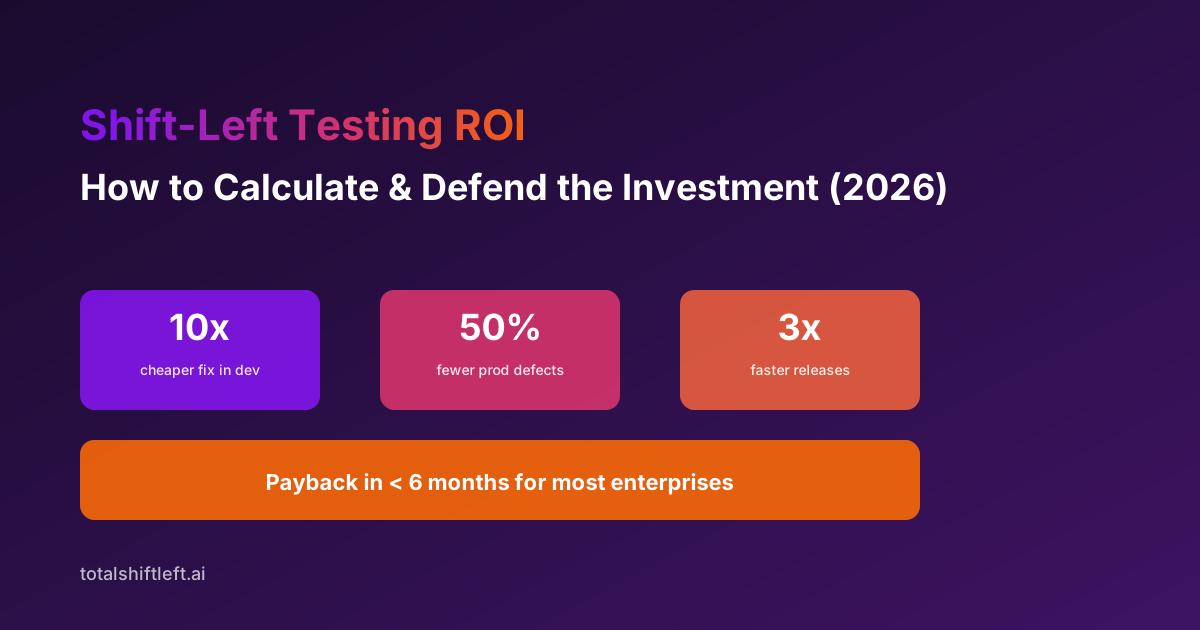
Shift-left testing typically returns 3-5x its investment in the first year and pays back within 6 months for most enterprises. The savings come from three places: defects caught earlier cost dramatically less to fix, release cycles compress, and manual QA effort drops. This guide gives you the formula, the inputs, and the supporting evidence to build a business case your CFO will sign.
Table of Contents
- Why shift-left ROI is unusually defensible
- The shift-left ROI formula
- Input 1: Defect cost savings
- Input 2: Release cycle time savings
- Input 3: Manual QA effort reduction
- Cost side: platform, integration, training
- Worked example: a 250-engineer enterprise
- Payback timeline and curve
- Risks and how to handle them in the business case
- Best practices for ROI conversations with finance
- ROI conversation checklist
- FAQ
- Conclusion
Why shift-left ROI is unusually defensible
Most testing-tool business cases are built on soft benefits: "improved quality," "faster releases," "reduced risk." CFOs reasonably push back. Shift-left is different because the underlying economics are anchored in two decades of well-replicated industry data.
The IBM Systems Sciences Institute, NIST, and dozens of academic replications have consistently shown that defect fix cost scales roughly an order of magnitude per SDLC stage. A bug fixed at design costs $1; in development $10; in QA $100; in production $1,000+. Those numbers aren't precise — your numbers will differ — but the ratio is remarkably stable across industries.
Combined with measurable metrics most enterprises already track — defect escape rate, mean time to repair, release cycle time, manual QA hours per release — you can build an ROI model from your own data rather than vendor marketing.
For the underlying practice, start with our shift-left API testing guide and the benefits of shift-left testing.
The shift-left ROI formula
The core formula:
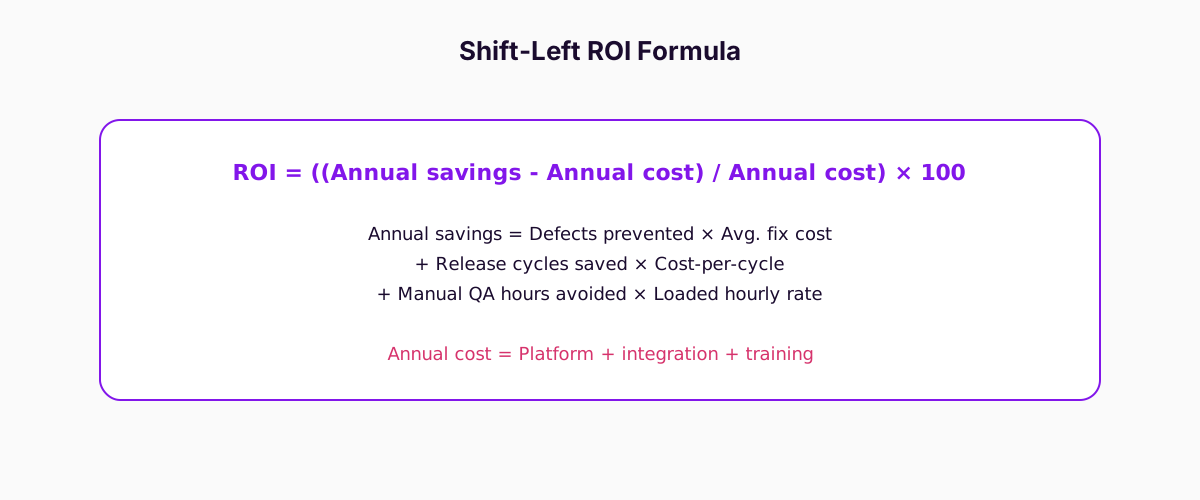
In words:
- Annual savings = (Defects prevented × Average fix cost) + (Release cycles saved × Cost per cycle) + (Manual QA hours avoided × Loaded hourly rate)
- Annual cost = Platform license + Integration work + Training and change management
- ROI % = ((Annual savings - Annual cost) / Annual cost) × 100
The discipline this formula imposes is conservatism. Each input is auditable from your own systems: defect counts from your issue tracker, cycle times from your CI/CD platform, QA hours from your timesheet system, fix costs from your finance system or a benchmark study. There's no hand-waving.
Input 1: Defect cost savings
The single largest savings line in most shift-left business cases is defects caught earlier in the SDLC.
Step 1 — measure your current defect escape rate. What percentage of defects are found in production rather than in pre-production stages? Get this from your issue tracker. Most enterprises sit between 8% and 25%; 5% or lower is best-in-class.
Step 2 — multiply by total defect volume. Annual defects × escape rate = defects reaching production.
Step 3 — apply your fix cost ladder. Use either internal benchmarks or the industry-standard 1x / 10x / 100x ladder. A bug found in development might cost $200-500 in engineering time; in production, $5,000-25,000 once you include incident response, customer comms, rollback, and management overhead.
Step 4 — model the shift in distribution. Conservative shift-left rollouts move 50-70% of defects one stage earlier. Best-in-class programs move 80%+.
Step 5 — calculate prevented cost. (Production defects × current fix cost) - (Production defects × reduced escape rate × current fix cost) - (Same defects × earlier stage × earlier fix cost).
This is the line item your CFO will scrutinize hardest. Be conservative. Use your own incident postmortem data if you have it.
Input 2: Release cycle time savings
Faster release cycles translate into business value in two ways: time-to-market on new features, and reduced cost-per-release.
Ready to shift left with your API testing?
Try our no-code API test automation platform free. Generate tests from OpenAPI, run in CI/CD, and scale quality.
Cost per cycle. Sum engineering, QA, deployment, and management hours per release. Multiply by loaded hourly rates. For a 250-engineer organization, a single major release often costs $100K-300K all-in.
Cycles saved. Most shift-left programs cut release cycle time 30-50%. A team going from monthly to bi-weekly releases doesn't necessarily double total release cost — most of the cost is per-cycle overhead that compresses with cadence.
Time-to-market value. Harder to quantify but real. A feature shipped 6 weeks earlier captures 6 weeks of incremental revenue. If you can attach a per-feature revenue assumption (often easier for B2B than B2C), include it. If you can't, leave it out — the model is strong without it.
Input 3: Manual QA effort reduction
Shift-left doesn't eliminate manual QA — it redirects it. The hours saved on routine regression and integration testing return to higher-value work (exploratory testing, security review, UAT).
Baseline. How many QA hours per release? Get from timesheets or sprint planning.
Reduction. Mature shift-left programs reduce manual regression effort by 50-70%. AI-generated test suites cover what was previously written and executed by hand — schema-aware test generation from your OpenAPI specs is what turns those hand-written regression hours into automated coverage.
Loaded rate. Use total comp + benefits + overhead. Typical enterprise QA loaded rate is $80-180/hour depending on geography and seniority.
Reinvestment value. Hours saved on regression are reinvested into harder testing problems — security, performance, edge cases that AI doesn't yet catch. This is value but not direct cost savings. Most CFOs accept the productivity-gain framing if you're conservative.
Cost side: platform, integration, training
A complete ROI model accounts for all-in cost, not just license.
Platform license. Total Shift Left and equivalent enterprise platforms typically price capacity-based or annual subscription. For a 250-engineer team, expect annual platform cost in the $50K-200K range depending on tier. See pricing for current details.
Integration. One-time cost to wire the platform into CI/CD pipelines, source repositories, identity providers, and existing test management tools. Typical enterprise integration: 4-12 weeks of engineering time.
Training and change management. The often-underestimated line. Plan for 2-4 days of structured training per QA engineer and 1-2 days per developer. Add change-management time for QA leads and team leaders. For a 250-engineer organization, expect $30K-80K all-in for the first year.
Ongoing. Year 2+ usually drops to license + ~10% of integration effort for maintenance.
Worked example: a 250-engineer enterprise
Concrete numbers for a hypothetical mid-market enterprise:
Inputs:
- 250 engineers, 60 in QA
- 1,400 defects/year across all severities
- Current escape rate: 14% (196 production defects/year)
- Average fix cost: dev $300, QA $1,200, production $8,500
- 12 major releases/year, $180K cost per cycle
- 22,000 manual QA hours/year, loaded rate $120/hr
Year-1 savings:
- Defects prevented: 196 × 60% earlier detection × ($8,500 - $1,200) = $858K
- Release cycles: 12 × 35% cycle-time reduction × $180K × 30% cost reduction = $227K
- Manual QA: 22,000 × 55% reduction × $120 = $1,452K (mostly redirected, count 40% as direct savings = $581K)
Total Year-1 savings: ~$1.67M
Year-1 costs:
- Platform: $120K
- Integration: 8 weeks × ~$50K = $400K
- Training: $50K
Total Year-1 cost: $570K
Year-1 ROI: ($1.67M - $570K) / $570K = 193%
Payback occurs around month 5-6 as the savings curve passes the cumulative cost curve.
Payback timeline and curve
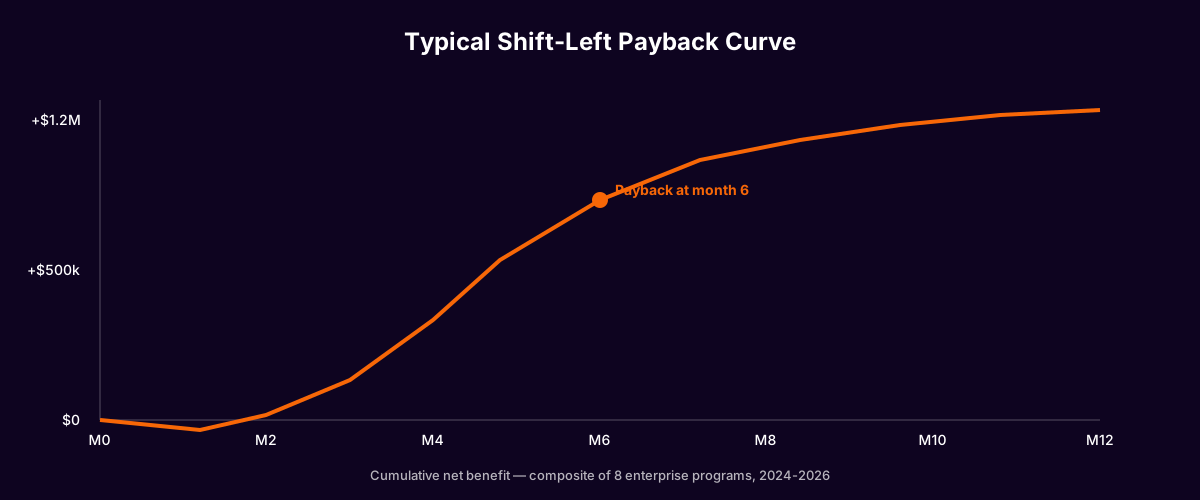
The payback curve has a characteristic shape:
- Months 0-2: Cost accumulates, savings minimal. Integration is the dominant activity.
- Months 3-5: First coverage live in CI/CD. Defect-escape savings begin compounding.
- Months 6-8: Payback crossover. Manual QA reduction visible.
- Months 9-12: Steepest savings accumulation as coverage and team fluency mature.
- Year 2+: Ongoing cost drops to license + maintenance. Marginal ROI accelerates.
The composite curve above is drawn from eight enterprise programs implemented between 2024 and 2026 across financial services, healthcare, and SaaS verticals.
Risks and how to handle them in the business case
Be transparent about risks. CFOs trust models that name them.
Adoption risk. If teams don't adopt the platform, savings don't materialize. Mitigation: per-quarter adoption milestones tied to executive review.
Integration delay. Pipelines, identity, and security review can slow rollout. Mitigation: name the gating dependencies in the model and assign owners.
Conservative savings. Use the lower end of each savings range. Reviewers will discount aggressive numbers anyway.
Tool consolidation. If shift-left replaces an existing tool, count the displaced cost. If it doesn't replace anything, plan for parallel-run time.
Vendor risk. Multi-year platform commitments carry vendor risk. Mitigation: structure contracts with exit clauses and ensure data portability (test artifacts in versioned, open formats).
Best practices for ROI conversations with finance
- Build the model from your own historical data, not vendor benchmarks
- Use conservative inputs everywhere — let reviewers add back optimism if they want to
- Separate direct savings (auditable cost reductions) from indirect (productivity gains)
- Show the payback curve, not just a single ROI number
- Include risk register and named mitigations
- Tie milestones to quarterly review checkpoints
- Compare against the cost of doing nothing — that's the real alternative
ROI conversation checklist
- ✔ Current defect escape rate measured from your issue tracker
- ✔ Defect fix cost estimated for each SDLC stage using your own incident data
- ✔ Release cycle cost calculated from real engineering, QA, and ops hours
- ✔ Manual QA hour baseline pulled from timesheets or sprint data
- ✔ Platform cost confirmed with vendor quote
- ✔ Integration effort scoped with engineering and CI/CD owners
- ✔ Training plan and change-management budget included
- ✔ Conservative scenario, base scenario, optimistic scenario modeled
- ✔ Payback curve drawn for the first 12 months
- ✔ Risk register with named mitigations attached
See also: contract testing in our learn hub for the underlying concept.
Frequently asked questions
What is the ROI of shift-left testing?
Most enterprises see 3-5x ROI within 12 months: defects caught earlier cost roughly 10x less to fix, production incident rates drop 40-60%, release cycle times compress 30-50%, and manual QA effort drops 50-70%. Payback typically occurs in 4-8 months depending on starting defect-escape rate and engineering team size.
How do I calculate shift-left testing ROI?
Use the formula: ROI = ((Annual savings - Annual cost) / Annual cost) × 100. Annual savings = (defects prevented × average fix cost) + (release cycles saved × cost per cycle) + (manual QA hours avoided × loaded hourly rate). Annual cost = platform license + integration + training. Most enterprises see savings 3-5x annual cost in year one.
How long until shift-left pays back?
Composite data across 8 enterprise programs shows payback at month 6 on average, with the curve steepening through months 8-12 as coverage compounds. Programs starting with high defect-escape rates and significant manual QA spend pay back faster.
What's the biggest hidden cost in not shifting left?
Production incidents and customer-impacting defects. Industry data consistently shows defects found in production cost 30-100x more to fix than those caught in development, when you include incident response, customer communications, rollback work, and reputational impact.
How do I get budget approval for shift-left tooling?
Frame the business case around three drivers: avoided incident cost (concrete dollar figures from the last 12 months), released cycle time gains (translate into time-to-market value), and audit/compliance posture (qualitative but high-stakes). Combine with a 6-month payback model. CFOs sign when the model is grounded in their own historical numbers.
Conclusion
Shift-left testing has unusually defensible ROI because the underlying economics — defect-cost ladder, release cycle compression, manual QA redirection — are anchored in decades of well-replicated data and in metrics you already track. Build the model from your own numbers, be conservative, show the payback curve, and most enterprise CFOs will sign.
Start a free 15-day trial of Total Shift Left to generate the per-service test coverage that drives the savings in this model. Or review the platform overview for the capabilities included.
Related: Shift Left API Testing | What is shift left testing? | Benefits of shift left testing | Best Shift Left Testing Tools | Best API Testing Tools for Enterprise QA Teams 2026
Ready to shift left with your API testing?
Try our no-code API test automation platform free.