
Benefits of Shift Left Testing: 10 Proven Gains (2026)
Quick answer
Shift left testing's main benefits are dramatically lower defect costs, faster release velocity, and reduced production incidents — IBM reports production bugs cost 6x more to fix than design-phase bugs, and teams cut defect escape rates by up to 40%. Other gains include shorter developer feedback loops (seconds to minutes instead of weeks), stronger security posture, and better collaboration between QA and engineering.
Reviewed by Parveen Kumari
.svg)
In this guide
- Benefits of Shift Left Testing in Modern Software Development (2026)
- What Is Shift Left Testing?
- Why the Benefits of Shift Left Testing Are So Significant
- Key Benefits in Detail
- The Shift Left Testing ROI Architecture
- Tools That Maximize Shift Left Benefits
- Real Team Results: A Shift Left Implementation Case Study
- Common Obstacles to Capturing These Benefits
- Best Practices for Maximizing Shift Left Benefits
- Shift Left Benefits Realization Checklist
- Shift one check left and measure the difference
- Frequently asked questions about shift-left testing
Benefits of Shift Left Testing in Modern Software Development (2026)
The benefits of shift left testing include lower defect costs, faster release cycles, improved developer productivity, and stronger software quality. By moving testing earlier in the development lifecycle, teams catch bugs when they are cheapest to fix and reduce production incidents by up to 40%.
These benefits extend far beyond simply catching bugs earlier. When implemented properly, shift left testing transforms how engineering organizations operate — reducing costs, accelerating delivery, improving collaboration, and fundamentally changing the relationship between development speed and software quality.
IBM reports that bugs fixed in production cost 6x more than bugs caught during the design phase. Teams using shift left testing reduce their defect escape rate by up to 40%. These numbers represent real savings — in engineering hours, incident response costs, customer impact, and competitive position.
This guide documents every major benefit of shift left testing, explains the mechanisms behind each one, and provides practical guidance for capturing these benefits in your own organization.
Software quality and development speed used to be treated as a trade-off. Ship fast, accept more bugs. Ship slow, get higher quality. This trade-off was never actually true — it was an artifact of where testing was positioned in the development process.
When testing happens at the end, it creates bottlenecks. Every defect discovered requires a context switch back to code that developers have moved on from, a new build cycle, another round of QA validation, and potentially a delayed release. The friction of this late-stage feedback loop is what creates the perceived tension between speed and quality.
Shift left testing eliminates the trade-off by eliminating the late-stage bottleneck. When tests run continuously from the earliest stages of development, defects are found immediately — while context is fresh, while code is still being written, while fixing them is cheap and fast. The result is development that is faster and higher quality simultaneously.
Understanding these benefits in concrete, measurable terms is essential for engineering leaders making the case for shift left investment and for teams building the testing strategies that will define their delivery capabilities in 2026.
The economics behind moving checks earlier are worked through in the cost of late testing.
The argument for moving these checks off the post-deploy step entirely is in why teams cannot rely on post-deployment tests.
What Is Shift Left Testing?
Shift left testing is the practice of moving testing activities earlier in the software development lifecycle. Rather than a discrete testing phase after development, quality becomes a continuous, parallel activity embedded from requirements through deployment.
The core shift left techniques — unit testing, API testing from OpenAPI/Swagger specs, contract testing, static analysis, and CI/CD-integrated quality gates — each contribute to a cumulative quality effect that compounds over time. For a deeper exploration of what shift left testing is and how it works, see the complete guide to shift left testing.
Why the Benefits of Shift Left Testing Are So Significant
The Defect Cost Curve
The economics of software defects follow a well-documented exponential curve. IBM's research on software quality, documented in their engineering guidance and widely cited across the industry, demonstrates that the cost of fixing a defect grows dramatically with each stage of the development lifecycle:
- Requirements phase: Fixing a defect costs 1x (baseline)
- Design phase: Costs approximately 3-6x the baseline
- Development phase: Costs approximately 10x the baseline
- Testing phase: Costs approximately 15-40x the baseline
- Production: Costs approximately 60-100x the baseline
IBM reports bugs fixed in production cost 6x more than during design — and this figure understates the full production cost when you factor in incident response, customer impact, SLA penalties, and reputational damage.
Shift left testing attacks this curve directly. By catching defects earlier, every defect found in development rather than production represents a 60-100x cost reduction in remediation.
The Compounding Quality Effect
Each shift left investment builds on the previous one. A unit test suite that catches 70% of logic errors means 30% fewer bugs reach integration testing. An API test suite that catches 80% of interface issues means 80% fewer integration failures reach staging. Contract tests that catch breaking changes before deployment mean fewer production incidents. The defect catch rates at each layer compound to produce overall escape rates far lower than any single layer could achieve alone.
Release Cadence as a Force Multiplier
Teams using shift left testing consistently achieve higher release cadences — not because they are taking more risks, but because the cost of each release is lower. When tests run automatically on every commit and every pull request, releasing is not a high-stakes event requiring weeks of manual regression testing. It is a routine, automated operation with built-in quality verification.
High-performing DevOps teams, as measured by DORA metrics, consistently exhibit high shift left maturity. The correlation between automated testing integration and deployment frequency is one of the strongest predictors of engineering performance. For a deeper look at how testing fits into the broader DevOps lifecycle, see our DevOps testing strategy guide.
Key Benefits in Detail
Benefit 1: Dramatically Lower Defect Remediation Costs
The most quantifiable benefit of shift left testing is the reduction in defect remediation costs. IBM reports bugs fixed in production cost 6x more than during design — and the engineering community broadly validates this finding.
For an engineering team spending $2 million annually on defect remediation, even a modest 30% reduction in the proportion of defects discovered in production translates to $600,000 in annual savings. For enterprise organizations with larger engineering headcounts and higher-cost incidents, the savings scale correspondingly.
The mechanism is straightforward: defects found earlier require less work to fix. A unit test failure pinpoints exactly which function has a logic error. A contract test failure identifies exactly which inter-service interface has a breaking change. Compare this to a production incident, which requires incident triage, environment reproduction, log analysis, code archaeology, fix implementation, and re-validation.
Benefit 2: Faster Release Velocity
Counterintuitively, investing in shift left testing makes teams faster, not slower. The initial investment in building test infrastructure and adopting automated testing practices is recovered quickly as teams reduce the time spent on manual regression testing, defect reproduction, and production incident response.
Ready to shift left with your API testing?
Try our no-code API test automation platform free. Generate tests from OpenAPI, run in CI/CD, and scale quality.
Teams that have reached shift left maturity — comprehensive automated test suites, CI/CD quality gates, and spec-driven API testing — report shipping features in days that previously took weeks. The constraint on speed shifts from "waiting for QA" to "waiting for the feature to be built." Learn how to build these quality gates in our guide to shift left testing in CI/CD pipelines.
Benefit 3: Improved Developer Productivity
Short feedback loops are a defining characteristic of high-productivity development. When a developer writes a function and a unit test failure tells them in 30 seconds that their logic is wrong, they fix it immediately. When they receive the same information through a QA report three weeks later, they spend hours reconstructing context before they can even start fixing the issue.
Shift left testing dramatically shortens these feedback loops at every stage:
- Static analysis: feedback in seconds at commit time
- Unit tests: feedback in seconds to minutes in CI
- API tests: feedback in minutes on every pull request
- Integration tests: feedback in minutes before merge
Developers working in this environment report higher confidence, lower cognitive load, and less time spent on debugging and rework — all of which translate to higher feature delivery throughput.
Benefit 4: Reduced Defect Escape Rate
Teams using shift left testing reduce their defect escape rate by up to 40%. This is the percentage of defects that escape pre-production testing and are discovered by users in production. Reducing this rate directly reduces production incidents, customer-reported bugs, support ticket volume, and emergency engineering response.
A lower defect escape rate also changes the culture of production deployments. Instead of a high-stakes event with potential for customer impact, deployments become routine operations with high confidence that the software behaves as expected. This enables more frequent deployments, which themselves create smaller, lower-risk change sets — a virtuous cycle.
Benefit 5: Better Security Posture
Security testing integrated into the development workflow — SAST (static application security testing) at the code level, dependency scanning for known vulnerabilities, and security-focused API testing — catches vulnerabilities before they reach production. This is the security equivalent of the defect cost curve: a SQL injection vulnerability caught in a code review costs minutes to fix; the same vulnerability exploited in production costs an incident response, potential data breach notification, regulatory scrutiny, and reputational damage.
Shift left security testing also supports compliance requirements. Organizations subject to SOC 2, PCI-DSS, HIPAA, and similar frameworks benefit from demonstrable, automated security testing integrated into every development cycle.
Benefit 6: Stronger Team Collaboration
Shift left testing changes how development and quality teams interact. Instead of developers "throwing code over the wall" to QA, and QA returning defect lists to developers, shift left teams collaborate from the beginning of every feature.
QA engineers participate in requirements reviews to identify testability concerns and define acceptance criteria. Developers write tests alongside code. Product managers define the expected behaviors that will be validated by automated tests. This earlier collaboration surfaces misunderstandings and ambiguities when they are cheap to resolve, rather than after implementation is complete.
Benefit 7: Improved API Quality and Reliability
For teams building APIs — whether internal microservices or external developer-facing products — shift left API testing provides specific, high-value benefits. Shift-Left API enables teams to import OpenAPI/Swagger specifications and automatically generate comprehensive test suites covering all endpoints, HTTP methods, parameters, and response codes.
This means:
- API tests are available immediately when the spec is written, before implementation is complete
- Coverage is comprehensive by default — no endpoints missed, no edge cases overlooked
- Tests stay synchronized with the API spec, preventing test drift
- Breaking changes are caught in CI before they reach integration environments
The result is APIs that are more reliable, better documented through their test coverage, and faster to iterate on because developers have immediate feedback when changes break expected behaviors.
Benefit 8: Measurable Quality Metrics
Shift left testing creates a data-rich quality environment. Test coverage percentages, pass/fail rates, defect discovery rates by pipeline stage, mean time to detect (MTTD), and defect escape rates are all measurable, trackable metrics that enable data-driven quality decisions.
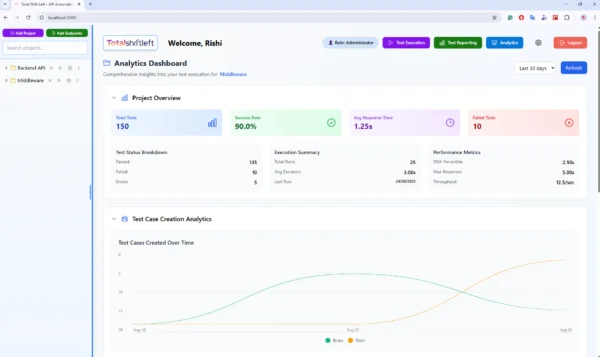
The analytics capabilities in platforms like Shift-Left API provide engineering leaders with clear visibility into API test coverage, test run results, and trends over time. This data supports investment decisions, demonstrates the ROI of quality infrastructure, and enables continuous improvement based on evidence rather than intuition.
Benefit 9: Enabling Continuous Delivery
Continuous delivery — the practice of ensuring software is always in a releasable state — is only possible with robust automated testing. Without shift left testing, every potential release requires a manual validation cycle. With it, every commit is automatically validated against a comprehensive test suite, and the deployment pipeline can be triggered with confidence at any time.
This capability is transformative for business agility. Organizations that can deploy daily or multiple times per day can respond to market changes, customer feedback, and competitive pressures far faster than organizations limited to weekly or monthly release cycles.
Benefit 10: Reduced Technical Debt
Technical debt — the accumulated cost of shortcuts, poor design decisions, and undocumented behavior — grows when teams cannot refactor safely. Shift left testing, particularly comprehensive unit test suites, provides the safety net that enables confident refactoring. When developers can change implementation details and immediately verify that behavior is preserved through tests, they maintain higher code quality over time.
Without this safety net, code becomes progressively harder to modify as teams accumulate untested complexity. With it, teams refactor continuously, keeping code quality high and preventing the accumulation of debt that eventually slows development to a crawl.
The Shift Left Testing ROI Architecture
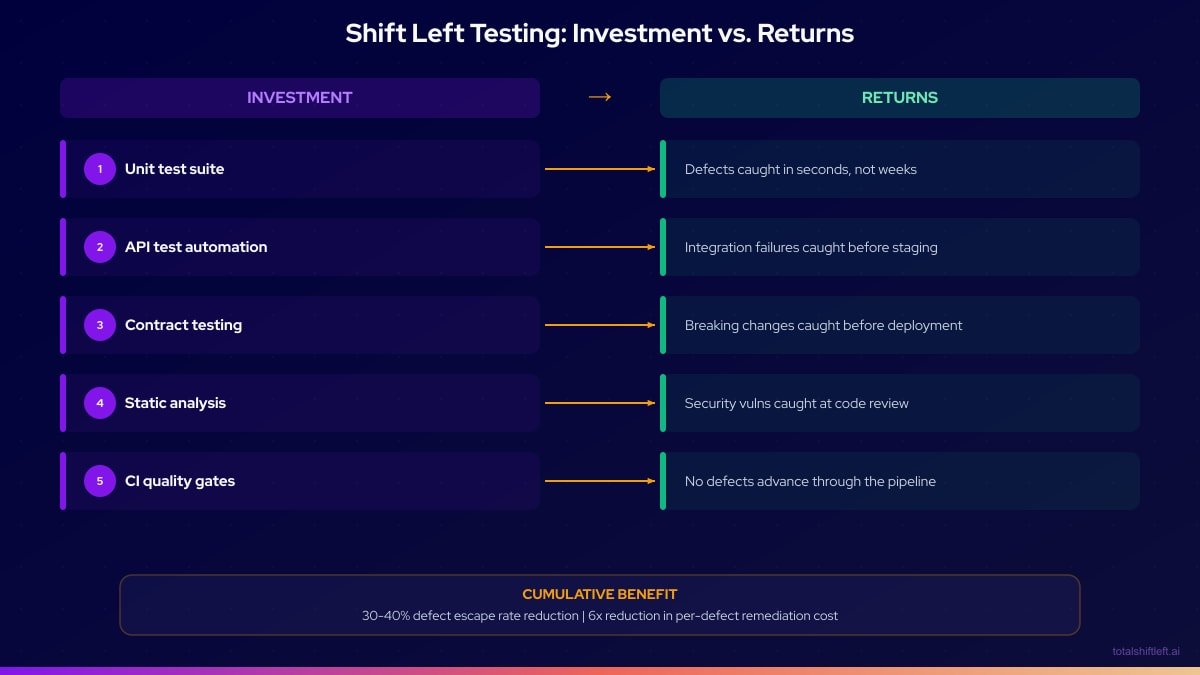
The ROI compounds because each layer reduces the number of defects that reach subsequent layers. Fewer unit-level defects mean fewer integration test failures. Fewer integration failures mean fewer staging issues. Fewer staging issues mean fewer production incidents. The return on the initial investment in each layer is amplified by the compounding effect across the pipeline.
Tools That Maximize Shift Left Benefits
For a comprehensive comparison of the platforms available today, see our guide to the best shift left testing tools.
| Category | Tools | Benefit Delivered |
|---|---|---|
| API Test Automation | Shift-Left API, REST Assured, Karate | Comprehensive API coverage from OpenAPI specs |
| Unit Testing | Jest, JUnit, PyTest, Mocha, NUnit | Immediate defect detection at code level |
| Contract Testing | Pact, Spring Cloud Contract | Prevents breaking changes between services |
| Static Analysis | SonarQube, ESLint, Semgrep | Early security and quality detection |
| CI/CD Orchestration | GitHub Actions, GitLab CI, Jenkins | Automated quality gate enforcement |
| Mock Servers | WireMock, MockServer, TSL Mocks | Test isolation for early integration testing |
| Code Coverage | Istanbul, JaCoCo, Coverage.py | Quantify and enforce test completeness |
| Security Scanning | Snyk, Dependabot, OWASP ZAP | Shift security testing left |
Why API Test Automation Delivers Outsized Benefits
Of all the shift left tools and techniques, API test automation from OpenAPI specifications delivers some of the highest ROI — particularly for microservices architectures where service interfaces are the most common source of integration failures.
Free PDF (10 pages)
Shift Left Testing Playbook
Move testing earlier in your SDLC with a proven adoption roadmap. Includes CI/CD architecture, tool stack recommendations, and metrics to track success.
Download FreeShift-Left API automates the generation and maintenance of API test suites from existing API specifications. Teams that previously spent days writing and maintaining API tests now have comprehensive coverage within hours of importing a spec. Tests run automatically in CI/CD pipelines, providing continuous validation of API behavior without ongoing manual maintenance.
Real Team Results: A Shift Left Implementation Case Study
Problem
A fintech company with a 35-person engineering team was struggling with a pattern that is familiar to many organizations: their release process was increasingly painful. Every release required a 3-day manual regression cycle, completed by 2 QA engineers. Despite this investment, production incidents related to API failures and integration issues were occurring on average twice per release cycle.
The business impact was significant: delayed releases, customer-reported bugs, an engineering team spending 25-30% of their capacity on rework and incident response, and a QA team perpetually behind.
Solution
The team implemented a comprehensive shift left testing strategy over 8 weeks:
Week 1-2: Onboarded Shift-Left API, imported OpenAPI specs for all 12 services, and achieved immediate automated coverage of 180+ endpoints. Tests integrated into their GitHub Actions CI/CD pipeline.
Week 3-4: Established unit test coverage standards (minimum 75% for business logic) and integrated SonarQube for static analysis at the pull request stage.
Week 5-6: Implemented contract testing with Pact for the 6 most critical inter-service interfaces. Added API mocking to enable early integration testing without dependent service availability.
Week 7-8: Defined CI/CD quality gates, established code coverage thresholds, and trained the team on the new workflow.
Results After 2 Quarters
- Manual regression cycle eliminated — replaced by automated pipeline running in under 12 minutes
- Production incidents related to API issues: reduced from 8 per quarter to 2 per quarter (75% reduction)
- QA engineer capacity freed from regression testing: 60% of their time, redirected to exploratory testing and quality strategy
- Developer rework time: reduced by approximately 35%
- Release frequency: increased from biweekly to weekly, with several weeks achieving multiple releases
- Defect escape rate: reduced from 22% of defects reaching production to 13% (40% improvement)
Common Obstacles to Capturing These Benefits
Obstacle 1: Incomplete Adoption
The benefits of shift left testing compound across layers. A unit test suite without API tests, or API tests without CI quality gates, delivers partial benefits. Teams that treat shift left as an à la carte selection rather than a systematic strategy capture only a fraction of the available benefits.
Solution: Implement shift left as a complete strategy with defined quality layers, not as individual tools adopted in isolation. For common obstacles and their solutions, see shift left testing challenges.
Obstacle 2: Test Suite Decay
Test suites that are written but not maintained become liabilities. Flaky tests, obsolete tests, and tests that do not keep pace with code changes erode confidence and reduce the value of the testing infrastructure.
Solution: Treat test code with the same discipline as production code. Require test updates as part of any feature or change. Use spec-driven test generation (as with Shift-Left API) to keep API tests synchronized with API definitions automatically.
Obstacle 3: Measuring the Wrong Things
Teams that measure test count rather than defect escape rate miss the point of shift left testing. More tests are not inherently better — comprehensive, meaningful tests at the right layers are what deliver benefits.
Solution: Track defect escape rate, mean time to detect, and defect discovery by pipeline stage. These metrics directly reflect the quality benefits of shift left investment.
Best Practices for Maximizing Shift Left Benefits
- Start with API testing from OpenAPI/Swagger specs. Generating test suites directly from your API schema delivers immediate, comprehensive coverage without requiring extensive test authoring — the highest ROI starting point for most teams.
- Enforce quality gates, not just quality metrics. Metrics that do not gate pipeline progression are monitoring, not quality control. Make test passage mandatory.
- Invest in fast pipelines. Benefits compound when tests run quickly. Slow pipelines lead to skipped testing, destroying the value of the investment.
- Use coverage to find gaps, not to celebrate numbers. Code coverage is a tool for finding untested paths, not a vanity metric. 90% coverage that does not include critical paths is less valuable than 70% coverage of every critical path.
- Make QA engineers quality architects. Freed from manual regression cycles, QA engineers can design better quality systems, define edge case scenarios, and identify coverage gaps. This increases the strategic value of the QA function.
- Track ROI explicitly. Document defect counts by stage, time spent on rework, and production incident rates before and after shift left investment. Concrete ROI data sustains investment and drives adoption.
- Extend shift left to security. Security vulnerabilities are defects too. The cost-to-fix curve applies equally to security issues. Integrating SAST and dependency scanning into the development workflow captures the same benefits for security that unit testing captures for functional quality.
Shift Left Benefits Realization Checklist
- ✔ API tests generated from OpenAPI/Swagger specs and running in CI on every PR
- ✔ Unit test coverage thresholds defined and enforced in the build pipeline
- ✔ Contract tests in place for critical microservice interfaces
- ✔ Static analysis and security scanning integrated at PR/commit stage
- ✔ CI/CD quality gates prevent defective code from advancing through the pipeline
- ✔ Defect escape rate tracked and used as a primary quality KPI
- ✔ QA engineers contributing to quality strategy, not just manual regression testing
- ✔ Release frequency and defect rate trends tracked quarter-over-quarter
See also: contract testing in our learn hub for the underlying concept.
Shift one check left and measure the difference
The cheapest shift-left move is a pre-commit hook: the contract check that used to fail in CI ten minutes later now fails in two seconds, before the commit exists.
# .pre-commit-config.yaml
repos:
  - repo: local
    hooks:
      - id: openapi-lint
        name: Lint the API spec
        entry: npx @stoplight/spectral-cli lint openapi.yaml --fail-severity error
        language: system
        files: ^openapi\.yaml$
        pass_filenames: false

      - id: openapi-breaking
        name: Block breaking contract changes
        entry: bash -c 'git show origin/main:openapi.yaml > /tmp/base.yaml &&
                        oasdiff breaking /tmp/base.yaml openapi.yaml --fail-on ERR'
        language: system
        files: ^openapi\.yaml$
        pass_filenames: false
The same two checks still run in CI as the backstop — the point of shifting left is not to remove the gate, it is to move the feedback to where the change is cheapest to make.
Frequently asked questions about shift-left testing
What are the main benefits of shift left testing?
The main benefits of shift left testing include significantly lower defect remediation costs, faster release cycles, improved developer productivity through shorter feedback loops, higher software quality, reduced production incidents, better team collaboration, and stronger security posture through early vulnerability detection.
How much does shift left testing reduce defect costs?
IBM reports that bugs fixed in production cost 6x more than bugs caught during design. Teams using shift left testing consistently reduce their defect escape rate by 30-40%, translating directly to reduced rework costs, fewer production incidents, and lower operational burden on engineering teams.
Does shift left testing slow down development?
No — shift left testing accelerates development over time. While there is an initial investment in building automated tests and pipelines, teams recover this investment quickly through faster debugging (tests pinpoint issues immediately), reduced rework cycles, fewer production incidents, and faster release velocity once the testing infrastructure matures.
How does shift left testing benefit the entire team, not just QA?
Shift left testing benefits developers through shorter feedback loops and less rework. It benefits QA engineers by freeing them from manual regression cycles to focus on higher-value exploratory and strategy work. It benefits product managers through more predictable delivery timelines. And it benefits customers through higher-quality, more reliable software.
Sources and further reading
- DORA State of DevOps research — the multi-year dataset behind the four delivery metrics.
- NIST SP 800-218 (SSDF) — the secure software development practices auditors map to.
- Google Testing Blog — Google's engineering write-ups on test sizing and flakiness.
Key takeaways
- The benefits of shift left testing are not abstract quality improvements — they are concrete, measurable business outcomes.
- Lower defect remediation costs, faster release velocity, reduced production incidents, and improved developer productivity each have direct business value.
- IBM's finding that production bugs cost 6x more than design-phase fixes reflects a broader truth: quality invested early returns far more value than quality inspected late.
For engineering leaders evaluating where to invest for maximum impact in 2026, shift left testing represents one of the clearest opportunities available. The path to capturing these benefits starts with the highest-ROI first step: automated API testing from your existing OpenAPI/Swagger specifications. Shift-Left API makes this immediate — import your specs, generate comprehensive tests, and integrate them into your CI/CD pipeline in hours, not weeks. Start your free trial today.
Related: What Is Shift Left Testing? Complete Guide | Shift Left Testing Strategy | Shift Left Testing Challenges and Solutions | Best Shift Left Testing Tools | DevOps Testing Strategy | How to Build a CI/CD Testing Pipeline | No-code API testing platform | Start Free Trial
Continue learning
Go deeper in the Learning Center
Hands-on lessons with runnable code against our live sandbox.
Turn an OpenAPI spec into hundreds of tests in minutes. Here's what the AI actually does well — and where it still needs you.
A contract is a promise. Contract testing keeps you honest. Here's how to do it right.
Ready to shift left with your API testing?
Try our no-code API test automation platform free.