
API Testing Data Residency: GDPR and Cross-Border Data (2026)
Quick answer
GDPR/Schrems II data residency for API testing means keeping captured payloads, AI inference paths, and run-report storage inside the EU or a customer-controlled region. Key requirements: self-hosted or EU-region LLM with no cloud fallback, EU-region run-report storage, signed SCCs for any remaining cross-border flows (typically vendor support), and a documented Transfer Impact Assessment. Fully on-prem deployment eliminates most transfers.
Reviewed by Smeet Gohel
How GDPR, Schrems II, and equivalent data-residency rules apply to API testing — captured payloads, AI inference paths, and run-report storage. EU SCC, transfer impact assessments, and the patterns that survive a DPA review.
In this guide
- What is API testing under GDPR?
- The key components of API testing under GDPR
- How GDPR applies to API test data
- Where Schrems II changes the math
- Three places residency leaks
- Patterns that survive DPA review
- API testing under GDPR reference architecture
- Why API testing under GDPR matters at enterprise scale
- API testing under GDPR tools compared
- API testing under GDPR in practice: a worked example
- Reference architecture
- API testing under GDPR metrics that matter
- API testing under GDPR rollout playbook
- API testing under GDPR challenges and how to solve them
- API testing under GDPR best practices
- API testing under GDPR checklist
- Assert that data stayed in the region
What is API testing under GDPR?
API testing data residency is the practice of designing API testing programs so that captured payloads, AI inference inputs, run reports, and any other testing-derived artifacts containing personal data remain inside the legal jurisdiction authorized by the organization's GDPR Records of Processing Activities (RoPA) and Data Processing Agreements (DPAs). For EU-headquartered or EU-customer-serving organizations, Schrems II tightened the conditions on transfers to third countries, making cross-border testing flows a procurement-blocking concern in 2026.
If abuse protection is in scope, how to test API rate limiting has the k6 and Python cases.
The key components of API testing under GDPR
Each enterprise program in this area has the same load-bearing components, regardless of vendor. The components separate cleanly into governance, enforcement, and evidence layers.
EU-region platform deployment
The platform runs in an EU-region cloud (AWS Frankfurt, Azure West Europe, GCP Belgium) or on customer-controlled EU-region infrastructure. Default-region settings are EU; cross-region operation is opt-in with documented justification.
EU-region AI inference
Self-hosted LLM in the EU region or an EU-region inference service certified for the relevant data class. No fallback to non-EU LLM endpoints. The "fail closed" behavior is verified during evaluation.
In-region synthetic data
Test fixtures generated by EU-region synthetic data services. Production-derived data, where used, is masked in-region before reaching the test environment — never sent to a non-EU masking service.
EU-region run-report storage
Run reports stored in EU-region object storage by default. Reports are stripped of personal data before retention; summary metadata (coverage, pass/fail) replaces full payload capture.
DPA + SCCs
Data Processing Agreement signed with current EU Standard Contractual Clauses for any remaining cross-border flows (typically vendor support access). The DPA enumerates the testing tool as a processing activity, the categories of personal data, the legal basis, and the retention period.
Documented Transfer Impact Assessment
Any cross-border data flow has a documented TIA — what personal data flows where, what legal mechanism covers it, what supplementary measures apply. Self-hosted deployment with no outbound calls eliminates most transfers and shortens the TIA.
How GDPR applies to API test data
GDPR covers any processing of personal data, and "personal data" is defined broadly enough that most production-derived test data still qualifies. Pseudonymized data — where direct identifiers are replaced but re-identification is possible — is in scope. Only fully synthetic data with no relationship to a real person sits outside GDPR scope.
For API testing programs, three categories of data deserve scrutiny:
- Test fixtures — request bodies, parameter sets, expected responses. If derived from production, in scope.
- Captured payloads — request and response bodies stored during test execution. Frequently contain personal data even when fixtures don't.
- Run report metadata — environment names, user identifiers of who ran the test, IP addresses. In scope when they identify a person.
The Records of Processing Activities (RoPA) and Data Processing Agreements (DPAs) that an EU organization maintains usually need to enumerate the testing tool as a processing activity, the categories of personal data it processes, the legal basis, and the retention period.
Where Schrems II changes the math
The Schrems II ruling (CJEU C-311/18, July 2020) invalidated the EU-US Privacy Shield and tightened the conditions for transferring EU personal data to third countries. For API testing in 2026, this affects three flows:
Cloud-LLM AI test generation. If the tool sends OpenAPI specs or captured payloads to OpenAI, Anthropic, or Google in US-hosted infrastructure, that's a cross-border transfer of EU personal data (or at minimum personal-data-revealing schema). It requires SCCs, supplementary measures, and a Transfer Impact Assessment that survives the "essentially equivalent protection" test.
Cross-region SaaS storage. A SaaS testing tool that stores run reports in US-region cloud storage triggers the same analysis even if the test execution is in an EU region.
Vendor support access. US-based vendor support engineers accessing EU-region tenants for troubleshooting purposes is a transfer that needs documenting.
Most EU buyers resolve these by requiring the testing tool to run fully inside the EU — including the LLM — or by selecting a vendor with EU-region operations and EU-resident support. For sovereignty-sensitive workloads (German Länder, French OIV, Italian PA), the requirement strengthens to in-country deployment.
Three places residency leaks
Ready to shift left with your API testing?
Try our no-code API test automation platform free. Generate tests from OpenAPI, run in CI/CD, and scale quality.
Three patterns where API testing tools leak EU personal data unintentionally:
| Leak | What happens | Mitigation |
|---|---|---|
| Cloud LLM inference | Spec or payload sent to non-EU LLM API | Self-hosted LLM in EU region; no fallback |
| Telemetry / analytics | Usage events including environment names sent to vendor's central analytics | Disable telemetry; verify no fallback |
| Cross-region run-report storage | Reports stored in vendor's default US region | Configure EU-region storage; verify in DPA |
A useful evaluation question: "Show me, on the network, every outbound connection the platform makes during a test run." Vendors that can produce a clear, complete answer are usually compliant by design. Vendors that struggle to answer have undocumented data flows that will fail DPA review.
Patterns that survive DPA review
Three patterns scale well in EU and EU-adjacent (UK, Switzerland, Norway) deployments:
EU-region-only SaaS. Vendor operates an EU-region tenant with EU-region storage, EU-region inference, and EU-resident support. Strong DPA, signed SCCs as belt-and-braces. Works for most non-sensitive workloads.
Single-tenant private cloud in customer-controlled EU region. Vendor's platform runs in the customer's AWS Frankfurt / Azure West Europe / GCP Belgium account. No vendor-side data plane. Stronger residency posture; needs more customer ops involvement.
Fully on-prem. Platform runs on customer infrastructure inside the customer's authorization boundary, with self-hosted LLM. Strongest residency posture; eliminates most transfers entirely. See on-prem API testing platforms for the buyer checklist.
In all three cases, the AI inference path needs the same residency discipline as the rest of the platform. A platform that "supports EU-region operation" but uses a US-hosted LLM for AI test generation creates a Schrems II transfer that the DPA review will catch. Choosing a tool with GDPR-aligned data handling and residency controls built in removes most of that risk before the DPO ever reviews it.
API testing under GDPR reference architecture
A reference architecture for GDPR / Schrems II-aligned API testing:
- EU-region or on-prem platform running on infrastructure in the customer's authorized region.
- EU-region or self-hosted LLM for AI-assisted test generation; no inference calls to non-EU regions.
- Test data discipline — synthetic data preferred; production-derived data masked in-region before reaching the test environment.
- EU-region run-report storage with retention policy aligned to the RoPA.
- Documented data flows in the customer's DPA; SCCs and TIAs only where strictly necessary.
- Audit logging retained in-region.
For deployment patterns that support this architecture, see the deployment page and data masking for regulated test environments.
GDPR and Schrems II do not name API testing tools as a special category, but the data flows in modern testing platforms — captured payloads, AI inference, run-report storage — are exactly the cross-border flows the rules target. The procurement-side discipline in 2026 is enumerating every outbound connection and either eliminating it or covering it with a documented transfer mechanism. The cleanest answer is usually "fully inside the customer's region" — and the AI testing market has mostly caught up to making that achievable.
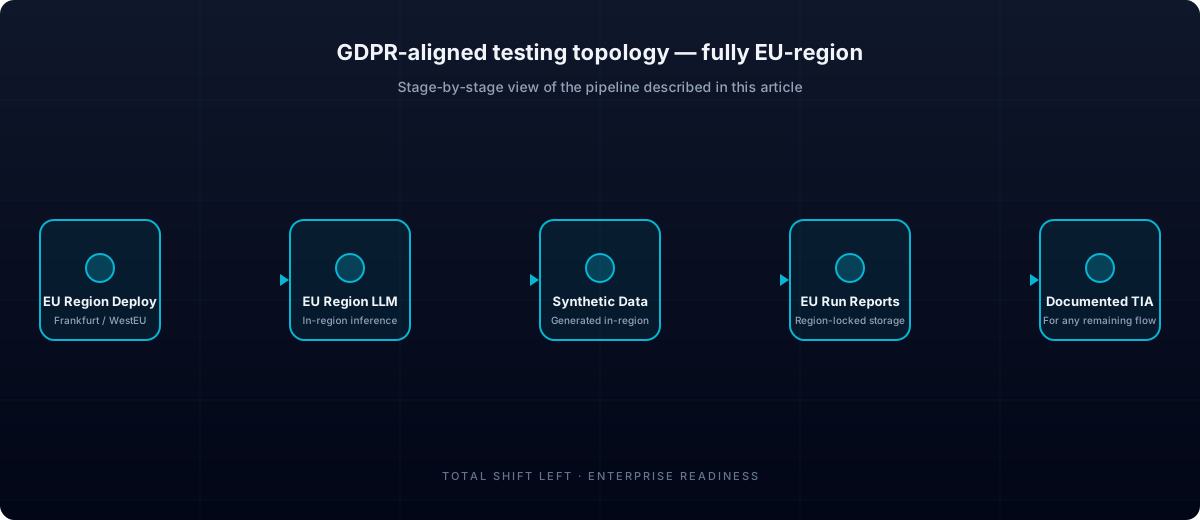
GDPR / Schrems II-aligned API testing topology — fully EU-region.
Why API testing under GDPR matters at enterprise scale
EU data protection authority enforcement actions in 2024-2025 increasingly cite AI-tool data flows as Article 28 / 32 violations — the average GDPR fine in 2024 was €2.1M, with several large enforcement actions specifically calling out cross-border transfers of testing-derived data. Schrems II compliance now sits as a procurement-blocking concern at the majority of regulated EU enterprises evaluating SaaS testing tools.
API testing under GDPR tools compared
A practical view of the tool categories that scale across enterprise testing programs in this area:
| Category | Example tools |
|---|---|
| EU-region cloud hosting | AWS Frankfurt / Paris, Azure West Europe, GCP Belgium with sovereign-cloud certifications where required |
| Self-hosted LLM in EU | Ollama / vLLM / LM Studio on EU-region GPU infrastructure |
| Synthetic data generation | Faker (locale-aware), Synthea, MOSTLY AI for non-PHI domains |
| Masking pipelines | In-boundary tools (DataVeil, ARX) operating on EU-region data only |
| EU-region run-report storage | AWS S3 EU regions, Azure Blob West Europe, GCP Buckets EU |
Tool selection is secondary to architecture. The patterns above hold regardless of which specific vendor you adopt.
API testing under GDPR in practice: a worked example
A representative deployment pattern from an enterprise rollout in this area:
Problem. A pan-European insurance carrier evaluated a US-headquartered SaaS API testing platform. The DPO blocked the buy because run reports were stored in US-region cloud storage and the AI test generation called OpenAI in US infrastructure. The Transfer Impact Assessment could not justify either flow.
Solution. The carrier switched to a vendor offering EU-region operation with EU-resident support and self-hosted LLM running in AWS Frankfurt. The TIA was simplified to a one-page document because the only cross-border flow was vendor support access, which was governed by SCCs.
Results. DPO approved within 3 weeks. The buy closed at the originally negotiated commercial terms. Schrems II review on the renewed contract was a 30-minute conversation rather than a 3-month back-and-forth.
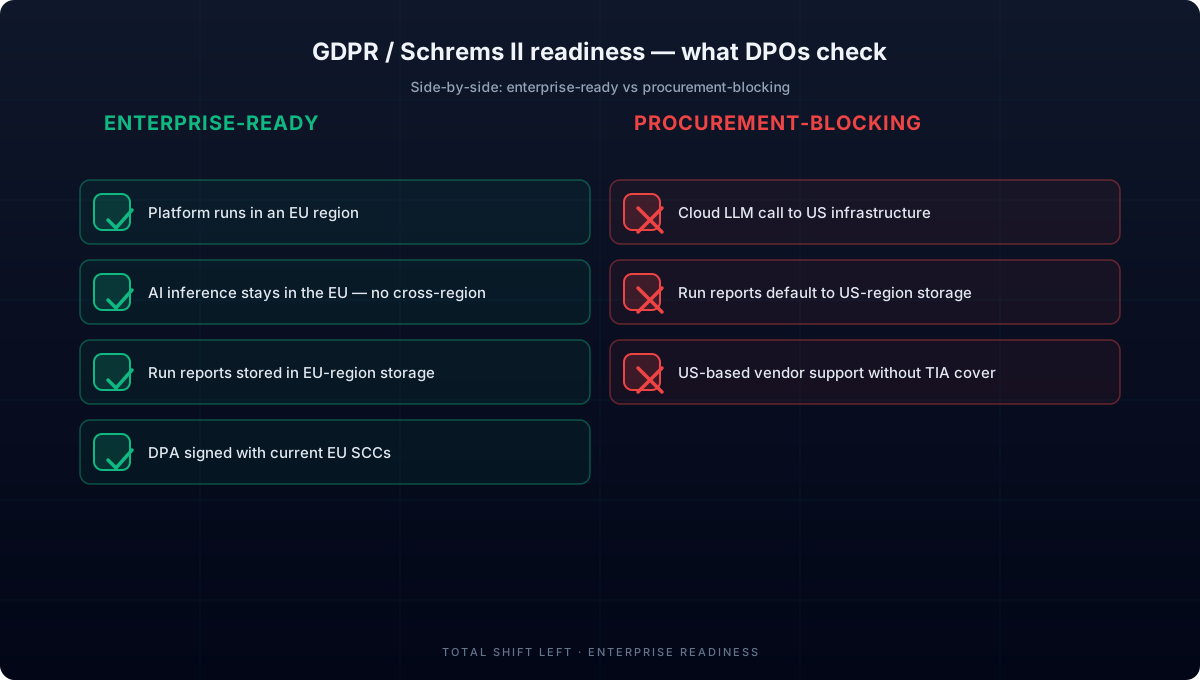
GDPR / Schrems II — enterprise readiness checklist.
Reference architecture
A GDPR / Schrems II-aligned architecture keeps every data flow inside the EU (or the customer-controlled boundary). Platform deployment runs in an EU-region cloud (AWS Frankfurt, Azure West Europe, GCP Belgium) or on customer-controlled EU-region infrastructure. AI inference runs on a self-hosted LLM in the EU region, or on an EU-region inference service certified for the relevant data class. Run report storage uses EU-region object storage with retention policy aligned to the RoPA. Captured-payload handling strips personal data before retention; reports reduce to coverage and pass/fail with no embedded PII. Vendor support access is governed by the DPA with current SCCs; for sovereignty-sensitive workloads, EU-resident support staff are required. Test data is synthetic by default; production-derived data is masked in-region before reaching the test environment. The architecture eliminates most cross-border transfers entirely; remaining flows are documented and covered by signed mechanisms.
Free 1-page checklist
API Testing Checklist for CI/CD Pipelines
A printable 25-point checklist covering authentication, error scenarios, contract validation, performance thresholds, and more.
Download FreeAPI testing under GDPR metrics that matter
Three metrics address EU buyers' core concerns. TIA scope — count of cross-border data flows requiring transfer impact assessments — should trend toward zero as the architecture matures; one or two well-documented flows (typically vendor support) are common steady state. DPA exception requests — count of requests to deviate from the documented DPA per quarter — measures whether the program is operating within its stated boundaries. Subprocessor changes — count of subprocessor additions or changes per quarter — flags risk of architecture drift; each change must be reviewed against the residency posture. Report all three to the DPO and procurement leadership on a quarterly cadence.
API testing under GDPR rollout playbook
EU buyers typically execute an 8-week rollout for the residency architecture. Weeks 1-2: vendor due diligence. Walk every data flow with the vendor. Confirm EU-region operation, EU-region inference, EU-region storage. Identify any cross-border flows. Weeks 3-4: contracting. Sign a DPA with current EU SCCs. Document subprocessor list. Negotiate EU-resident support if needed. Weeks 5-6: deployment. Stand up the platform in the EU region. Verify in-region inference and storage. Document the data flow in the RoPA. Weeks 7-8: TIA and rollout. Complete a Transfer Impact Assessment for any remaining flows. Begin team onboarding. Most EU rollouts complete cleanly within 8-10 weeks once vendor architecture is suitable; the binding constraint is vendor architecture, not operations.
API testing under GDPR challenges and how to solve them
Cloud LLM inference path is in US infrastructure. Switch to self-hosted LLM in the EU region or to an EU-region inference service certified for the data class.
Run-report storage defaults to US region. Configure EU-region storage as the default. Verify in the DPA. Confirm vendor cannot move data cross-region without notice.
US-based vendor support staff need access during incidents. Document the transfer in the DPA, governed by SCCs and supplementary measures. For sovereignty-sensitive workloads, require EU-resident support staff.
Captured payloads contain personal data even with masked fixtures. Strip captured payloads of personal data before retention; reduce run reports to coverage and pass/fail status. Retain underlying captures only via internal pointers if needed.
API testing under GDPR best practices
- Run the platform in an EU region (or in customer-controlled EU-region cloud accounts)
- Use self-hosted LLM in the EU; verify no cross-region inference fallback
- Configure EU-region run-report storage; verify in the DPA
- Strip captured payloads of personal data before retention
- Require EU-resident support staff for sovereignty-sensitive workloads
- Document every cross-border data flow in the Transfer Impact Assessment
- Use synthetic data preferentially; mask production-derived data in-region
API testing under GDPR checklist
A pre-flight checklist enterprise teams can run against their current state:
- ✔ Platform runs in an EU region or EU-region cloud accounts
- ✔ AI inference path is in the EU; no cross-region fallback
- ✔ Run reports are stored in EU-region storage by default
- ✔ A documented Transfer Impact Assessment covers any remaining transfers
- ✔ Captured payloads stripped of personal data before retention
- ✔ Vendor DPA is signed with current EU SCCs
- ✔ Subprocessor list is current and EU-residency-friendly
- ✔ Sovereignty-sensitive workloads use in-country deployment where required
Take the next step. See how regulated-industry API testing applies these ideas to your workflow, or explore on-premise deployment options for the broader picture.
See also: jwt authentication in our learn hub for the underlying concept.
Assert that data stayed in the region
Residency is testable: create a record through the regional endpoint, then prove it is not readable from the other region and that the storage location the API reports matches the region you wrote to.
# tests/test_residency.py
import requests, pytest

EU, US = "https://eu.api.example.com", "https://us.api.example.com"

def test_eu_record_is_not_reachable_from_the_us_endpoint(eu_token, us_token):
    created = requests.post(f"{EU}/v1/customers",
                            json={"name": "Test", "email": "t@example.eu"},
                            headers={"Authorization": f"Bearer {eu_token}"})
    assert created.status_code == 201
    cid = created.json()["id"]

    # the same identifier must not resolve in the other region
    cross = requests.get(f"{US}/v1/customers/{cid}",
                         headers={"Authorization": f"Bearer {us_token}"})
    assert cross.status_code in (403, 404), "personal data crossed the region boundary"

def test_api_reports_the_storage_region(eu_token):
    r = requests.get(f"{EU}/v1/customers/self",
                     headers={"Authorization": f"Bearer {eu_token}"})
    assert r.headers.get("X-Data-Region") == "eu-central-1"
Sources and further reading
- GDPR full text — the articles that constrain personal data in test systems.
- ISO/IEC 27001 — the ISMS standard enterprise programmes certify against.
- HashiCorp Vault documentation — secret storage and dynamic credentials for test runs.
Key takeaways
- GDPR and Schrems II compliance for API testing tools is mostly an architecture and contracting decision: EU-region operation, in-region inference, EU-region storage, documented transfer impact for any remaining cross-border flows.
- EU buyers in 2026 are increasingly disqualifying SaaS tools that can't demonstrate this end-to-end.
- Vendors that offer it as a first-class option win the buy; vendors that don't end up in 6-month TIA negotiations or losing the procurement entirely.
API testing under GDPR FAQ
Does GDPR apply to test data?
Yes if the test data contains personal data, including pseudonymized data. Synthetic data with no relationship to a real person is out of scope. Test data derived from production — even after partial masking — usually remains in GDPR scope and triggers the same controls as the source production data.
Does Schrems II affect AI test generation?
It can. If the AI testing tool sends OpenAPI specs or captured payloads containing EU personal data to a US-hosted LLM, that's a cross-border transfer requiring SCCs, supplementary measures, and a transfer impact assessment. Most EU buyers in 2026 require a self-hosted LLM in an EU region instead.
Where can I store API test run reports?
In a region authorized by your DPA / RoPA for the personal data contained. For most EU customers that means EU-region storage with the storage provider under SCC. Reports stripped of personal data — reduced to coverage and pass/fail status — can be stored more flexibly.
What's a transfer impact assessment for an API testing tool?
A documented analysis of whether the tool's data flows include cross-border transfers of EU personal data, what legal mechanism covers each transfer, and what supplementary measures apply. Self-hosted deployment with no outbound calls eliminates the transfers and shortens the TIA.
Ready to shift left with your API testing?
Try our no-code API test automation platform free.