
Cargo vs Postman: API Testing in Rust Ecosystems (2026)
Cargo vs Postman: API Testing in Rust Ecosystems (2026)
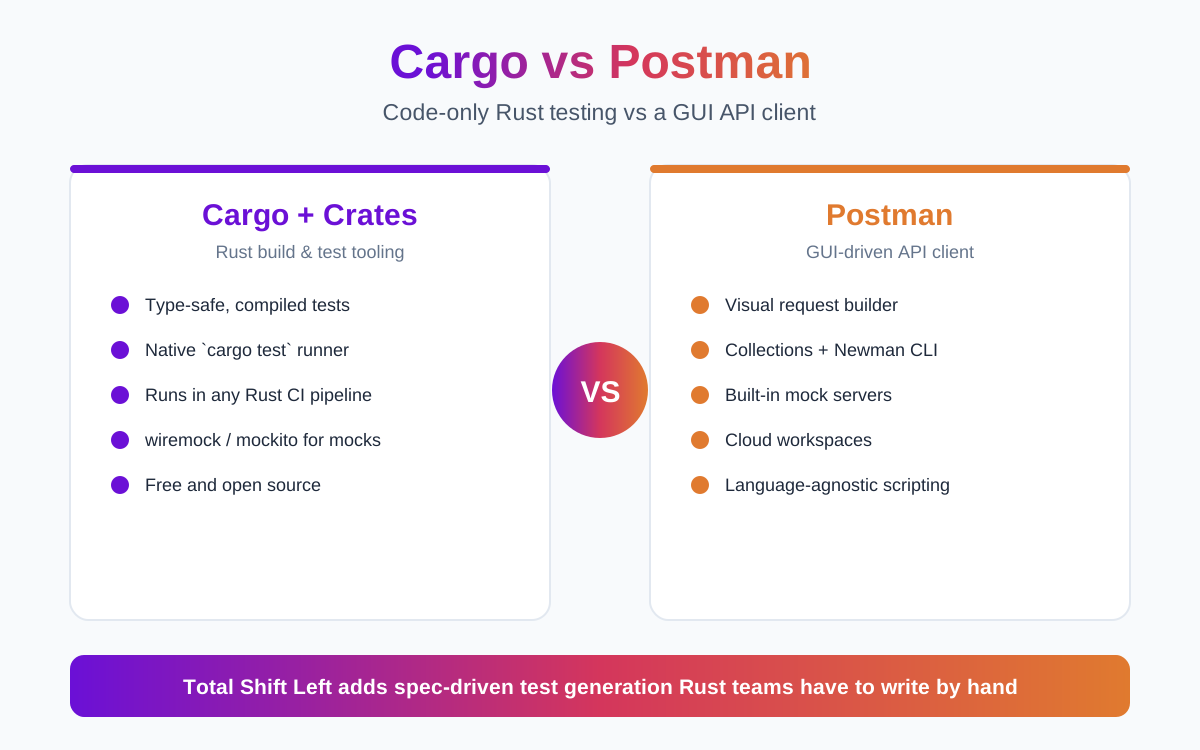
If you have searched "cargo vs postman," you are likely a Rust developer trying to figure out how API testing fits into your workflow. The comparison is not apples to apples. Cargo is Rust's build system and package manager with a powerful built-in test runner. Postman is a GUI-based API exploration and testing platform. They solve different problems, but both touch API testing in ways that matter for Rust teams building web services.
This guide breaks down what each tool actually does for API testing, where they overlap, and where neither is sufficient on its own.
What Cargo Does for API Testing
Cargo is the standard build tool for Rust. Every Rust developer uses cargo build, cargo run, and cargo test daily. The test framework built into Cargo is first-class — it compiles and runs tests defined with the #[test] attribute, including integration tests in the tests/ directory.
For API testing, Rust teams typically combine Cargo's test runner with HTTP client crates. A typical setup looks like this:
- reqwest or hyper for making HTTP requests to API endpoints
- serde and serde_json for serializing and deserializing JSON payloads
- tokio as the async runtime for non-blocking test execution
- wiremock or mockito for mocking external services during testing
The result is integration tests that compile with your application code, run in your CI pipeline with cargo test, and fail the build when assertions break. This is native, fast, and deeply integrated into the Rust ecosystem.
The limitation is that every test is handwritten. You write the HTTP call, construct the payload, define the assertions, and maintain each test as the API evolves. There is no automatic generation, no coverage tracking against an API specification, and no self-healing when endpoints change.
What Postman Does for API Testing
Postman is a GUI-based platform for building, sending, and organizing API requests. You create requests manually, group them into collections, script assertions in JavaScript, and share workspaces with your team.
For Rust developers, Postman serves one role well: ad-hoc exploration. When you are building a new endpoint with Actix-web, Axum, or Rocket, Postman lets you quickly send requests, inspect responses, and iterate on the API design without writing test code.
The limitation for Rust teams is that Postman sits outside your development workflow. It does not integrate with Cargo, does not understand your Rust types, and requires maintaining a separate collection that drifts from your actual API over time. Running Postman tests in CI requires Newman, which adds another dependency outside the Rust toolchain.
Ready to shift left with your API testing?
Try our no-code API test automation platform free. Generate tests from OpenAPI, run in CI/CD, and scale quality.
Feature Comparison: Cargo vs Postman for API Testing
| Capability | Cargo + Crates | Postman |
|---|---|---|
| API exploration | No GUI — code only | Full GUI with request builder |
| Automated tests | Native with cargo test | Collections + Newman CLI |
| CI/CD integration | Native — runs in any Rust CI | Requires Newman or Postman CLI |
| Language | Rust (type-safe, compiled) | JavaScript (dynamic scripting) |
| Spec-driven generation | Manual test writing only | No automatic generation |
| Coverage tracking | No built-in API coverage | No spec-level coverage |
| Mocking | wiremock, mockito crates | Built-in mock servers |
| Team collaboration | Git-based (tests are code) | Cloud workspaces |
| Maintenance model | Manual — update tests with code | Manual — update collections separately |
| Cost | Free and open source | Free tier with paid plans |
When to Use Cargo for API Testing
Cargo is the right choice when your tests need to be part of the Rust compilation and CI pipeline. Specific scenarios include:
Unit and integration tests for your Rust API. If you are building a REST API with Axum or Actix-web, writing integration tests in Rust means your tests share types with your application. A struct change propagates to tests at compile time.
Performance-sensitive test suites. Cargo tests compile to native binaries. For large API surfaces where test execution speed matters, Rust tests outperform interpreted test runners significantly.
Internal service testing in microservices. When your Rust services communicate over gRPC or REST, Cargo tests let you validate inter-service contracts using the same protobuf or OpenAPI types your services use.
When to Use Postman for API Testing
Postman is the right choice for exploration and manual verification during development:
Debugging a specific endpoint. When you need to quickly send a request with different headers, query parameters, or payloads, Postman's GUI is faster than writing a throwaway Rust test.
Sharing API examples with frontend teams. Postman workspaces let non-Rust developers interact with your API without needing the Rust toolchain installed.
Documenting API behavior. Postman collections serve as executable documentation that team members can run without understanding Rust.
The Gap Neither Tool Fills
Both Cargo tests and Postman collections share the same fundamental limitation: every test is manually authored and manually maintained. Neither tool:
- Generates tests automatically from an OpenAPI specification
- Tracks coverage against your API spec (which endpoints, methods, and response codes are tested)
- Self-heals when your API changes
- Enforces contract compliance as a CI/CD quality gate
For a Rust team with ten endpoints, this is manageable. For an enterprise API surface with hundreds of endpoints across multiple services, manual test authoring becomes the bottleneck.
Where Total Shift Left Fits for Rust Teams
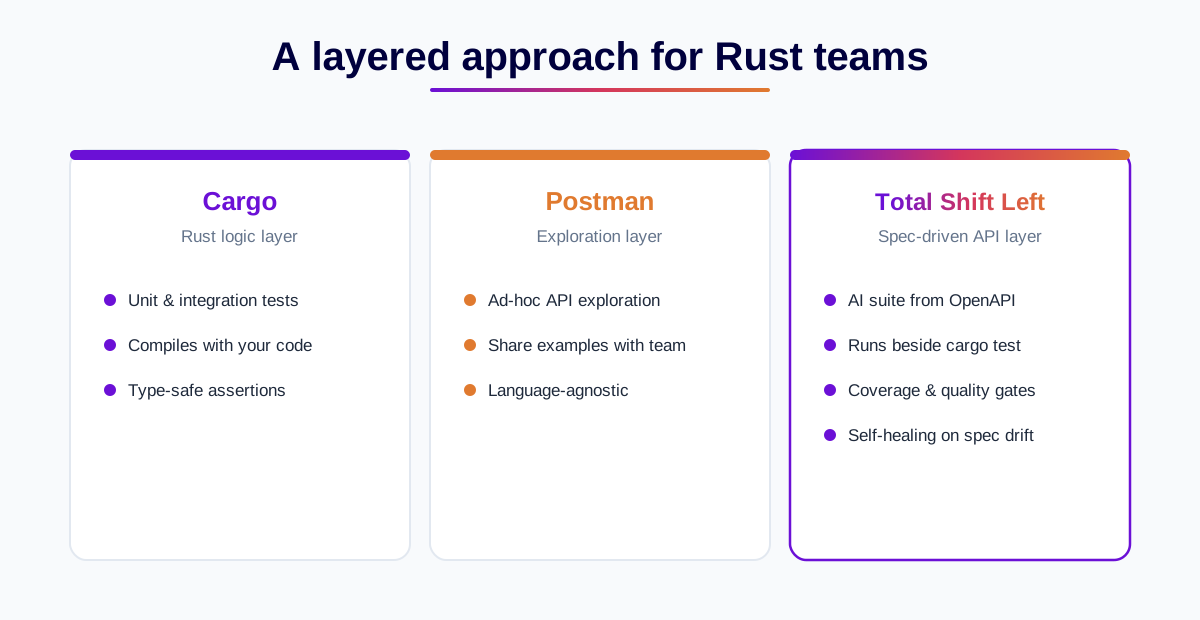
Total Shift Left closes the gap between Cargo's code-level testing and Postman's manual exploration by operating at the specification layer. The workflow for Rust teams:
-
Import your OpenAPI spec. Whether your Rust API generates its spec via utoipa, paperclip, or a manually maintained YAML file, Total Shift Left ingests it and understands your entire API surface.
-
AI generates the test suite. Positive paths, negative scenarios, edge cases, and boundary conditions are generated automatically from your schema — not one request at a time, but as a comprehensive suite covering every endpoint.
-
Run in CI alongside cargo test. Your Cargo tests validate Rust-level logic. Total Shift Left tests validate API-level behavior, spec compliance, and contract integrity. Both run in the same pipeline.
-
Coverage tracking and quality gates. Total Shift Left tracks which endpoints, methods, and response codes are covered. Quality gates block merges when coverage drops below thresholds — something neither
cargo testnor Newman provides. -
Self-healing on spec changes. When your API evolves, Total Shift Left detects spec drift and regenerates affected tests automatically. No manual collection updates, no broken handwritten tests.
For enterprise Rust teams running microservices, this layered approach — Cargo for unit and integration logic, Total Shift Left for spec-driven API validation — delivers coverage that neither tool achieves alone.
The Practical Recommendation
If you are a Rust developer evaluating "cargo vs postman" for API testing, the answer is not either/or:
- Use Cargo tests for Rust-native integration testing that compiles with your code and runs in CI
- Use Postman for ad-hoc exploration and sharing API examples with non-Rust team members
- Use Total Shift Left for automated, spec-driven test generation that tracks coverage and enforces quality gates across your entire API surface
The combination eliminates the manual maintenance burden that both Cargo tests and Postman collections impose at scale, while keeping each tool in the role it was designed for.
FAQ
Can I use Cargo for API testing?
Yes. Cargo's built-in test framework combined with HTTP client crates like reqwest or hyper lets you write integration tests that call API endpoints directly. These tests run with cargo test and integrate natively into Rust CI/CD pipelines without external tools.
Should I use Postman or Cargo for testing Rust APIs?
Use Postman for ad-hoc API exploration and manual debugging during development. Use Cargo tests for automated integration testing in CI/CD. For comprehensive spec-driven coverage across large API surfaces, add a platform like Total Shift Left that generates suites from your OpenAPI spec.
How does Total Shift Left fit into a Rust API testing workflow?
Total Shift Left imports your OpenAPI specification and generates comprehensive test suites automatically. These run in CI/CD alongside your cargo test suite, covering spec compliance, edge cases, and contract validation that neither Cargo tests nor Postman collections address systematically.
Ready to shift left with your API testing?
Try our no-code API test automation platform free.