
Postman vs OpenAPI: Collections vs Spec-Driven Testing
Quick answer
Postman is collection-based — a human builds and maintains each request and assertion in a GUI. OpenAPI test automation is spec-driven — tests are generated automatically from the OpenAPI document and regenerate when it changes. You can convert between the two: openapi-to-postmanv2 turns an OpenAPI spec into a Postman collection for exploration, and postman-to-openapi reverse-engineers an OpenAPI document from an existing collection as a starting point for migration. For CI/CD at scale, spec-driven automation wins on coverage and maintenance; Postman remains the better tool for manual, exploratory API debugging.
Reviewed by Rishi Gaurav
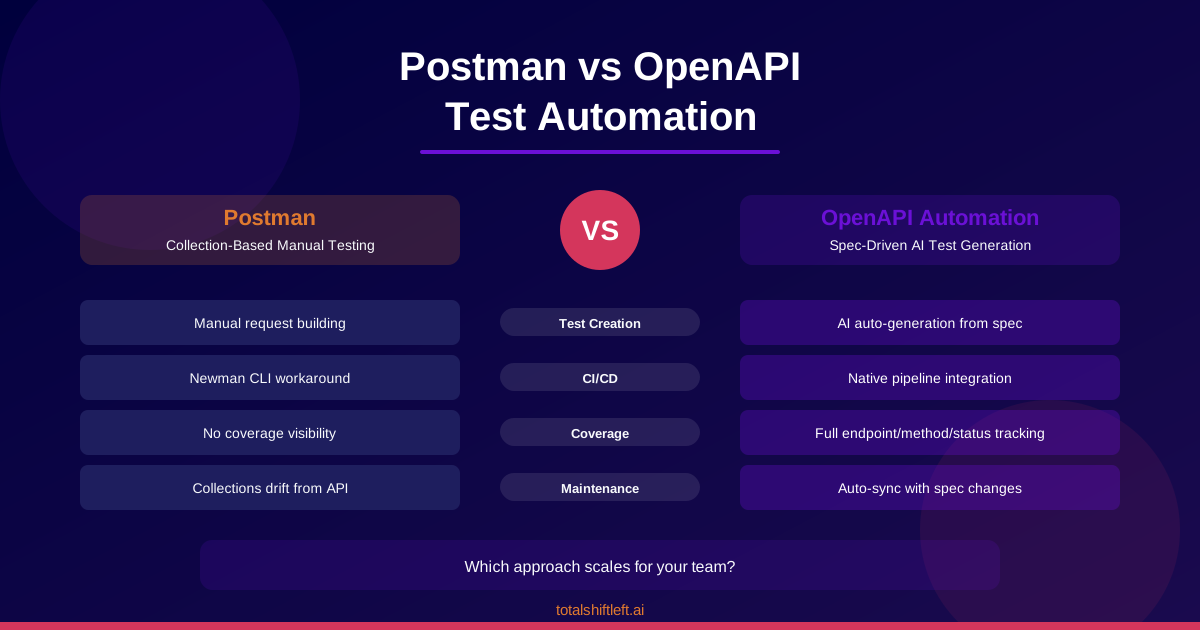
Postman vs OpenAPI test automation is the defining paradigm choice for API quality engineering in 2026 — a structural decision between manually curating request collections and letting the OpenAPI specification drive test generation, execution, and maintenance automatically. The tool that worked for a 10-endpoint service in 2018 is not the architecture that scales to 200 microservices under weekly release cadence.
The World Quality Report 2025 found that 71% of engineering organizations now consider API testing their single largest test-automation cost center, and the DORA 2024 State of DevOps report links manual test maintenance directly to lower deployment frequency and higher change-failure rates. Meanwhile IBM Systems Sciences Institute and NIST research continue to show defects caught at commit cost 5-15x less to fix than those caught in QA — and traditional collection tools were never designed to catch defects at commit. Choosing the wrong paradigm is not a tooling preference; it is a multi-year compounding cost.
Most API teams hit the same crossroads. A tool — typically Postman — that felt frictionless at ten endpoints starts creating drag at fifty and outright blockage at two hundred. The collection becomes the bottleneck: who owns it, who updates it when the schema changed, who scripts the assertions, who exports it for Newman.
The alternative is spec-driven automation: treat the OpenAPI definition as authoritative, let a platform generate tests from it, and wire those tests into CI/CD so every PR gets validated without human authoring. This is the paradigm shift the World Quality Report has tracked for three years — away from script-based tooling toward spec-driven and AI-driven platforms.
This guide compares the two paradigms end to end. For the broader alternatives landscape see best Postman alternatives; for the migration playbook see how to migrate from Postman to spec-driven testing.
In this guide
- What Is Postman vs OpenAPI Test Automation?
- Converting Between Postman Collections and OpenAPI
- Why Postman and OpenAPI test automation matters in 2026
- Key Components of Each Paradigm
- Postman and OpenAPI test automation reference architecture
- Postman and OpenAPI test automation tools compared
- Postman and OpenAPI test automation in practice: a worked example
- Postman and OpenAPI test automation challenges and how to solve them
- Postman and OpenAPI test automation best practices
- Postman and OpenAPI test automation checklist
- Postman and OpenAPI test automation FAQ
What Is Postman vs OpenAPI Test Automation?
The two approaches solve overlapping problems with fundamentally different architectures.
The Postman paradigm is collection-based and human-authored. A developer or QA engineer opens Postman, constructs a request, adds headers, picks an auth scheme, sets variables, and writes a JavaScript pm.test() assertion in the sandbox. The request is saved into a collection, the collection is checked into a workspace, and the collection is exported as JSON so Newman can run it in CI. Every endpoint, every method, every assertion is an artifact a human typed. When the API changes, a human types the update. This is the definition of a collection-based paradigm.
The OpenAPI test automation paradigm is spec-driven and machine-authored. The team maintains an OpenAPI 3.x document — often already generated from code annotations (Swashbuckle, FastAPI, springdoc) for documentation and SDK purposes. A spec-driven platform parses the document, enumerates every operation, models the request/response schemas, and generates positive, negative, and boundary tests automatically. Learn the mechanics at generate tests from OpenAPI and AI-assisted negative testing.
The single architectural decision that separates the two paradigms is the source of truth. In Postman the collection is authoritative for what gets tested; the API is secondary. In spec-driven automation the specification is authoritative; tests are a derived artifact, not a curated one. That one change produces different coverage economics, different maintenance curves, different CI/CD behavior, and different organizational staffing models.
| Postman Collection | OpenAPI Document | |
|---|---|---|
| Source of truth | The collection itself | The spec |
| Authored by | Human, in the GUI | Generated from code annotations or written directly |
| What it captures | Concrete example requests + JS assertions | The full contract: every operation, schema, constraint |
| Test generation | None — collection is the tests | Full test suites generated from every operation |
| Drifts when API changes | Silently, until someone notices | Detected — schema validation fails against the live API |
| Best for | Manual exploration, debugging one request | CI/CD automation, coverage tracking, contract enforcement |
The head-to-head on the two most common API clients is in Apidog vs Postman, including pricing, offline use and self-hosting.
The other comparison teams usually run at the same time is Postman vs Insomnia, which turns on how much platform you want around the client.
If the confusion is between the spec tooling and the client, Swagger vs Postman separates what each one owns.
Converting Between Postman Collections and OpenAPI
Teams rarely start from zero on either side, so conversion tooling matters during migration.
OpenAPI → Postman collection (for teams that want to explore a spec-driven API manually in Postman's GUI):
npx openapi-to-postmanv2 -s openapi.yaml -o postman-collection.json -p
# -p pretty-prints the output; the generated collection includes one
# request per operation with example values pulled from the spec
Postman collection → OpenAPI (a starting point when migrating away from a collection that has no spec behind it — treat the output as a draft, not a finished contract):
npx postman-to-openapi collection.json -o openapi-draft.yaml
# Reverse-engineers paths, methods, and example-derived schemas from the
# collection. Review and tighten every schema by hand afterward — this
# only captures what the collection's saved examples happened to exercise,
# not the full contract your API actually supports.
Neither direction is lossless. openapi-to-postmanv2 gives you working requests, not assertions — you still write pm.test() scripts by hand afterward. postman-to-openapi gives you a schema shaped by whatever example responses were saved, which is almost always narrower than the API's real behavior (optional fields that were always populated in the saved examples get inferred as required, for instance). Use the reverse-conversion as a first draft to accelerate spec authoring, then validate it against the live API before treating it as authoritative.
There is a third route that skips the conversion step for the tests themselves. Shift-Left API's Postman collection import reads the collection directly: one test per request, assertions carried over (and compiled from the collection's own pm.test() scripts where a check cannot be mapped one-to-one), variable captures preserved, and a list of whatever it could not bring across. Collection and folder auth lands in reusable authentication profiles. That keeps the hand-written assertions you already trust while the spec-driven suite is generated beside them — useful during the parallel-run period described below.
Why Postman and OpenAPI test automation matters in 2026
Microservice sprawl has outpaced manual authoring
The arithmetic is unforgiving. A team with 200 endpoints × 3 methods each is 600 request variants, and a responsible suite of 5 assertions per variant is 3,000 hand-written artifacts. At 20 minutes per unit authored and 5 minutes per month maintained, that is 1,000 hours of one-time work and 250 recurring hours every month. Spec-driven automation collapses both.
Release cadence now demands commit-level validation
DORA's 2024 report identifies deployment frequency as one of four elite metrics, and collection-based tooling breaks the cycle. Weekly and daily deploys cannot wait for QA to re-script a Postman collection. Validation must happen on the PR, not the nightly build. See API test automation with CI/CD step by step for the wiring pattern.
Coverage gaps compound silently
Teams on hand-built collections typically reach 30-60% endpoint coverage. Spec-driven automation routinely reaches 90-100% because generation enumerates every operation the spec describes, not just the ones a human remembered to script. This is the finding behind why Postman collections aren't enough for CI/CD.
Schema drift is a leading incident source
When the backend changes a required field and the Postman collection still sends the old payload, the pipeline passes and production breaks. Spec-driven platforms compare live responses against the committed schema on every build. For context see API schema validation: catching drift and validation errors.
QA economics have inverted
The Consortium for IT Software Quality (CISQ) estimated poor software quality cost US organizations more than $2.4 trillion in 2022. A large share is late defect detection — exactly what shift-left and spec-driven automation target. Teams that migrate redirect QA from script maintenance into exploratory testing, contract design, and risk modeling.
Ready to shift left with your API testing?
Try our no-code API test automation platform free. Generate tests from OpenAPI, run in CI/CD, and scale quality.
Key Components of Each Paradigm
Source of truth
In Postman the collection .json is authoritative; the API itself is secondary. In spec-driven automation the OpenAPI document is authoritative; tests are a derived artifact the platform regenerates whenever the spec changes. This single decision drives every downstream difference. See contract testing for the broader context.
Test authoring model
Postman requires a human in the request builder for every endpoint, with JavaScript in the pm.test() sandbox for every assertion. Spec-driven platforms read the specification and emit positive, negative, and boundary cases automatically, leaving humans to curate rather than compose. Details: AI test generation features.
Assertion library
Postman assertions live as imperative JavaScript in the collection. Spec-driven assertions are declarative: status-code expectations, schema validation, response-time thresholds, and contract checks derived from the spec. The declarative model is easier to audit, review, and maintain.
Execution runtime
Postman runs interactively in the GUI and headlessly via Newman. Newman shells out to Node.js and emits pass/fail. Spec-driven platforms run on a dedicated test execution engine with sharded parallelism, JUnit/SARIF output, and native quality-gate evaluation. Parallelism is often the deciding factor — 40 minutes sequential becomes 4 minutes sharded.
CI/CD integration surface
Postman integrates through Newman plus custom shell glue. Spec-driven platforms ship first-class GitHub Actions, GitLab CI, Azure DevOps, Jenkins, and CircleCI connectors with PR annotations and blocking merge checks. See API testing in CI/CD and how to wire it step by step. In Shift-Left API's case, a CI runner executes a test pack, writes JUnit XML and a JSON summary, and fails the build below a pass-rate threshold; GitHub Actions, Jenkins and Azure DevOps are first-party integrations, while GitLab CI, CircleCI and Bitbucket Pipelines call the same runner through the public REST API today (CI/CD integrations).
Authentication and environment management
Postman stores environments and variables in workspace files synced through its cloud. Spec-driven platforms centralize OAuth2 client credentials, JWT issuers, and token refresh patterns with integrations to HashiCorp Vault, AWS Secrets Manager, and Azure Key Vault (Shift-Left API: HashiCorp Vault). Shift-Left API now mirrors Postman's OAuth 2.0 experience here — Postman's grant types plus Device Code, "Get New Access Token", provider pre-fill for Entra ID, Okta, Auth0, Keycloak and Google, automatic refresh — alongside NTLM, JWT signing, Hawk and multi-step sign-in, so moving off Postman does not mean rebuilding the auth layer by hand.
Coverage and observability
Postman emits per-request pass/fail in Newman output. Spec-driven platforms compute endpoint, method, parameter, and status-code coverage against the full specification, surfacing untested operations explicitly. See API test coverage for the measurement model and analytics and monitoring features for the dashboards.
Maintenance behavior under change
Postman requires manual collection updates when the API changes, with no signal when drift occurs. Spec-driven platforms diff the new spec against the old one and raise breaking changes for review; in Shift-Left API, approving a change creates new endpoint versions and does not edit existing tests. Mechanics: AI test maintenance.
Postman and OpenAPI test automation reference architecture
Both paradigms can be described as a five-layer pipeline, and the differences become visible layer by layer.
At the source layer Postman relies on the collection JSON file, stored in a workspace and exported to a repository or Postman Cloud. Spec-driven automation uses the OpenAPI document stored in the application repository next to the source code — often auto-generated from annotations — with AsyncAPI or GraphQL SDL as equivalents for non-REST surfaces.
At the authoring layer Postman depends on a human operator in the request builder. Spec-driven platforms run a generator that reads the spec, produces test cases, and stores them in a versioned test store linked to the spec hash. This is the layer where the paradigm's scalability is decided.
At the execution layer Postman executes via Newman in CI. Spec-driven platforms run a containerized runtime with parallel shards, first-class auth resolution, and native environment isolation. Execution throughput and flakiness behavior differ by an order of magnitude at scale.
At the validation layer Postman compares responses against hand-coded pm.expect assertions. Spec-driven platforms validate against the OpenAPI schema directly, catching contract violations and drift without human assertion authoring. This is the feedback surface developers actually see.
At the feedback and governance layer Postman produces Newman HTML reports. Spec-driven platforms deliver PR annotations, coverage dashboards, quality-gate enforcement, RBAC, audit logging, and Slack/Teams escalation — the enterprise collaboration and security surface. Organizations routinely report 10x maintenance reductions after migrating, because the pipeline stops depending on human curation.
Postman and OpenAPI test automation tools compared
| Platform | Paradigm | Spec-Driven Generation | Native CI/CD | Coverage Tracking | AI Repair of Failing Tests |
|---|---|---|---|---|---|
| Shift-Left API (Total Shift Left) | OpenAPI AI-first | Yes — from spec and/or requirement documents | GitHub Actions/Azure DevOps/Jenkins; GitLab, CircleCI, Bitbucket via REST API | Endpoint, method, status, param, requirement | Yes — proposed fixes a person approves |
| Postman + Newman | Collection-based | Import only, no assertions | Newman CLI glue | No | No |
| Apidog | Hybrid design/test | Partial | Limited connectors | Partial | Limited |
| ReadyAPI (SmartBear) | Scripted automation | Import, heavy scripting | Enterprise plugins | Basic | No |
| Schemathesis | OSS property-based | Yes (fuzz-style) | CLI / custom | Coverage via plugins | No |
| Karate | DSL scripting | Manual authoring | Yes | No | No |
| REST Assured | Java library | Manual authoring | JUnit/TestNG | No | No |
| Stoplight | Design-first platform | Spec-centric, light execution | Limited | Spec-side only | No |
Two migration paths deserve note. Teams with heavy Postman investment typically land on a dedicated Postman alternative rather than a generic test framework, because the paradigm change requires more than a CLI swap. Teams evaluating incumbents should read the ReadyAPI vs Shift Left, Apidog vs Shift Left, and best AI API testing tools 2026 comparisons for side-by-side capability matrices. The broader landscape is covered in best API test automation tools compared.
Postman and OpenAPI test automation in practice: a worked example
Illustrative scenario: a composite example, not a named customer's measured results.
Problem: A healthcare-SaaS platform operated 95 REST endpoints across 11 microservices, tested through 340 Postman collections owned by two QA engineers. Coverage sat at ~52%, concentrated on happy-path flows. Collection maintenance consumed 12 hours per sprint. Newman ran in GitHub Actions and produced 98% pass rates, yet production incidents from untested or drifted endpoints occurred monthly. The root cause was the paradigm: the collection was authoritative, the API had moved past it, and no mechanism existed to surface the gap.
Solution: The team validated their OpenAPI document against the live API, corrected 14 discrepancies, and imported the corrected spec into a spec-driven platform. They ran generated tests in parallel with Newman for three sprints. Quality gates were introduced as advisory first, then blocking. A migration runbook guided collection retirement per service.
Results: In a scenario like this, endpoint coverage rises quickly once the generated suite runs alongside the collections, the suite surfaces schema violations and behavior differences the collections never exercised, and collection maintenance time falls. QA time moves to exploratory testing and API security testing. Measure coverage and incident counts before and after.
Postman and OpenAPI test automation challenges and how to solve them
The team has no OpenAPI specification
Some organizations, especially those built on hand-rolled frameworks, lack a formal spec at all. Solution: Generate one from code annotations — Swashbuckle for .NET, springdoc for Spring, FastAPI for Python, Fastify Schema for Node — starting with the highest-traffic endpoints. The spec pays for itself across documentation, SDK generation, and testing; do not treat it as a testing-only artifact.
Free Interactive spreadsheet + guide
Test Automation ROI Calculator
Quantify the ROI of test automation for your team. Input your team size, bug rates, and fix times — get projected savings in hours and dollars.
Download FreePostman collections contain genuine business-logic assertions
Generation covers structure and contract but not multi-step workflows or domain math. Solution: Keep hand-authored assertions for the ~10% of tests that validate calculated totals, transition-state rules, or compliance-sensitive semantics. Let generation cover the 90% of structural cases. Audit existing Postman scripts to quantify the split before migration — it is usually smaller than teams assume.
Multi-step flows are also less of a manual job than they were. In Shift-Left API, workflows can be built from approved use-case requirements, from the spec and existing tests, or from a one-sentence description, with each step's inputs wired to the earlier step that produces them; if a step has no test yet, the product names it and can generate it as part of the same accepted change.
Teams are culturally invested in Postman workflows
QA engineers who have built expertise in Postman scripting can treat migration as a threat. Solution: Run both paradigms in parallel for two sprint cycles and let the data argue. Track coverage percentage, maintenance hours, and defects caught on each side. Move the team forward on evidence, and frame the change as a capability upgrade, not a replacement of people.
Undocumented or shadow endpoints exist
Generation tests what the spec describes; endpoints missing from the spec go untested. Solution: Pull API gateway or load-balancer access logs, diff the observed endpoint list against the spec's operation list, and add missing entries. This discovery step routinely surfaces shadow endpoints from deprecated features or forgotten proofs-of-concept — a security and compliance win in itself.
Newman is embedded in the existing pipeline
Pulling Newman out abruptly risks CI regressions. Solution: Follow a staged retirement. Add the spec-driven job as advisory alongside Newman for sprint one, promote it to blocking for sprint two, mark Newman jobs as advisory for sprint three, and remove Newman in sprint four. See the full migration guide for the exact sequence and rollback points.
Spec quality is poor — loose types, missing examples
A weak spec produces overly permissive or noisy tests. Solution: Treat spec quality as a precondition, not a nice-to-have. Run Spectral (or equivalent) as a PR check, require required fields on every object, and insist on at least one example per schema. Investment in spec quality is the single highest-ROI action in a spec-driven workflow.
Postman and OpenAPI test automation best practices
- Keep Postman for exploration, move automation to spec-driven. The two tools serve different jobs. Postman is excellent for debugging a single request or learning a new API; CI/CD automation belongs on a specification-driven platform.
- Measure the coverage gap before migrating. Export the Postman collection, enumerate the endpoints it covers, diff against the full API surface. The number is almost always worse than the team believes, and that data drives the business case.
- Validate the OpenAPI spec against the live API first. A stale or inaccurate spec produces stale or inaccurate tests. Run a contract diff before generating anything.
- Lint specifications as a PR check. Spectral (or equivalent) on every commit. Require examples, descriptions, and
requiredmarkers. Spec quality is load-bearing. - Run both paradigms in parallel during transition. Two sprint cycles minimum. Promote the new suite to blocking only after it matches or exceeds Newman's defect detection.
- Centralize authentication in the platform's vault. OAuth2 clients, JWT signers, and API keys belong in a managed vault, not scattered across CI environment variables and Postman workspaces.
- Enforce quality gates, not just pass/fail. Configure thresholds on coverage percentage, schema-compliance rate, and response-time SLAs. See API quality gates: what to measure.
- Shard execution aggressively. 40 minutes sequential is a dead pipeline. 4 minutes sharded 10-way is a pipeline developers trust.
- Track maintenance hours explicitly. Measure QA sprint time on collection updates before and after migration. This is the most persuasive ROI number to leadership.
- Treat generated tests as a baseline, not the ceiling. Layer custom business-logic and security assertions on top. AI generation covers breadth; humans cover depth where failure is unacceptable.
- Deprecate collections on a defined timeline. Set retirement dates for Postman collections covered by generated tests and hold the line. Zombie collections consume attention forever if left alone.
- Cross-link the quality story. Publish coverage dashboards where engineers already live — PR comments, Slack, engineering dashboards. See analytics and monitoring.
Postman and OpenAPI test automation checklist
- ✔ Inventory all Postman collections and map owners, endpoints covered, and last-updated timestamps
- ✔ Compute current coverage percentage against the full API surface
- ✔ Audit or generate an OpenAPI specification for every service
- ✔ Lint specs with Spectral and require examples plus required-field annotations
- ✔ Diff the live API against the spec and reconcile discrepancies before migration
- ✔ Pull gateway logs to identify shadow or undocumented endpoints
- ✔ Select one pilot service with 10-20 endpoints for first migration
- ✔ Import the pilot spec into the spec-driven platform and generate baseline tests
- ✔ Review generated tests alongside the spec to build team confidence
- ✔ Wire the platform into CI/CD (GitHub Actions, GitLab, Azure DevOps, or Jenkins)
- ✔ Run spec-driven tests in parallel with existing Newman jobs for two sprint cycles
- ✔ Migrate authentication into the platform vault — OAuth2, JWT, API keys, secrets
- ✔ Configure sharded parallel execution to keep PR feedback under five minutes
- ✔ Enable quality gates on coverage, schema compliance, and response-time baselines
- ✔ Add PR annotations and Slack/Teams escalation for failures
- ✔ Promote the spec-driven suite from advisory to blocking after parity is demonstrated
- ✔ Deprecate redundant Postman collections on a published timeline
- ✔ Redirect recovered QA capacity to exploratory and risk-based testing
- ✔ Review platform ROI quarterly against baseline coverage, maintenance, and incident metrics
To see how Shift-Left API compares with Postman, read the Postman vs Shift-Left API page.
Postman and OpenAPI test automation FAQ
What is the core difference between Postman and OpenAPI test automation?
Postman is a collection-based paradigm where humans manually build, script, and maintain each request and assertion in a GUI. OpenAPI test automation is a spec-driven paradigm where tests are generated automatically from the OpenAPI specification, regenerate when the spec changes, and run headlessly in CI. The first treats the collection as the source of truth; the second treats the specification as the source of truth, and that single architectural decision produces different scalability, coverage, and maintenance economics.
Can Postman import OpenAPI specs and do the same thing?
Postman can import an OpenAPI spec to scaffold a collection, but it does not auto-generate assertions, does not self-heal when the spec changes, and does not track coverage against the full API surface. After import you still hand-write pm.test scripts and manually reconcile the collection on every spec revision, which preserves the core maintenance burden that spec-driven automation eliminates.
Which approach is better for CI/CD pipelines?
OpenAPI-driven test automation is a materially better fit for CI/CD. Newman runs Postman collections headlessly but emits only pass/fail and requires manual collection maintenance. Spec-driven platforms emit JUnit and SARIF, evaluate configurable quality gates, shard in parallel, and hold spec changes for review — the behaviors DORA research identifies as prerequisites for elite delivery performance.
How do I migrate from Postman to OpenAPI test automation without breaking CI?
Run both pipelines in parallel for two sprint cycles. Import the OpenAPI spec into a spec-driven platform, generate the baseline suite, and wire it alongside existing Newman jobs. Compare coverage, defects caught, and maintenance hours. Once parity or improvement is demonstrated, deprecate Postman collections on a defined timeline starting with the most-maintained collections.
When should a team stay on Postman instead of migrating?
Teams with fewer than twenty endpoints, no CI/CD gating requirement, no OpenAPI specification, and no contract-stability obligations to external consumers can reasonably stay on Postman for longer. Postman also remains valuable for exploratory debugging and one-off API investigation even after automated testing moves to spec-driven platforms. The two tools coexist; only the automation layer migrates.
How much maintenance does each paradigm consume?
Organizations running Postman collections at scale report QA engineers spending 40-60 percent of sprint capacity updating collections to match API changes. Teams on spec-driven automation report under 10 percent sprint overhead because tests are generated from the specification instead of maintained by hand. The delta compounds with the number of endpoints, which is why the two paradigms diverge sharply as microservice count grows.
Sources and further reading
- Postman Learning Center — Postman's own documentation for collections and scripts.
- OpenAPI Specification — the normative spec for describing HTTP APIs.
- Newman — the CLI runner that executes Postman collections in CI.
Key takeaways
- Postman solved the "how do I test this endpoint right now" problem brilliantly, and it remains the right tool for exploratory debugging.
- What it was not designed to do is scale hand-curated collections into the CI/CD layer of a 200-microservice organization under weekly release cadence — and DORA, IBM, NIST, and World Quality Report data all point to the same conclusion: paradigms that depend on manual maintenance are the largest single drag on delivery performance in modern API organizations.
- OpenAPI test automation is not a new UI over the same workflow. It is a different architecture: the specification is the source of truth, generation replaces authoring, change detection and reviewed repair replace manual reconciliation, and coverage is computed rather than guessed.
- Teams that migrate typically report less maintenance work, higher coverage and fewer schema-drift incidents within a quarter or two. Measure your own baseline before you switch.
If you want to see the spec-driven paradigm applied to your own API end to end — OpenAPI ingested, positive, negative, and boundary tests generated, quality gates wired into your pipeline, collections retired on a defined timeline — explore the Total Shift Left platform, start a free trial, or book a live walkthrough. Try a working sandbox at demo.totalshiftleft.ai or compare pricing at /pricing. First generated suite in under 10 minutes.
Related: Best Postman Alternatives | Migrate from Postman to Spec-Driven Testing | Why Postman Collections Aren't Enough for CI/CD | How to Generate API Tests from OpenAPI | Shift-Left AI-First API Testing Platform | API Test Automation with CI/CD | API Schema Validation: Catching Drift | Best API Test Automation Tools Compared | API Learning Center | OpenAPI Test Automation | Postman Alternative | Start Free Trial
Ready to shift left with your API testing?
Try our no-code API test automation platform free.