
OpenAPI Test Coverage: Complete Guide for 2026
Quick answer
OpenAPI test coverage measures how thoroughly your test suite exercises the spec across four dimensions — endpoints, HTTP methods, status codes, and parameter values — not just endpoint counts. A practical baseline is 95% endpoint, 90% method, 80% status code, and 70% parameter coverage, with CI gates failing on any dimension dropping more than 2%. AI generation is the fastest way to close the gap, especially on the parameter and status-code dimensions humans skip.
Reviewed by Parveen Kumari
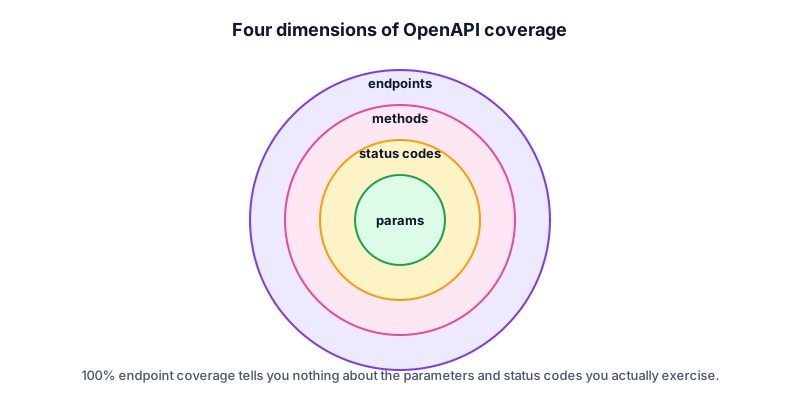
OpenAPI test coverage is the most lied-about metric in API testing. Teams that report 100% are usually counting endpoints, the easiest dimension. The bugs live in the dimensions they aren't measuring. This guide explains how to measure coverage honestly across four dimensions, gate it in CI, and close the five most common gaps in 2026.
In this guide
- What is OpenAPI test coverage?
- The four dimensions of coverage
- How to measure coverage in CI
- What good coverage looks like
- Five common coverage gaps and how to close them
- AI generation as the coverage lever
- Real implementation example
- OpenAPI coverage checklist
- FAQ
Which version of the spec you are on changes what validators accept — OpenAPI 3.0 vs 3.1 lists every difference.
What is OpenAPI test coverage?
OpenAPI test coverage measures how thoroughly your test suite exercises the operations defined in your OpenAPI specification. The spec is the source of truth — every operation, parameter, request body schema, response schema, and status code is declared. Coverage is the percentage of that surface your tests actually hit.
It is not line coverage. Line coverage measures how much application code your tests execute. OpenAPI coverage measures how much of your contract your tests validate. Both matter; they don't substitute for each other.
The four dimensions of coverage
Endpoint coverage. Of the unique URL paths in the spec, how many does your suite call at least once? This is the easiest dimension and the most often reported. 100% here is the floor, not the ceiling.
Method coverage. Of all operationId values in the spec, how many are exercised? GET /users and POST /users are different operations. A suite that hits 100% endpoints but only GET is missing half the surface.
Status code coverage. Of the response status codes declared per operation, how many does your suite trigger? 200, 201, 400, 401, 403, 404, 409, 422, 429, 500 — most operations declare 4–6 of these. Hitting only 200 is the most common gap.
Parameter coverage. Of the parameter values implied by enum, min, max, pattern, and oneOf constructs, how many distinct values does your suite exercise? This is the deepest dimension and where AI generators add the most value.
A 100% endpoint score with 30% parameter coverage is the common pathology. The bugs live in the parameter dimension. Automated coverage-gap detection surfaces exactly which methods, status codes, and parameter values your suite is missing, so you can target the weakest dimension instead of trusting a single endpoint number.
How to measure coverage in CI
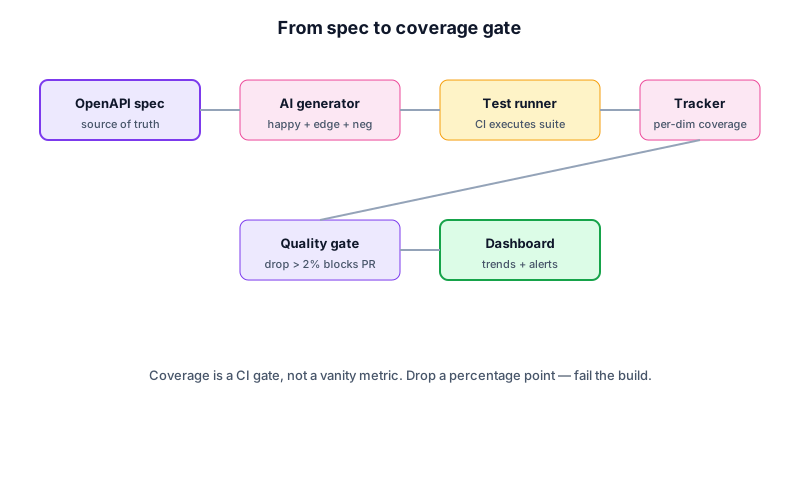
The pipeline has six stages:
- OpenAPI spec — the source of truth. Lint with Spectral on every commit.
- AI generator — produces tests for every operation, status code, and parameter declared in the spec. Total Shift Left's generator achieves 80%+ baseline coverage in minutes.
- Test runner — CI executes the suite. Failures block merge.
- Tracker — instrumentation around the OpenAPI validator records what was hit.
- Quality gate — coverage drop > 2% in any dimension fails the build.
- Dashboard — trends, alerts, deltas per release.
For a step-by-step CI integration, see API testing in CI/CD and the shift left API testing guide.
Ready to shift left with your API testing?
Try our no-code API test automation platform free. Generate tests from OpenAPI, run in CI/CD, and scale quality.
What good coverage looks like
A practical baseline for a mature API:
| Dimension | Baseline | Excellent |
|---|---|---|
| Endpoints | 95% | 100% |
| Methods | 90% | 98% |
| Status codes | 80% | 92% |
| Parameters | 70% | 85% |
The thresholds rise across the columns because each subsequent dimension is exponentially larger than the prior one. Hitting 100% parameter coverage is impractical for any non-trivial API; 85% is genuinely excellent.
The discipline that matters more than the numbers is the trend — coverage should never drop release-over-release. A 2% drop in any dimension fails the build.
Five common coverage gaps and how to close them
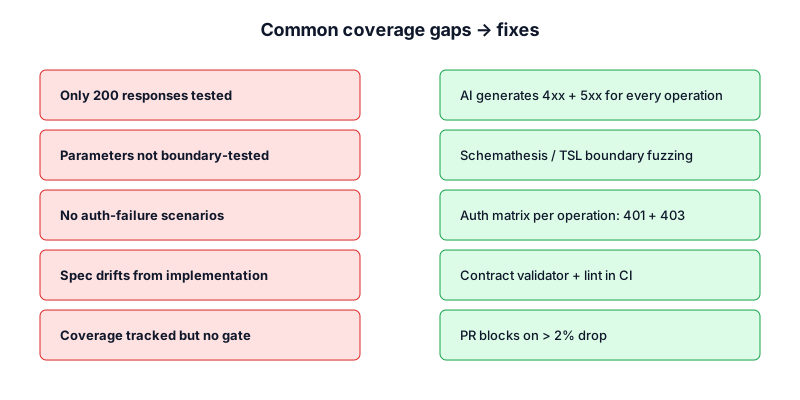
Gap 1: Only 200 responses tested. Every operation declares more. Fix: AI generates negative tests for every declared 4xx and 5xx code.
Gap 2: Parameters not boundary-tested. A spec says min: 1, max: 100. The suite passes 50 and calls it a day. Fix: schema-aware fuzzing (Schemathesis, Total Shift Left) generates boundary, off-by-one, and out-of-range cases.
Gap 3: No auth-failure scenarios. The suite tests 200 for an authenticated user but never 401 for missing token, 403 for wrong scope, or 401 for expired token. Fix: an auth matrix that crosses every protected operation against every failure mode.
Gap 4: Spec drifts from implementation. Code changes; spec doesn't. Tests pass against the stale spec. Fix: contract validator (Pact, Schemathesis, Total Shift Left) asserts deployed responses match the spec on every PR.
Gap 5: Coverage tracked but no gate. A dashboard shows coverage; nobody fails a build on it. Fix: a CI quality gate that fails on > 2% drop in any dimension.
AI generation as the coverage lever
The single highest-leverage lift on coverage is AI test generation. A schema-aware generator reads the OpenAPI spec and produces:
- Happy-path tests for every operation
- Negative-path tests for every declared 4xx response
- Boundary tests for every
min/max/enum/patternconstraint - Auth tests for every security scheme declaration
Total Shift Left's generator runs in seconds on a typical 50-endpoint spec and lifts a baseline 30% suite to 80%+ coverage immediately. Schemathesis is the open-source alternative — same idea, requires more wiring. Postbot in Postman generates per request, not at suite level.
For a regulated buyer who needs the AI on-prem, only Total Shift Left ships a self-hosted LLM (Ollama, vLLM, LM Studio) so spec content never leaves the network.
OpenAPI test coverage in practice: a worked example
A regulated insurer (anonymized) baselined coverage on a 180-microservice estate:
| Before | After (6 months) |
|---|---|
| Endpoints: 78% | Endpoints: 99% |
| Methods: 71% | Methods: 96% |
| Status codes: 22% | Status codes: 84% |
| Parameters: 14% | Parameters: 71% |
The status-code and parameter shifts were the real story. The team was already at "good enough" on endpoints; the bugs were in the dimensions they weren't measuring. AI generation produced the lift in 90 days. Quality gates kept it from regressing afterward.
Outcomes:
- 47% reduction in defect-fix cost
- 70% reduction in audit prep time (coverage proofs auto-generated)
- $700K+ first-year savings against platform investment
OpenAPI coverage checklist
- ✔ Coverage measured across all four dimensions (not just endpoints)
- ✔ AI generation produces baseline coverage on PR open
- ✔ Quality gate fails build on > 2% drop in any dimension
- ✔ 4xx and 5xx tests exist for every declared response
- ✔ Parameter boundary cases generated automatically
- ✔ Auth-failure matrix covers every protected operation
- ✔ Contract validator asserts deployed responses match spec
- ✔ Coverage trends are dashboarded release-over-release
Free 1-page checklist
API Testing Checklist for CI/CD Pipelines
A printable 25-point checklist covering authentication, error scenarios, contract validation, performance thresholds, and more.
Download FreeRelated reading: how AI generates tests from OpenAPI · OpenAPI testing tools compared.
See also: generate tests from openapi in our learn hub for the underlying concept.
Measure which operations the suite actually touched
Endpoint coverage is countable: enumerate the operations in the spec, record which ones the suite exercised, and report the difference. This script does it from any runner that can log its requests:
# coverage.py — spec operations vs operations exercised
import json, sys, yaml, re

spec = yaml.safe_load(open("openapi.yaml"))
operations = {
    f"{method.upper()} {path}"
    for path, item in spec["paths"].items()
    for method in item
    if method in {"get", "post", "put", "patch", "delete", "head", "options"}
}

# requests.log: one "METHOD /actual/path" per line, emitted by the test client
def to_template(method, url):
    for op in operations:
        m, p = op.split(" ", 1)
        if m != method:
            continue
        if re.fullmatch(re.sub(r"\{[^}]+\}", r"[^/]+", p), url):
            return op
    return None

hit = set()
for line in open("requests.log"):
    method, url = line.split()
    op = to_template(method, url)
    if op:
        hit.add(op)

missed = sorted(operations - hit)
pct = 100 * len(hit) / len(operations)
print(json.dumps({"total": len(operations), "covered": len(hit),
                  "endpointCoverage": round(pct, 1), "uncovered": missed}, indent=2))
sys.exit(0 if pct >= float(sys.argv[1] if len(sys.argv) > 1 else 80) else 1)
Endpoint coverage is the floor, not the goal. An operation counted as covered by one happy-path call has had its status code checked and nothing else — which is why response-code and schema-constraint coverage are the next two numbers to track.
OpenAPI test coverage FAQ
What is OpenAPI test coverage? A measure of how thoroughly your test suite exercises operations defined in your OpenAPI spec across four dimensions: endpoints, HTTP methods, declared status codes, and parameter values.
Why is endpoint coverage alone misleading? 100% endpoint coverage means every URL has a test. It says nothing about the methods, status codes, or parameter values exercised. Most bugs hide in those dimensions.
How do I measure OpenAPI coverage? Run a tracker (Total Shift Left, Schemathesis with stats, or custom OpenAPI validator instrumentation) that records every operation, status code, and parameter value exercised.
What is a good coverage threshold? A practical baseline: 95% endpoint, 90% method, 80% status code, 70% parameter. Fail builds on > 2% regression in any dimension.
How does AI test generation help OpenAPI coverage? Schema-aware AI generators read the spec and produce tests for every operation, status code, and parameter — including the 4xx cases humans typically skip. The cheapest way to lift coverage above 80%.
Does line coverage replace OpenAPI coverage? No. Line coverage measures application code execution; OpenAPI coverage measures contract validation. Both are necessary; neither substitutes for the other.
Sources and further reading
- OpenAPI Specification — the normative spec for describing HTTP APIs.
- Schemathesis documentation — property-based testing driven straight from an OpenAPI spec.
- Dredd documentation — spec-versus-implementation validation for HTTP APIs.
Key takeaways
- If you only measure endpoint coverage, you are flying blind. The four-dimension model — endpoints, methods, status codes, parameters — is the difference between coverage as a vanity metric and coverage as a real defect-prevention tool.
- AI generation lifts you to a useful baseline; quality gates keep you there.
Ready to baseline your spec? Start a free Total Shift Left account, import an OpenAPI spec, and run AI-generated coverage in under five minutes. Related: OpenAPI test automation · shift left API testing · Total Shift Left vs ReadyAPI.
Ready to shift left with your API testing?
Try our no-code API test automation platform free.