
Consul vs Postman: Service Mesh Networking vs API Testing (2026)
Consul vs Postman: Service Mesh Networking vs API Testing (2026)
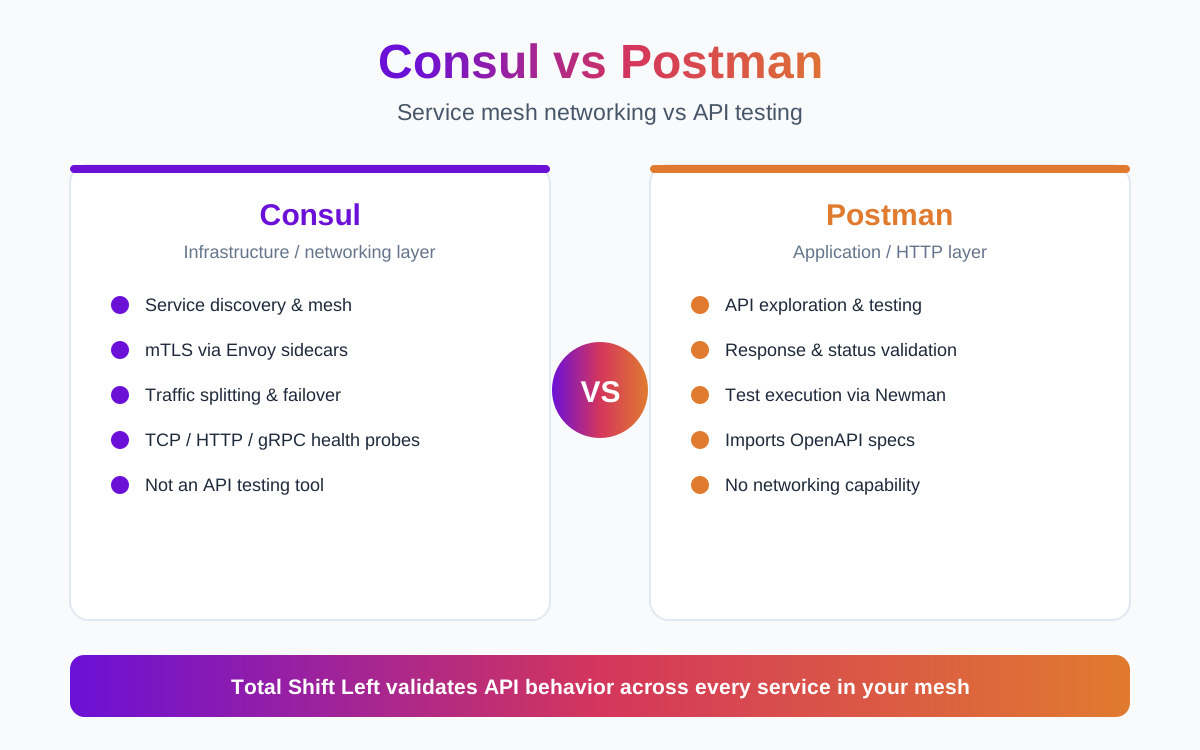
If you have searched "consul vs postman," you are likely working in a microservices environment and trying to understand how service networking and API testing fit together. The short answer: Consul and Postman are not alternatives. HashiCorp Consul manages how your services find and communicate with each other. Postman tests what those services return when you call their APIs. They operate at different layers of your architecture.
This guide clarifies the confusion, explains what each tool does, how they work together in microservices environments, and where the testing gaps appear in service mesh architectures.
What Consul Does
HashiCorp Consul is a service networking platform. Its core capabilities:
- Service discovery — services register themselves with Consul and discover other services by name instead of hardcoded IP addresses
- Service mesh (Consul Connect) — encrypts service-to-service traffic with mutual TLS, enforces access policies through intentions, and routes traffic through Envoy sidecar proxies
- Health checking — monitors service instances and removes unhealthy ones from the service catalog automatically
- Key/value store — provides distributed configuration storage for service settings
- Traffic management — supports traffic splitting for canary deployments, failover routing, and load balancing across service instances
Consul answers the question: how do my services find each other and communicate securely? It operates at the infrastructure and networking layer, below the API layer that application developers work with directly.
What Postman Does
Postman is an API exploration and testing platform. You build HTTP requests, organize them into collections, script assertions in JavaScript, and run them manually or via Newman in CI/CD. Postman operates at the application layer — it sends HTTP requests and validates what comes back.
Postman answers the question: does this API endpoint return the correct response? It does not manage how services discover each other, how traffic is routed, or how service-to-service communication is secured.
Why People Compare Them
The search "consul vs postman" happens because teams building microservices need both service networking and API testing, and the boundary between infrastructure and application testing is blurry in modern architectures:
Both tools touch service health. Consul health checks verify that a service instance is alive and reachable. Postman tests verify that a service endpoint returns correct responses. Teams wonder which tool covers which kind of validation.
Microservices create API surfaces. Every service in a Consul mesh exposes APIs that other services consume. Testing those APIs requires understanding both the networking layer (Consul) and the application layer (API testing tools).
Platform teams manage both. In 2026, platform engineering teams often own Consul configuration and API testing infrastructure. They need clarity on how these tools complement each other.
Side-by-Side Comparison
Ready to shift left with your API testing?
Try our no-code API test automation platform free. Generate tests from OpenAPI, run in CI/CD, and scale quality.
| Capability | Consul | Postman |
|---|---|---|
| Primary purpose | Service discovery and mesh networking | API exploration and testing |
| Operating layer | Infrastructure / networking | Application / HTTP |
| Health checking | TCP, HTTP, gRPC health probes | API response validation |
| Service-to-service security | mTLS via Envoy sidecars | No networking capability |
| Traffic management | Splitting, failover, load balancing | No traffic control |
| API testing | Not an API testing tool | Full API testing workflow |
| Configuration | HCL/JSON config files | GUI + collection JSON |
| CI/CD role | Infrastructure provisioning | Test execution via Newman |
| Spec awareness | No OpenAPI awareness | Imports OpenAPI (converts to collection) |
How Consul and Postman Work Together
In a microservices architecture with Consul service mesh, the tools serve complementary roles:
Consul manages the network path. When Service A calls Service B, Consul resolves the service name to a healthy instance, routes traffic through the Envoy sidecar proxy, and encrypts the connection with mTLS. This happens at the infrastructure layer, invisible to the API request itself.
Postman tests the API behavior. After Consul routes the traffic, the API endpoint on Service B processes the request and returns a response. Postman (or any API testing tool) validates that the response is correct — proper status code, valid JSON schema, correct business logic.
A practical workflow:
- Consul registers services and manages mesh networking
- Developers use Postman to explore and debug individual service APIs during development
- API tests validate endpoint behavior independent of the networking layer
- Consul health checks ensure service instances are reachable
- API tests ensure service endpoints return correct responses
Testing Challenges in Service Mesh Environments
Service meshes create specific challenges for API testing that neither Consul nor Postman addresses fully:
Dynamic service registration. Services scale up and down, and their network addresses change. Postman collections with hardcoded URLs break when service instances change. Consul resolves service names dynamically, but Postman does not integrate with Consul's service catalog natively.
mTLS complexity. In a Consul Connect mesh, service-to-service traffic requires mutual TLS certificates managed by Consul. Testing APIs from outside the mesh requires either bypassing mTLS (which does not test the real path) or configuring test clients with valid certificates (which adds operational complexity to Postman or Newman).
Contract compliance across services. In a mesh with dozens of services, each service exposes APIs consumed by other services. Validating that all service-to-service contracts are honored requires testing every API surface — a manual effort that scales poorly with Postman collections.
Traffic splitting and canary testing. Consul supports routing a percentage of traffic to a canary deployment. Testing the canary's API behavior requires targeting specific service instances, which Postman's static URL model does not support natively.
Health check vs. functional correctness. Consul health checks verify that a service is reachable and returns a 200 on its health endpoint. They do not validate that the API returns correct data, handles edge cases properly, or complies with the OpenAPI specification. The gap between "service is up" and "service is correct" is where API testing lives.
Where Total Shift Left Fits in Service Mesh Environments
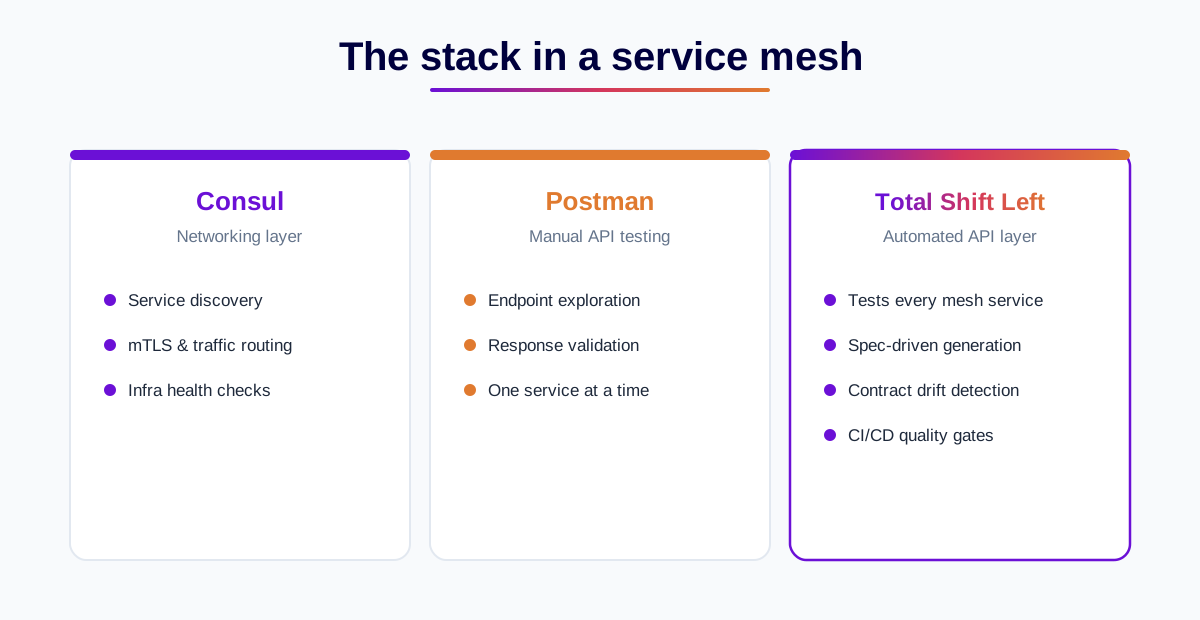
Total Shift Left addresses the API testing gaps that appear in service mesh architectures:
Spec-driven testing independent of networking. Total Shift Left imports OpenAPI specifications for each service in your mesh and generates comprehensive test suites from the schema. The tests validate API contracts — request/response schemas, status codes, error handling — regardless of whether traffic routes through Consul Connect, a load balancer, or direct connections.
Coverage across the full mesh. For a mesh with 30 services, each exposing 10-50 endpoints, Total Shift Left generates and tracks tests across the entire API surface. Coverage reports show which services and endpoints are tested, making it visible when new services deploy without adequate test coverage.
Contract validation for service-to-service APIs. In a service mesh, the contracts between services are critical. Total Shift Left validates that each service's API implementation matches its OpenAPI specification, catching contract violations before they cause cascading failures across the mesh.
CI/CD quality gates per service. Each service in the mesh can have its own quality gate — minimum coverage thresholds, schema compliance requirements, and contract validation checks. A service cannot deploy into the mesh unless its API tests pass and coverage meets the threshold.
Self-healing on spec changes. When service APIs evolve, Total Shift Left detects specification changes and regenerates affected tests. In a service mesh where contract changes can break downstream consumers, this automated update prevents stale tests from masking real issues.
The Practical Architecture
For enterprise teams running microservices with Consul:
- Consul manages service discovery, mesh networking, mTLS, health checking, and traffic management
- Total Shift Left generates and runs API tests for each service, tracks coverage across the mesh, and enforces contract compliance in CI/CD
- Postman serves as the exploration tool for developers debugging individual service endpoints during development
This layered approach keeps each tool in its strength: Consul for infrastructure, automated spec-driven testing for API quality, and Postman for manual exploration.
FAQ
Is Consul a replacement for Postman?
No. Consul and Postman serve entirely different purposes. Consul manages service discovery, networking, and service mesh connectivity. Postman tests API endpoints. They operate at different layers of your infrastructure and are complementary, not competing.
How do I test APIs in a Consul service mesh?
Testing APIs in a Consul mesh requires reaching services through the mesh proxy (Envoy sidecar). You can configure Postman to target mesh endpoints, but maintaining collections for dynamically registered services is challenging. Spec-driven tools like Total Shift Left handle this by generating tests from OpenAPI specs regardless of the underlying service discovery mechanism.
What testing challenges does a service mesh create?
Service meshes add complexity including mTLS between services, dynamic service registration, traffic splitting for canary deployments, and sidecar proxy routing. API tests must account for these networking behaviors. Tools that operate at the spec layer abstract away mesh complexity and test API contracts independently of the networking infrastructure.
Ready to shift left with your API testing?
Try our no-code API test automation platform free.