
dbt vs Postman: Different Tools, Different Jobs (2026)
dbt vs Postman: Different Tools, Different Jobs (2026)
If you have searched "dbt vs postman," you are probably working on a data platform that touches both data transformation and API endpoints. The comparison is confusing because dbt and Postman operate in completely different layers of your architecture. dbt transforms data inside your warehouse. Postman tests HTTP APIs. They are not competitors, but understanding where each fits — and where they overlap — matters for teams building modern data platforms.
What dbt Does
dbt (data build tool) is a transformation framework for analytics engineering. It lets you write SQL SELECT statements that define how raw data becomes analysis-ready tables and views in your data warehouse (Snowflake, BigQuery, Redshift, Databricks, or PostgreSQL).
The key capabilities of dbt for data quality:
- SQL-based transformations that turn raw ingested data into clean, modeled tables
- Built-in testing with schema tests (not_null, unique, accepted_values, relationships) and custom data tests
- Documentation generated from YAML schema files alongside your models
- Version-controlled SQL managed in Git like application code
- Incremental models that process only new or changed data
- Lineage tracking that shows how data flows through transformations
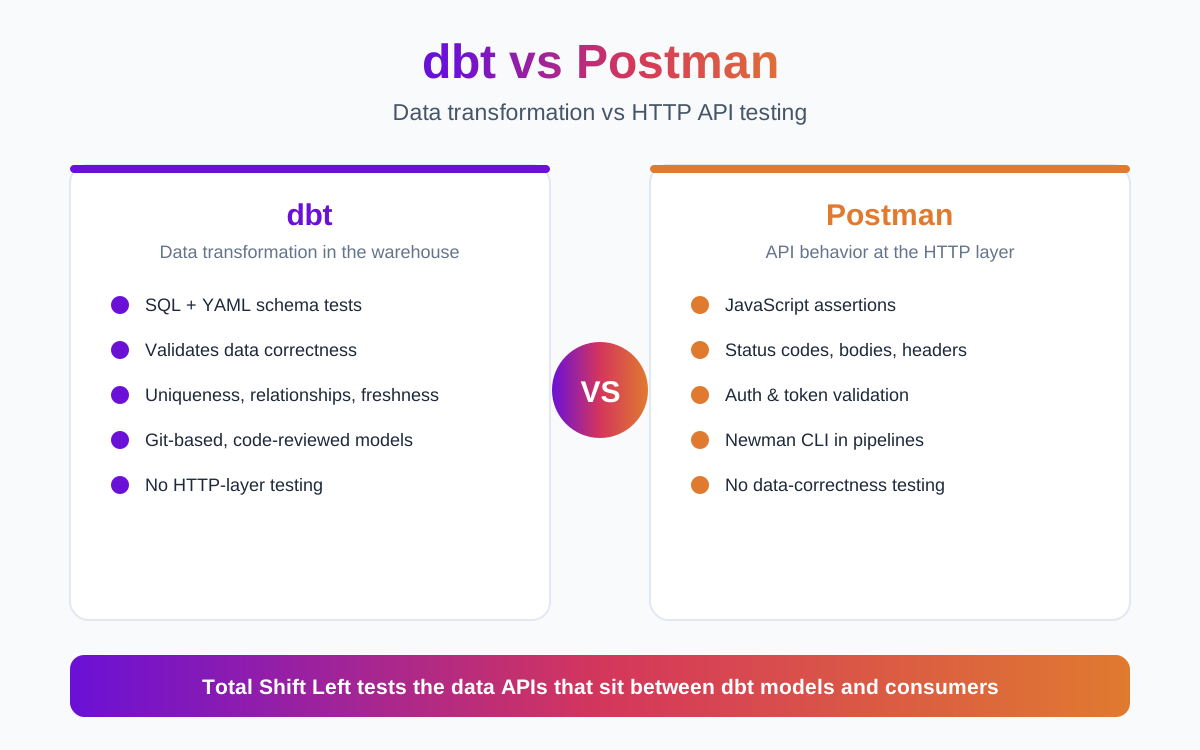
dbt's testing framework validates data correctness inside the warehouse. A dbt test asserts that a column has no null values, that a primary key is unique, or that a foreign key relationship holds. These are data-layer assertions, not API-layer assertions.
What Postman Does
Postman is an API exploration and testing platform. It lets you build HTTP requests, organize them into collections, script assertions in JavaScript, and run them manually or via Newman in CI/CD.
Postman operates at the HTTP layer. It sends requests to endpoints and validates responses — status codes, headers, response bodies, authentication flows, and error handling. It knows nothing about your data warehouse, SQL transformations, or data lineage.
Why People Search "dbt vs Postman"
The search happens because modern data platforms blur the boundary between data engineering and API development. Specifically:
Data APIs are everywhere. Tools like Cube, Hasura, PostgREST, and custom FastAPI/Flask services expose warehouse data through REST or GraphQL endpoints. The data lives in dbt-managed tables, but it is served through HTTP APIs.
Both tools have "testing." dbt has data tests. Postman has API tests. Teams working on data platforms need both kinds of testing and wonder which tool covers what.
Platform teams own both layers. In 2026, many platform engineering teams are responsible for the full stack from warehouse transformation to API endpoint. They need clarity on which testing tool covers which layer.
Ready to shift left with your API testing?
Try our no-code API test automation platform free. Generate tests from OpenAPI, run in CI/CD, and scale quality.
Side-by-Side Comparison
| Capability | dbt | Postman |
|---|---|---|
| Primary purpose | Data transformation in warehouses | HTTP API exploration and testing |
| Testing layer | Data correctness inside the warehouse | API behavior at the HTTP layer |
| Test language | SQL + YAML schema tests | JavaScript assertions |
| What it validates | Column values, uniqueness, relationships, freshness | Status codes, response bodies, headers, auth |
| CI/CD integration | dbt Cloud or CLI in pipelines | Newman CLI in pipelines |
| Spec awareness | YAML schema files for models | OpenAPI spec import (converts to collection) |
| Coverage tracking | Model and test coverage in dbt docs | No spec-level coverage tracking |
| Collaboration | Git-based (SQL is code) | Cloud workspaces |
| Cost | dbt Core is free; dbt Cloud has paid tiers | Free tier with paid plans |
Where dbt and Postman Overlap
The overlap exists in one specific scenario: when your data platform exposes API endpoints that serve dbt-transformed data.
Example architecture:
- Raw data lands in your warehouse via Fivetran, Airbyte, or custom ingestion
- dbt transforms raw data into clean, business-ready models
- A REST or GraphQL API (Hasura, Cube, custom service) exposes those models as endpoints
- Frontend applications and internal tools consume those endpoints
In this architecture, you need testing at two layers:
dbt tests validate the data layer. Is the revenue calculation correct? Are there null customer IDs? Do the foreign keys between orders and customers hold? These are SQL-level assertions that run inside the warehouse.
API tests validate the HTTP layer. Does the /api/v1/revenue endpoint return a 200 with the correct JSON schema? Does pagination work correctly? Does the authentication middleware reject invalid tokens? Does the error response for a missing resource return 404 with the expected error format?
dbt cannot test API behavior. Postman cannot test warehouse data correctness. You need both.
The Gap in Data API Testing
When your data platform serves dozens or hundreds of API endpoints, both dbt and Postman hit limitations:
dbt's limitation: It only validates data inside the warehouse. It cannot test the API layer — serialization, authentication, rate limiting, pagination, caching, error handling, or response format compliance. A dbt test passing does not guarantee the API endpoint serving that data works correctly.
Postman's limitation: Maintaining collections for data APIs is manual and prone to drift. Data API endpoints frequently change schemas as dbt models evolve. Each schema change requires manual collection updates in Postman. For data platforms with hundreds of endpoints, this maintenance becomes unsustainable.
The missing layer: Neither tool tracks API-level test coverage against the OpenAPI specification. Neither generates tests automatically when the API schema changes. Neither enforces contract compliance as a CI/CD quality gate.
Where Total Shift Left Fits for Data Platform Teams
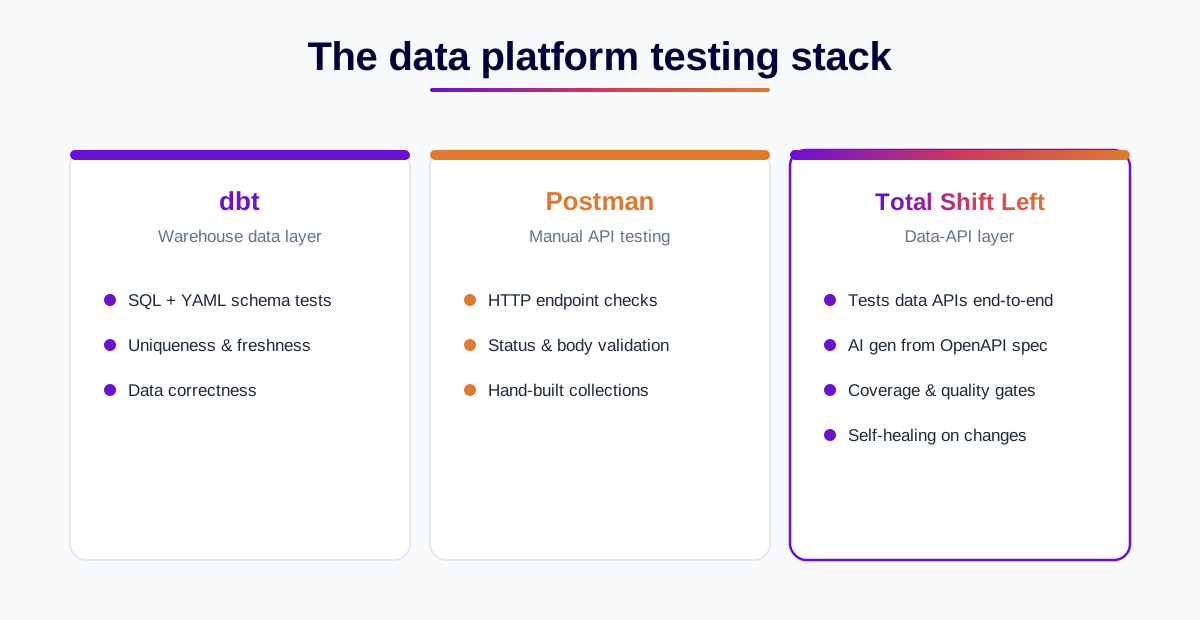
Total Shift Left bridges the gap between dbt's data-layer testing and Postman's manual API exploration by automating the API testing layer:
Import your data API spec. Whether your data API is generated by Hasura, Cube, or a custom service, Total Shift Left ingests the OpenAPI specification and understands every endpoint, parameter, and response schema.
Generate comprehensive API tests. The platform automatically generates tests from the schema covering response validation, pagination behavior, error handling, authentication flows, and edge cases across your entire data API surface. This is not one-request-at-a-time testing — it is suite-level generation.
Track coverage and enforce quality gates. Know exactly which data API endpoints are tested and which are not. Set coverage thresholds in CI/CD so that new endpoints cannot ship without test coverage.
Self-heal when dbt models change. When dbt model changes propagate to your API schema, Total Shift Left detects the spec changes and regenerates affected tests. No manual Postman collection updates required.
The layered approach for data platform teams:
- dbt tests validate data correctness inside the warehouse
- Total Shift Left validates API behavior, schema compliance, and contract integrity at the HTTP layer
- Postman serves as the exploration tool for ad-hoc debugging during development
The Practical Answer
dbt and Postman are not alternatives to each other. They test different layers of your architecture. If you searched "dbt vs postman," the real question is probably how to test the API layer of your data platform effectively.
For small data APIs with a few endpoints, Postman collections work fine alongside dbt tests. For data platforms at scale — dozens of endpoints, evolving schemas, CI/CD quality requirements — spec-driven automation with Total Shift Left eliminates the manual maintenance burden that Postman collections impose while dbt handles the data quality layer it was designed for.
FAQ
Is dbt an alternative to Postman?
No. dbt and Postman solve different problems. dbt transforms and tests data inside your warehouse using SQL. Postman sends HTTP requests to test APIs. They are not substitutes for each other, but they can be complementary when your data platform exposes REST or GraphQL endpoints.
When would I use both dbt and Postman together?
When your data platform exposes APIs that serve transformed data. dbt validates the data transformations inside the warehouse. Postman or an API testing tool validates that the API layer correctly serves that data with proper authentication, pagination, error handling, and response formats.
How does Total Shift Left help teams with data APIs?
Total Shift Left imports the OpenAPI specification of your data API endpoints and generates comprehensive test suites automatically. This covers response schema validation, pagination behavior, error handling, and authentication flows that dbt tests cannot reach and that manual Postman collections struggle to maintain at scale.
Ready to shift left with your API testing?
Try our no-code API test automation platform free.