
Enterprise Test Data Management Strategy: PII, Synthetic Data & Compliance (2026)
An enterprise test data management strategy that handles PII, PHI, and cardholder data without expanding compliance scope or breaking developer velocity. Synthetic generation, masking pipelines, and the framework that scales across teams.
What is this
Enterprise test data management (TDM) strategy is the platform-engineering practice of providing test data to dozens of product teams without expanding compliance scope, breaking referential integrity, or slowing developer velocity. The 2026 framework most enterprises converge on has four patterns — pure synthetic, masked production copy, tokenized references, and live sandbox APIs — each chosen by data class and use case, with default-deny on production data unless explicitly justified.
Key components
Each enterprise program in this area has the same load-bearing components, regardless of vendor. The components separate cleanly into governance, enforcement, and evidence layers.
Synthetic data generation
Schema-aware generators producing realistic but provenance-free test data. AI-assisted generation infers patterns from production statistics without copying records. Domain-specific libraries (FHIR, X12, ISO 20022) cover regulated domains. Default pattern at most enterprises in 2026.
Masking pipeline
Production data with direct identifiers replaced by format-preserving masked equivalents that retain referential integrity across tables and services. Masking runs in-boundary, never on third-party services that fall outside the authorization scope.
Tokenization vault
Cross-system integration tests use opaque tokens resolvable only by an authorized vault service. Real PII never enters the test environment; linkage between systems is preserved without exposing the underlying identifiers.
Sandbox APIs
Live vendor sandboxes (Stripe, Adyen, Plaid, Okta) for third-party integrations. The vendor handles compliance scope; tests use realistic but vendor-controlled data.
Per-environment classification
Every test environment tagged with the categories of data it can hold (synthetic-only, masked-production-allowed, tokenized-only). Pipelines verify the tag before populating.
Governance workflow
Default-deny on production data with explicit approval workflow per use case. Approvals retained for the audit window. The objective is making the choice between synthetic and masked production a deliberate, tracked decision.
Table of Contents
- Why test data is now a platform engineering problem
- The four-pattern framework
- When synthetic data is the right answer
- When masking is the right answer
- Governance and approval workflows
- Reference architecture
Why test data is now a platform engineering problem
Historically, test data was a QA problem. Each team or each test author solved their own data needs, often by copying a slice of production into a test environment. At enterprise scale in 2026, that pattern fails three ways:
- Compliance scope. Every environment with production-derived data carries the same regulatory weight as production. Hundreds of dev/test environments × full compliance scope is unmanageable.
- Realism degradation. Hand-built fixtures don't represent the breadth of production cases; they cover happy paths and miss edge cases that AI test generation could discover.
- Coordination cost. Teams that need linked data across services (a customer in one system referenced from claims in another) end up either re-creating the linkage manually or sharing data that should be siloed.
The pattern that scales is to move test data management to a platform engineering or data platform team that ships it as a product — synthetic generators, masking pipelines, tokenization services — and lets product teams consume the right pattern for their case.
The four-pattern framework
A practical framework most enterprises converge on:
| Pattern | Compliance scope | Best for |
|---|---|---|
| Pure synthetic | None | New features, AI-driven generation, cross-team integration tests |
| Masked production copy | Reduced (depending on masking) | Regression of complex production-only data shapes |
| Tokenized references | Pushed to vault | Cross-system integration tests where linkage matters |
| Live sandbox APIs | Vendor scope | Payment processors, identity providers, third-party APIs |
The platform team's job is to make each of these patterns a one-call API for product teams. The product teams' job is to choose the right pattern for the test case at hand. The compliance / privacy function's job is to define which patterns are acceptable for which categories of regulated data.
When synthetic data is the right answer
Synthetic data wins for most cases at enterprise scale. The 2024-vintage objection that synthetic data lacks realism has been substantially mitigated by:
- Schema-aware generators that respect referential integrity, value distributions, and domain constraints
- AI-assisted generation that infers patterns from production statistics without copying production records
- Domain-specific libraries (FHIR resources, X12 claims, ISO 20022 messages) that produce realistic regulated-domain data
For new features, the compliance benefits are decisive: zero compliance scope, no breach surface, no patient/customer rights complications. For AI-driven test generation specifically, the realism is now sufficient for almost all happy-path and edge-case generation.
The remaining gap is in long-tail production behaviors — rare value distributions, unusual cross-table relationships, edge-case data shapes that emerge from years of production usage. For those cases, masked production data still has a place.
Ready to shift left with your API testing?
Try our no-code API test automation platform free. Generate tests from OpenAPI, run in CI/CD, and scale quality.
When masking is the right answer
Masking works when you need realism that synthetic generation can't approximate, and you have the operational discipline to keep the masked data inside the right boundary. Three guardrails:
- Mask in-region, in-boundary. Never send production data to a third-party masking service if that service sits outside your authorization boundary.
- Validate masking strength. A masking pipeline that produces re-identifiable output is worse than no masking — it gives false comfort. Periodically audit masking strength against re-identification techniques.
- Preserve referential integrity. A masked customer ID must be the same masked ID across every table and every service. Otherwise integration tests break.
For deeper coverage see data masking for regulated test environments and synthetic test data vs production data.
Governance and approval workflows
A working governance pattern at enterprise scale:
- Default-deny on production data. Use of production data — even masked — requires explicit approval per environment per use case. Default is synthetic.
- Approved masking pipelines only. Only the platform team's reviewed masking pipeline is approved for production-derived data. Ad-hoc masking scripts are prohibited.
- Per-environment scope tracking. Every test environment is tagged with the categories of data it can hold. Pipelines verify the tag before populating.
- Audit trail for production-data approvals. Who approved using masked production data for which use case, when, retained for the audit window.
The objective isn't to make production data hard to use. It's to make the choice between synthetic and masked production a deliberate decision tracked centrally.
Reference architecture
A reference architecture for enterprise test data management:
- Synthetic data generator as a service: schema-aware, AI-assisted, available via internal API. Generates fixtures into the test environment of choice.
- Masking pipeline as a service: pulls from a controlled production extract, applies approved masking, deposits into approved test environments. Strict in-boundary execution.
- Tokenization vault for cross-environment integration tests: replaces direct PII references with tokens; only authorized services can resolve.
- Governance layer: per-environment scope tags, per-team policies, approval workflow.
- Audit logging: every data movement logged centrally; retained for the audit window.
For complementary content see test data management for modern applications and test data generation tools for API testing.
Enterprise test data management in 2026 is a platform engineering product. The teams that ship it well — as a small set of services that product teams consume — get out of the way of developer velocity while keeping compliance scope contained. The teams that leave test data as each team's problem end up with hundreds of compliance-in-scope environments and an audit story that doesn't hold up.
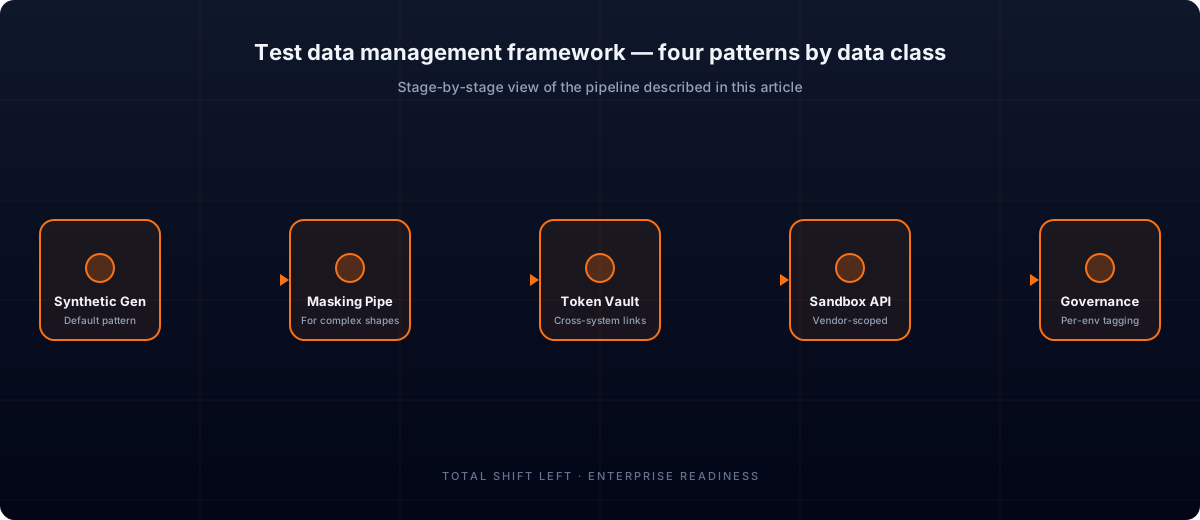
Test data management framework — four patterns by data class.
Why this matters at enterprise scale
IDC's 2024 test data management survey found that organizations with platform-team-owned synthetic-first patterns reduced compliance-related test data incidents by 65% versus teams using ad-hoc production cloning. With GDPR / HIPAA / PCI-DSS enforcement tightening on test environments, synthetic-first is increasingly the only pattern that scales without compounding compliance scope.
Tools landscape
A practical view of the tool categories that scale across enterprise testing programs in this area:
| Category | Example tools |
|---|---|
| Synthetic data generators | Faker, Synthea (FHIR), MOSTLY AI, Tonic.ai, Total Shift Left fixtures |
| Masking pipelines | In-boundary tools (DataVeil, ARX, Privacera) with referential integrity |
| Tokenization vaults | HashiCorp Vault, AWS Secrets Manager with token resolution APIs |
| Sandbox APIs (vendor-scoped) | Stripe, Adyen, Plaid, Okta sandboxes |
| Governance / approval | Internal workflows, ServiceNow integrations, Backstage entity tags |
Tool selection is secondary to architecture. The patterns above hold regardless of which specific vendor you adopt.
Real implementation example
A representative deployment pattern from an enterprise rollout in this area:
Problem. A pharma company had 80+ test environments, most populated by hand-cloned production data. Annual GDPR-scope review consumed 6 weeks. PII handling incidents averaged 1 per quarter. Engineering velocity was bottlenecked on test data provisioning requests.
Solution. A new TDM platform team shipped a four-pattern framework: synthetic generators for new features (default), in-boundary masking for regression, tokenization vault for cross-system tests, vendor sandboxes for third-party integrations. Default-deny on production data; approval workflow for exceptions.
Results. GDPR-scope environments dropped from 80 to 12 within 6 months. PII incidents dropped to zero across the next 18 months. Engineering velocity on test data provisioning improved 5x. The TDM platform became one of the team's highest-NPS internal services.
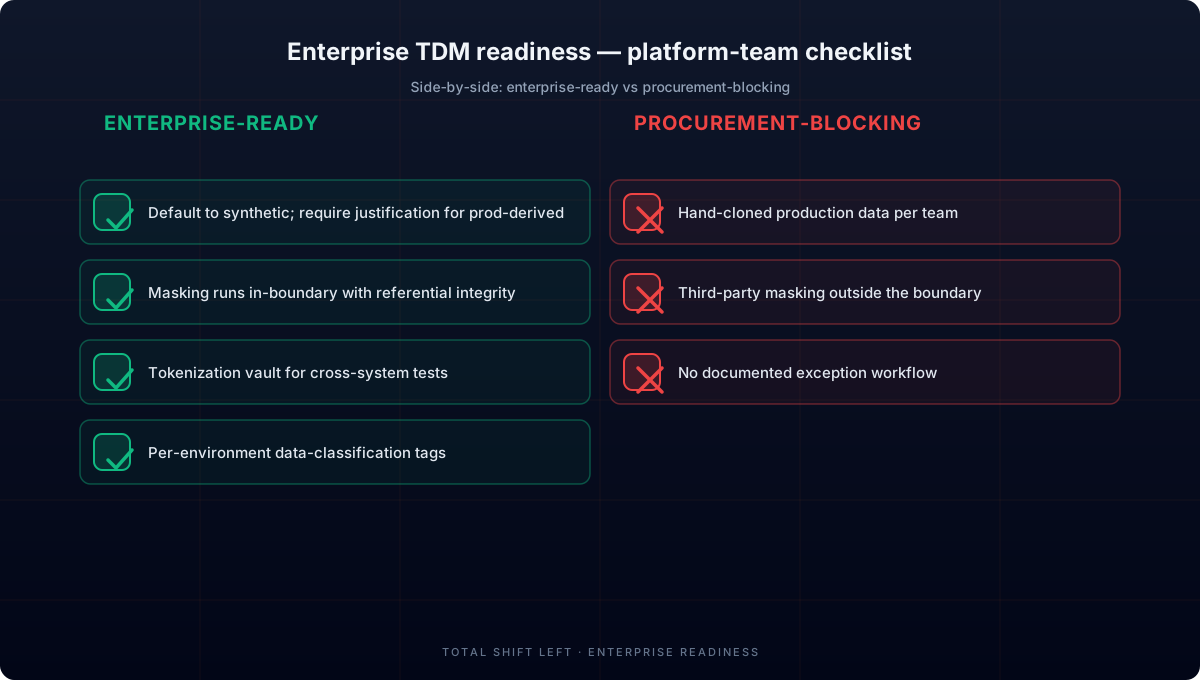
Enterprise TDM — readiness checklist.
Reference architecture
A four-pattern TDM architecture has five components. Synthetic data generator as a service — schema-aware, AI-assisted, available via internal API. Generates fixtures into the test environment of choice. Most cases use this pattern. Masking pipeline as a service — pulls from a controlled production extract, applies approved masking with referential integrity, deposits into approved test environments. Strict in-boundary execution. Tokenization vault for cross-environment integration tests — replaces direct PII references with tokens; only authorized services resolve. Sandbox API integrations for vendor-scoped data (payment processors, identity providers). Governance layer with per-environment scope tags, per-team policies, and approval workflow for production-data exceptions. The platform team operates all five as a cohesive product — the goal is one-call APIs for product teams to consume the right pattern for each test case.
Metrics that matter
Three metrics establish TDM platform value. Compliance-scope environment count — total number of test environments classified as in-scope for regulated data — should trend down over time as synthetic-first patterns mature. PII / regulated-data incidents — count of confirmed handling violations per quarter — should trend toward zero. TDM platform NPS — measured with consuming product teams — separates well-executed platforms from those producing shadow tooling. Report to the platform engineering leadership, compliance, and consuming engineering teams on a quarterly cadence.
Rollout playbook
A 12-month rollout aligns most enterprise TDM programs. Months 1-3: foundation. Build the synthetic generator and masking pipeline as services. Stand up the tokenization vault. Define per-environment classification tags. Months 4-6: pilot. Onboard 2-3 product teams. Validate the patterns produce realistic enough data for test cases. Iterate. Months 7-9: rollout. Open onboarding. Establish default-deny on production data with documented exception workflow. Tag legacy environments. Months 10-12: phase out legacy. Schedule retirement of legacy production-data environments. Migrate dependent test suites to the platform patterns. Most enterprises retire 60-80% of legacy environments by month 12; complete elimination takes 18-24 months as long-tail dependencies clear.
Common challenges and how to address them
Synthetic data lacks production realism. Use schema-aware generators that respect referential integrity, value distributions, and domain constraints. Most realism gaps in 2026 are addressable; the cases that aren't are narrow enough for masked production with strict in-boundary handling.
Existing teams resist losing access to production data. Reframe as platform service: production data is available via a controlled masking pipeline for cases that genuinely need it. The pattern is more available, not less.
Cross-system tests need linked identities. Tokenization vault: tests use opaque tokens; only authorized services resolve. Linking is preserved without exposing PII to test environments.
Compliance scope is unclear in legacy environments. Tag every environment with its data classification. Pipelines verify the tag before populating. Default to lower scope; raise only when justified.
Best practices
- Default to synthetic data; require justification for production-derived data
- Run all generation and masking in-boundary; never send production data to a third-party masking service
- Use referential-integrity-preserving masking when production data is required
- Tokenize cross-system identifiers via a vault rather than masking them in-line
- Tag every test environment with its data classification
- Phase out legacy production-data environments on a documented schedule
- Measure compliance scope reduction as a TDM platform metric
Implementation checklist
A pre-flight checklist enterprise teams can run against their current state:
- ✔ Synthetic data generation is available as a one-call service
- ✔ Masking pipeline runs in-boundary with documented referential integrity
- ✔ Tokenization vault is operational for cross-system tests
- ✔ Default-deny policy on production data with documented exception workflow
- ✔ Every test environment is tagged with its data classification
- ✔ Audit trail exists for every production-data approval
- ✔ Compliance scope is measured and trending downward
- ✔ TDM platform team owns the services; product teams consume them
Take the next step. See how test data management features applies these ideas to your workflow, or explore AI API testing platform for the broader picture.
See also: validation errors in our learn hub for the underlying concept.
Conclusion
Enterprise test data management in 2026 is a platform engineering product. The teams that ship it well — as a small set of services that product teams consume — get out of the way of developer velocity while keeping compliance scope contained. The teams that leave test data as each team's problem end up with hundreds of compliance-in-scope environments and an audit story that doesn't hold up.
FAQ
Should enterprise test environments use production data?
Only when masked, and only when the alternative (synthetic data) is materially worse for test fidelity. Production data carries compliance scope into every environment that touches it. Synthetic data has no provenance and no breach surface, so it scales cleaner across hundreds of teams.
What does a test data management framework look like?
A small set of services: a synthetic data generator, a masking pipeline for production data, a tokenization vault for cross- environment references, and a governance layer that decides which teams use which patterns. Most enterprises run this as a platform engineering product.
Who owns test data management at enterprise scale?
Usually the platform engineering or data platform team, with the privacy/compliance function setting policy. Pure-QA ownership is becoming uncommon because the data engineering work involved is more substantial than the testing work.
How does this scale with AI-driven testing?
AI test generation needs realistic-looking schemas to work well. Synthetic data with proper distributions, constraints, and cross-table relationships gives AI generators what they need without any compliance footprint. The combination is one of the major reasons enterprises are converging on synthetic-first.
Ready to shift left with your API testing?
Try our no-code API test automation platform free.