
10 Best Test Data Generation Tools in 2026 (Free & OSS)
Quick answer
Faker (embedded in test code, free) is the right default for unit and integration tests; Synth and Mockaroo add schema-driven generation from your OpenAPI spec for free or low cost; GenRocket and Tonic.ai are worth the enterprise price only once you need complex multi-entity relationships or production-realistic synthetic data. Layer tools by test type rather than picking one for everything.
Reviewed by Parveen Kumari

Test data generation tools are software applications and libraries that create realistic, structured test data programmatically for use in API testing, integration testing, performance testing, and other quality assurance activities. They range from open-source libraries like Faker to enterprise platforms like GenRocket that model complex data relationships and business rules.
Choosing the right test data generation tools can cut API test creation time by 70% or more. A 2025 SmartBear survey found that 52% of API testers spend more time creating test data than writing actual test logic. The right generation tool eliminates that overhead by automatically producing valid payloads, edge case inputs, and realistic data sets from your API specifications — turning hours of manual data crafting into seconds of automated generation.
API testing requires data at every level. Unit tests need focused input/output pairs. Integration tests need multi-entity scenarios that span related endpoints. Contract tests need payloads that validate schema compliance. Performance tests need thousands or millions of realistic records. Security tests need malicious and boundary inputs that probe for vulnerabilities.
Most teams handle this data manually — hand-crafting JSON payloads, maintaining fixture files, copying production records. This approach fails at scale. When your API has 80 endpoints, each accepting complex nested objects with 20+ fields, manual data creation becomes the bottleneck that slows every test initiative.
Test data generation tools solve this by automating data creation. They read your API schemas, understand field types and constraints, generate valid data that exercises happy paths, and produce invalid data that exercises error handling. The best tools do this while maintaining referential integrity across related entities and respecting business rules that go beyond schema validation.
This guide compares the leading test data generation tools for API testing, evaluates their strengths and weaknesses, and provides a framework for choosing the right tool — or combination of tools — for your testing stack.
In this guide
- What Are Test Data Generation Tools?
- Why Test Data Generation Matters for API Testing
- Key Capabilities to Evaluate
- Tool Architecture Patterns
- Top Tools Compared
- Faker vs Hand-Crafted Seed Data: The Tradeoffs
- Test data generation in practice: a worked example
- Test data generation challenges and how to solve them
- Test data generation best practices
- Selection Checklist
- The three generation approaches, in code
- Test data generation FAQ
What Are Test Data Generation Tools?
Test data generation tools are software that creates structured data matching defined schemas, constraints, and business rules without requiring manual authoring of individual records. They span a spectrum from simple libraries that generate random values for basic data types to sophisticated platforms that model complex entity relationships and produce statistically realistic data sets.
For API testing specifically, generation tools serve four functions. First, they create request payloads — valid JSON or XML bodies that satisfy API input schemas, used for functional and integration testing. Second, they create seed data — database records that establish the preconditions tests require (a customer must exist before you can test the order endpoint). Third, they create negative test inputs — boundary values, malformed data, null fields, oversized strings, and injection payloads for security and robustness testing. Fourth, they create bulk data — thousands or millions of records for performance and load testing scenarios.
The best test data generation tools integrate with API specifications (OpenAPI/Swagger, GraphQL schemas, gRPC protobuf definitions) to automate generation without manual field mapping. You point the tool at your API spec, and it produces valid payloads automatically — adapting as the spec evolves, which is a foundational capability for shift-left testing workflows.
For the generation step specifically, see API test data generation.
Why Test Data Generation Matters for API Testing
Eliminating Manual Payload Crafting
Creating test payloads by hand is tedious and error-prone. A complex API endpoint might accept a nested JSON body with 30 fields, each with specific types, formats, and constraints. Manually creating valid payloads for every endpoint — plus invalid variations for negative testing — consumes hours that should be spent on test logic. Generation tools reduce this to configuration or automatic schema reading.
Enabling Comprehensive Negative Testing
Most manual testers focus on happy-path data. They send valid requests and verify correct responses. But production bugs frequently occur on unhappy paths — null values, empty strings, maximum-length inputs, special characters, boundary dates, negative numbers. Generation tools systematically produce these edge cases, enabling the thorough negative testing that catches real-world failures before they reach production.
Supporting Performance Testing at Scale
Performance testing requires realistic data at production volume. You cannot assess whether your API handles 10,000 concurrent users by sending the same 5 test records repeatedly — the database cache will mask real performance characteristics. Generation tools produce millions of unique, realistic records that create production-like access patterns for accurate performance benchmarking.
Accelerating Test Maintenance
When an API schema changes — a field is added, a type is modified, a constraint is updated — all test data must be updated. Hand-maintained fixtures require manual updates across dozens of test files. Schema-driven generation tools automatically adapt to spec changes, eliminating the maintenance burden that accumulates as APIs evolve.
Key Capabilities to Evaluate
Schema-Driven Generation
The most valuable capability for API testing is generating data directly from API schemas. Tools that read OpenAPI specs, JSON Schema definitions, or database DDL and produce valid data automatically eliminate the mapping between specification and test data. Evaluate whether the tool handles nested objects, arrays, enums, regex patterns, and format constraints (date, email, URI).
How Total Shift Left does this: Total Shift Left reads every endpoint, parameter, and constraint in your OpenAPI or Swagger spec and generates matching request payloads automatically — no manual field mapping required. The same schema read also drives edge case detection, which turns constraints like
minLength,maxLength,pattern, andenuminto boundary-value, null, and type-mismatch test data alongside the valid payloads.
Relationship Modeling
Real API tests require related entities. Testing an order endpoint requires a customer, products, and possibly an address. Generation tools that model these relationships — ensuring the customer ID in the order payload references an actually-created customer — produce test scenarios that work end-to-end. Without relationship modeling, you are manually coordinating IDs across generated datasets.
Deterministic Output
For CI/CD integration, generation must be deterministic — the same configuration must produce the same output every run. This ensures test reproducibility and makes failures debuggable. Evaluate whether the tool supports seed-based generation that produces identical data given the same seed value.
Negative and Boundary Generation
Beyond valid data, evaluate whether the tool generates boundary values (min/max integers, empty strings, maximum-length strings), null values for optional and required fields, type mismatches (string where integer expected), and format violations (invalid email, malformed date). These capabilities drive the negative testing that catches robustness bugs.
CI/CD Integration
The tool must integrate with your pipeline. Evaluate API access (can your pipeline call it programmatically?), CLI support (can it run as a pipeline step?), language bindings (can test code call it directly?), and output formats (JSON, CSV, SQL, database direct-load). Tools that require a GUI for every operation will not scale in automated CI/CD pipelines.
Performance and Volume
For load testing, the tool must generate large volumes efficiently. A tool that takes 30 minutes to generate 1 million records is impractical for pipelines with time constraints. Evaluate generation throughput and whether the tool supports streaming output or parallel generation.
Tool Architecture Patterns
Test data generation tools follow three architectural patterns, each with different trade-offs for API testing.
Library-embedded generation (Faker, Chance.js) runs inside your test code. You call generator functions directly in your test setup methods. This pattern provides the tightest integration — generated data flows directly into API client calls without serialization or file I/O. It works best for unit and integration tests where developers control the test code and need fine-grained control over generated values. The limitation is that business rules and relationships must be coded manually.
Ready to shift left with your API testing?
Try our no-code API test automation platform free. Generate tests from OpenAPI, run in CI/CD, and scale quality.
Platform-based generation (GenRocket, Tonic.ai) runs as a separate service that your tests consume through APIs. You define data models, relationships, and rules in the platform, then request generated data via REST API or CLI. This pattern provides richer modeling capabilities — complex relationships, conditional logic, distribution-based generation — at the cost of an additional service dependency. It works best for end-to-end tests and shared data scenarios where multiple teams need consistent, governed data.
Schema-driven generation (Synth, Mockaroo, Schemathesis) reads your API specification and generates data automatically. You point the tool at your OpenAPI spec, and it produces valid (and optionally invalid) payloads. This pattern provides the fastest time-to-value — no manual modeling required — but may lack the business rule sophistication needed for complex scenarios. It works best for contract testing, smoke testing, and initial API validation.
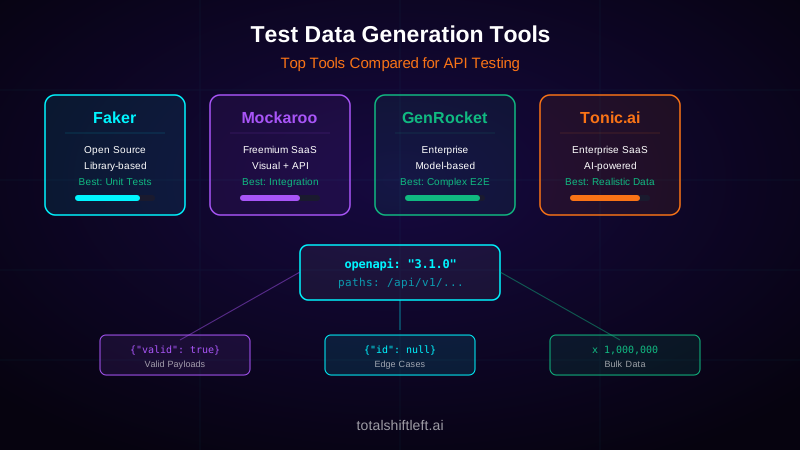
Most mature testing organizations use a combination: Faker embedded in unit tests, a platform like GenRocket or Tonic.ai for complex integration scenarios, and schema-driven tools for automated contract and smoke testing as part of their API testing strategy. Platforms that support connecting live data sources for generation go a step further, seeding tests from real databases and files rather than purely synthetic values.
Top Tools Compared
| Tool | Type | Languages | Schema Import | Relationship Modeling | Pricing | Best For |
|---|---|---|---|---|---|---|
| Faker | Library | Python, JS, Java, Ruby, Go, PHP | No (manual) | Manual coding | Free (OSS) | Unit/integration test data in code |
| Mockaroo | SaaS + API | Any (REST API) | JSON Schem |
a, SQL | Visual foreign keys | Free tier / $60+/mo | Visual design + API-driven generation | | GenRocket | Platform | Java, REST API | DB DDL, custom models | Full entity modeling | Enterprise pricing | Complex enterprise data with business rules | | Tonic.ai | SaaS | Any (API + DB connectors) | Production DB schemas | Automatic from schema | Enterprise pricing | Production-realistic synthetic data | | Synth | CLI | Any (JSON output) | JSON Schema | Declarative references | Free (OSS) | Schema-driven generation in pipelines | | Schemathesis | CLI + Library | Python | OpenAPI, GraphQL | N/A (payload focused) | Free (OSS) | Automated API fuzzing and property testing | | Gretel.ai | SaaS | Python SDK | CSV, DB | AI-learned relationships | Free tier / custom | AI-powered statistically accurate generation | | Snaplet | SaaS + CLI | Any (DB output) | PostgreSQL schemas | Automatic FK detection | Free (OSS Core) | PostgreSQL snapshot and transform | | SDV | Library | Python | Pandas DataFrames | Multi-table statistical | Free (OSS) | Statistical modeling for related tables | | DataProf | Platform | Any (DB + API) | DB DDL | Entity modeling | Enterprise pricing | Masking + generation with profiling |
Faker: Developer Favorite for In-Code Generation
Faker is the most widely used test data generation library, available in every major programming language. It generates realistic values for common data types — names, emails, addresses, phone numbers, dates, UUIDs — and supports custom providers for domain-specific data. Its strength is simplicity: import the library, call a function, get data. For API testing, developers use Faker to build request payload factories — functions that generate valid API payloads with randomized but realistic values.
Limitations: No built-in schema import (you map fields manually), no relationship modeling (you code FK relationships yourself), and no governance features. Faker is a building block, not a platform.
Mockaroo: Visual Design with API Backbone
Mockaroo provides a web interface for designing data schemas visually, then generating data via API, download, or direct database load. It supports 150+ data types, conditional logic, formula fields, and foreign key relationships. For API testing, Mockaroo's REST API allows pipelines to request generated data programmatically, and its schema import reduces setup time for teams with existing JSON Schema or SQL definitions.
Limitations: The free tier is limited to 1,000 rows per generation and 200 API calls per day. Complex business rules require formula expressions that can become difficult to maintain.
GenRocket: Enterprise-Grade Model-Based Generation
GenRocket is a full test data automation platform designed for enterprise environments. It uses a model-based approach where you define domains (entities), attributes (fields), relationships, and generation rules in a visual interface. The platform then generates data that satisfies all constraints — including complex business rules that span multiple entities. GenRocket integrates with CI/CD through its REST API and CLI.
Limitations: Enterprise pricing puts it out of reach for small teams. The learning curve is steeper than library-based tools. Best suited for organizations with dedicated test data engineering roles.
Tonic.ai: Production-Realistic Synthetic Data
Tonic.ai connects to production databases, learns data distributions and patterns, and generates synthetic data that is statistically identical to production while containing zero real records. For API testing, this means test data that exercises the same code paths and query patterns as real data. Tonic.ai also provides de-identification for teams that need masked production data.
Limitations: Requires production database access for initial profiling. Enterprise pricing. Best suited for teams that need production-realistic data for complex business logic testing.
Faker vs Hand-Crafted Seed Data: The Tradeoffs
Teams evaluating Faker inevitably ask whether generated data is actually better than a small, carefully hand-written fixture set. The honest answer is that each wins on a different axis:
Faker wins on volume and edge-case surface. Generating 500 randomized records surfaces encoding issues, unusual name formats, and boundary values a developer wouldn't think to hand-write. It's the right choice for negative testing, performance testing, and anywhere "many varied inputs" matters more than "these exact three scenarios."
Hand-crafted data wins on determinism and narrative clarity. A fixture named customerWithExpiredCard documents intent in a way faker.finance.creditCardNumber() never will, and it produces the same result on every run — no seed management required to reproduce a specific failure.
The practical rule most teams converge on: hand-write the 5-10 fixtures that represent named business scenarios your team discusses in standups ("the over-limit customer," "the order with a discontinued SKU"), and use Faker for everything else — bulk records, negative-path fuzzing, and load-test volume. Treat it as a spectrum, not a binary choice.
Test data generation in practice: a worked example
Problem: A logistics SaaS company tested their shipment tracking API with 200 hand-crafted JSON fixtures. When the API added 8 new fields for international customs data, updating all 200 fixtures took the QA team 3 days. Negative testing was minimal — only 12 of the 200 fixtures tested error paths. Performance testing used the same 200 records repeated, masking real performance bottlenecks.
Solution: The team implemented a three-tool strategy. Faker was embedded in unit test code with custom providers for shipment-specific data (tracking numbers, customs codes, carrier identifiers). Mockaroo's API was integrated into the CI/CD pipeline to generate 500-record datasets for integration tests, with schemas imported from the API's OpenAPI spec so updates propagated automatically. For performance testing, they used Synth with production-profiled distributions to generate 2 million unique shipment records that created realistic database access patterns.
Results: Test data creation time dropped from 3 days to zero for schema changes (automatic regeneration from spec). Negative test coverage increased from 6% to 43% of test cases through systematic boundary and invalid input generation. Performance test accuracy improved — they discovered a query plan degradation at 500K records that the previous 200-record tests never triggered. Total test maintenance effort decreased by approximately 60%.
Test data generation challenges and how to solve them
Generating Realistic Domain-Specific Data
Generic generators produce generic data. An address field gets a random US address, but your logistics app needs addresses in 40 countries with correct postal code formats, state/province structures, and character sets. Solution: Build custom Faker providers or Mockaroo custom types for your domain. Invest time upfront in domain-specific generators that the entire team reuses. For highly specialized domains (medical codes, financial instruments), evaluate whether Tonic.ai's production-profiling approach delivers better realism than rule-based generation.
Free PDF + code examples
OpenAPI to Test Generation Template Pack
Go from OpenAPI spec to full test coverage. Includes sample specs, example generated tests, edge case patterns, and CI/CD integration guides.
Download FreeMaintaining Consistency Across Microservices
In microservices architectures, the same customer entity appears in multiple service databases. Generated customer data must be consistent across all services — same ID, same name, matching foreign keys. Solution: Use a centralized generation orchestrator that creates shared entities first (customers, products) and distributes identifiers to service-specific generators. GenRocket's domain-based approach or custom orchestration scripts with Faker can achieve this.
Balancing Realism with Generation Speed
More realistic data (correct distributions, valid business rules, referential integrity) requires more complex generation logic, which slows generation. For CI/CD pipelines with time budgets, generation speed matters. Solution: Use tiered generation: fast, simple generation (Faker) for unit tests that run in seconds, moderate-complexity generation (Mockaroo) for integration tests with minute-level budgets, and full-complexity generation (GenRocket, Tonic.ai) for nightly performance test runs with hour-level budgets.
Handling Stateful API Sequences
Many API tests require sequential operations — create a customer, then create an order referencing that customer, then update the order, then query the order status. Generated data must flow through these sequences correctly. Solution: Use request chaining in your test framework where the response from one API call (e.g., the created customer ID) feeds into the next request's generated payload. Faker's seed mechanism ensures the surrounding data is deterministic while dynamic IDs flow through naturally.
Schema Evolution and Backward Compatibility
When your API adds new required fields, existing generated data becomes invalid. When your API deprecates fields, generators may produce data with unnecessary fields. Solution: Drive generation from the current OpenAPI spec (Synth, Mockaroo schema import). Run generation as a CI pipeline step that regenerates data from the latest spec on every build. Flag generation failures caused by spec changes as explicit build failures.
Evaluating Tools Without Long Trials
Enterprise tools (GenRocket, Tonic.ai) require significant setup before you can evaluate their fit. Open-source tools (Faker, Synth) are easy to try but may not reveal limitations until you scale. Solution: Run a structured evaluation: define 5 representative test scenarios (simple CRUD, complex relationship, negative testing, bulk generation, cross-service consistency). Evaluate each tool against all 5 scenarios within a 2-week timebox. This reveals tool limitations faster than an open-ended trial.
Test data generation best practices
- Start with schema-driven generation. Point your generation tool at your OpenAPI spec or database DDL. Automatic generation from specs eliminates manual field mapping and adapts automatically to schema changes.
- Layer tools by test type. Use Faker in unit tests for speed, Mockaroo or Synth in integration tests for schema-driven coverage, and GenRocket or Tonic.ai in E2E tests for complex scenarios. No single tool is optimal for all test types.
- Build domain-specific providers. Invest in custom generators for your industry — logistics codes, financial instruments, healthcare identifiers, telecom plans. Generic data produces generic tests.
- Generate negative data systematically. Do not rely on manual edge case creation. Use tools that generate boundary values, null inputs, type mismatches, and format violations automatically for every field.
- Seed everything. Use deterministic seeds for all random generation. Every test run should produce identical data given the same seed, ensuring test reproducibility and debuggability.
- Integrate generation into CI/CD. Generation should be a pipeline step, not a manual pre-test activity. When the pipeline runs, data generates automatically from current schemas.
- Profile production for realism. Use production data profiling (without extracting actual records) to capture distributions and patterns. Configure generators to match these profiles for realistic performance testing.
- Version generation configurations. Store Faker scripts, Mockaroo schemas, Synth configurations, and GenRocket models in version control. Changes to generation config should be code-reviewed like application code.
- Monitor generation quality. Validate generated data against schema constraints after generation. Catch generation bugs before they cause test failures.
- Document your data strategy. For each test suite, document which tool generates its data, what schemas drive it, and how to regenerate. New team members should be able to understand the test data management approach quickly.
Selection Checklist
- ✔ Identify your test types and their data requirements (volume, complexity, realism)
- ✔ Map each test type to a generation approach (library, platform, schema-driven)
- ✔ Evaluate schema import capabilities against your API specification format
- ✔ Test relationship modeling with your most complex multi-entity scenario
- ✔ Verify deterministic output with seed-based generation for CI/CD reproducibility
- ✔ Assess negative/boundary generation for comprehensive API robustness testing
- ✔ Confirm CI/CD integration through API, CLI, or language bindings
- ✔ Benchmark generation throughput for your performance testing volume requirements
- ✔ Evaluate governance features if operating in a regulated enterprise environment
- ✔ Compare total cost of ownership including licensing, setup, and ongoing maintenance
- ✔ Run 5 representative test scenarios through each candidate tool
- ✔ Validate team adoption feasibility — developer experience and learning curve
- ✔ Plan for multi-tool strategy mapping different tools to different test layers
See also: validation errors in our learn hub for the underlying concept.
The three generation approaches, in code
Library generators like Faker give you full control and run inside the test process — the right default when the data has to satisfy business rules the schema does not express:
from faker import Faker
fake = Faker(); Faker.seed(20260819)          # deterministic across machines

def order(customer_tier="pro"):
    return {
        "sku":   fake.bothify("??-####").upper(),
        "qty":   fake.random_int(1, 50),
        "buyer": {"name": fake.name(), "email": fake.unique.email(domain="example.test")},
        "notes": fake.sentence(nb_words=8),
        # a business rule no schema captures: pro accounts never order below MOQ
        "minimum": 10 if customer_tier == "pro" else 1,
    }
Schema-driven generators take the shape straight from the contract, so they never drift; and CLI generators produce bulk volume for load tests without any code at all:
// schema-driven: valid by construction, regenerates when the spec changes
import jsf from 'json-schema-faker';
import yaml from 'js-yaml';
import { readFileSync } from 'node:fs';

jsf.option({ alwaysFakeOptionals: true, useExamplesValue: true });
const spec = yaml.load(readFileSync('openapi.yaml', 'utf8'));
const order = jsf.generate(spec.components.schemas.Order);
console.log(JSON.stringify(order, null, 2));

// bulk volume for a load test, no code:
//   npx faker-cli --count 100000 --template '{"sku":"{{string.alpha}}","qty":{{number.int}}}' > seed.ndjson
Test data generation FAQ
What are the best test data generation tools for API testing?
The best test data generation tools for API testing are Faker (open-source libraries for Python, JavaScript, Java), Mockaroo (visual SaaS with API access), GenRocket (enterprise model-based generation), Tonic.ai (production-schema synthetic data), and Synth (open-source schema-driven CLI). The best choice depends on your scale, budget, and complexity requirements.
How do test data generation tools work with API testing?
Test data generation tools create realistic request payloads, database seed data, and mock response data for API tests. They read API schemas (OpenAPI/Swagger specs) to generate valid payloads automatically, produce edge case inputs for negative testing, and create large data sets for performance testing — all without manual data crafting.
Should I use open-source or commercial test data generation tools?
Use open-source tools (Faker, Synth) when you need developer-embedded generation for unit and integration tests, have simple data relationships, and want zero licensing cost. Use commercial tools (GenRocket, Tonic.ai, Mockaroo Pro) when you need complex multi-entity generation, production-data-driven profiles, enterprise governance, and dedicated support.
Can test data generation tools read OpenAPI specs?
Yes, several tools generate test data directly from OpenAPI specifications. Synth can import JSON Schema definitions. Mockaroo supports schema import. Many CI/CD-integrated tools like Shift-Left API read OpenAPI specs to automatically generate valid and invalid request payloads for comprehensive API testing.
How do you choose the right test data generation tool?
Choose based on five criteria: data complexity (simple fields vs. multi-entity relationships), integration needs (embedded in test code vs. standalone platform), scale (hundreds vs. millions of records), compliance requirements (governance, audit trails, masking), and budget (open-source vs. enterprise licensing). Most teams use a combination of tools for different testing layers.
Sources and further reading
- Faker (Python) — locale-aware fake data generation.
- Faker.js — the JavaScript equivalent for generated test data.
- json-schema-faker — generates payloads directly from a JSON Schema.
Key takeaways
- The test data generation tools landscape in 2026 offers options for every team size, budget, and complexity level.
- The key insight is that no single tool handles all API testing scenarios optimally.
- The most effective approach layers tools by test type: lightweight libraries (Faker) embedded in unit test code, schema-driven generators (Synth, Mockaroo) for integration and contract tests, and enterprise platforms (GenRocket, Tonic.ai) for complex E2E and performance scenarios.
- Start with the tool that addresses your current pain point. If manual payload creation is your bottleneck, embed Faker into your test code this week — the immediate productivity gain is significant.
- If schema changes are breaking your tests, adopt schema-driven generation from your OpenAPI spec.
- If performance test realism is the concern, evaluate Tonic.ai or production-profiled Synth configurations.
Then expand systematically. Build domain-specific providers, integrate generation into your CI/CD pipeline, and establish generation configurations as version-controlled artifacts. Over time, your test data generation strategy becomes an automated, governed component of your test data management practice — generating exactly the right data, at the right time, for every test in your pipeline.
Ready to generate API tests automatically from your OpenAPI specs? Start your free trial of Shift-Left API and see how AI-powered test generation creates comprehensive test suites with intelligent data in minutes.
Related: Test Data Management Complete Guide | Synthetic Test Data vs Production Data | Best Practices for TDM | Data Masking for Testing | REST API Testing Best Practices | API Testing Strategy for Microservices
Ready to shift left with your API testing?
Try our no-code API test automation platform free.