
Synthetic Test Data vs Production Data: When to Use Each (2026)
Quick answer
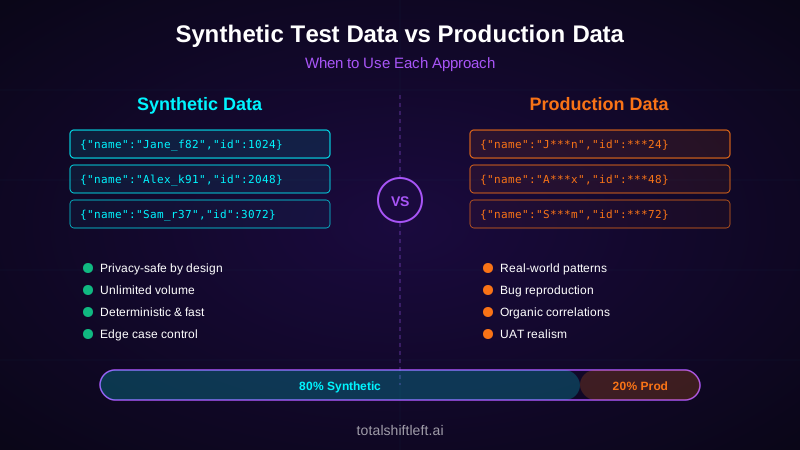
Synthetic test data should be the default for unit, integration, API, and performance tests because it is privacy-safe by construction, deterministic, and provisions in seconds instead of hours. Masked production data is better reserved for regression testing, UAT, and reproducing specific production bugs. Most teams land on an 80/20 hybrid — synthetic for most tests, masked production data for the remaining edge cases synthesis can't anticipate.
Reviewed by Sushant Joshi
Synthetic test data is artificially generated data that mimics the structure, format, and statistical properties of real production data without containing any actual customer information. It is created programmatically, is privacy-compliant by design, and provides unlimited volume and full control over test scenarios.
The debate between synthetic test data and production data for testing is one of the most consequential decisions in modern test data management. A 2025 Gartner report found that 60% of organizations will use synthetic data for testing by 2026, up from 10% in 2022. Yet many teams still default to cloning production databases — creating privacy risks, environment bottlenecks, and data that is simultaneously too large and not targeted enough for effective testing.
Every test consumes data. The question is where that data comes from — and the answer has implications for test speed, reliability, privacy compliance, and maintenance cost that compound across thousands of test runs.
Production data offers realism. It contains the actual patterns, edge cases, and data distributions that your application encounters in the real world. But it also contains personally identifiable information (PII), requires significant storage and provisioning time, and creates dependencies on production infrastructure that slow down testing.
Synthetic test data offers control. You can generate exactly the scenarios you need, at any volume, with zero privacy risk. But poorly generated synthetic data lacks realism — it may not exercise the code paths that real data triggers, missing bugs that only manifest with production-like patterns.
The right answer for most teams is not either-or. It is a deliberate hybrid strategy where synthetic data handles the majority of test scenarios (unit tests, integration tests, CI/CD pipeline runs) and masked production data fills gaps where realism is non-negotiable (regression testing, UAT, production bug reproduction). This guide provides the framework for making that decision — scenario by scenario, test type by test type.
In this guide
- What Is Synthetic Test Data?
- Why the Data Source Decision Matters
- Key Characteristics Compared
- Synthetic Data Architecture
- Tools for Synthetic Data Generation
- Synthetic test data in practice: a worked example
- Synthetic test data challenges and how to solve them
- Synthetic test data best practices
- Decision Checklist
- Generate it, or mask it — the two options in code
- Synthetic test data FAQ
What Is Synthetic Test Data?
Synthetic test data is data generated programmatically to match the structure, format, constraints, and statistical properties of real data without deriving from any actual records. Unlike production data copies, synthetic data has never existed in a real system — it is created entirely from models, rules, or algorithms.
The spectrum of synthetic data ranges from simple to sophisticated. At the simplest level, a Faker library call generates a random name, email, and phone number. At the most sophisticated level, generative AI models trained on production data distributions produce synthetic records that are statistically indistinguishable from real data while containing zero actual customer information.
Between these extremes sit schema-driven generators that read your OpenAPI specification or database schema and produce valid data automatically, model-based generators like GenRocket that define entity relationships and business rules, and template-based generators like Mockaroo that allow visual data design with conditional logic. Wiring these generators in as pluggable test data sources lets each suite draw from whichever generator fits the scenario without rewriting the tests themselves.
The critical distinction is that synthetic data is privacy-safe by construction. Because no real person's information was ever input into the generation process, the output cannot contain PII regardless of how realistic it appears. This is fundamentally different from data masking, where real data is transformed — masking can fail or be reversed, but synthetic data has no real data to expose.
The generation step itself — Faker, json-schema-faker and schema-derived payloads — is covered in how to generate test data for API testing.
Why the Data Source Decision Matters
Privacy and Compliance Implications
Using production data in test environments — even internally — triggers regulatory obligations under GDPR, CCPA, HIPAA, and PCI-DSS. Each regulation requires specific controls: access logging, data minimization, right-to-deletion compliance, and breach notification procedures. Synthetic data eliminates these obligations entirely because no personal data is involved. Teams that default to synthetic data reduce their compliance surface area dramatically.
Test Reliability and Determinism
Production data changes constantly. A test that depends on a specific customer record will break if that record is modified in the next production snapshot. Synthetic data is deterministic — generated from seeds and rules, it produces identical output every time. This determinism is the foundation of reliable test automation in CI/CD pipelines where tests must produce consistent results across hundreds of daily runs.
Speed of Provisioning
Copying and loading a production database into a test environment can take hours. Generating synthetic data takes seconds. For teams running shift-left testing with fast feedback loops, provisioning speed directly impacts developer productivity. A developer who waits 2 hours for test data will skip tests. A developer who gets data in 10 seconds will test everything.
Edge Case Coverage
Production data contains whatever scenarios users have actually created. It often lacks important edge cases — maximum-length strings, Unicode characters, null values in optional fields, boundary dates, negative quantities. Synthetic data generators can be configured to produce these edge cases systematically, improving coverage beyond what production data naturally provides.
Key Characteristics Compared
Realism and Data Distribution
Production data wins on realism. It contains the organic patterns that emerge from real user behavior — the skewed distributions, the unexpected field combinations, the legacy data from five schema versions ago. Synthetic data approximates these patterns but can miss subtle correlations. The gap is closing: tools like Tonic.ai and Mostly AI generate synthetic data that passes statistical similarity tests, but for complex multi-entity relationships, production data remains more trustworthy.
Privacy and Compliance
Synthetic data wins decisively. It contains no real PII by construction, requires no masking or anonymization, and creates no regulatory obligations. Production data requires masking, access controls, audit trails, and compliance monitoring — all of which add cost and complexity. For teams in heavily regulated industries (healthcare, finance, government), synthetic data is often the only practical choice for widespread test environment use.
Volume and Scalability
Synthetic data can be generated at any volume — 100 records for a unit test or 100 million for a load test — in minutes. Production data volume is fixed and expensive to replicate. If your production database is 5TB, every test environment copy costs 5TB of storage. Synthetic data lets you right-size data volume for each test type, reducing infrastructure costs significantly.
Ready to shift left with your API testing?
Try our no-code API test automation platform free. Generate tests from OpenAPI, run in CI/CD, and scale quality.
Maintenance Overhead
Production data copies require ongoing maintenance: refreshing snapshots, re-running masking, updating when schemas change. Synthetic data generation scripts adapt automatically when driven from OpenAPI specs or database schemas — change the spec, and the generated data changes with it. However, custom generation rules (business logic constraints, realistic distributions) do require maintenance when business rules evolve.
Bug Reproduction
Production data is essential for reproducing bugs reported by real users. If a customer reports that their specific order combination causes a crash, you need that data (masked but structurally identical) to reproduce the issue. Synthetic data cannot reproduce bugs you have not already anticipated — it generates from rules, not from the chaotic reality of production usage.
Cost Analysis
Synthetic data has lower ongoing costs: no storage for large database copies, no compute for masking pipelines, no licensing for data virtualization platforms (for teams that only need generation). Production-based approaches incur storage costs (multiple copies of large databases), compute costs (masking and subsetting pipelines), and often tool licensing costs (Delphix, Informatica, Broadcom TDM). For enterprise-scale operations, the cost difference can reach six figures annually.
Synthetic Data Architecture
A production-grade synthetic data architecture consists of four layers that work together to deliver realistic, compliant test data on demand.
The schema layer reads data structure definitions from Op
enAPI specifications, database DDL, or Avro/Protobuf schemas. This ensures generated data always matches current field names, types, and constraints. When a developer adds a new field to an API, the generator automatically includes it.
The rules layer defines business logic constraints that go beyond schema validation. An order total must equal the sum of its line items. A shipping date must follow the order date. A customer's age must be consistent with their birth date. These rules are maintained alongside application code and reviewed as part of the normal development process.
The distribution layer captures statistical profiles from production data — without extracting actual records. It records that 62% of customers are in the US, average order value follows a log-normal distribution with mean $47, and 8% of orders contain more than 5 items. Generators use these profiles to produce statistically realistic data.
The provisioning layer exposes APIs that CI/CD pipelines and developer tools consume. A pipeline requests "100 customers with 500 orders across 3 product categories" and receives a complete, consistent data set loaded into a containerized database in seconds. This layer integrates with orchestration tools to set up multi-service test scenarios for microservices testing.
Tools for Synthetic Data Generation
| Tool | Type | Best For | Open Source |
|---|---|---|---|
| Faker (Python/JS/Java) | Library | Developer-driven unit/integration test data | Yes |
| Mockaroo | SaaS | Visual schema design with API access | Freemium |
| GenRocket | Platform | Enterprise model-based generation with complex relationships | No |
| Tonic.ai | SaaS | Statistically accurate synthetic data from production schemas | No |
| Mostly AI | SaaS | AI-powered synthetic data preserving statistical properties | No |
| Synth | CLI | Schema-driven synthetic data from JSON schema definitions | Yes |
| Snaplet | SaaS + OSS | PostgreSQL synthetic snapshots with transformation | Yes (Core) |
| Gretel.ai | SaaS | Privacy-safe synthetic data with differential privacy | Freemium |
| SDV (Synthetic Data Vault) | Library | Statistical modeling for multi-table synthetic generation | Yes |
| DataProf | Platform | Generation with profiling, masking, and discovery | No |
For API testing, Faker libraries integrated directly into test code provide the fastest path. For enterprise environments requiring governed, production-realistic data, Tonic.ai and GenRocket deliver the most sophisticated generation capabilities.
Synthetic test data in practice: a worked example
Problem: A healthcare SaaS company needed to test their patient management system with realistic data. HIPAA prohibited using any real patient data in development or staging environments. The team had been using a small set of hand-crafted fixtures — 50 patients with predictable data — that failed to catch bugs related to data diversity (Unicode names, extreme dates, complex medication histories, concurrent appointments).
Solution: The team implemented a two-tier synthetic data strategy. For unit and API integration tests, they embedded Faker into their test framework with custom providers for healthcare-specific data (ICD-10 codes, medication names, insurance plan structures). For end-to-end and performance tests, they deployed Tonic.ai connected to a statistical profile of production data (distributions only, no actual records) to generate 100,000-patient synthetic databases that matched production patterns in demographics, visit frequency, and diagnosis distribution.
Results: Test coverage for edge cases increased from 23% to 78% (measured by mutation testing). HIPAA compliance concerns were eliminated — auditors confirmed that no PHI existed in any non-production environment. Performance test realism improved significantly because synthetic data matched production volume and distribution patterns. Data provisioning time dropped from 4 hours (manual fixture updates) to 3 minutes (automated generation).
Synthetic test data challenges and how to solve them
Synthetic Data Lacks Complex Correlations
Real-world data has organic correlations that are difficult to model: customers in certain zip codes tend to buy specific products, orders placed on weekends have different patterns than weekday orders, and legacy accounts have data quirks from old system migrations. Solution: Use production data profiling to capture correlation matrices and conditional distributions. Configure generators to reproduce these correlations explicitly. Validate with statistical comparison tests (Kolmogorov-Smirnov, chi-squared) against production profiles.
Schema Drift Between Generation and Testing
Generated data that was valid yesterday may be invalid today if a schema migration added constraints. Solution: Drive generation from the same schema source that the application uses (OpenAPI spec, database migration files). Run generation as part of the CI pipeline so data is always generated against the current schema version.
Multi-Service Data Consistency
In microservices architectures, a test scenario may require coordinated data across 5 services with shared identifiers. A customer ID generated for the user service must match in the order service, payment service, and notification service. Solution: Use a centralized generation orchestrator that creates shared entities first, then distributes identifiers to service-specific generators. Maintain a shared ID registry during generation.
Performance Test Realism
Generating 10 million synthetic records is easy. Generating 10 million records that produce realistic query patterns, index usage, and cache behavior is hard. Solution: Profile production query patterns and hot spots. Configure generators to produce data that triggers the same access patterns — same cardinality distributions, same key ranges, same null frequencies.
Free PDF + code examples
OpenAPI to Test Generation Template Pack
Go from OpenAPI spec to full test coverage. Includes sample specs, example generated tests, edge case patterns, and CI/CD integration guides.
Download FreeOrganizational Resistance
Teams accustomed to production data copies may resist synthetic approaches, arguing it is "not real enough." Solution: Run parallel test suites — one with synthetic data, one with masked production data — and compare defect detection rates. In practice, synthetic data catches different bugs (edge cases) while production data catches others (real-world patterns). This evidence supports a hybrid approach that most teams accept.
Generator Maintenance Burden
As the application evolves, generation rules must be updated. Business logic changes, new entities are added, and relationships shift. Solution: Treat generation rules as code — version controlled, code-reviewed, and tested. Automate rule validation against schema changes in CI. Assign generation rule maintenance to the same team that owns the data model.
Synthetic test data best practices
- Default to synthetic for all new tests. Make synthetic data the standard choice. Require explicit justification for using production data — not the other way around.
- Profile production data to improve synthetic realism. Extract statistical distributions, field correlations, and value frequencies from production. Use these profiles to configure generators without ever exposing actual records.
- Use seed-based generation for determinism. Configure random seeds so the same generation run always produces identical data. This ensures test reproducibility and makes failures debuggable.
- Generate from schemas, not hard-coded rules. Drive generation from OpenAPI specs, database DDL, or Avro schemas. When the schema changes, generation adapts automatically.
- Build domain-specific generators. Extend base libraries with custom providers for your industry — healthcare codes, financial instruments, telecom plan structures. Generic generators produce generic data that misses domain-specific edge cases.
- Validate synthetic data quality automatically. Run validation suites that check generated data against schema constraints, business rules, and statistical similarity to production profiles.
- Right-size data volume for the test type. Unit tests need 10 records. Integration tests need 100. Performance tests need millions. Generate exactly what each scenario requires.
- Combine synthetic and masked data strategically. Use synthetic for the 80% of tests where privacy, speed, and edge case coverage matter most. Use masked production data for the 20% where real-world realism is essential.
- Version generation configurations. Store Faker scripts, Mockaroo schemas, and GenRocket models in version control alongside test code. Changes to generation rules should go through code review.
- Measure and compare defect detection rates. Track which data source catches which bugs. Use this data to optimize your hybrid strategy over time.
Decision Checklist
- ✔ Identify all test types in your pipeline (unit, integration, API, E2E, performance, UAT)
- ✔ Map each test type to its data realism requirements (low, medium, high)
- ✔ Classify all data fields by sensitivity (PII, PHI, PCI, non-sensitive)
- ✔ Default to synthetic data for unit, integration, API, and performance tests
- ✔ Reserve masked production data for UAT, regression, and production bug reproduction
- ✔ Select synthetic generation tools appropriate for your technology stack
- ✔ Profile production data distributions for synthetic generator configuration
- ✔ Implement seed-based generation for test determinism and reproducibility
- ✔ Build domain-specific data providers for industry-specific fields
- ✔ Integrate generation into CI/CD pipeline with schema-driven automation
- ✔ Validate synthetic data quality against schema constraints and business rules
- ✔ Compare defect detection rates between synthetic and production data approaches
- ✔ Document the data strategy decision for each test type with rationale
See also: validation errors in our learn hub for the underlying concept.
Generate it, or mask it — the two options in code
Synthetic data is generated from the schema, so it never contained anyone real and needs no legal review:
# synthetic: valid by construction, deterministic, no PII ever present
from faker import Faker
from jsonschema import validate
import yaml, json

fake = Faker(); Faker.seed(20260819)
schema = yaml.safe_load(open("openapi.yaml"))["components"]["schemas"]["Customer"]

def customer(tier="pro"):
    row = {
        "name":  fake.name(),
        "email": fake.unique.email(domain="example.test"),
        "phone": fake.numerify("+1-###-###-####"),
        "tier":  tier,
        "address": {"line1": fake.street_address(), "city": fake.city(),
                    "postcode": fake.postcode(), "country": "US"},
    }
    validate(row, schema)
    return row

print(json.dumps([customer() for _ in range(5)], indent=2))
A masked production copy keeps the distribution — the long tail of weird real values that synthetic generators smooth away — but only if the masking is deterministic, so joins survive:
-- masked copy: same shape and cardinality, no recoverable identity
CREATE OR REPLACE VIEW export.customers_masked AS
SELECT id,
       encode(hmac(email, current_setting('app.mask_key'), 'sha256'), 'hex')
         || '@example.test'                        AS email,
       'User ' || substr(md5(id::text), 1, 8)      AS full_name,
       date_trunc('year', date_of_birth)           AS date_of_birth,
       country_code, tier, created_at              -- preserved: tests depend on them
FROM public.customers;

-- the rule that decides between the two:
--   need realistic distribution and volume -> masked copy
--   need a specific edge case, or an environment with no PII at all -> synthetic
Synthetic test data FAQ
What is synthetic test data?
Synthetic test data is artificially generated data that mimics the structure, format, and statistical properties of real production data without containing any actual customer or user information. It is created programmatically using tools like Faker, Mockaroo, or GenRocket and is privacy-safe by design.
When should you use synthetic test data instead of production data?
Use synthetic test data for unit tests, integration tests, CI/CD pipeline runs, performance testing at scale, privacy-regulated environments, and any scenario where you need unlimited data volume or full control over edge cases. Synthetic data is the default choice for most testing scenarios.
When is production data better than synthetic data for testing?
Production data (properly masked) is better for regression testing against real-world patterns, validating complex business logic that depends on realistic data distributions, reproducing production bugs that only occur with specific data combinations, and user acceptance testing where stakeholders need to see realistic scenarios.
How do you ensure synthetic test data is realistic enough?
Ensure synthetic data realism by profiling production data to capture distributions, patterns, and constraints, then configuring generators to replicate those characteristics. Use schema-driven generation from OpenAPI specs or database DDL, validate with statistical comparison tests, and iterate based on test failure analysis.
Can synthetic data fully replace production data in testing?
Synthetic data can handle 80-90% of testing needs but cannot fully replace production data. Some scenarios require real-world data patterns that are difficult to synthesize — complex multi-entity relationships, legacy data quirks, and data distributions that evolved organically over years. A hybrid approach using synthetic data as the default with masked production data for specific scenarios is optimal.
Sources and further reading
- GDPR full text — the articles that constrain personal data in test systems.
- Faker (Python) — locale-aware fake data generation.
- json-schema-faker — generates payloads directly from a JSON Schema.
Key takeaways
- The synthetic data vs production data decision is not binary — it is a spectrum that should be calibrated for each test type and scenario in your pipeline.
- Synthetic test data should be your default because it is faster to provision, privacy-safe by construction, deterministic for CI/CD, and controllable for edge case coverage.
- Masked production data should supplement synthetic data where real-world realism is essential — regression testing, UAT, and production bug reproduction.
- The teams that get this right build a hybrid strategy: synthetic data generators for 80% of tests (unit, integration, API, performance) and masked production data for the remaining 20% (regression, UAT, specific bug reproduction).
- This approach delivers the speed and privacy of synthetic data while preserving the realism of production data where it matters most.
- Start by auditing your current test data sources. Identify which test types are using production data unnecessarily.
Migrate those to synthetic generation — starting with unit and API integration tests where Faker or Mockaroo can deliver immediate results with minimal setup.
Ready to accelerate your API testing with intelligent test data? Start your free trial of Shift-Left API and see how AI-powered test generation creates targeted test scenarios automatically.
Related: Test Data Management Complete Guide | Best Practices for Test Data Management | Test Data Generation Tools | Data Masking for Testing | REST API Testing Best Practices | Automated Testing in CI/CD
Ready to shift left with your API testing?
Try our no-code API test automation platform free.