
Test Data Management for Modern Applications (2026)
Quick answer
Test data management is the discipline of creating, masking, subsetting, versioning, and provisioning the data automated tests consume across the development lifecycle. The World Quality Report 2025 found 44% of testing delays trace back to inadequate test data — not slow execution. The fix combines synthetic generation as the default, deterministic masking for production copies, and automated per-run provisioning integrated into CI/CD.
Reviewed by Rishi Gaurav
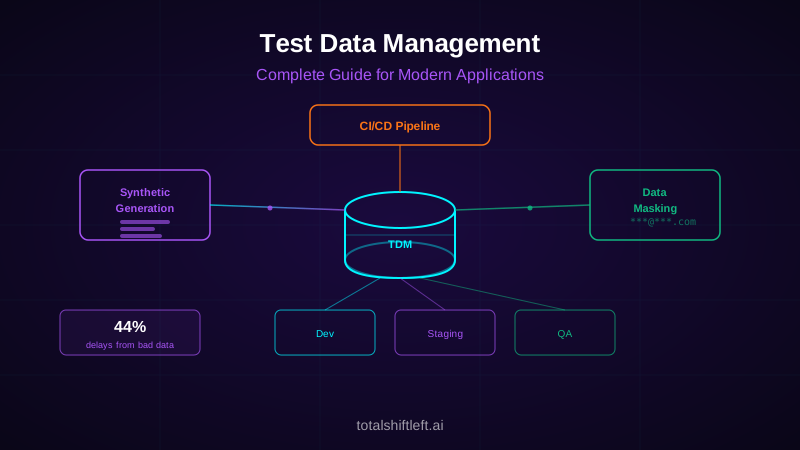
Test data management (TDM) is the discipline of creating, provisioning, maintaining, and governing data sets used during software testing. It encompasses synthetic data generation, production data masking, data subsetting, version control, and automated provisioning to ensure test environments have realistic, compliant, and repeatable data at every stage of the development lifecycle.
Test data management has become the silent bottleneck in modern software delivery. According to the World Quality Report 2025, 44% of testing delays are caused by inadequate test data — not by slow test execution or insufficient automation. Teams that have invested heavily in CI/CD pipeline automation and shift-left testing still find themselves waiting days for usable test data while their pipelines sit idle.
Modern applications are architecturally complex. A single user action on a fintech platform might traverse an API gateway, hit three microservices, query two databases, call an external payment processor, and publish events to a message queue. Testing that flow requires data in every one of those systems — coordinated, consistent, and realistic enough to exercise real business logic.
Most engineering teams solve this problem poorly. They clone production databases (creating privacy risks), maintain a single shared staging environment (creating contention and flaky tests), or hard-code test data in fixtures (creating brittle tests that break when schemas change). The result is predictable: slow test cycles, unreliable results, and a testing bottleneck that undermines every investment in automation.
This guide covers test data management comprehensively — from foundational concepts to architecture patterns, tools, and implementation strategies. Whether you are building a test automation framework from scratch or optimizing an existing pipeline, effective test data management is the multiplier that makes everything else work.
In this guide
- What Is Test Data Management?
- Why Test Data Management Matters
- Key Components of Test Data Management
- Test Data Management Architecture
- Tools for Test Data Management
- Test data management in practice: a worked example
- Test data management challenges and how to solve them
- Test data management best practices
- Test Data Management Checklist
- A test data lifecycle you can run in CI
- Test data management FAQ
What Is Test Data Management?
Test data management is the systematic approach to planning, creating, maintaining, and governing the data that software tests consume. It is not simply "creating test data" — it is a discipline that addresses the full lifecycle of test data from creation through retirement.
At its core, test data management answers five questions: What data do my tests need? Where does that data come from? How do I keep it realistic and current? How do I ensure it complies with privacy regulations? How do I provision it fast enough to not bottleneck my pipeline?
The scope of TDM extends across multiple domains. It includes synthetic data generation — creating realistic but entirely artificial data using tools like Faker, Mockaroo, or GenRocket. It includes data masking — transforming sensitive production data so it can be safely used in non-production environments. It includes data subsetting — extracting representative slices of production databases that preserve referential integrity while reducing volume. And it includes data provisioning — the automated delivery of the right data to the right environment at the right time, integrated into CI/CD workflows.
The distinction between test data management and ad hoc data creation is governance. TDM treats test data as an asset with defined ownership, version control, quality standards, and compliance requirements — not as a throwaway artifact that each developer creates independently.
The data layer under all of this has its own failure modes — database testing strategies for DevOps teams covers migrations, isolation and rollback.
The generation step itself — Faker, json-schema-faker and schema-derived payloads — is covered in how to generate test data for API testing.
Why Test Data Management Matters
Accelerating Test Execution Cycles
Test data preparation is frequently the longest phase in the testing workflow. Teams report spending 30-60% of their total testing time on data-related activities: creating data, loading data, verifying data correctness, and debugging data-related test failures. Automated test data provisioning eliminates this overhead by delivering pre-validated data sets on demand.
Enabling Reliable Test Automation
Flaky tests are the enemy of DevOps testing. A significant percentage of flaky tests trace back to data issues — shared mutable data, stale references, missing dependencies, or environment-specific data assumptions. Proper test data management provides isolated, deterministic data sets that eliminate data-related flakiness entirely.
Ensuring Privacy Compliance
GDPR, CCPA, HIPAA, and PCI-DSS all restrict how personal data can be used outside production. Teams that copy production databases into staging or QA environments without masking are exposed to regulatory penalties, audit findings, and reputational risk. TDM provides structured data masking workflows that maintain data utility while eliminating privacy exposure.
Supporting Microservices and API Testing
Microservices architectures multiply the test data challenge. Each service owns its data store, and testing cross-service flows requires coordinated data across multiple databases, message queues, and external dependencies. Effective TDM provides data orchestration capabilities that set up multi-service test scenarios in a single operation — a critical enabler for API testing strategies in microservices.
Key Components of Test Data Management
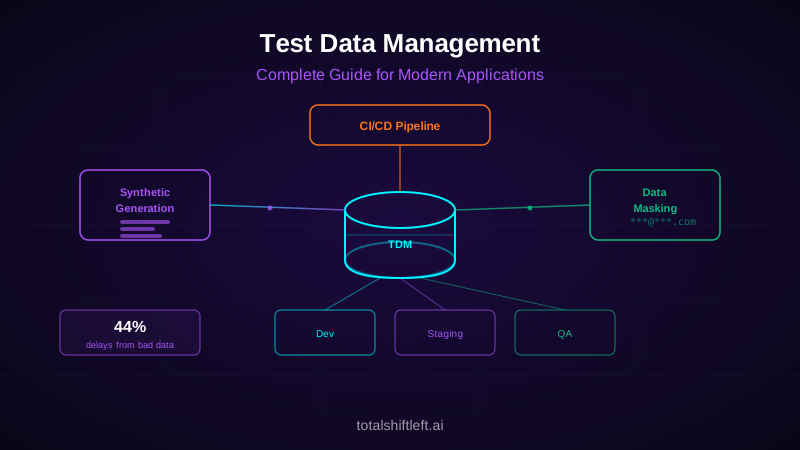
Synthetic Data Generation
Synthetic data generation creates realistic test data programmatically without using any real customer information. Generators produce data that matches production patterns — correct formats, realistic distributions, valid relationships — while being entirely artificial. This approach eliminates privacy concerns by design and provides unlimited data volume for load testing and performance testing scenarios.
Production Data Masking
Data masking transforms sensitive fields in production data copies so the data retains its statistical properties and referential integrity while becoming non-identifiable. Effective masking is deterministic (the same input always produces the same masked output), referentially consistent (masked foreign keys still match across tables), and format-preserving (a masked email still looks like an email).
Data Subsetting
Data subsetting extracts a representative slice of production data that is small enough for testing but comprehensive enough to cover important scenarios. Good subsetting preserves referential integrity — if you extract an order, you also extract its customer, line items, payments, and shipping records. This reduces storage costs and speeds up environment provisioning while maintaining data realism.
Ready to shift left with your API testing?
Try our no-code API test automation platform free. Generate tests from OpenAPI, run in CI/CD, and scale quality.
Data Provisioning and Orchestration
Data provisioning automates the delivery of test data to environments. In modern pipelines, this means APIs that CI/CD tools can call to create fresh data, containerized data stores (Dockerized databases pre-loaded with test data), and self-service portals where developers request specific data scenarios without filing tickets. Platforms that let tests pull values directly from connected data sources — databases, CSV files, or prior API responses — remove the separate provisioning step entirely for many scenarios.
Data Version Control
Test data evolves with the application. When a schema migration adds a new required column, all test data must be updated. Data version control tracks these changes, associates data versions with application versions, and enables rollback when tests need to run against older schemas.
Data Quality Monitoring
Data quality monitoring validates that test data meets defined standards — correct formats, valid ranges, complete relationships, and appropriate distributions. It catches data degradation before it causes test failures, reducing debugging time and improving test reliability.
Test Data Management Architecture
A well-designed test data management architecture operates as a service layer between test execution and data storage. At the center is a TDM platform that exposes provisioning APIs consumed by CI/CD pipelines, test frameworks, and developer tools.
The platform connects to three data sources: a synthetic data engine that generates data on demand from defined models, a masked data repository that contains anonymized production snapshots refreshed on a schedule, and a data subset library that offers pre-built slices for common testing scenarios.
Data flows through the architecture in a predictable pattern. A pipeline run triggers a provisioning request specifying the scenario (e.g., "e-commerce checkout with 3 items, applied coupon, and international shipping"). The TDM platform resolves this to specific data requirements, assembles the data from the appropriate sources, loads it into the target environment (a containerized database, a mock service, or a shared staging instance), and returns connection details to the test runner.
After test execution, the platform handles cleanup — resetting environments, archiving results data, and releasing resources. This full lifecycle automation is what transforms test data from a bottleneck into an enabler, especially for teams running automated testing in CI/CD pipelines.
Tools for Test Data Management
| Tool | Type | Best For | Open Source |
|---|---|---|---|
| Faker (Python/JS/Java) | Synthetic Generation | Unit/integration test data with realistic formats | Yes |
| Mockaroo | Synthetic Generation | Visual data design with API access and complex schemas | Freemium |
| GenRocket | Model-Based Generation | Enterprise test data automation with complex relationships | No |
| Delphix | Masking & Virtualization | Database virtualization and time-travel for large data sets | No |
| Informatica TDM | Masking & Subsetting | Enterprise data masking with regulatory compliance workflows | No |
| Broadcom Test Data Manager | Full TDM Suite | Mainframe-to-cloud test data with complex data lineage | No |
| Tonic.ai | Synthetic + Masking | Privacy-safe synthetic data from production schemas | No |
| Snaplet | Snapshot & Transform | PostgreSQL snapshot, subset, and transform workflows | Yes (Core) |
| DataProf | Masking & Generation | Data masking with built-in profiling and discovery | No |
| Test Data Bot | Generation | API-first test data generation for CI/CD pipelines | Yes |
The right tool depends on your constraints. Open-source generators like Faker work well for API testing at the unit and integration level. Enterprise tools like Delphix and Informatica address masking, subsetting, and compliance at scale. Most organizations use a combination — Faker for developer-driven test data and an enterprise tool for governed production-based data.
Test data management in practice: a worked example
Problem: A mid-size insurance company ran API tests against a shared staging environment. The environment contained a single production clone refreshed monthly. Four development teams shared the same data, constantly overwriting each other's test scenarios. Test results were unreliable — a test might pass at 9 AM and fail at 2 PM because another team modified the data it depended on. Privacy compliance was also a concern since the staging environment contained unmasked customer PII.
Solution: The team implemented a three-layer test data strategy. First, they deployed Delphix to create virtualized, masked copies of production data that could be provisioned in minutes rather than hours. Second, they used Faker to generate synthetic data for unit and API integration tests, eliminating the dependency on production data for most test types. Third, they built a provisioning API integrated with their Jenkins pipeline that created isolated data environments for each pipeline run and destroyed them after completion.
Results: Test data provisioning time dropped from 3 days to 12 minutes. Flaky test rate decreased by 74% (from 18% to under 5%) because each pipeline run had isolated data. Privacy compliance was achieved — no unmasked PII existed outside production. And developer satisfaction improved measurably because teams no longer competed for shared test environments.
Test data management challenges and how to solve them
Data Complexity in Microservices
Microservices architectures distribute data across dozens of independent stores. Creating consistent test data that spans multiple services requires understanding entity relationships that cross service boundaries. Solution: Build a centralized data model that maps cross-service entities and use orchestrated provisioning that creates coordinated data across all required services in a single operation.
Maintaining Referential Integrity in Masked Data
Masking individual fields is straightforward. Maintaining referential integrity across masked tables — where a masked customer ID in the orders table must match the same masked ID in the customers table — is significantly harder. Solution: Use deterministic masking algorithms that produce the same output for the same input, ensuring consistency across all tables and databases that reference the same entity.
Scaling Data Provisioning for CI/CD
A team running 50 pipeline builds per day needs 50 isolated data environments. Provisioning full database copies for each run is impractical. Solution: Use database virtualization (Delphix, Windocks) that creates thin clones sharing a common base image, or containerized databases (Docker) pre-loaded with scenario-specific data that spin up in seconds.
Data Freshness and Schema Drift
Test data created last month may not work with this month's schema. Migrations add columns, change types, or alter constraints. Stale test data causes cryptic failures that waste debugging time. Solution: Tie test data generation to schema versions. Run data validation as part of the migration pipeline — when the schema changes, test data is regenerated or updated automatically.
Handling External Dependencies
Tests that depend on third-party APIs (payment processors, identity providers, shipping calculators) need realistic response data. Solution: Combine service virtualization with test data management. Use tools like WireMock or Mountebank to simulate external services with response data generated from the same TDM platform that feeds your databases.
Free PDF + code examples
OpenAPI to Test Generation Template Pack
Go from OpenAPI spec to full test coverage. Includes sample specs, example generated tests, edge case patterns, and CI/CD integration guides.
Download FreeCompliance Across Jurisdictions
Different regions have different privacy rules. EU data requires GDPR compliance, US healthcare data requires HIPAA compliance, and payment data requires PCI-DSS. Solution: Implement policy-based masking where data classification tags drive the masking rules applied. A field tagged as "EU-PII" automatically receives GDPR-compliant masking regardless of which environment it flows into.
Test data management best practices
- Treat test data as code. Store data definitions, generation scripts, and masking rules in version control alongside application code. Data should go through the same review and CI processes as code.
- Automate provisioning end-to-end. No developer should file a ticket to get test data. Provisioning should be API-driven, self-service, and integrated into CI/CD pipelines.
- Use synthetic data as the default. Generate synthetic data for unit tests, integration tests, and most API tests. Reserve masked production data for scenarios that genuinely require production-level realism.
- Isolate test data per execution. Each pipeline run, each developer workspace, and each test suite should have its own data. Shared mutable test data is the primary cause of flaky tests.
- Mask production data before it leaves production. Never copy unmasked production data to non-production environments. Implement masking as an automated step in any production-to-lower-environment data flow.
- Version your data alongside your schema. When a migration changes the schema, update the test data definitions in the same commit. This prevents schema drift from causing test failures.
- Monitor data quality continuously. Run automated validation checks on test data stores to detect corruption, staleness, or drift before it impacts tests.
- Build scenario libraries. Create reusable, named data scenarios ("new customer checkout," "returning customer with loyalty points," "international order with customs") that teams can provision by reference.
- Design for data cleanup. Every provisioning operation should have a corresponding cleanup operation. Use database transactions, containerized environments, or automated teardown scripts.
- Measure data provisioning time. Track how long it takes to provision test data and treat it as a key pipeline metric. If data provisioning is the longest step, it deserves optimization investment.
- Align data with test types. Unit tests need minimal, focused data. Integration tests need multi-entity relationship data. Performance tests need production-scale volume. Match your data strategy to each test type.
Test Data Management Checklist
- ✔ Inventory all data stores, schemas, and entity relationships used in testing
- ✔ Classify data fields by sensitivity (PII, PHI, PCI, non-sensitive)
- ✔ Implement deterministic masking for all sensitive fields with referential integrity preserved
- ✔ Set up synthetic data generation for unit and integration test scenarios
- ✔ Build a self-service provisioning API consumable by CI/CD pipelines
- ✔ Create isolated data environments for each pipeline run (no shared mutable data)
- ✔ Version test data definitions alongside application code and schema migrations
- ✔ Implement automated data quality validation on all test data stores
- ✔ Build reusable scenario libraries covering common business workflows
- ✔ Configure automated cleanup and environment teardown after test execution
- ✔ Establish data refresh schedules for masked production data repositories
- ✔ Document data lineage — know where every test data set originates
- ✔ Monitor data provisioning time as a pipeline performance metric
- ✔ Validate compliance posture with regular audits of non-production data stores
See also: validation errors in our learn hub for the underlying concept.
A test data lifecycle you can run in CI
Test data management is four operations — provision, seed, use, reset. Automating all four is what stops environments from drifting into "nobody knows what is in there":
# .github/workflows/api-tests.yml
jobs:
  test:
    runs-on: ubuntu-latest
    services:
      postgres:                                   # 1. provision — disposable, per run
        image: postgres:16-alpine
        env: { POSTGRES_PASSWORD: test }
        options: --health-cmd pg_isready --health-interval 5s
    env:
      DATABASE_URL: postgresql://postgres:test@localhost/postgres
    steps:
      - uses: actions/checkout@v4
      - run: alembic upgrade head                 # 2. schema
      - run: python scripts/seed.py --profile ci --seed 20260819   # 3. deterministic data
      - run: pytest tests/api                     # 4. use
      # no teardown needed — the service container dies with the job
For the shared lower environments that cannot be disposable, make the reset explicit and scheduled, and verify it afterwards rather than assuming it worked:
#!/usr/bin/env bash
# refresh-staging.sh — runs nightly
set -euo pipefail
psql "$STAGING_DSN" -c 'DROP SCHEMA public CASCADE; CREATE SCHEMA public;'
alembic -x url="$STAGING_DSN" upgrade head
psql "$STAGING_DSN" -f seeds/reference-data.sql
python scripts/seed.py --dsn "$STAGING_DSN" --profile staging --seed "$(date +%Y%m%d)"
pytest tests/test_masking.py --dsn "$STAGING_DSN"   # prove no real PII landed
Test data management FAQ
What is test data management?
Test data management is the practice of planning, creating, maintaining, and governing the data used during software testing. It includes synthetic data generation, production data masking, data subsetting, version control, and automated provisioning to ensure tests have realistic, compliant, and repeatable data sets.
Why is test data management important for modern applications?
Modern applications use microservices, APIs, and CI/CD pipelines that require hundreds of test runs daily. Without proper test data management, teams face flaky tests from stale data, privacy violations from unmasked production data, environment bottlenecks from shared data sets, and slow test cycles from manual data preparation.
What are the main approaches to test data management?
The three main approaches are synthetic data generation (creating realistic fake data programmatically), production data masking (anonymizing real data for safe testing use), and data subsetting (extracting representative slices of production databases). Most teams use a combination of all three approaches.
How does test data management fit into CI/CD pipelines?
Test data management integrates into CI/CD pipelines through automated provisioning APIs that create fresh data sets for each pipeline run, containerized data stores pre-loaded with test data, and self-service data reset mechanisms that restore test environments between runs without manual intervention.
What tools are used for test data management?
Common test data management tools include Delphix and Informatica for enterprise data masking and subsetting, Faker and Mockaroo for synthetic data generation, GenRocket for model-based test data automation, Broadcom Test Data Manager for mainframe-to-cloud environments, and Tonic.ai for privacy-safe synthetic data.
Sources and further reading
- Faker (Python) — locale-aware fake data generation.
- GDPR full text — the articles that constrain personal data in test systems.
- json-schema-faker — generates payloads directly from a JSON Schema.
Key takeaways
- Test data management is the infrastructure layer that determines whether your test automation investment delivers returns or generates frustration.
- Teams that treat test data as an afterthought — sharing staging environments, cloning unmasked production databases, hard-coding fixtures — will always struggle with flaky tests, slow cycles, and compliance exposure regardless of how sophisticated their test frameworks are.
- The path forward is systematic: generate synthetic data by default, mask production data when realism is required, automate provisioning into your CI/CD pipeline, isolate data per execution, and govern everything with version control and quality monitoring.
- Start with the highest-impact change for your team. If flaky tests are your primary pain point, implement data isolation.
- If compliance is the concern, deploy masking. If provisioning speed is the bottleneck, automate with APIs and containers.
- Then expand systematically until test data management is a fully integrated, fully automated part of your development lifecycle.
Ready to automate your API testing with intelligent test data generation? Start your free trial of Shift-Left API and experience how AI-powered test generation eliminates manual data setup.
Related: API Testing Complete Guide | Synthetic Test Data vs Production Data | Best Practices for Test Data Management | Test Data Generation Tools | Data Masking for Testing | DevOps Testing Best Practices
Ready to shift left with your API testing?
Try our no-code API test automation platform free.