
Shift-Left Testing for Microservices: Complete Architecture Guide (2026)
Shift-left testing for microservices replaces slow, flaky end-to-end suites with fast per-service API tests, consumer-driven contracts, and AI-generated coverage that runs on every pull request. The result: faster feedback, cleaner releases, and a fraction of the maintenance burden of a traditional E2E-heavy strategy.
This guide walks through the 2026 reference architecture: where each test type belongs, how contracts move between services, which tools fit where, and how to operate the whole stack in CI/CD without grinding delivery to a halt.
Table of Contents
- Why E2E-heavy testing fails in microservices
- What is shift-left testing for microservices?
- The microservices testing pyramid
- Consumer-driven contract testing
- Per-service API test generation
- Test data isolation across services
- CI/CD architecture for microservices shift-left
- Tools and platforms
- Real implementation example
- Common challenges
- Best practices
- Checklist
- FAQ
- Conclusion
Why E2E-heavy testing fails in microservices
The dominant testing strategy of the monolith era — a large suite of end-to-end tests that exercise the whole system — falls apart in microservices for three reasons.
Combinatorial complexity. A system of 50 microservices has hundreds of interaction paths. Trying to cover them with E2E tests produces a suite that takes hours to run, blocks deployments, and accumulates flakiness faster than the team can debug it.
Diagnostic ambiguity. When an E2E test fails in a 12-service flow, the bug could be in any of those services. Diagnosis takes hours. Developers learn to ignore E2E failures, which corrodes the entire testing culture.
Pace mismatch. Microservices are deployed independently and frequently — sometimes dozens of times per day per service. A monolithic E2E suite cannot keep up with that cadence. Either it bottlenecks deployments or it gets skipped.
The shift-left answer is to push validation into each service. Most defects are caught by the service's own API and contract tests, before any cross-service interaction is exercised. A small, curated E2E layer still exists to catch true cross-service issues, but it's a minority of the testing investment, not the majority.
For the broader pattern, see our shift-left API testing pillar and the deeper API testing strategy for microservices guide.
What is shift-left testing for microservices?
Shift-left testing for microservices means validating each service as early and as locally as possible, then verifying cross-service contracts at the API boundary rather than through full integration. Concretely:
- At commit: unit tests and per-service API tests run in seconds
- At pull request: AI-generated functional and negative API tests cover the changed endpoints
- At pull request: consumer-driven contract tests verify the service against all consumer expectations
- At merge: a small E2E happy-path suite runs against an ephemeral environment
- At deploy: smoke tests and progressive rollouts replace heavyweight integration testing
This pattern collapses the traditional "integration testing phase" into seconds-per-PR rather than hours-per-release. It is what makes continuous deployment at microservice scale viable.
The microservices testing pyramid
A useful 2026 update to the classic Cohn testing pyramid for microservices looks like this:
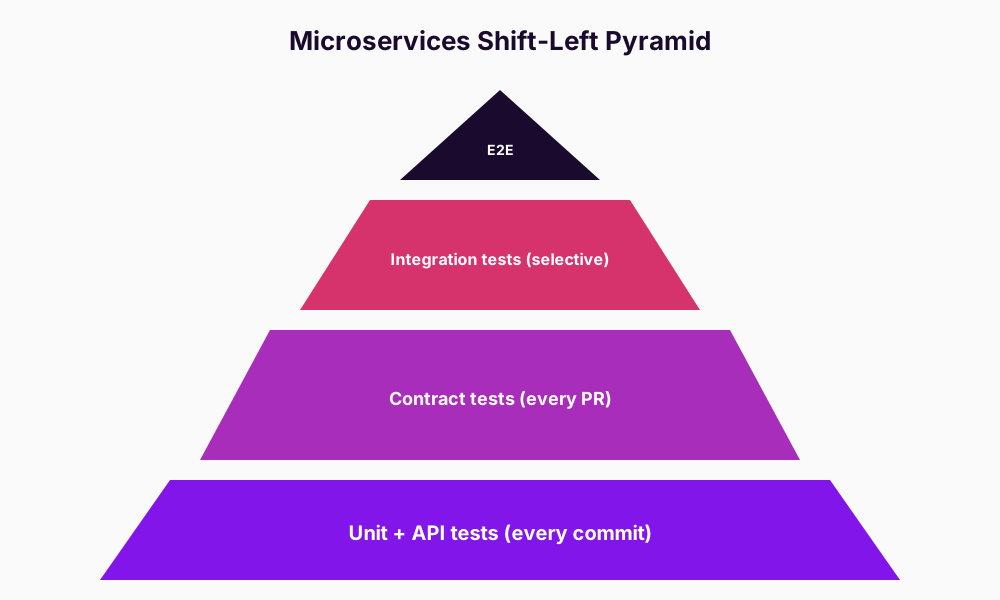
Base — unit and API tests, every commit. Fast, isolated, exhaustive. AI-generated API tests dramatically expand the base layer without ballooning maintenance cost.
Lower middle — contract tests, every pull request. Consumer-driven contracts between every pair of services that talk to each other. Catches breaking changes the moment they happen.
Upper middle — selective integration tests. A small number of tests exercise specific multi-service scenarios that contracts alone can't verify (e.g., distributed transactions, ordering invariants).
Tip — end-to-end happy paths. A handful of curated user-journey tests run against an ephemeral environment as a final smoke gate.
Most teams over-invest in the upper layers and under-invest in the base. Flipping that ratio is the single biggest leverage move in microservices shift-left.
Consumer-driven contract testing
Consumer-driven contract testing is the connective tissue of microservices shift-left. Each consumer service declares — in code, version-controlled — what it actually uses from each provider. The provider then verifies against all consumer contracts on every PR. If a provider change breaks a consumer expectation, the provider's PR fails before merge.
Ready to shift left with your API testing?
Try our no-code API test automation platform free. Generate tests from OpenAPI, run in CI/CD, and scale quality.
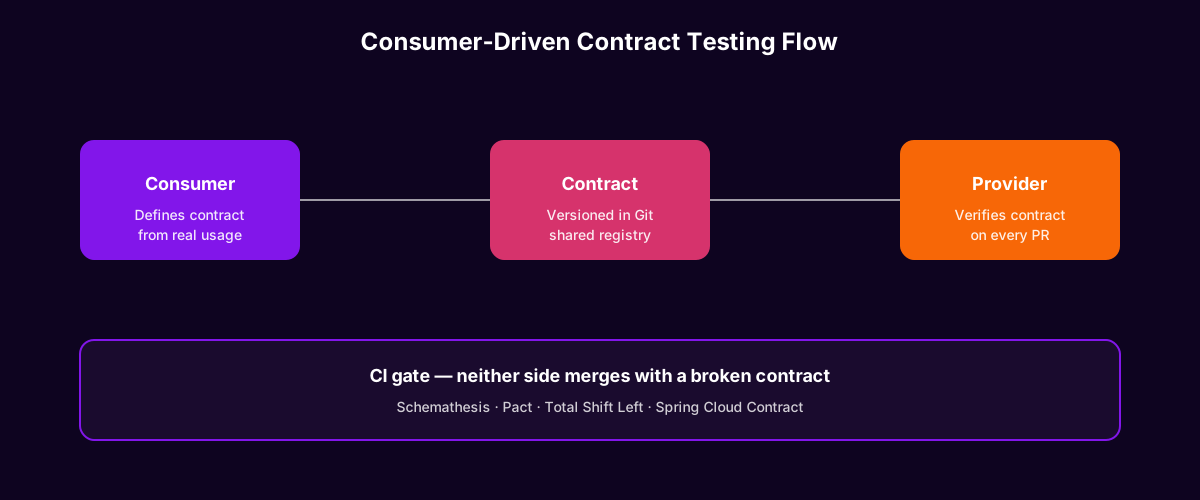
The mechanics:
- Consumer writes a test that uses a mock provider. The test's expectations are captured as a contract.
- The contract is published to a shared broker (Pact Broker, a Git repo, or a registry like Total Shift Left's contract registry).
- The provider's CI verifies against every contract on every PR. If verification fails, the PR is blocked.
- The contract is versioned alongside code. Backward-compatibility rules govern when a contract change is allowed.
This pattern eliminates the entire class of bugs that arise when a provider changes a response shape without the consumer noticing. See our deeper contract testing for microservices guide for implementation details with Pact and Spring Cloud Contract.
Total Shift Left layers AI-generated contract conformance tests on top of consumer-driven contracts, catching cases where the contract itself is too permissive — a complementary safety net.
Per-service API test generation
Each service in a microservice estate has its own OpenAPI specification (or should — if it doesn't, that's the prerequisite). With the spec in hand, AI test generation can produce hundreds of functional, boundary, and negative tests per service in seconds.
The per-service pattern:
- Spec lives in the service's own repo
- AI generation runs as a CI step, producing a per-PR test suite
- Tests run against the service in isolation, with mocked dependencies
- Coverage report is attached to the PR
Wiring this per-service step into every pipeline is what native CI/CD integrations handle — the generate-and-run loop becomes a standard job in GitHub Actions, GitLab CI, or Jenkins for each service.
This is exactly the pattern Total Shift Left implements out of the box: ingest spec → generate tests → run in CI → report. The cost-per-service is near-zero because everything is automated; what previously took weeks of test authoring takes minutes.
Test data isolation across services
Microservices test data is a hard problem because each service has its own datastore and tests need consistent shapes across service boundaries. The 2026 pattern combines three approaches:
- Per-service synthetic data generated from each service's OpenAPI spec
- Shared contract fixtures that define the cross-service shapes consumers expect
- Per-PR ephemeral environments that spin up isolated database instances per service
See Test Data Management Best Practices for API Testing for the deeper pattern, and Managing test data in microservices for service-mesh-specific guidance.
CI/CD architecture for microservices shift-left
A reference CI/CD pipeline per microservice runs five stages on every PR:
- Build + unit tests (seconds)
- Per-service API tests against mocked dependencies (seconds to a minute)
- Consumer-driven contract verification (seconds)
- AI-generated negative and security tests (a few minutes)
- Optional E2E smoke on an ephemeral environment for changes that cross service boundaries
Cross-service E2E is a separate, less frequent pipeline — typically running on merge to main, against an ephemeral environment built with tools like Kubernetes preview environments, Telepresence, or Garden.io.
For per-platform pipeline templates, see our API testing in CI/CD guide and the integration pages for Jenkins, GitHub Actions, GitLab CI, and Azure DevOps.
Tools and platforms
| Layer | Tools |
|---|---|
| Unit testing | Jest, JUnit, pytest, Go test |
| Per-service API testing | Total Shift Left, Schemathesis, REST Assured |
| Consumer-driven contracts | Pact, Spring Cloud Contract, Total Shift Left contract registry |
| Service virtualization / mocks | WireMock, Prism, Total Shift Left mocks |
| Ephemeral environments | Garden, Telepresence, Tilt, Kubernetes preview |
| Observability for testing | OpenTelemetry, Jaeger |
For organizations standardizing on a single platform, Total Shift Left provides spec-driven API generation, contract registry, and mock servers in one tool — reducing the number of components to integrate and govern. For the broader landscape, see Best Shift Left Testing Tools and Best API Testing Tools for Enterprise QA Teams 2026.
Real implementation example: a B2B SaaS moving from E2E-heavy to shift-left
A B2B SaaS platform — call it Northpine — ran 48 microservices and a 2,200-test Cypress E2E suite. The suite took 4 hours, was 18% flaky on any given run, and blocked deployment 2-3 days per month. Engineering velocity was visibly suffering.
The migration took two quarters:
Q1: contract foundation. Pact contracts introduced between every pair of services. Initial contract authoring took 6 weeks. 380 contracts in place by end of quarter. E2E suite trimmed from 2,200 to 1,200 tests as contract coverage replaced redundant E2E paths.
Q2: AI-generated per-service tests. Total Shift Left rolled out to all 48 services. ~14,000 API tests auto-generated across the estate. Per-service CI pipelines now block merges on test failure. E2E suite trimmed to 220 happy-path tests.
Outcome at end of Q2:
- E2E suite runtime: 14 minutes (down from 4 hours)
- Flakiness: <2% (down from 18%)
- Mean time to deploy: 14 minutes from PR merge (down from 90 minutes)
- Production defect escape rate: down 47%
The key insight from Northpine: the E2E suite shrank not because E2E coverage was abandoned, but because most of what it was actually testing was per-service or pair-wise contract behavior that belonged at lower layers.
Common challenges
Challenge: services don't have OpenAPI specs. Solution: invest in specs first. They're the precondition for everything else and have value beyond testing (documentation, code generation, governance).
Challenge: contract test authoring feels slow. Solution: start with the highest-traffic consumer-provider pairs. Contract coverage doesn't need to be 100% on day one — partial coverage delivers most of the value.
Challenge: E2E tests still feel necessary. Solution: they are — just fewer. Curate a tiny set of happy-path E2E tests covering core user journeys. Resist the urge to add more.
Challenge: per-PR ephemeral environments are expensive. Solution: many teams over-engineer this. For most PR validation, mocks + contracts are sufficient. Reserve ephemeral environments for changes that touch service boundaries.
Challenge: teams own different services and don't agree on contracts. Solution: introduce a contract review process. Breaking changes require consumer signoff. This is process work, not tooling work.
Best practices
- Treat the OpenAPI spec as the source of truth for every service
- Generate per-service tests automatically; never hand-author what AI can generate
- Implement consumer-driven contracts for every cross-service interaction that matters
- Limit E2E tests to a small set of curated happy-path scenarios
- Run all of the above on every PR, not on a nightly schedule
- Use mocked dependencies for per-service tests; reserve real-service integration for the E2E layer
- Version contracts in Git; require consumer signoff for breaking changes
- Build ephemeral environment capability for changes that span services
Microservices shift-left checklist
- ✔ Every service has an OpenAPI specification in version control
- ✔ Per-service API tests run on every commit, in seconds
- ✔ Consumer-driven contracts cover all cross-service interactions
- ✔ Contract verification blocks provider PRs on breaking changes
- ✔ AI-generated functional + negative tests run on every PR
- ✔ E2E suite is small (under 5% of total test count) and stable (under 2% flakiness)
- ✔ Ephemeral environments available for cross-service changes
- ✔ Mean PR-to-deploy time under 30 minutes
See also: contract testing in our learn hub for the underlying concept.
Frequently asked questions
What does shift-left testing mean in a microservices architecture?
It means moving validation from end-to-end test suites that run after integration into per-service contract and API tests that run on every pull request. Each service is validated in isolation using mocks for its dependencies, and consumer-driven contracts catch breaking changes before they cross service boundaries.
Why is end-to-end testing problematic in microservices?
End-to-end tests across many microservices are slow, flaky, and expensive to maintain. A single failed test can be caused by a bug in any of dozens of services, debugging is hard, and feedback loops are too long for high-velocity teams. Shift-left replaces most E2E coverage with contract and isolated-service tests.
What's the role of consumer-driven contract testing?
Consumer-driven contract (CDC) testing lets each consumer declare what it actually expects from each provider. The provider then verifies against all consumer contracts on every PR. This catches breaking changes the moment they happen. Pact and Spring Cloud Contract are the dominant tools.
How do AI-generated API tests fit microservices?
AI-generated tests dramatically expand coverage per service without the maintenance cost of hand-written suites. Total Shift Left ingests each service's OpenAPI spec and generates hundreds of functional, contract, and negative tests automatically — running on every PR for that service.
Should I still have E2E tests?
Yes, but few of them. A small, curated set of E2E happy-path tests covers true cross-service integration. The bulk of coverage lives in unit tests, API tests, and contract tests at the per-service layer.
Conclusion
Shift-left testing is the operating model that lets microservices deliver on their original promise: independent, fast, safe service evolution. Get the per-service API tests, the consumer-driven contracts, and the small curated E2E suite in place, and your engineering velocity becomes a function of feature work rather than test debugging.
Start a free 15-day trial of Total Shift Left to generate per-service API tests from your OpenAPI specs. Or explore the comparison with Karate if your team prefers a code-first contract approach.
Related: Shift Left API Testing | API testing strategy for microservices | Contract testing for microservices | Microservices testing complete guide | Best API Testing Tools for Enterprise QA Teams 2026
Ready to shift left with your API testing?
Try our no-code API test automation platform free.