
Microservices Testing: Strategy, Types, Tools & Examples
Quick answer
Microservices testing has to validate three things that monolithic testing does not: contract compatibility between every consumer and producer, behaviour across asynchronous event boundaries, and reliability under partial-failure scenarios (timeouts, retries, circuit breakers). The 2026 baseline stack: Pact or Total Shift Left for contracts, chaos testing in a staging cluster, and observability-driven assertions on traces and metrics.
Reviewed by Smeet Gohel

Microservices testing is the discipline of validating individually deployable services, their inter-service communications, data consistency across distributed boundaries, and the resilience of the overall system under degraded conditions. It spans every layer from isolated unit tests within a single service to chaos experiments that break production-like environments on purpose.
The shift from monolithic applications to microservices architectures has reshaped how engineering teams build, deploy, and scale software. Netflix runs more than 1,000 microservices. Amazon deploys code every 11.7 seconds. Uber processes over 500 million events per second across hundreds of services. The benefits are real: independent deployments, technology diversity, organizational autonomy, and granular scaling.
But microservices also introduce a class of testing challenges that monoliths simply do not have. Network partitions, distributed transactions, service version skew, cascading failures, and data eventual consistency are now everyday realities. A 2025 DORA report found that organizations with mature microservices testing practices deploy 46x more frequently and recover from incidents 2,604x faster than those without.
This guide covers every dimension of microservices testing — from foundational strategies to advanced chaos engineering. Whether you are decomposing your first monolith, scaling an existing microservices platform, or building a greenfield distributed system, this pillar page provides the complete testing framework. If you are new to API testing, start there for the foundational concepts, then return here for the microservices-specific challenges.
In this guide
- What Is Microservices Testing?
- Why Microservices Testing Is Important
- Key Components of Microservices Testing
- Microservices Testing Architecture
- Shift-Left Testing for Microservices: Replacing Heavy E2E Suites
- Microservices Testing Tools Comparison
- Real-World Example: E-Commerce Platform Migration
- Common Challenges in Microservices Testing
- Best Practices for Microservices Testing
- Microservices Testing Checklist
- The layers, with the code for each
- Frequently asked questions about microservices testing
What Is Microservices Testing?
Microservices testing validates that each independently deployable service functions correctly in isolation and communicates reliably with every other service it depends on. Unlike monolith testing — where a single test suite covers the entire application — microservices testing must address multiple codebases, multiple databases, multiple deployment pipelines, and multiple runtime environments simultaneously.
The scope of microservices testing includes:
- Service-level correctness — Does each service handle its requests, apply its business logic, and return correct responses?
- Contract compliance — Do producers and consumers agree on API schemas, data types, field names, and error formats?
- Integration reliability — Do services communicate correctly over HTTP, gRPC, message queues, and event streams?
- Data consistency — Does data remain accurate across distributed databases using eventual consistency, sagas, or event sourcing?
- Resilience under failure — Does the system degrade gracefully when a service crashes, a network partition occurs, or a dependency times out?
- Deployment safety — Can each service deploy independently without breaking consumers that depend on the previous version?
The Microservices Testing Pyramid
The traditional testing pyramid (unit → integration → E2E) still applies, but microservices add layers. Each layer adds confidence but also adds cost, complexity, and execution time — the goal is to push as much validation as possible into the lower, faster layers, a principle at the core of shift-left testing:
| Layer | Validates | Speed | Runs | Typical Tools |
|---|---|---|---|---|
| 1. Unit | Business logic within a single service | Seconds | Every commit | JUnit, Jest, pytest |
| 2. Component | A service in isolation, with stubbed dependencies | Seconds | Every commit | Testcontainers, WireMock |
| 3. Contract | API agreement between consumer and producer | Seconds | Every pull request | Pact, Spring Cloud Contract |
| 4. Integration | Real service-to-service communication in a shared environment | Minutes | Merge to main / scheduled | Kubernetes staging, Total Shift Left |
| 5. End-to-end | Complete user workflows across the full distributed system | Minutes | Merge / pre-release | Playwright, Cypress |
| 6. Chaos | Resilience and fault tolerance under injected failure | Ongoing / scheduled | Recurring, production-like env | Chaos Monkey, Litmus, Gremlin |
Most teams over-invest in the top two layers (integration and E2E) and under-invest in the base. Flipping that ratio — heavy unit/component/contract coverage, a small curated E2E layer — is the single biggest leverage move in microservices testing strategy.
For services that speak gRPC rather than HTTP+JSON, the gRPC testing tools roundup covers grpcurl, ghz, the k6 gRPC module and the contract options.
Across service boundaries the problem changes shape — test data challenges in distributed systems covers consistency and setup across services.
Running the suite inside the cluster it is testing is covered in testing strategy for cloud-native applications.
If the service runs on Kubernetes, running the suite in-cluster removes a whole class of false confidence — see API testing in Kubernetes.
Why Microservices Testing Is Important
1. Independent Deployments Create Integration Risk
In a monolith, every component deploys together. You compile once, test once, and deploy once. In microservices, each service has its own deployment pipeline. Team A can deploy a breaking change to the User Service while Team B's Order Service still expects the old contract. Without contract tests verifying the interface agreement, this mismatch reaches production undetected.
2. Network Communication Is Inherently Unreliable
Monolith components communicate via in-process function calls that are effectively instantaneous and never fail due to network conditions. Microservices communicate over the network — HTTP, gRPC, AMQP, Kafka — where latency fluctuates, connections drop, packets get lost, and DNS resolution can stall. Testing must validate not just the happy path, but every degraded network scenario.
3. Distributed State Is Hard to Reason About
A monolith typically uses a single database with ACID transactions. Microservices each own their data store, and cross-service operations rely on eventual consistency, the saga pattern, or distributed transactions. Testing must verify that data converges correctly across boundaries, that compensating transactions execute when a step fails, and that read-your-own-writes semantics hold where expected.
4. Failure Blast Radius Expands Exponentially
When a monolith function throws an exception, the error is contained within that request. When a microservice fails, every upstream and downstream dependency is affected. A single slow database query in the Payment Service can back up the Order Service, which stalls the Cart Service, which degrades the entire user experience. Testing must simulate these cascade scenarios.
5. Observability Gaps Hide Bugs
In a monolith, a stack trace tells the entire story. In microservices, a single user request traverses five, ten, or twenty services. Without distributed tracing, correlating logs across services is nearly impossible. Microservices testing must validate that telemetry — traces, metrics, and logs — is correctly propagated so that when production issues occur, teams can diagnose them rapidly.
Key Components of Microservices Testing
Unit Testing Per Service
Each microservice is its own deployable unit, and unit tests validate the internal business logic without crossing any service boundary. In a Java service using Spring Boot, this means testing service classes, mappers, and validators with JUnit and Mockito. In a Node.js service, this means testing handlers and middleware with Jest. Unit tests should cover 80%+ of each service's codebase and execute in under 30 seconds.
Component Testing with Testcontainers
Component tests validate a single service end-to-end, including its database and local dependencies, but with all external services stubbed. Testcontainers has become the standard approach — it spins up real PostgreSQL, Redis, Kafka, or MongoDB instances in Docker containers for each test run. This eliminates the flakiness of shared test databases while keeping tests realistic.
Contract Testing with Pact and Spring Cloud Contract
Contract testing is arguably the most important layer specific to microservices. It solves the fundamental problem: how do you verify that independently deployed services still agree on their API interfaces? Contract testing for microservices operates in two phases:
- Consumer-driven contracts — The consuming service defines what it expects (fields, types, status codes) and publishes the contract to a broker.
- Provider verification — The producing service runs the consumer's contract against its actual implementation. If it fails, the provider knows it will break a consumer.
Pact is the most widely adopted tool for HTTP-based contract testing. Spring Cloud Contract is popular in the Java ecosystem. Both integrate with CI/CD pipelines so that contract violations block deployments before they reach production.
Integration Testing Across Service Boundaries
Integration tests verify that real services communicate correctly when deployed together. This typically runs in a staging environment or a Kubernetes namespace that mirrors production. Unlike contract tests (which use mocks), integration tests send real requests across real networks to real service instances. They are slower and more expensive but catch issues that contract tests cannot — such as serialization bugs, authentication middleware failures, and network timeout misconfigurations.
End-to-End Testing for Critical Paths
End-to-end tests validate complete user journeys that span multiple services. In an e-commerce platform, this might mean: user logs in (Auth Service) → browses products (Catalog Service) → adds to cart (Cart Service) → checks out (Order Service) → processes payment (Payment Service) → receives confirmation (Notification Service). Modeling these as chained, multi-step integration test workflows — where each step passes data to the next — keeps them maintainable. These tests are expensive and slow, so limit them to the top 5-10 critical business flows.
Chaos Testing and Fault Injection
Chaos testing goes beyond functional correctness to validate system resilience. It deliberately injects failures — service crashes, network partitions, CPU spikes, disk full conditions — into a production-like environment and observes whether the system recovers. Netflix's Chaos Monkey randomly terminates service instances. Gremlin provides controlled fault injection. Litmus operates natively in Kubernetes. Chaos testing answers the question that no other test type can: will our system survive when things go wrong?
Ready to shift left with your API testing?
Try our no-code API test automation platform free. Generate tests from OpenAPI, run in CI/CD, and scale quality.
Microservices Testing Architecture
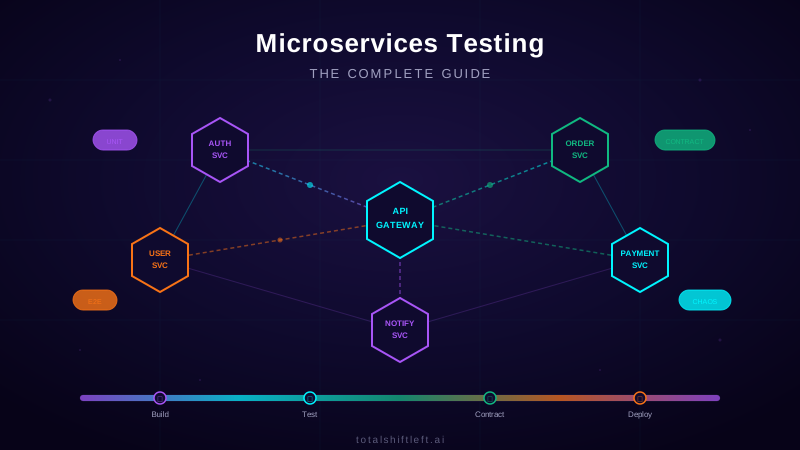
A robust microservices testing architecture follows the testing honeycomb model, which emphasizes integration tests at the center with unit tests and E2E tests at the edges. The architecture includes:
Per-Service Test Pipeline: Each microservice has its own CI/CD pipeline that runs unit tests, component tests, and contract tests independently. This pipeline must pass before the service can deploy. The pipeline uses Testcontainers for local dependencies and Pact Broker for contract management.
Shared Integration Environment: A Kubernetes-based staging environment runs the latest version of every service. Integration tests execute against this environment on a scheduled basis (typically every 30 minutes or after any service deploys). Tools like Argo CD or Flux manage the environment state.
Chaos Testing Environment: A dedicated environment (often a copy of production) runs continuous chaos experiments. Litmus or Gremlin inject failures on a schedule, and observability tooling (Grafana, Datadog, Jaeger) validates that alerting and recovery mechanisms work as expected.
Contract Broker: A centralized Pact Broker (or PactFlow for enterprise teams) stores all consumer contracts and provider verification results. The can-i-deploy tool checks whether a specific service version is compatible with all its consumers before allowing deployment.
Observability Stack: Distributed tracing (Jaeger or Zipkin), metrics (Prometheus), and logging (ELK or Loki) provide the telemetry foundation. Tests validate not only functional outcomes but also that traces propagate correctly, metrics emit expected values, and logs contain correlation IDs.
Shift-Left Testing for Microservices: Replacing Heavy E2E Suites
The dominant testing strategy of the monolith era — a large suite of end-to-end tests that exercise the whole system — falls apart in microservices for three reasons: combinatorial complexity (a 50-service system has hundreds of interaction paths; covering them with E2E tests produces a suite that takes hours and accumulates flakiness faster than it can be debugged), diagnostic ambiguity (when an E2E test fails in a 12-service flow, the bug could be in any of those services, and diagnosis takes hours), and pace mismatch (services deploy independently, sometimes dozens of times a day per service — a monolithic E2E suite cannot keep up, so it either bottlenecks deployments or gets skipped).
The shift-left answer is to push validation into each service: most defects are caught by a service's own API and contract tests, before any cross-service interaction is exercised. A reference CI/CD pipeline per microservice runs five stages on every pull request:
- Build + unit tests (seconds)
- Per-service API tests against mocked dependencies (seconds to a minute)
- Consumer-driven contract verification (seconds)
- AI-generated negative and security tests (a few minutes)
- Optional E2E smoke on an ephemeral environment, only for changes that cross service boundaries
Cross-service E2E becomes a separate, less-frequent pipeline — typically running on merge to main against an ephemeral environment (Kubernetes preview environments, Telepresence, Garden.io) — rather than the primary gate on every commit.
Proof point: a B2B SaaS platform running 48 microservices had a 2,200-test Cypress E2E suite that took 4 hours, was 18% flaky per run, and blocked deployment 2–3 days per month. Over two quarters they introduced Pact contracts between every service pair (380 contracts by end of quarter one) and rolled out AI-generated per-service API tests across all 48 services (~14,000 tests). The E2E suite shrank to 220 curated happy-path tests, runtime dropped from 4 hours to 14 minutes, flakiness fell from 18% to under 2%, and mean time to deploy dropped from 90 minutes to 14. The key insight: the E2E suite didn't shrink because coverage was abandoned — most of what it was testing was actually per-service or pairwise contract behavior that belonged at a lower, faster layer.
Microservices Testing Tools Comparison
| Tool | Category | Language Support | Best For | License |
|---|---|---|---|---|
| Pact | Contract Testing | Java, JS, Python, Go, Ruby, .NET | Consumer-driven contract testing across polyglot services | MIT |
| Spring Cloud Contract | Contract Testing | Java/Kotlin | Spring Boot microse |
rvices with Groovy or YAML contracts | Apache 2.0 | | Testcontainers | Component Testing | Java, JS, Python, Go, .NET, Rust | Spinning up real databases, queues, and caches in Docker for tests | Apache 2.0 | | WireMock | Service Virtualization | Java (standalone server for any language) | Stubbing external HTTP dependencies for isolated testing | Apache 2.0 | | k6 | Performance Testing | JavaScript | Load testing individual services and distributed workflows | AGPL-3.0 | | Chaos Monkey | Chaos Testing | Java | Randomly terminating instances in cloud environments | Apache 2.0 | | Litmus | Chaos Testing | Go (Kubernetes-native) | Kubernetes-native chaos experiments with CRDs | Apache 2.0 | | Gremlin | Chaos Testing | SaaS + agents | Enterprise fault injection with safety controls | Commercial | | Jaeger | Distributed Tracing | Go (multi-language clients) | Tracing requests across microservices boundaries | Apache 2.0 | | Total Shift Left | API Test Automation | No-code (any API) | AI-powered API testing with auto-generated tests and CI/CD integration | Commercial |
How to Build Your Microservices Testing Stack
Adopting all of these tools simultaneously is the wrong move — build in order of impact:
- Per-service API testing first. If services don't have automated functional API tests running in their own CI/CD pipeline, that's the highest-priority gap. Spec-driven generation from each service's OpenAPI document is the fastest win — comprehensive coverage for an entire fleet in days, not months.
- Contract testing for your highest-risk service pairs. Once per-service API testing is in place, identify which service-to-service relationships have the most frequent contract-drift incidents and implement Pact (or equivalent) there first. Full adoption across every relationship is a multi-month effort — prove value on the worst offenders before expanding.
- Replace shared integration environments with mocking + Testcontainers. Shared staging environments that every team depends on are a source of slow, flaky tests. Systematically replace them with service virtualization for service-to-service dependencies and Testcontainers for infrastructure dependencies (databases, queues).
- Performance testing for critical services. Add load-testing regression checks (k6 or similar) to the services where a performance regression would have the highest business impact, with thresholds based on current baselines.
- Distributed tracing as foundational infrastructure. Instrument tracing even without a specific testing goal — it pays for itself the first time it cuts a production incident's diagnosis time from hours to minutes, and it makes test-failure debugging faster too.
Real-World Example: E-Commerce Platform Migration
The Problem
A mid-size e-commerce company with $200M annual GMV was running a monolithic Java application. Deployment frequency had slowed to once every two weeks due to a 4-hour regression test suite. Each deployment required a full team lockdown, and production incidents averaged 3 per deployment. The CTO decided to decompose the monolith into 12 microservices: Auth, User Profile, Product Catalog, Inventory, Cart, Order, Payment, Shipping, Notification, Search, Recommendation, and Analytics.
The Solution
The engineering team implemented a layered microservices testing strategy:
Layer 1 — Unit Tests Per Service: Each service maintained 85%+ unit test coverage using JUnit 5 (Java services) and Jest (Node.js services). Unit tests executed in under 20 seconds per service.
Layer 2 — Component Tests with Testcontainers: Each service ran component tests against real PostgreSQL and Redis instances using Testcontainers. The Cart Service, for example, validated add-to-cart, update-quantity, and remove-item flows against a real database without depending on the Product Catalog Service.
Layer 3 — Contract Tests with Pact: The team identified 34 consumer-provider relationships across the 12 services. Each consumer published contracts to a PactFlow broker. Provider verification ran in every provider's CI pipeline. The can-i-deploy check blocked any release that would break a consumer.
Layer 4 — Integration Tests in Staging: A Kubernetes staging environment ran all 12 services. A suite of 120 integration tests validated critical cross-service flows every 30 minutes.
Layer 5 — Chaos Tests Weekly: Using Litmus, the team ran chaos experiments every Friday: random pod termination, network latency injection (200ms added to inter-service calls), and Kafka broker failures. Circuit breakers (Resilience4j) and retry policies were validated under real failure conditions.
The Results
After six months of operating with the new testing strategy:
- Deployment frequency increased from biweekly to 25 deployments per day (across all services)
- Production incidents dropped from 3 per deployment to 0.2 per deployment
- Mean time to recovery (MTTR) decreased from 4 hours to 12 minutes (distributed tracing enabled rapid root cause analysis)
- Regression test execution time dropped from 4 hours to 8 minutes per service pipeline
- Contract violations caught pre-production: 147 in the first quarter (each one would have been a production bug)
The investment in layered microservices testing paid for itself within three months through reduced incident costs and faster delivery.
Common Challenges in Microservices Testing
Challenge 1: Test Environment Management
The Problem: Microservices testing requires running multiple services, databases, message brokers, and caches simultaneously. Shared staging environments become unstable when multiple teams deploy conflicting versions. Local environments consume enormous resources.
The Solution: Use ephemeral environments. Tools like Kubernetes namespaces with Argo CD, Docker Compose for local development, and Testcontainers for CI pipelines provide isolated environments per test run. Each pull request can spin up its own namespace with the exact service versions needed, run tests, and tear down. This eliminates the "works in staging but not in production" problem.
Challenge 2: Service Dependency Chains
The Problem: Testing the Order Service requires the Cart Service, which requires the Product Catalog Service, which requires the Inventory Service. The dependency chain means you cannot test one service without deploying four others.
The Solution: Apply contract testing for microservices aggressively. At the unit and component layer, stub all external dependencies using WireMock or service virtualization. At the contract layer, verify interface agreements without running dependent services. Reserve real dependency chains for integration tests only. This inverts the dependency — instead of needing all services running to test one, you verify each service independently against its contracts.
Free 1-page checklist
API Testing Checklist for CI/CD Pipelines
A printable 25-point checklist covering authentication, error scenarios, contract validation, performance thresholds, and more.
Download FreeChallenge 3: Data Consistency Across Services
The Problem: Each microservice owns its database, and there is no distributed transaction coordinator. A user places an order, but the payment fails. The Order Service recorded the order, the Inventory Service decremented stock, but the Payment Service rejected the charge. Data is now inconsistent across three services.
The Solution: Test saga orchestration and compensation logic explicitly. Write integration tests that simulate mid-saga failures — payment timeout after inventory deduction — and verify that compensating transactions (re-increment inventory, cancel order) execute correctly. Use event-sourced test fixtures to replay exact event sequences and validate convergence.
Challenge 4: Flaky Tests from Network Variability
The Problem: Integration tests that call real services over the network produce intermittent failures due to latency spikes, DNS resolution delays, cold starts, and connection pool exhaustion. Test suites that pass 95% of the time erode team confidence.
The Solution: Implement retry logic in test frameworks (with exponential backoff), use health check gates before executing tests (wait until all services report healthy), set generous timeouts for CI environments (2x the production SLA), and quarantine consistently flaky tests for investigation. Track flakiness metrics per test and per service to identify systemic issues.
Challenge 5: Observability Verification
The Problem: The system works correctly in tests, but when a production incident occurs, teams cannot trace the request path across services. Logs lack correlation IDs, traces are incomplete, and metrics do not capture the right dimensions.
The Solution: Make observability a testable requirement. Write assertions that verify trace context propagation — after calling Service A which calls Service B which calls Service C, assert that a single trace ID connects all three spans. Validate that structured logs contain the correlation ID, request ID, and user ID. Check that Prometheus metrics increment correctly after each operation. Treat observability gaps as bugs, not nice-to-haves.
Best Practices for Microservices Testing
- Own your contracts. Every service that exposes an API must have consumer-driven contract tests. No exceptions. A missing contract test is a production incident waiting to happen.
- Test the failure modes, not just the happy paths. For every service dependency, write tests for timeout, 500 error, malformed response, and connection refused. Circuit breakers only work if you verify they trip correctly.
- Keep test data isolated. Never share test databases between services or between test runs. Use Testcontainers or ephemeral databases that are created and destroyed per test suite. Shared test data is the leading cause of flaky microservices tests.
- Implement the can-i-deploy pattern. Before any service deploys to production, verify that its version is compatible with all deployed consumer versions. Pact Broker's can-i-deploy tool automates this check and should be a mandatory gate in every pipeline.
- Monitor test execution time per service. Set a budget: unit tests under 30 seconds, component tests under 2 minutes, contract tests under 1 minute. When a test suite exceeds its budget, investigate and optimize. Slow tests discourage developers from running them.
- Shift testing left aggressively. Run contract tests and component tests on every pull request. Do not wait for staging. The earlier you catch a contract violation, the cheaper it is to fix. Apply shift-left testing principles to every service pipeline.
- Use feature flags for deployment safety. Decouple deployment from release. Deploy new code behind feature flags, validate it with targeted tests and canary traffic, then gradually roll out. If tests detect a regression, disable the flag instantly without rolling back the deployment.
- Centralize contract management. Use a Pact Broker or PactFlow to store, version, and visualize all contracts across your microservices ecosystem. This provides a living dependency map and enables the can-i-deploy check across the entire platform.
- Automate chaos experiments. Do not run chaos tests manually. Schedule them in your CI/CD pipeline or as recurring jobs. Automated chaos testing catches resilience regressions before they reach production. Start with simple experiments (pod kill) and progressively increase severity (network partition, AZ failure).
- Invest in an API testing strategy for microservices. Build a deliberate strategy document that maps every service, its dependencies, its contracts, and its test coverage. Review and update it quarterly as services evolve.
Microservices Testing Checklist
- ✔ Each microservice has 80%+ unit test coverage with tests executing in under 30 seconds
- ✔ Component tests run against real local dependencies (databases, caches) using Testcontainers
- ✔ Consumer-driven contract tests exist for every service-to-service API relationship
- ✔ Pact Broker (or equivalent) stores all contracts with can-i-deploy gates enforced
- ✔ Integration tests validate critical cross-service flows in a staging environment
- ✔ End-to-end tests cover the top 5-10 business-critical user journeys
- ✔ Chaos tests inject pod failures, network latency, and resource exhaustion on a recurring schedule
- ✔ Circuit breakers are tested for correct trip and recovery behavior under each failure mode
- ✔ Saga and compensation logic is tested for mid-flow failure scenarios
- ✔ Distributed tracing propagation is verified across all service boundaries
- ✔ Structured logs include correlation IDs, request IDs, and user context
- ✔ Prometheus/OpenTelemetry metrics are asserted in integration tests
- ✔ Test environments are ephemeral — created per pipeline run and destroyed after
- ✔ Test execution time budgets are set and monitored per service (unit < 30s, component < 2m)
- ✔ Service dependency maps are documented and updated with each new service
- ✔ CI/CD testing pipeline runs contract tests on every pull request before merge
- ✔ Feature flags decouple deployment from release for safe rollout
- ✔ Flaky test detection and quarantine process is in place
- ✔ Security testing (authentication, authorization, input validation) is automated per service
- ✔ Performance baselines are established per service and regressions block deployment
The layers, with the code for each
Microservices testing is four layers, and each one answers a different question. Unit and integration stay inside the service, with real dependencies supplied by containers:
# integration: real Postgres and a real Kafka, thrown away after the run
import pytest
from testcontainers.postgres import PostgresContainer
from testcontainers.kafka import KafkaContainer

@pytest.fixture(scope="session")
def infra():
    with PostgresContainer("postgres:16-alpine") as pg, KafkaContainer() as kafka:
        yield {"db": pg.get_connection_url(), "brokers": kafka.get_bootstrap_server()}

def test_order_creation_emits_an_event(app, infra, consumer):
    r = app.post("/v1/orders", json={"sku": "A-1", "qty": 2})
    assert r.status_code == 201
    event = consumer.poll(timeout=5.0)
    assert event["type"] == "order.created"
    assert event["orderId"] == r.json()["id"]
Contract testing is the layer that replaces most end-to-end tests: the consumer declares what it needs, the provider verifies it can still deliver it, and neither has to be deployed at the same time as the other:
// consumer side (Pact) — declares the expectation
await provider.addInteraction({
  state: 'order 42 exists',
  uponReceiving: 'a request for order 42',
  withRequest: { method: 'GET', path: '/v1/orders/42' },
  willRespondWith: {
    status: 200,
    body: { id: like('42'), sku: like('A-1'), qty: like(2), status: like('pending') },
  },
});

// provider side, in the provider's own pipeline:
//   pact-provider-verifier --provider-base-url http://localhost:8080 \
//     --pact-broker-base-url https://pacts.example.com --publish-verification-results
// deploy gate:
//   pact-broker can-i-deploy --pacticipant orders-api --version "$GIT_SHA" --to-environment production
Frequently asked questions about microservices testing
What is microservices testing?
Microservices testing is the practice of validating individually deployable services and their interactions in a distributed architecture. It encompasses unit testing, integration testing, contract testing, end-to-end testing, and chaos testing to ensure services communicate correctly and handle failures gracefully.
Why is testing microservices harder than testing monoliths?
Microservices introduce network communication, distributed state, independent deployments, and service dependencies that don't exist in monoliths. Each service can fail independently, data consistency spans multiple databases, and integration points multiply exponentially with each new service.
What is contract testing in microservices?
Contract testing verifies that API consumers and producers agree on the interface specification. Tools like Pact allow consumer teams to define their expectations and producer teams to verify those expectations are met, preventing integration breaks when services deploy independently.
How do you test microservices in CI/CD pipelines?
Microservices testing in CI/CD involves running unit tests per service, contract tests across service boundaries, integration tests in staging environments, and automated smoke tests post-deployment. Each service pipeline should independently validate its contracts before merging.
What is chaos testing for microservices?
Chaos testing deliberately introduces failures like network latency, service crashes, and resource exhaustion into a distributed system to verify that the architecture handles degraded conditions gracefully. Tools like Chaos Monkey and Litmus automate fault injection in production-like environments.
Sources and further reading
- Martin Fowler — Testing Strategies in a Microservice Architecture — the canonical breakdown of microservice test layers.
- Pact documentation — the consumer-driven contract testing toolchain.
- Testcontainers — throwaway real dependencies for integration tests.
Key takeaways
- Microservices testing is not a single technique — it is a layered discipline that spans from unit tests inside individual services to chaos experiments that stress the entire distributed system.
- The organizations that excel at microservices delivery are the ones that invest in contract testing to prevent integration breaks, chaos testing to validate resilience, and observability to diagnose production issues in minutes instead of hours.
- The testing strategy you build must match the complexity of your architecture.
- Start with solid unit tests per service. Add consumer-driven contract tests for every service boundary.
- Implement component tests with Testcontainers. Reserve end-to-end tests for critical paths.
- Then, when your system matures, introduce chaos testing to prove that your resilience patterns actually work under fire.
Total Shift Left provides AI-powered API testing that accelerates microservices test creation, automatically generates contract tests from your OpenAPI specs, and integrates into any CI/CD pipeline. Whether you are testing 5 services or 500, the platform helps you catch integration defects before they reach production.
Start your free trial and see how Total Shift Left transforms your microservices testing strategy.
Advanced Microservices Testing Cluster
- Chaos Testing for Microservices
- Fault Injection Testing Explained
- Resilience Testing for Distributed Systems
- Service Dependency Testing Strategies
- Testing Event-Driven Microservices
- Testing Kafka-Based Microservices
- Testing Message Queue Systems
- Microservices Reliability Testing Guide
- End-to-End Testing Strategies for Microservices
- Canary Testing in Microservices Deployments
Observability & Debugging Cluster
- Observability vs Monitoring in DevOps
- Distributed Tracing Explained for Microservices
- Debugging Microservices with Distributed Tracing
- Logging Strategies for Microservices Testing
- Monitoring API Performance in Production
- OpenTelemetry for Microservices Observability
- How to Debug Failed API Tests in CI/CD
- Root Cause Analysis for Distributed Systems
- Using Jaeger for Microservices Debugging
- Observability Testing Strategy for Microservices
API Testing Guide | Shift-Left Testing Guide | DevOps Testing Guide | Contract Testing for Microservices | API Testing Strategy for Microservices | Managing Test Data in Microservices
Continue learning
Go deeper in the Learning Center
Hands-on lessons with runnable code against our live sandbox.
A contract is a promise. Contract testing keeps you honest. Here's how to do it right.
The network is unreliable. Here's how clients should retry, how servers should behave, and how to test both.
REST is the default API style on the web. Here's what it actually means — stripped of jargon and with runnable examples.
Ready to shift left with your API testing?
Try our no-code API test automation platform free.