
Managing Test Data in Microservices: Strategies (2026)
Quick answer
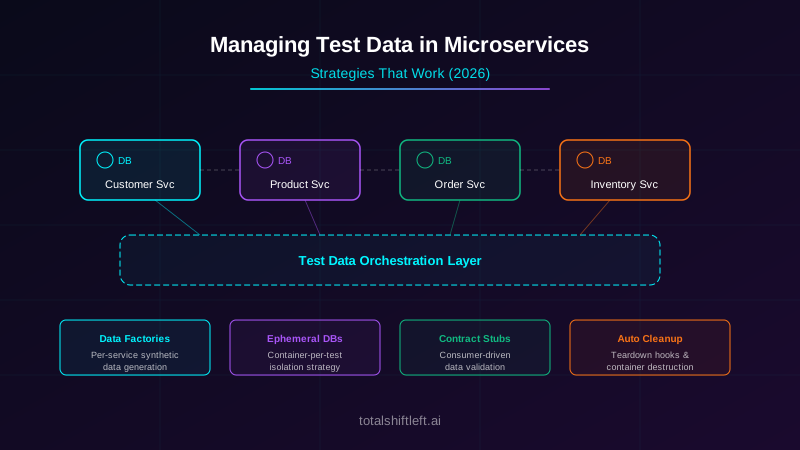
Managing test data in microservices means giving each service its own test data factory and ephemeral database instance rather than sharing a single test database across teams. The core techniques are service-level data factories, Testcontainers-based ephemeral databases for total isolation, contract-driven stubs (Pact) for cross-service dependencies, and an orchestration layer that creates end-to-end test data through each service's own API.
Reviewed by Parveen Kumari

Test data microservices management is the practice of generating, distributing, isolating, and cleaning up test data across independently deployed services, each with its own data store. Effective test data strategies eliminate flaky tests, enable parallel test execution, and make CI/CD pipelines reliable in distributed architectures.
Managing test data in microservices architectures is fundamentally different from managing test data in monoliths. In a monolith, you have one database, one schema, and one connection. Setting up test data means inserting rows into known tables. In microservices, you have dozens of databases, each owned by a different team, each with different schemas, access patterns, and deployment schedules. A single end-to-end test scenario might require coordinated data across five or more services—and if any one of them is in the wrong state, the test fails for reasons that have nothing to do with the code being tested.
The shift from monolithic architectures to microservices has delivered enormous benefits in deployment independence, team autonomy, and scalability. But it has also created a testing problem that most organizations underestimate: test data management becomes exponentially more complex as the number of services grows.
Consider a straightforward test scenario: "verify that a customer can place an order." In a monolith, this requires setting up rows in the customers table and the products table, then executing the order flow. In a microservices architecture, this requires coordinated data across the customer service, product catalog service, inventory service, pricing service, and order service—each with its own database, its own schema, and its own API for data access.
Teams that ignore this complexity end up with flaky test suites, slow pipelines, and a growing list of tests that are skipped because "the data isn't right." This guide covers the strategies that work for managing test data in microservices—strategies used by teams running hundreds of services in production with reliable, fast test pipelines. If you are building a testing strategy for microservices, test data management is the foundation that everything else depends on.
In this guide
- What Is Test Data Management in Microservices
- Why Test Data Management Matters in Microservices
- Key Components of Microservices Test Data Strategy
- Architecture for Microservices Test Data
- Tools for Microservices Test Data Management
- Test data in microservices in practice: a worked example
- Test data in microservices challenges and how to solve them
- Test data in microservices best practices
- Test data in microservices checklist
- Frequently asked questions about test data in microservices
What Is Test Data Management in Microservices
Test data management in microservices is the set of practices, tools, and infrastructure that ensure every test at every level—unit, integration, contract, and end-to-end—has access to the correct data in the correct state at the time of execution. It encompasses:
- Data generation: Creating synthetic test data that matches each service's schema and business rules.
- Data distribution: Getting the right data into the right service's data store before tests execute.
- Data isolation: Ensuring that tests running in parallel do not interfere with each other's data.
- Data cleanup: Removing or resetting test data after test execution to prevent state leakage.
- Data versioning: Keeping test data aligned with schema changes as services evolve independently.
Unlike monolithic test data management—where a single database migration and seed script handle everything—microservices test data management must account for the fact that each service is an independent deployable with its own data lifecycle. This is what makes the problem fundamentally harder and why dedicated strategies are essential.
The data layer under all of this has its own failure modes — database testing strategies for DevOps teams covers migrations, isolation and rollback.
Across service boundaries the problem changes shape — test data challenges in distributed systems covers consistency and setup across services.
The mechanics of producing the data itself are covered in API test data generation, with Faker and schema-derived examples.
Why Test Data Management Matters in Microservices
Flaky Tests Are Almost Always Data Problems
When engineering teams investigate flaky tests in microservices architectures, the root cause is data-related in the majority of cases. Tests that pass on Monday and fail on Tuesday, or pass locally and fail in CI, are almost always experiencing data state drift. The test expects a customer with ID 42 to exist, but another test deleted it. The test expects the product catalog to have 10 items, but a parallel test added 3 more.
Pipeline Reliability Depends on Data Predictability
A CI/CD pipeline is only as reliable as its test suite. If 5% of test runs fail due to data issues rather than code bugs, the pipeline signal-to-noise ratio degrades rapidly. Developers begin ignoring test failures, assuming they are "data problems," which means real code bugs slip through undetected. This is the path to testing challenges that undermine your entire quality strategy.
Service Independence Requires Data Independence
The core promise of microservices is that each service can be developed, tested, and deployed independently. But if your test data strategy requires coordinating data setup across multiple services for basic tests, you have re-introduced coupling at the data layer. True service independence requires that each service can be tested in isolation with self-contained test data.
Compliance and Security Mandate Synthetic Data
Using production data copies for testing creates compliance risks (GDPR, HIPAA, CCPA), security exposure, and unpredictable test behavior. Microservices test data strategies must be built on synthetic data generation from the ground up—not as an afterthought applied to production data snapshots.
Key Components of Microservices Test Data Strategy
Service-Level Test Data Factories
Each microservice should maintain its own test data factory—a module that generates valid test data for that service's domain. The factory encapsulates the service's schema, business rules, and constraints, producing data objects that are guaranteed to be valid for that service.
// OrderService test data factory
class OrderTestDataFactory {
  static createValidOrder(overrides = {}) {
    return {
      customerId: faker.string.uuid(),
      items: [{ productId: faker.string.uuid(), quantity: 1, price: 29.99 }],
      shippingAddress: AddressFactory.createValid(),
      ...overrides
    };
  }
}
Factories should support overrides so that specific tests can customize specific fields without knowing the full schema. This pattern keeps tests readable and resilient to schema changes. For API-level suites, data-driven testing that runs each case across many input rows turns a single factory-generated scenario into broad coverage without hand-writing every permutation.
Ready to shift left with your API testing?
Try our no-code API test automation platform free. Generate tests from OpenAPI, run in CI/CD, and scale quality.
Ephemeral Database Instances
The cleanest data isolation strategy is giving each test run its own database instance. Docker containers make this practical—spin up a Postgres container, run migrations, seed test data, execute tests, and destroy the container. Total isolation, zero cleanup complexity.
# docker-compose.test.yml
services:
  order-db-test:
    image: postgres:16
    environment:
      POSTGRES_DB: orders_test
    tmpfs: /var/lib/postgresql/data  # RAM-backed for speed
For services using DynamoDB, Redis, or other data stores, LocalStack and testcontainers provide equivalent ephemeral instances. The performance overhead is measured in seconds per test run—negligible compared to the hours lost debugging shared-state test failures.
Contract-Driven Data Stubs
When testing a service that depends on another service's data, use contract-driven stubs rather than live service calls. Pact, Spring Cloud Contract, or contract testing frameworks let you define the data shape a consumer expects and generate stubs that providers verify against their actual implementation.
Cross-Service Test Data Orchestration
For integration and end-to-end tests that span multiple services, a test data orchestration layer coordinates data setup. This layer calls each service's API to create the required data state rather than writing directly to databases—respecting service boundaries while ensuring data consistency.
Architecture for Microservices Test Data
The architecture for test data in microservices follows a layered approach, aligned with the test pyramid:
┌─────────────────────────────────────────────────────┐
│ End-to-End Test Data Layer │
│ Cross-service orchestration via API calls │
│ Shared test data service coordinates setup │
├─────────────────────────────────────────────────────┤
│ Integration Test Data Layer │
│ Contract stubs + ephemeral service instances │
│ Docker Compose for multi-service scen
arios │
├─────────────────────────────────────────────────────┤
│ Unit Test Data Layer │
│ In-memory factories, mocks, fixtures │
│ No external dependencies │
├─────────────────────────────────────────────────────┤
│ Shared Infrastructure Layer │
│ Schema registries, data generators, seed scripts │
│ Test data catalogs, anonymization pipelines │
└─────────────────────────────────────────────────────┘
Unit tests use in-memory data factories and mocks. Zero external dependencies, sub-millisecond data setup. This is where the majority of your tests should operate.
Integration tests use ephemeral database containers and contract stubs. Each service's integration test suite spins up its own database, seeds it through the service's own API, and destroys it after execution.
End-to-end tests use a test data orchestration service that coordinates data creation across multiple services via their APIs. This layer is the most complex and should be used sparingly—consistent with the test pyramid approach in DevOps.
Tools for Microservices Test Data Management
| Tool | Category | Best For | Microservices Fit |
|---|---|---|---|
| Testcontainers | Ephemeral Infrastructure | Database containers per test | Excellent—native multi-container support |
| Faker.js / Bogus | Data Generation | Realistic synthetic data | Good—language-specific factories |
| Pact | Contract Testing | Consumer-driven data stubs | Excellent—built for microservices |
| LocalStack | Cloud Emulation | AWS service mocking | Excellent—DynamoDB, SQS, S3 |
| Flyway / Liquibase | Schema Migration | Database versioning | Good—per-service migration tracking |
| Docker Compose | Environment Orchestration | Multi-service test setups | Good—standard for integration tests |
| Tonic.ai | Data Masking | Production data anonymization | Good—handles cross-service relationships |
| Shift-Left API | API Test Generation | Automated API test data | Excellent—generates from OpenAPI specs |
The tool selection depends on your service count, data store diversity, and team size. Teams with fewer than 10 services can often manage with Testcontainers and Faker alone. Teams with 50+ services typically need dedicated test data orchestration infrastructure.
Test data in microservices in practice: a worked example
Scenario: An e-commerce platform with 12 microservices migrating from a shared test database to service-owned test data.
Before: All 12 services shared a single test database populated by a nightly SQL script. Tests ran serially to avoid data conflicts. The full test suite took 47 minutes. Approximately 12% of test runs failed due to data state issues.
Implementation steps:
-
Week 1-2: Each service team created a test data factory for their service's domain objects using Faker.js. Unit tests were migrated to use factories instead of shared database fixtures.
-
Week 3-4: Integration tests were migrated to Testcontainers. Each service's integration test suite received its own Postgres container spun up at test start and destroyed at test end.
-
Week 5-6: Cross-service tests were refactored to use a test data orchestration service. This service exposed endpoints like
POST /test-data/scenarios/customer-places-orderthat coordinated data creation across the customer, product, inventory, and order services via their APIs. -
Week 7-8: The shared test database was decommissioned. All test data was now generated synthetically, owned by individual services, and isolated per test run.
Results:
- Test suite duration dropped from 47 minutes to 11 minutes (parallel execution now possible)
- Flaky test rate dropped from 12% to under 1%
- Each service could run its full test suite independently in under 3 minutes
- New services could be added without modifying the shared data setup
Test data in microservices challenges and how to solve them
Challenge: Schema Drift Between Services and Test Data
As services evolve independently, their schemas change. Test data factories that were valid last week may produce invalid data this week because a required field was added or a validation rule changed.
Solution: Tie test data factories to schema definitions. If your service uses an OpenAPI spec, generate factory templates from the spec. When the spec changes, the factory changes automatically. Shift-Left API can generate test data from OpenAPI specs, keeping your test data aligned with your actual API contracts.
Challenge: Data Dependencies Across Service Boundaries
An order requires a valid customer ID and product IDs. But the order service does not own customers or products—those are managed by other services. How do you create the necessary data without coupling test setup across services?
Free PDF + code examples
OpenAPI to Test Generation Template Pack
Go from OpenAPI spec to full test coverage. Includes sample specs, example generated tests, edge case patterns, and CI/CD integration guides.
Download FreeSolution: Use the stranger pattern—the order service's test suite creates stub data for dependent services. For unit and integration tests, mock the customer and product service responses. For end-to-end tests, use the orchestration layer to create real data through each service's API.
Challenge: Test Data Volume for Performance Testing
Performance tests require realistic data volumes—thousands or millions of records—which cannot be generated per-test-run in the same way functional test data can.
Solution: Maintain pre-generated performance test data sets as versioned artifacts. Store them in object storage (S3, GCS) and load them into ephemeral databases at the start of performance test runs. Regenerate these artifacts on a scheduled basis or when schemas change.
Challenge: Stateful Services and Event Sourcing
Services that use event sourcing or CQRS patterns require test data to be created through event sequences rather than direct database insertion. Setting up a specific state requires replaying a specific sequence of events.
Solution: Create event sequence factories alongside data factories. Instead of generating a final-state object, generate the sequence of events that produces that state. This ensures test data goes through the same business logic as production data, catching issues that direct insertion would miss.
Test data in microservices best practices
- Every test creates its own data. Never rely on data created by another test or a shared seed script. Test data coupling is the primary source of flaky tests in microservices.
- Use factories, not fixtures. Fixtures are static and brittle. Factories generate data dynamically with sensible defaults and override support.
- Prefer ephemeral databases over shared databases. The few seconds of container startup time is a small price for complete data isolation.
- Generate test data from API specifications. This keeps test data aligned with actual API contracts automatically. Tools like Shift-Left API automate this process entirely.
- Clean up test data aggressively. If you cannot use ephemeral databases, implement per-test cleanup hooks that run regardless of test pass/fail status.
- Version test data factories with service code. Test data factories should live in the same repository as the service and be updated in the same PR that changes the schema.
- Monitor test data health. Track flaky test rates, data setup times, and cleanup failures as operational metrics. A rising flaky test rate is an early warning that test data management is degrading.
- Separate functional test data from performance test data. They have different requirements for volume, variety, and lifecycle management.
Test data in microservices checklist
- ✔ Each microservice has its own test data factory module
- ✔ Unit tests use in-memory data factories with zero external dependencies
- ✔ Integration tests use ephemeral database containers (Testcontainers or Docker Compose)
- ✔ Contract tests use Pact or equivalent for cross-service data stubs
- ✔ End-to-end tests use a test data orchestration service for cross-service setup
- ✔ Test data factories generate data from API specifications or schema definitions
- ✔ No test depends on data created by another test
- ✔ No test uses production data (all data is synthetic or anonymized)
- ✔ Test data cleanup runs automatically after every test suite execution
- ✔ Performance test data sets are pre-generated and versioned as artifacts
- ✔ Test data factories are versioned alongside service source code
- ✔ Flaky test rate is monitored and stays below 2%
- ✔ CI/CD pipeline runs all service test suites in parallel without data conflicts
See also: validation errors in our learn hub for the underlying concept.
Frequently asked questions about test data in microservices
Why is test data management harder in microservices than monoliths?
In monoliths, a single database holds all data, making setup and teardown straightforward. Microservices distribute data across multiple databases, each owned by a different service. Test scenarios that span services require coordinated data across multiple stores with different schemas, access patterns, and lifecycle rules. This distributed ownership model means that no single team controls the full data picture, and changes in one service's schema can break test data assumptions in downstream services—a complexity that simply does not exist in monolithic architectures.
Should each microservice own its own test data?
Yes. Service-level test data ownership is a core principle of effective microservices testing. Each service team should maintain test data factories, fixtures, and generators for their service's data store. Cross-service test scenarios should compose data from individual service factories rather than using a centralized data setup that couples services together. This mirrors the principle of service autonomy that microservices architectures are built on—if a service can be deployed independently, it should be testable independently.
How do you handle test data for integration tests across microservices?
Use contract-driven data stubs for consumer-side tests and dedicated test data factories for provider-side tests. For end-to-end integration tests that must span multiple services, create a shared test data seeding service that coordinates data setup across services through their public APIs rather than writing directly to their databases. This approach respects service boundaries while enabling cross-service test scenarios.
What is the best approach for test data cleanup in microservices?
Implement automatic cleanup at three levels: per-test cleanup using teardown hooks that run regardless of test outcome, per-suite cleanup using database transaction rollbacks or container destruction, and per-environment cleanup using scheduled purge jobs for long-lived test environments. Ephemeral databases via Docker containers provide the cleanest isolation—each test run gets a fresh database instance that is destroyed when the run completes, eliminating cleanup complexity entirely.
Can synthetic test data replace production data in microservices testing?
For the vast majority of test scenarios, synthetic data generated from schema definitions and business rules is superior to production data. It is predictable, reproducible, and free of compliance constraints. Production data snapshots are occasionally useful for reproducing specific bugs, but they must be anonymized before use and should never be the primary test data source. Teams that rely on production data copies for testing invariably face GDPR, HIPAA, or PII exposure risks.
Sources and further reading
- Testcontainers — throwaway real dependencies for integration tests.
- Faker (Python) — locale-aware fake data generation.
- Martin Fowler — Testing Strategies in a Microservice Architecture — the canonical breakdown of microservice test layers.
Key takeaways
- Managing test data in microservices architectures requires deliberate strategy—it does not emerge naturally from good coding practices.
- The complexity of distributed data ownership, cross-service dependencies, and parallel test execution demands purpose-built infrastructure: service-level factories, ephemeral databases, contract-driven stubs, and orchestrated cross-service data setup.
- The teams that invest in this infrastructure see immediate returns: faster pipelines through parallel execution, fewer flaky tests through data isolation, and true service independence through self-contained test data.
- The teams that defer this investment accumulate flaky test debt that eventually undermines their entire testing strategy.
- For the API testing layer of your microservices architecture—where test data complexity is highest because every API endpoint requires specific request data in specific formats—Shift-Left API generates comprehensive test suites with valid test data directly from your OpenAPI specifications.
- No manual data setup, no factory code to maintain, and complete coverage of your API contracts.
Start your free trial and eliminate test data headaches from your microservices testing today.
Related: API Testing Strategy for Microservices | Contract Testing for Microservices | Best Testing Tools for Microservices | Test Data Automation in CI/CD Pipelines | DevOps Testing Best Practices | How to Build a CI/CD Testing Pipeline | Platform | Start Free Trial
Ready to shift left with your API testing?
Try our no-code API test automation platform free.