
SOAP/WSDL Testing in 2026: Still Essential for BFSI
Quick answer
SOAP and WSDL services still run core banking platforms, SWIFT/ISO 20022 payment settlement, and insurance claims engines in 2026, so testing them remains essential rather than legacy cleanup. Modern platforms parse WSDL definitions to auto-generate functional, negative, and security tests (XXE, WS-Security replay, oversized payloads) and run them in CI/CD alongside REST suites. For BFSI, the key requirement is a self-hosted AI model so WSDL files and test data never leave the network perimeter.
Reviewed by Parveen Kumari
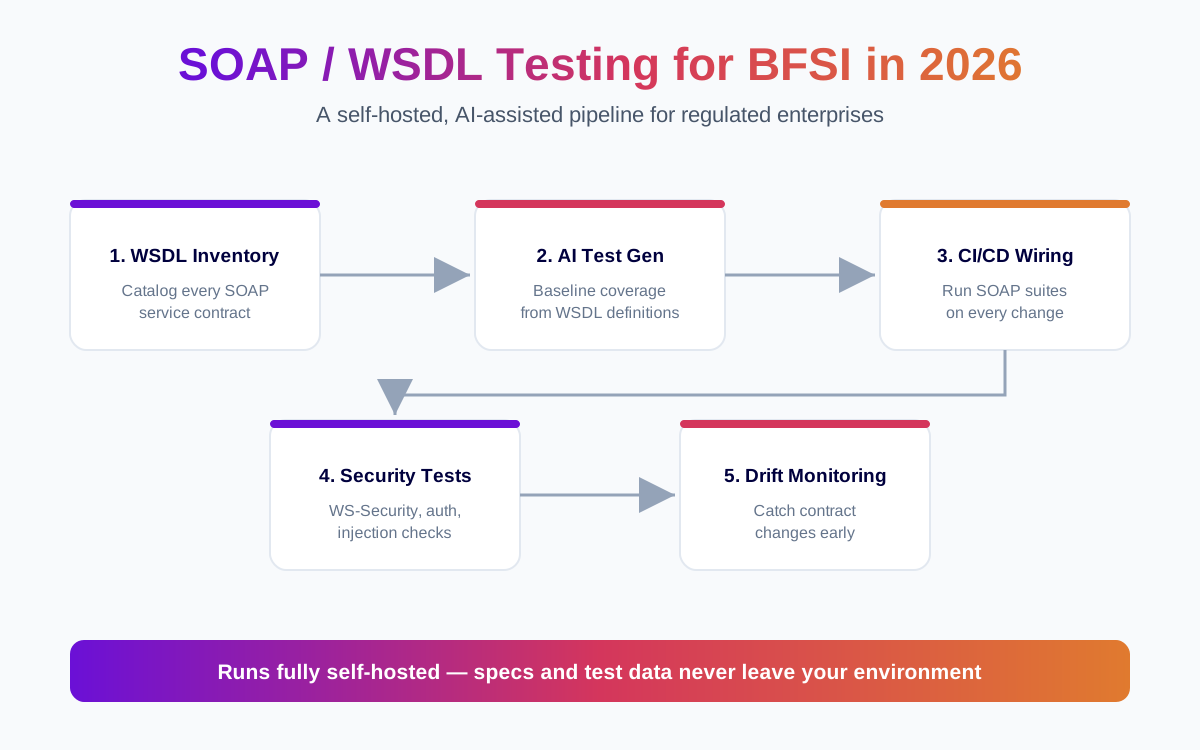
If you work in banking, insurance, or payments, you already know: SOAP services are not going anywhere. Core banking platforms, payment settlement networks (SWIFT, ISO 20022 gateways), insurance claims engines, and government interoperability layers all run on SOAP/WSDL — and they will for years to come. The question is not whether to test them. It is whether your testing toolchain has kept up.
This guide covers why SOAP/WSDL testing remains critical for BFSI in 2026, where legacy tools fall short, and how modern AI-native platforms generate and run SOAP tests without sending your WSDL files to a third-party cloud.
In this guide
- Why SOAP/WSDL Services Persist in Regulated Industries
- What Modern SOAP/WSDL Testing Actually Looks Like
- The Self-Hosted Requirement for BFSI SOAP Testing
- A Practical SOAP Testing Strategy for 2026
- How Total Shift Left Handles SOAP/WSDL
- SOAP testing tools that are still maintained
- SOAP and WSDL testing FAQ
Why SOAP/WSDL Services Persist in Regulated Industries
REST and GraphQL dominate greenfield development. But regulated industries operate differently. Core systems were built on SOAP because it offered built-in standards for security (WS-Security), transactions (WS-AtomicTransaction), and reliable messaging (WS-ReliableMessaging) — things that mattered when the system was processing interbank settlements or insurance claims worth millions per hour.
Replacing these services is a multi-year, high-risk program that most institutions defer. Meanwhile, new REST-based services wrap or orchestrate the existing SOAP backends. The result is a hybrid architecture where SOAP and REST coexist, often within the same transaction flow.
Three facts keep SOAP entrenched in BFSI:
Regulatory inertia. Regulators validated these systems. Re-platforming triggers re-validation — a cost that dwarfs the technology migration itself.
Protocol-level guarantees. WS-Security, WS-Policy, and SAML-based token exchange are baked into the WSDL contract. REST equivalents exist but require custom implementation and lack the same formalized contract.
Integration density. A single core banking WSDL might have 200+ operations consumed by dozens of internal and external systems. Changing the contract has blast-radius implications that keep teams conservative.
Teams on SmartBear tooling asking the same question should start with the best ReadyAPI alternatives, which covers what actually replaces its SOAP and data-driven features.
What Modern SOAP/WSDL Testing Actually Looks Like
Legacy SOAP testing meant SoapUI. For years, SoapUI (and its commercial successor ReadyAPI) was the de facto standard. You imported a WSDL, manually built test cases, wired up assertions on XPath expressions, and ran them from a desktop client.
That workflow has three problems in 2026:
Manual test creation does not scale. A complex WSDL with 150+ operations and deep XML schemas generates thousands of possible input combinations. Writing test cases by hand covers a fraction of them.
Desktop-first tools do not fit CI/CD. SoapUI projects can be run from the command line, but the authoring and maintenance experience is GUI-bound. Teams end up with test suites that only one or two people can maintain.
No AI generation. Traditional tools cannot ingest a WSDL and generate negative tests, boundary-value tests, or security-focused payloads automatically. You get what you write.
Modern SOAP/WSDL testing brings three capabilities that legacy tools lack:
1. AI-Generated Tests from WSDL Definitions
An AI-native testing platform parses your WSDL — including complex types, enumerations, min/max constraints, and operation signatures — and generates test cases automatically. This is exactly what dedicated SOAP and WSDL testing support provides: happy-path validation, null and empty field handling, boundary values derived from XML Schema restrictions, malformed XML payloads for robustness testing, and WS-Security header manipulation for auth-bypass checks.
The key differentiator for regulated teams: the AI model doing this generation should run inside your perimeter. If your WSDL describes your core banking API, sending it to a cloud-hosted LLM is a data residency risk that your CISO will flag before procurement finishes the first review.
Ready to shift left with your API testing?
Try our no-code API test automation platform free. Generate tests from OpenAPI, run in CI/CD, and scale quality.
2. First-Class WSDL Support, Not an Afterthought
Some modern API testing tools treat SOAP as a second-class citizen — a compatibility checkbox that technically works but lacks feature parity with REST. Look for platforms that handle WSDL imports natively: operation discovery, complex type resolution, SOAP 1.1 and 1.2 support, MTOM attachments, and WS-Security configurations.
Total Shift Left treats REST, SOAP/WSDL, and GraphQL as first-class protocols — not a legacy add-on. The platform parses WSDL definitions the same way it parses OpenAPI specs: as the source of truth for test generation, contract validation, and regression coverage.
3. CI/CD Integration for SOAP Test Suites
SOAP tests should run in your pipeline, not in a desktop client. Modern platforms provide CI/CD plugins (Jenkins, GitHub Actions, Azure DevOps, GitLab CI, and others) that execute SOAP test suites as quality gates — the same way you run REST API tests. A failing SOAP contract test blocks the build, just like any other API test.
For teams already running API testing in CI/CD pipelines, adding SOAP coverage should not require a separate tool or workflow.
The Self-Hosted Requirement for BFSI SOAP Testing
Here is where regulated industries diverge from the rest of the market. Most cloud-native testing platforms require you to upload your API definitions to their servers. For a REST API spec describing a public-facing service, that may be acceptable. For a WSDL that describes your core banking operations, payment settlement logic, or insurance adjudication workflows, it is not.
BFSI security and compliance teams evaluate API testing tools against specific controls:
Data residency. Where does the WSDL file go? Where are test results stored? Can the vendor access them?
Network egress. Does the tool call home? Does the AI model require internet access?
Audit logging. Who ran which tests, when, and against which environment? Is there an immutable audit trail?
Access control. Can you enforce role-based access so that only authorized teams see specific WSDL definitions and test results?
Self-hosted platforms answer these questions cleanly. The WSDL stays on your infrastructure. The AI model (Ollama, vLLM, LM Studio, or any of 13+ supported providers) runs on your hardware. Test results stay in your database. Audit logs feed your SIEM.
For a deeper comparison, see our guide on on-premises API testing platforms and how Total Shift Left compares to SoapUI/ReadyAPI and Parasoft SOAtest.
A Practical SOAP Testing Strategy for 2026
If your organization runs SOAP/WSDL services alongside REST APIs, here is a testing strategy that works:
Start with Your WSDL Inventory
Most enterprises do not have a complete catalog of active WSDLs. Start by auditing your service registry (if you have one) or scanning your API gateway configurations. Identify which WSDLs are actively consumed, by whom, and how frequently.
Generate Baseline Test Coverage with AI
Import each WSDL into an AI-native platform and let it generate an initial test suite. This gets you to 60-80% operation coverage in hours instead of weeks. Review the generated tests, adjust assertions where business logic requires specific validation, and commit the suite to source control.
Wire SOAP Tests into Your CI/CD Pipeline
Run the SOAP test suite as a quality gate alongside your existing REST API tests. Use the same CI/CD plugin, the same pass/fail criteria, and the same reporting dashboard. Consistency matters — teams should not need a separate workflow for SOAP.
Add Security-Focused SOAP Tests
SOAP services are frequent targets for XML-based attacks: XML External Entity (XXE) injection, SOAP action spoofing, WS-Security token replay, and oversized XML payloads (billion laughs). Your test suite should include negative security tests for each of these vectors. AI-generated security tests from the WSDL schema cover the common patterns; your security team can layer on custom payloads for business-specific risks.
Free 1-page checklist
API Testing Checklist for CI/CD Pipelines
A printable 25-point checklist covering authentication, error scenarios, contract validation, performance thresholds, and more.
Download FreeFor more on API security testing approaches, see the API security testing guide.
Monitor Contract Drift
When a SOAP service's WSDL changes — a new operation, a modified complex type, a deprecated field — your tests should catch it before downstream consumers do. Contract drift testing compares the current WSDL against the version your tests were generated from and flags breaking changes automatically.
How Total Shift Left Handles SOAP/WSDL
Total Shift Left supports SOAP/WSDL as a production-ready protocol alongside REST and GraphQL. Here is what that means in practice:
WSDL import and parsing. Upload a WSDL (or point to a live URL), and the platform resolves all operations, complex types, and schema definitions automatically.
AI test generation. The platform uses your configured LLM — running on your infrastructure via Ollama, vLLM, LM Studio, or any of 13+ supported providers — to generate functional, negative, and security test cases from the WSDL definition.
CI/CD execution. Run SOAP tests as quality gates through the first-party Jenkins or Azure DevOps plugins, or via the public REST API from GitHub Actions, GitLab CI, CircleCI, Bitbucket Pipelines, or any other CI/CD tool.
Enterprise controls. RBAC with five roles, AES-256 credential storage, and audit logs — the same controls applied to REST and GraphQL testing.
Self-hosted deployment. Everything runs inside your perimeter. No WSDL data leaves your network. No API specs are sent to external AI providers.
SOAP testing tools that are still maintained
What is realistic for a SOAP estate in 2026:
| Tool | Licence | WSDL-driven | WS-Security | CI-native | Best for |
|---|---|---|---|---|---|
| SoapUI Open Source | Free (EPL) | Yes | Partial | Via the Maven plugin | The default for a WSDL-first estate |
| ReadyAPI | Commercial | Yes | Full | Yes | Regulated estates needing WS-Security and reporting |
| Karate | Free (Apache 2.0) | Manual envelopes | Manual | Yes | Mixed SOAP and REST in one suite |
| REST Assured | Free (Apache 2.0) | Manual envelopes | Manual | Yes | JVM teams already running REST Assured |
| Apache CXF (wsdl2java) | Free (Apache 2.0) | Yes | Full | Yes | Generating a typed client to test against |
| Postman | Freemium | No | No | Via Newman | Ad-hoc probing only |
For BFSI specifically the deciding factor is usually WS-Security: signing, encryption and timestamp validation are where the free tools require the most manual work, and where an unmaintained in-house helper class becomes a long-term liability.
SOAP and WSDL testing FAQ
Is SOAP still used in banking in 2026? Yes. Core banking platforms, payment settlement networks (SWIFT gateways, ISO 20022 adapters), and insurance claims systems still rely heavily on SOAP/WSDL services. These systems are too critical and too deeply integrated to replace quickly.
Can AI generate tests from a WSDL file? Yes. AI-native testing platforms parse WSDL definitions — including complex types, restrictions, and operation signatures — and generate functional, negative, and security test cases automatically. The quality depends on the richness of the WSDL schema.
What is the risk of using cloud-hosted tools for SOAP testing in regulated industries? The primary risk is data residency. Your WSDL describes your API's operations, data structures, and security mechanisms. Uploading it to a third-party cloud may violate internal security policies, regulatory requirements (GDPR, PCI DSS, HIPAA), or contractual obligations with partners and regulators.
How does self-hosted AI test generation work for SOAP? A self-hosted platform runs the LLM on your infrastructure (using Ollama, vLLM, LM Studio, or similar). The WSDL is parsed locally, test cases are generated locally, and nothing leaves your network. You get AI-generated coverage without the cloud data risk.
Should SOAP tests run in CI/CD alongside REST tests? Yes. Treating SOAP tests differently from REST tests creates workflow fragmentation. Modern platforms run both protocol types through the same CI/CD plugins, quality gates, and reporting dashboards.
SOAP and WSDL are not relics — they are the infrastructure layer that regulated industries depend on. Testing them with modern, AI-native tools is not optional; it is a requirement for teams that want to shift testing left without introducing data residency risk.
If your team tests SOAP/WSDL services in a regulated environment, book a demo with our architect or start a free 15-day trial to see how Total Shift Left handles WSDL test generation on your own infrastructure.
Sources and further reading
Ready to shift left with your API testing?
Try our no-code API test automation platform free.