
API Penetration Testing vs Security Testing: Key Differences
Quick answer
API penetration testing is a manual, time-bounded adversarial exercise (one to three weeks) where ethical hackers exploit vulnerabilities and business logic flaws using tools like Burp Suite. API security testing is continuous and automated, scanning for OWASP API Top 10 issues in CI/CD on every code change. Neither replaces the other — pen testing catches chained attacks automation misses, while automated testing covers the 364 days between annual pen tests.
Reviewed by Sushant Joshi

API penetration testing vs API security testing represents two complementary but distinct approaches to securing APIs. Penetration testing is an adversarial, manual exercise simulating real-world attacks, while security testing is a continuous, automated practice validating security controls throughout the development lifecycle. Understanding when and how to use each is critical for complete API protection.
APIs now handle 83% of all web traffic, and API-related security breaches increased by 68% in 2025 alone. Security teams face a critical question: should they invest in API penetration testing, API security testing, or both?
The confusion between these two approaches costs organizations real money. Teams that rely solely on annual penetration tests discover vulnerabilities months after they are introduced. Teams that only run automated security scans miss the complex, chained attack vectors that a skilled attacker would exploit. The result is a false sense of security that crumbles under a real attack.
This guide breaks down the API penetration testing vs security testing debate with clarity. You will learn exactly what each approach covers, when to use each one, and how to combine them into a layered defense that catches vulnerabilities before attackers do — aligned with the shift-left testing philosophy of moving security earlier in development.
In this guide
- What Is API Penetration Testing vs API Security Testing?
- Why Understanding the Difference Matters
- The key components of API penetration testing
- How Each Approach Works
- API penetration testing tools compared
- API penetration testing in practice: a worked example
- API penetration testing challenges and how to solve them
- API penetration testing best practices
- API penetration testing checklist
- What each one actually runs
- API penetration testing FAQ
What Is API Penetration Testing vs API Security Testing?
API penetration testing is a time-bounded, adversarial assessment where ethical hackers manually attempt to exploit vulnerabilities in your APIs. Pen testers think like attackers — they chain multiple weaknesses together, explore business logic flaws, and attempt to escalate privileges in ways automated tools cannot replicate. A typical API pen test lasts one to three weeks and produces a detailed report of exploitable vulnerabilities ranked by severity.
API security testing is a continuous practice of validating API security controls throughout the software development lifecycle. It encompasses automated scanning for OWASP API Top 10 vulnerabilities, authentication and authorization testing, input validation checks, schema compliance verification, and security regression testing. Security testing runs in CI/CD pipelines on every pull request and deployment.
The fundamental distinction is this: penetration testing answers "Can an attacker break in right now?" while security testing answers "Are our security controls working correctly on every change?" Both questions matter, but they require different methodologies, tools, timelines, and skill sets to answer effectively.
Why Understanding the Difference Matters
Security Coverage Gaps
Organizations that confuse penetration testing with security testing invariably have coverage gaps. A penetration test performed once per year leaves 364 days where new vulnerabilities go undetected. Conversely, automated security testing without pen testing misses the business logic vulnerabilities and chained attacks that only human adversarial thinking can uncover.
Budget Allocation
API penetration testing typically costs $15,000 to $50,000 per engagement for external assessors. Automated API security testing tools cost $500 to $5,000 per month. Understanding the distinct value each provides prevents over-investing in one approach while neglecting the other. Smart teams allocate budget for continuous automated testing supplemented by periodic manual assessments.
Compliance Requirements
Regulatory frameworks like PCI DSS, SOC 2, and HIPAA distinguish between penetration testing and vulnerability scanning. PCI DSS Requirement 11.4 specifically mandates periodic penetration testing that cannot be satisfied by automated scanning alone. Understanding which compliance requirements map to which approach prevents audit failures.
Risk-Based Decision Making
Different APIs carry different risk profiles. A public-facing payment API requires both rigorous automated testing and frequent penetration testing. An internal reporting API might only need automated security testing with annual pen tests. Understanding the distinction enables risk-appropriate security investment across your API portfolio.
The key components of API penetration testing
Penetration Testing: Scope and Methodology
API penetration testing follows structured methodologies like OWASP Testing Guide and PTES. The tester begins with reconnaissance, mapping all endpoints, parameters, and authentication mechanisms. They then systematically test for injection, broken authentication, excessive data exposure, and business logic flaws — often discovering vulnerability chains that automated tools miss entirely.
Penetration Testing: Attack Simulation
Pen testers simulate real attacker behavior: brute-forcing credentials, manipulating JWT tokens, exploiting race conditions, testing for IDOR (Insecure Direct Object References), and attempting privilege escalation. They test what happens when API calls are made out of sequence, when parameters are swapped between users, and when rate limits are deliberately circumvented.
Security Testing: Automated Scanning
Automated API security testing uses DAST (Dynamic Application Security Testing) tools that crawl API specifications, generate test cases for known vulnerability patterns, and execute them against running APIs. These tools check for SQL injection, XSS via API responses, broken authentication patterns, and missing security headers on every build.
Security Testing: Schema and Contract Validation
Security testing validates that APIs conform to their OpenAPI specifications — rejecting unexpected parameters, enforcing required fields, and verifying response schemas. Platforms that build these security tests directly from your OpenAPI spec get complete endpoint coverage without hand-authoring each check. Schema violations frequently indicate security issues: an API that accepts parameters not in its spec is likely vulnerable to mass assignment attacks.
Ready to shift left with your API testing?
Try our no-code API test automation platform free. Generate tests from OpenAPI, run in CI/CD, and scale quality.
Security Testing: Authentication and Authorization Matrix
Automated security testing verifies the complete authentication and authorization matrix: every endpoint tested with no credentials, expired tokens, valid tokens with wrong roles, and valid tokens with correct roles. This matrix testing catches BOLA (Broken Object Level Authorization) vulnerabilities that are the number one API security risk according to OWASP.
Penetration Testing: Business Logic Analysis
The most valuable aspect of penetration testing is business logic vulnerability discovery. Automated tools cannot understand that a financial API should not allow negative transfer amounts, or that an ordering API should not permit applying the same discount code twice. Human testers understand business context and test for logic flaws that no scanner can detect.
How Each Approach Works
API penetration testing follows a lifecycle that typically spans two to four weeks. The engagement begins with scoping, where the testing team and the organization agree on target APIs, testing boundaries, and rules of engagement. The tester then performs reconnaissance — analyzing API documentation, reverse-engineering mobile apps to discover hidden endpoints, and mapping the complete attack surface.
The active tes
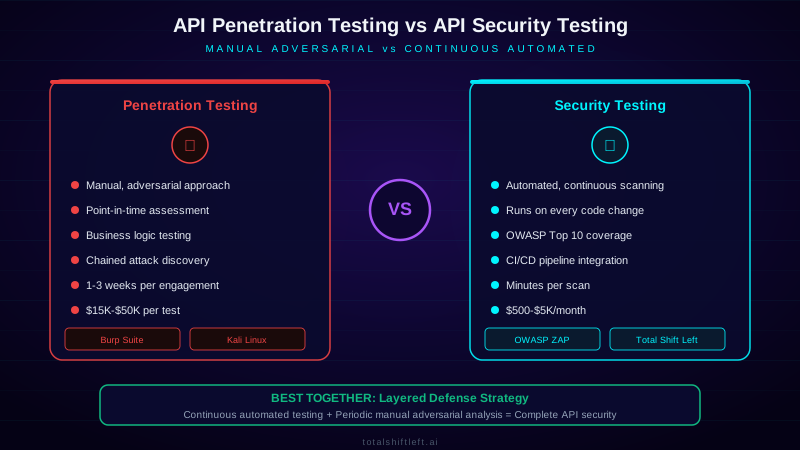
ting phase involves systematic exploitation attempts following a methodology. The pen tester uses intercepting proxies like Burp Suite to capture and modify API requests, tools like sqlmap to test for injection, and custom scripts to test business logic. Every finding is validated manually to eliminate false positives and assess real-world exploitability.
Automated API security testing operates on a completely different cycle. It integrates into your CI/CD pipeline and executes on every code change. The security testing tool ingests your OpenAPI specification, generates test cases covering OWASP API Top 10 categories, and runs them against your API in a staging environment. Results feed back to developers within minutes, blocking insecure code from reaching production.
The key architectural difference is that penetration testing is an outside-in assessment by an adversary, while security testing is an inside-out validation by the development team. Both perspectives are necessary — the adversary finds what the builder missed, and the builder prevents what the adversary would exploit.
API penetration testing tools compared
| Tool | Type | Best For | Open Source |
|---|---|---|---|
| Burp Suite Professional | Pen Testing | Manual API exploitation, intercepting proxy | No |
| OWASP ZAP | Both | Automated scanning + manual testing | Yes |
| Postman + Newman | Security Testing | API functional + security test automation | Partial |
| sqlmap | Pen Testing | SQL injection detection and exploitation | Yes |
| Nuclei | Both | Template-based vulnerability scanning | Yes |
| StackHawk | Security Testing | CI/CD-integrated DAST scanning | No |
| 42Crunch | Security Testing | OpenAPI spec audit + conformance testing | No |
| Total Shift Left | Security Testing | AI-powered security test generation from specs | No |
| Kiterunner | Pen Testing | API endpoint discovery and enumeration | Yes |
| Arjun | Pen Testing | Hidden parameter discovery | Yes |
Penetration testers typically combine multiple tools with custom scripting, while automated security testing relies on tools that integrate directly into development workflows and provide consistent, repeatable results.
API penetration testing in practice: a worked example
Problem: A fintech company with 200+ API endpoints relied exclusively on annual penetration testing. Between annual tests, a developer introduced a new account transfer endpoint with a Broken Object Level Authorization (BOLA) vulnerability. The endpoint allowed any authenticated user to transfer funds from any account by manipulating the account ID parameter. The vulnerability existed in production for four months before the next scheduled pen test discovered it.
Solution: The company implemented a dual-layer strategy. They deployed Total Shift Left for continuous automated API security testing integrated into their CI/CD pipeline. The tool automatically generated authorization matrix tests from their OpenAPI specs, testing every endpoint with cross-user credentials on every deployment. They maintained quarterly penetration testing for business logic review and chained attack discovery.
Results: The automated security testing caught 94% of OWASP API Top 10 vulnerabilities within the CI/CD pipeline before code reached staging. The remaining 6% — primarily complex business logic flaws — were caught during quarterly pen tests. Mean time to detect security vulnerabilities dropped from 120 days to under 24 hours. The combined cost was 40% less than the incident response and remediation costs from their previous breach.
API penetration testing challenges and how to solve them
Challenge: Over-Reliance on Penetration Testing
Many organizations treat annual penetration testing as their complete API security program. A pen test is a snapshot — it only validates security at the moment of testing. APIs change daily with new endpoints, modified parameters, and updated business logic. Solution: Use penetration testing to establish a security baseline and validate complex attack scenarios, but implement automated security testing for continuous coverage between pen tests.
Challenge: Automated Testing False Positives
Automated security testing tools generate false positives that erode developer trust. When 40% of security alerts are false alarms, developers stop investigating any of them. Solution: Tune your security testing tools by customizing scan policies, excluding known false positive patterns, and validating findings against your specific API architecture. Tools like Total Shift Left that generate tests from your actual OpenAPI specification produce significantly fewer false positives.
Challenge: Testing in Production vs Staging
Penetration tests often target production environments to test real-world conditions, but this risks service disruption. Automated security tests typically run in staging, but staging may not perfectly mirror production security configurations. Solution: Run automated security testing in staging environments that mirror production security controls. Reserve production testing for controlled penetration test engagements with agreed-upon rules of engagement and rollback plans.
Free PDF guide (12 pages)
Top 50 API Testing Mistakes
50 real-world API testing mistakes organized by category — from authentication to performance — each with a concrete fix strategy.
Download FreeChallenge: Skills Gap
API penetration testing requires specialized skills that are expensive and scarce. Only 15% of organizations have dedicated API security testing expertise in-house. Solution: Outsource penetration testing to specialized firms while building internal automated security testing capabilities. Use security testing tools that generate tests automatically, reducing the security expertise required from your development team.
Challenge: Scope Creep in Pen Tests
Penetration test engagements frequently suffer from scope creep — testers spending too much time on infrastructure issues and not enough on API-specific vulnerabilities. Solution: Define API-specific scope in the statement of work. Require testers to focus on OWASP API Security Top 10 categories and provide API documentation upfront to maximize testing efficiency.
API penetration testing best practices
- Layer both approaches — Use automated security testing for continuous coverage and penetration testing for periodic deep analysis. Neither alone is sufficient.
- Shift security testing left — Integrate automated API security tests into your CI/CD pipeline so vulnerabilities are caught before code reaches staging.
- Test the authorization matrix — Verify every endpoint with every user role automatically. BOLA vulnerabilities are the #1 API security risk and are easily tested with automation.
- Define clear pen test scope — Ensure penetration test engagements focus specifically on API security, not just network and infrastructure. Provide OpenAPI specs and API documentation upfront.
- Remediate before retesting — Fix vulnerabilities found in automated testing immediately. Do not accumulate a backlog of known security issues waiting for a pen test to validate them.
- Use spec-driven security testing — Generate security tests from your OpenAPI specifications to ensure complete endpoint coverage and reduce false positives.
- Automate regression testing — When a penetration test finds a vulnerability, add an automated test case to prevent regression. Every pen test finding should become an automated check.
- Test business logic separately — Automated tools miss business logic flaws. Document business rules and include them in pen test scope. Consider dedicated business logic review sessions.
- Track security metrics — Measure mean time to detect, mean time to remediate, vulnerability density per endpoint, and the ratio of automated vs. manual findings to optimize your approach.
- Rotate pen testing firms — Use different penetration testing firms periodically to get fresh perspectives and avoid blind spots from familiarity.
API penetration testing checklist
- ✔ Automated API security testing integrated into CI/CD pipeline
- ✔ OWASP API Security Top 10 covered by automated tests
- ✔ Authentication and authorization matrix tested on every deployment
- ✔ Penetration testing scheduled at least annually
- ✔ Pen test scope specifically covers API-layer vulnerabilities
- ✔ OpenAPI specifications provided to pen testers before engagement
- ✔ Pen test findings converted to automated regression tests
- ✔ Security testing results block deployments on critical findings
- ✔ Business logic test cases documented and included in pen test scope
- ✔ Remediation SLAs defined for critical, high, medium, and low severity
- ✔ Security testing metrics tracked and reviewed monthly
- ✔ Staging environment mirrors production security configuration
See also: jwt authentication in our learn hub for the underlying concept.
What each one actually runs
Automated API security testing is a scan you can put in every pipeline. It is repeatable, fast, and finds the classes of issue a scanner can see:
# .github/workflows/api-security.yml — runs on every PR
- name: ZAP API scan
  uses: zaproxy/action-api-scan@v0.9.0
  with:
    target: 'https://staging.example.com/openapi.yaml'
    format: openapi
    cmd_options: '-a -z "-config rules.cookie.ignorelist=session"'
A penetration test is a human chaining findings a scanner cannot reason about — here, guessing that object IDs are sequential and that ownership is never checked (BOLA, API1:2023):
# authenticate as user A, then walk IDs that belong to user B
TOKEN_A=$(curl -s -XPOST "$API/login" -d '{"u":"a","p":"..."}' | jq -r .token)
for id in $(seq 1000 1010); do
  code=$(curl -s -o /dev/null -w '%{http_code}' \
    -H "Authorization: Bearer $TOKEN_A" "$API/v1/orders/$id")
  echo "$id -> $code"     # any 200 here is a broken object level authorization finding
done
API penetration testing FAQ
What is the main difference between API penetration testing and API security testing?
API penetration testing is a manual, adversarial exercise where ethical hackers simulate real attacks against your APIs to find exploitable vulnerabilities. API security testing is a broader, often automated practice that continuously validates security controls including authentication, authorization, input validation, and encryption throughout the development lifecycle.
Can API penetration testing replace API security testing?
No. Penetration testing is a point-in-time assessment that finds exploitable vulnerabilities but cannot provide continuous protection. API security testing runs in CI/CD pipelines on every code change. You need both — automated security testing for continuous coverage and periodic penetration testing for deep adversarial analysis.
How often should you perform API penetration testing?
Most organizations should perform API penetration testing at least annually, with additional tests after major architectural changes, new API versions, or significant feature releases. High-risk industries like finance and healthcare often require quarterly penetration tests to meet compliance requirements.
What tools are used for API penetration testing vs security testing?
API penetration testing commonly uses Burp Suite Professional, OWASP ZAP (manual mode), Postman with custom scripts, and Kali Linux tools. Automated API security testing uses OWASP ZAP (automated mode), Snyk API, Total Shift Left, StackHawk, and 42Crunch integrated into CI/CD pipelines.
Is API penetration testing required for compliance?
Yes, many compliance frameworks require penetration testing. PCI DSS requires annual penetration tests and tests after significant changes. SOC 2, HIPAA, and ISO 27001 all recommend or require periodic penetration testing as part of their security assessment requirements.
Sources and further reading
- OWASP API Security Top 10 (2023) — the reference list of API risk categories.
- OWASP Web Security Testing Guide — test procedures for each class of web and API vulnerability.
- Burp Suite documentation — the reference toolkit for manual API security testing.
Key takeaways
- API penetration testing and API security testing are not interchangeable — they are complementary layers of a complete API security program.
- Automated security testing provides the continuous, scalable coverage your CI/CD pipeline demands, while penetration testing delivers the adversarial depth that only human expertise can achieve.
- The organizations with the strongest API security posture use both approaches strategically: automated testing on every commit, and periodic pen tests to validate what automation cannot catch.
Ready to build continuous API security testing into your development workflow? Start your free trial of Total Shift Left and generate automated security tests from your API specifications in minutes.
Related: API Testing: The Complete Guide | Common API Security Vulnerabilities | API Security Testing Tools Comparison | API Security Testing in CI/CD | REST API Testing Best Practices | What Is Shift Left Testing
Ready to shift left with your API testing?
Try our no-code API test automation platform free.