Apidog vs Postman (2026): Features, Pricing & Which to Pick
Quick answer
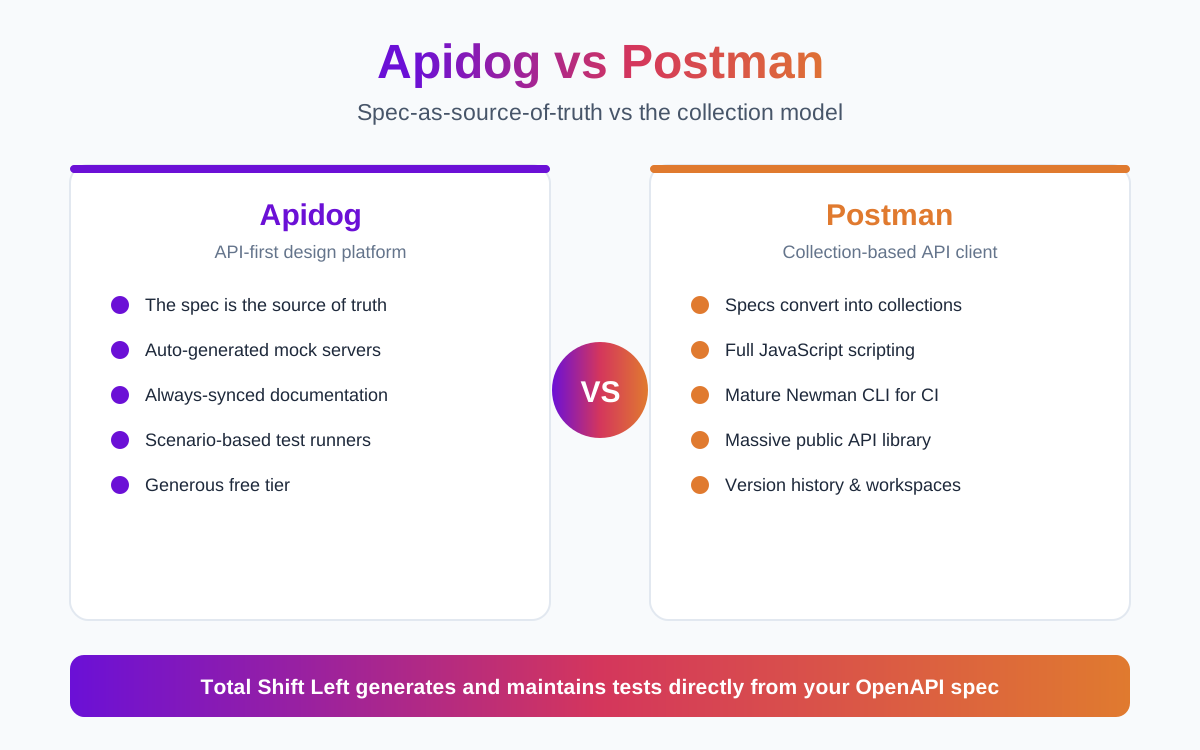
Apidog treats the OpenAPI spec as the single source of truth — design, mocks, docs, and tests all derive from it, so nothing drifts. Postman treats the collection as the primary object — you can import a spec, but it converts to an independent collection that diverges the moment either side changes. Pick Apidog for spec-first design with mocks that stay current automatically; pick Postman for the largest public API collection library and mature JavaScript scripting. Neither generates a full test suite or tracks coverage against the spec automatically — that's the gap a spec-driven automation layer like Total Shift Left fills alongside either tool.
Reviewed by Smeet Gohel
Apidog and Postman are the two API platforms most frequently compared in 2026. Both handle API design, testing, mocking, and documentation. The difference is architectural: Apidog was built spec-first from day one, while Postman evolved from a request builder into a platform where the spec is one of many imports rather than the foundation.
This guide covers the two head-to-head, plus pricing, where a spec-driven automation layer like Total Shift Left fits alongside either tool, and how to evaluate all three together.
In this guide
- The Core Architectural Difference
- Feature-by-Feature Comparison
- Pricing in 2026
- Where Apidog Wins
- Where Postman Wins
- Where Both Fall Short
- Where Total Shift Left Fits
- Apidog Alternatives
- Choosing Between Apidog and Postman
- Best Practices When Evaluating
- Moving a collection between the two (and to OpenAPI)
- Apidog vs Postman FAQ
For the two comparisons this one does not cover: curl vs Postman on reproducibility and debugging, and REST Assured vs Karate once the tests move out of a client and into a framework.
The Core Architectural Difference
Understanding one distinction explains most of the feature differences between these tools.
Apidog's model: The OpenAPI specification is the single source of truth. When you edit an endpoint in Apidog, you are editing the spec. Documentation, mock servers, and test cases derive from that spec automatically. Changes propagate everywhere.
Postman's model: The collection is the primary object. You can import an OpenAPI spec, but Postman converts it into a collection — an independent copy. The collection and the spec diverge the moment either is updated independently. Keeping them synchronized requires manual re-import or third-party integrations.
This architectural difference cascades into every feature comparison below.
The other comparison teams usually run at the same time is Postman vs Insomnia, which turns on how much platform you want around the client.
Feature-by-Feature Comparison
| Capability | Apidog | Postman |
|---|---|---|
| API design | Native spec editor — design is the spec | Import-based — spec converts to collection |
| Spec sync | Always in sync (spec is source of truth) | Manual re-import required |
| Mock servers | Auto-generated from spec with smart rules | Manual mock setup per collection |
| Documentation | Auto-generated, always current | Auto-generated from collection (may drift) |
| Testing | Basic assertions tied to endpoints | JavaScript scripting with full flexibility |
| Test automation | Scenario-based runners | Collection runners + Newman CLI |
| CI/CD integration | CLI available, growing ecosystem | Newman CLI, mature ecosystem |
| Collaboration | Real-time cloud workspaces | Cloud workspaces with version history |
| Public API network | Growing library | Massive public collection library |
| Environments | Shared environment variables | Environment and global variables |
| Pricing | Generous free tier | Free tier with 25 collection runs/month |
| Offline support | Desktop app with local storage | Desktop app with cloud sync |
Pricing in 2026
| Tier | Apidog | Postman |
|---|---|---|
| Free | Generous SaaS free tier | 25 collection runs/month |
| Pro / Team | $9–$15 / user / month | $14–$29 / user / month |
| Enterprise | Quote | Quote |
| Self-hosted | Enterprise only | Enterprise only |
Raw price is close between the two, so the meter matters more than the sticker. Postman charges by collection runs and Monitors — a team running frequent CI executions can hit the free-tier ceiling fast. Apidog charges per user with a more generous free allowance for solo builders. Neither offers self-hosted deployment below its top enterprise tier, which matters if your team is evaluating options for a regulated environment that requires on-prem or self-hosted LLM support.
Where Apidog Wins
Spec-first design workflow. If your team designs APIs before implementing them, Apidog's approach eliminates the translation step between design and testing. The spec you design is the spec your mock server uses, which is the spec your documentation renders.
Mock server simplicity. Apidog generates intelligent mock responses from your schema definitions automatically. You define a response schema once, and the mock server returns realistic data without additional configuration. Postman requires manual mock setup or Postbot-assisted generation.
Reduced drift. Because everything derives from the spec, Apidog structurally prevents the collection-spec drift that plagues Postman workflows. When an endpoint changes, documentation, mocks, and test expectations update together.
UI consistency. Apidog's interface was designed as a unified platform from the start. Design, test, and document views share the same navigation model. Postman's interface carries the legacy of its evolution from request builder to platform, which means some workflows require navigating between conceptually separate sections.
Ready to shift left with your API testing?
Try our no-code API test automation platform free. Generate tests from OpenAPI, run in CI/CD, and scale quality.
Where Postman Wins
Ecosystem maturity. Postman has over 30 million users, a massive public API network, and years of community-contributed collections. If you need to test a third-party API, chances are someone has already published a Postman collection for it.
Scripting flexibility. Postman's pre-request and test scripts use JavaScript with access to a rich API (pm.response, pm.environment, pm.expect). For complex validation logic — chaining requests, conditional flows, custom assertions — Postman's scripting model is more powerful than Apidog's assertion-based approach.
Newman and CI maturity. Newman has been the standard for running Postman collections in CI/CD for years. The ecosystem of plugins, reporters, and integrations is mature. Apidog's CLI is newer and still expanding its integration footprint.
Enterprise adoption. Postman is already deployed in most enterprises. Switching costs are real — teams have existing collections, workflows, and integrations built around Postman's model. Apidog requires migration effort that must be justified.
Where Both Fall Short
Both Apidog and Postman share limitations that become critical at enterprise scale:
No AI-powered test generation. Neither tool generates comprehensive test suites automatically from your spec. Apidog creates basic assertions tied to endpoints. Postman's Postbot assists with individual test scripts. Neither produces a full suite covering positive paths, negative scenarios, edge cases, and boundary conditions.
No coverage tracking against the spec. Neither tool tells you what percentage of your endpoints, methods, and response codes are covered by tests. You cannot set a coverage threshold as a CI/CD quality gate.
No self-healing tests. When your API evolves, both tools require manual test updates. Apidog reduces drift for documentation and mocks but does not automatically regenerate test assertions when schemas change.
No contract validation gates. Neither tool natively blocks a CI/CD pipeline merge when the API implementation deviates from the spec beyond configurable thresholds.
Where Total Shift Left Fits
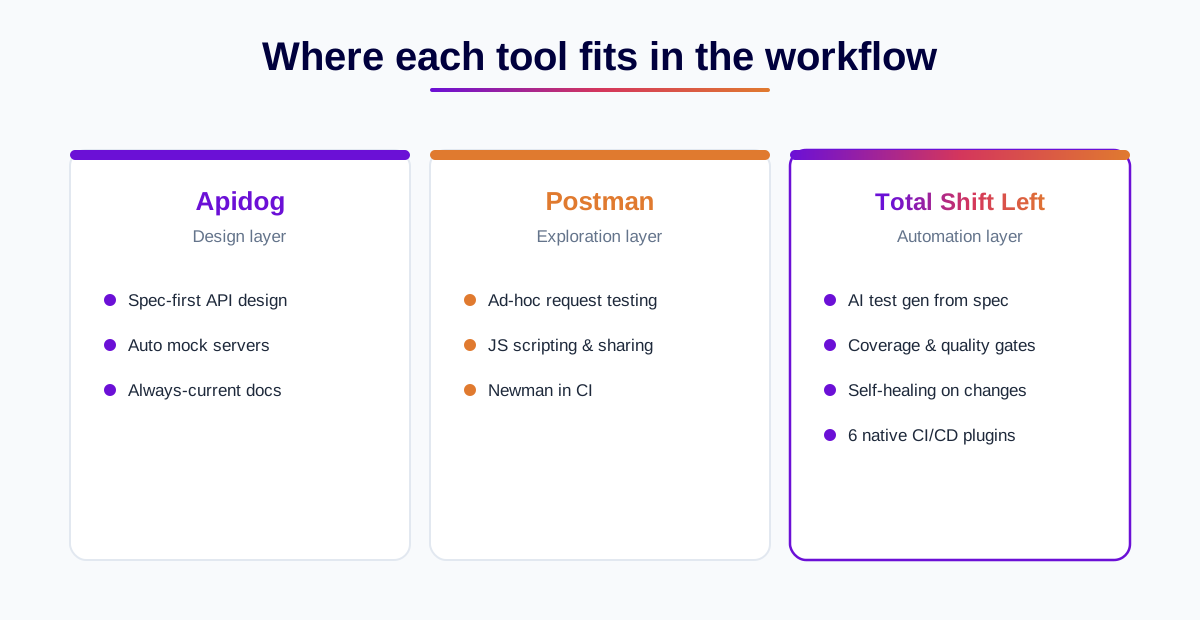
For teams that need to go beyond what Apidog and Postman provide individually, Total Shift Left operates at the automation layer:
AI test generation from the spec. Total Shift Left imports the same OpenAPI specification that Apidog edits or Postman imports — and can bring your existing Postman collections across directly — then generates a complete test suite, not one endpoint at a time, but comprehensive coverage across the entire API surface.
Coverage tracking with quality gates. The platform tracks which endpoints, methods, status codes, and schema properties are tested. Quality gates in CI/CD enforce minimum coverage thresholds, blocking merges that reduce API test coverage.
Self-healing on spec changes. When Apidog users update their spec or Postman users modify their collection, Total Shift Left detects the changes and regenerates affected tests. No manual assertion updates.
CI/CD-native execution. First-party Jenkins and Azure DevOps plugins run the generated suite as a pipeline step with configurable quality gates. GitHub Actions, GitLab CI, CircleCI, and Bitbucket Pipelines connect via the public REST API.
The practical workflow for many teams in 2026: use Apidog or Postman for design and exploration, use Total Shift Left for automated testing and CI/CD quality enforcement.
Real-World Example: Migrating Off Hand-Authored Collections
A regulated insurer (anonymized) ran 12 engineering teams and 180 microservices on hand-authored Postman collections, with $700K+ in annual cost-of-quality leaks attributable to API contract drift. The migration ran over two quarters:
- Month 1 — Imported OpenAPI specs into a spec-driven platform. AI generated 82% baseline test coverage in two days.
- Month 2 — Wired a CI plugin into the shared pipeline library. Contract gates started blocking merges on schema drift.
- Months 3–6 — Migrated 14,000 hand-authored collection assertions to spec-driven tests and decommissioned the Newman-based CI jobs.
Results: a 47% reduction in defect-fix cost, 62% less engineer time spent on test authoring, 70% less audit-prep time (contract proofs generated automatically instead of assembled by hand), and roughly 30,000 engineering hours redirected to product work. Postman collections remained in use for ad-hoc exploration — only the automation layer moved.
Apidog Alternatives
Apidog is one of several tools competing for the API-first design-and-test workflow. If Apidog's specific trade-offs don't fit your team, the realistic alternatives are:
- Postman — the default choice if ecosystem maturity, the public collection library, and JavaScript scripting flexibility matter more than spec-first design. See the comparison above.
- Total Shift Left — for teams whose bottleneck is automated test generation and CI/CD enforcement rather than design collaboration. Complements either Apidog or Postman rather than replacing the design workflow.
- Stoplight — a design-first platform similar in philosophy to Apidog, with a stronger focus on style-guide governance across large API portfolios; lighter on execution/testing than either Apidog or Postman.
- Insomnia — a lighter-weight, developer-focused REST client with OpenAPI support; a reasonable fit for smaller teams that find Postman's enterprise features unnecessary but don't need Apidog's mock-server depth.
- ReadyAPI (SmartBear) — the enterprise incumbent for teams with heavy SOAP/WSDL requirements alongside REST, with mature load-testing built in; higher cost and steeper learning curve than Apidog.
Free Interactive spreadsheet + guide
Test Automation ROI Calculator
Quantify the ROI of test automation for your team. Input your team size, bug rates, and fix times — get projected savings in hours and dollars.
Download FreeFor a broader field of Postman alternatives specifically (not just Apidog), see best Postman alternatives for API testing.
Choosing Between Apidog and Postman
Choose Apidog if:
- Your team practices API-first design
- Spec drift between design and testing is a recurring problem
- You want mock servers that stay current with your spec automatically
- You are starting a new project without existing Postman investment
Choose Postman if:
- You need access to the largest public API collection library
- Your team relies on complex JavaScript test scripting
- You have existing collections and CI pipelines built on Newman
- Enterprise adoption and vendor stability are primary concerns
Add Total Shift Left when:
- You need automated test generation covering your full API surface
- Coverage tracking and quality gates are required in CI/CD
- Manual test maintenance is consuming significant engineering time
- Contract compliance must be enforced programmatically
Best Practices When Evaluating
- ✔ Bring your real OpenAPI spec to any demo or trial, not a sample spec
- ✔ Time how long it takes to get from spec import to a working mock server and a running test
- ✔ Try the CI integration end-to-end in a throwaway repo, not just a screenshot in a sales deck
- ✔ Check whether spec changes propagate to mocks and docs automatically, or require a manual re-sync
- ✔ If evaluating automated testing on top of either tool, verify coverage tracking (endpoints, methods, status codes) and that quality gates actually fail builds, not just report
- ✔ For regulated environments, verify self-hosted or on-prem deployment options before committing to enterprise pricing
- ✔ Pilot on one team for 2–4 weeks before a wider rollout; measure time-to-first-passing-test, not just feature checkboxes
Moving a collection between the two (and to OpenAPI)
Both tools import and export the same two formats, so the lock-in question is really about which format you treat as the source of truth. Exporting a Postman collection to OpenAPI is the step that makes either tool replaceable:
# Postman collection -> OpenAPI 3 (the portable artifact)
npx postman-to-openapi ./Orders.postman_collection.json -f openapi.yaml

# OpenAPI 3 -> Postman collection (what Apidog and Postman both import)
npx openapi-to-postmanv2 -s openapi.yaml -o Orders.postman_collection.json -p

# run either one headlessly in CI
npx newman run Orders.postman_collection.json \
  -e staging.postman_environment.json \
  --reporters cli,junit --reporter-junit-export results.xml
Review the generated spec before trusting it — a converted collection only describes the requests that happened to be saved in it, not the full contract the API actually supports.
Apidog vs Postman FAQ
Is Apidog better than Postman?
Apidog is better for teams that want a unified API-first workflow where design, documentation, mocking, and testing share the same spec. Postman is better for teams that prioritize ad-hoc exploration, large public API collections, and established JavaScript scripting workflows.
Can I import Postman collections into Apidog?
Yes. Apidog supports direct import of Postman collections, converting them into its spec-driven format. The import preserves requests and basic assertions, though JavaScript test scripts may need adaptation to Apidog's assertion model.
What does Total Shift Left add beyond Apidog and Postman?
Total Shift Left adds AI-powered test suite generation from OpenAPI specs, self-healing tests, CI/CD quality gates with coverage thresholds, and contract validation. It operates at the automation layer that neither Apidog's lightweight testing nor Postman's scripted collections fully address at enterprise scale.
Which tool is cheapest — Apidog, Postman, or Total Shift Left?
Free tiers vary by what they meter. Postman caps collection runs at 25/month, which a team running frequent CI executions can hit quickly. Apidog's free tier is the most generous for solo users and isn't run-limited. Total Shift Left's Citizen Developer Edition is forever-free for one user with full AI test generation up to 50 endpoints. Compare based on your actual usage pattern, not the sticker price.
Are Apidog and Total Shift Left open source?
Neither is open source. Both have free tiers — Apidog has a generous SaaS free tier for solo users; Total Shift Left has a forever-free Citizen Developer Edition (single user, no expiry) plus a 15-day Enterprise trial.
Sources and further reading
- Apidog documentation — Apidog's own reference for design, mock and test features.
- Postman Learning Center — Postman's own documentation for collections and scripts.
- OpenAPI Specification — the normative spec for describing HTTP APIs.
Key takeaways
- Both tools import and export OpenAPI, so the lock-in question is which format your team treats as the source of truth — keep it the spec, and either tool becomes replaceable.
- Apidog bundles design, mocking, testing and documentation in one place; Postman has the larger ecosystem, the deeper CI story via Newman, and the higher price at team scale.
- Offline and self-hosted use is where the two differ most, and it is the requirement most teams discover after they have already standardised.
- Neither tool solves the underlying problem of collection-based testing: the suite only covers the requests somebody remembered to save.
- Run the export before you commit to either one. A collection you can convert to a spec is a decision you can reverse.
Ready to shift left with your API testing?
Try our no-code API test automation platform free.