
Enterprise Testing Strategy Guide (2026)
Quick answer
An enterprise testing strategy is an organization-wide framework that standardizes testing practices, tooling, governance, and metrics across dozens of teams via a quality governance council and a shared test platform. By 2026, tests are owned by the team that owns the code — not a central QA function — with API test automation from OpenAPI specs delivering the highest ROI, and test data governed through four patterns: pure synthetic, masked production, tokenized references, and live sandbox APIs.
Reviewed by Parveen Kumari

An enterprise testing strategy is an organization-wide framework that standardizes quality assurance practices, tooling, governance, and metrics across multiple teams, products, and technology stacks. It enables large engineering organizations to maintain consistent quality standards while scaling delivery velocity across dozens or hundreds of development teams.
Scaling software quality is fundamentally different from scaling software development. You can add developers to ship features faster, but without a corresponding investment in testing infrastructure and governance, more developers simply means more defects produced faster. Organizations with over 50 engineers that lack an enterprise testing strategy experience defect escape rates three to four times higher than those with a deliberate, governed approach to quality.
Enterprise software organizations face a testing paradox. As they grow—adding teams, products, services, and technology stacks—the need for testing increases exponentially while the coherence of their testing approach degrades. Individual teams adopt different frameworks, define different quality standards, and measure different metrics. The result is an organization that tests extensively but inconsistently, spending enormous effort on quality without achieving it.
The 2025 Accelerate State of DevOps report found that elite-performing organizations at enterprise scale share one characteristic: a unified testing strategy that provides guardrails without micromanagement. These organizations deploy 973 times more frequently than low performers while maintaining change failure rates below 5%.
This guide is written for CTOs, VP Engineering, QA Directors, and platform engineering leaders who need to build or overhaul an enterprise testing strategy. It covers the governance model, shared platform approach, tooling standards, and metrics framework required to scale quality across a large engineering organization. If you are building on DevOps testing principles, this guide shows you how to extend them enterprise-wide.
In this guide
- What Is an Enterprise Testing Strategy?
- Why Enterprises Need a Dedicated Testing Strategy
- Key Components of an Enterprise Testing Strategy
- Test Management: RACI and the Modern QA Operating Model
- Test Data Management at Enterprise Scale
- Enterprise Testing Architecture
- Tools for Enterprise Test Automation
- Enterprise testing strategy in practice: a worked example
- Enterprise testing strategy challenges and how to solve them
- Enterprise testing strategy best practices
- Enterprise Testing Strategy Checklist
- One strategy document, many teams, no per-team rewrite
- Enterprise testing strategy FAQ
What Is an Enterprise Testing Strategy?
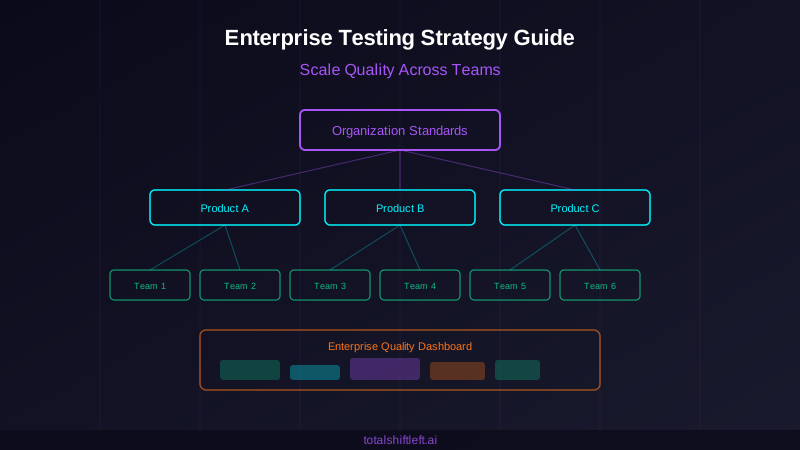
An enterprise testing strategy is a multi-layered framework that operates at three levels simultaneously:
Organization Level: Defines the quality vision, governance structure, approved tool catalog, and enterprise-wide metrics. This level is owned by a quality governance council or architecture team and applies to all products and teams.
Product Level: Translates organizational standards into product-specific test plans, coverage targets, and quality gates. Product teams define their own test architectures within the guardrails set by the organization.
Team Level: Individual teams implement the strategy through their daily testing practices, CI/CD configurations, and sprint-level quality activities. Teams have autonomy over test implementation details while adhering to organizational and product standards.
This three-level structure balances standardization with autonomy. Without organizational standards, chaos emerges. Without team autonomy, innovation stalls and adoption fails. The enterprise testing strategy is the mechanism that holds these forces in balance.
Unlike a software testing strategy for a single application, an enterprise strategy must account for multiple technology stacks, varying team maturity levels, organizational politics, and the coordination overhead inherent in large organizations. It is as much a governance and cultural initiative as a technical one.
Regulated programmes usually need the mapping written down as well as run — the requirements traceability matrix for API testing shows how to generate it from tagged tests instead of a spreadsheet.
SAP and S/4HANA integrations follow the same pattern with OData-specific wrinkles — see shift-left API testing for SAP.
Estates that still run SOAP alongside REST need a second toolchain — SOAP and WSDL testing in 2026 covers what is still maintained and what WS-Security costs you.
Where a platform team owns the harness rather than the tests, testing strategy for platform engineering covers the golden-path model.
If the layer boundaries are the open question, unit vs integration vs system testing covers them with examples.
Why Enterprises Need a Dedicated Testing Strategy
Team Proliferation Creates Quality Fragmentation
When an organization grows from five teams to fifty, each team makes independent decisions about testing tools, practices, and standards. One team uses Jest with 90% coverage targets. Another uses Mocha with no coverage requirement. A third team writes no automated tests at all. The enterprise has no way to assess overall quality or identify systemic risks because there is no common language or measurement framework.
Microservices Multiply Integration Risk
Enterprise applications typically consist of hundreds of microservices owned by different teams. Each service may pass its own tests while breaking downstream consumers. Without enterprise-wide contract testing standards and cross-team integration test coordination, defects hide in the seams between services.
Compliance and Audit Requirements Demand Consistency
Regulated enterprises in finance, healthcare, and government must demonstrate testing rigor to auditors and regulators. A fragmented testing approach makes compliance evidence collection painful and error-prone. An enterprise strategy that standardizes testing practices, metrics, and documentation simplifies compliance from a months-long ordeal to an automated report.
Tool Sprawl Wastes Engineering Budget
Without a curated tool catalog, enterprises accumulate dozens of overlapping test tools, each with its own license cost, training requirement, and maintenance burden. An enterprise strategy consolidates tooling to reduce cost, improve team mobility, and concentrate expertise. This is especially critical when building test automation frameworks at scale.
Key Components of an Enterprise Testing Strategy
Quality Governance Council
Establish a cross-functional council that owns the enterprise testing strategy. Members should include senior QA architects, platform engineering leads, security engineers, and development team representatives. The council meets monthly to review quality metrics, approve tool changes, and address systemic quality issues.
The council's responsibilities include:
- Defining enterprise-wide quality standards and metrics
- Maintaining the approved tool catalog
- Reviewing and approving exceptions to standards
- Conducting quarterly testing strategy reviews
- Publishing enterprise quality dashboards
Shared Test Platform
Build a centralized test platform that provides teams with pre-configured CI/CD templates, standard test frameworks, shared test data services, and environment provisioning. The platform reduces the effort required for each team to implement the testing strategy from weeks to days.
The platform should include:
- CI/CD pipeline templates with pre-configured quality gates
- Container-based test execution infrastructure
- Shared service virtualization and mock services
- Test data management APIs
- Centralized test reporting and analytics
Standardized Test Taxonomy
Define a common vocabulary for test types across the organization. When one team calls something an "integration test" and another calls the same thing a "component test," cross-team communication breaks down. Establish clear definitions for unit tests, component tests, contract tests, integration tests, end-to-end tests, performance tests, and security tests.
API Testing Automation at Scale
In a microservices enterprise, APIs are the integration fabric. Automating API testing across all services provides the highest return on investment because it catches the most impactful class of defects—contract violations and integration failures—at a fraction of the cost of end-to-end testing. Generating suites directly from each service's OpenAPI specification removes the manual authoring bottleneck that otherwise caps how far this scales. Shift-Left API enables enterprise-wide API test automation by generating tests directly from OpenAPI specifications, eliminating the need for each team to manually author API test suites.
Ready to shift left with your API testing?
Try our no-code API test automation platform free. Generate tests from OpenAPI, run in CI/CD, and scale quality.
Cross-Team Contract Testing
Mandate contract testing between all services that communicate through APIs. Use consumer-driven contracts so that changes to a provider service are validated against all kn
own consumer expectations before deployment. This is the single most effective practice for preventing integration defects at enterprise scale.
Enterprise Quality Metrics Framework
Define metrics at each level of the strategy:
- Organization: Overall defect escape rate, mean deployment frequency, change failure rate, test platform adoption rate
- Product: Product-level coverage, test execution time, flaky test rate, defect density by component
- Team: Sprint-level quality metrics, code coverage by service, test authoring velocity
Test Management: RACI and the Modern QA Operating Model
Test management at enterprise scale is an operating-model question, not a tool question. Traditional test management tools — Jira-style hierarchies of test cases owned by a central QA team — were built for an era of manual execution. They collapse at modern scale for three reasons: volume (a bank with 800 internal APIs releasing daily can't maintain hand-written test cases at the rate APIs change), ownership (tests written by a central QA team about a backend they don't own drift out of date the moment that backend ships a refactor), and audit alignment (auditors increasingly expect tests as code, in version control, with retained run history — not test cases in a ticket database).
The model that scales in 2026: tests are owned by the team that owns the code. Engineering owns unit, integration, and API tests. Security owns security tests. SRE owns chaos and resilience tests. The QA function's role shifts from executing tests to defining standards, operating a centralized evidence aggregation, and being the audit interface — the single point of contact when an auditor asks for evidence across the organization.
A practical RACI for enterprise API testing under this model:
| Activity | Engineering | QA function | Security | Platform |
|---|---|---|---|---|
| Author tests for own APIs | R / A | C | C | I |
| Define coverage standards | C | R / A | C | I |
| Define gating policy | C | A | R | C |
| Operate the test platform | I | C | I | R / A |
| Operate evidence aggregation | I | A | I | R |
| Run audit evidence requests | C | R / A | C | C |
| Investigate test failures | R / A | C | I | C |
The most common failure mode is the QA function trying to be Responsible for the activities marked R/A on Engineering — that's the trap behind a generation of stalled QA programs.
This model also changes which metrics matter. Replace activity metrics (test count, author count, execution count — they only tell you the function is busy) with outcome metrics: API coverage against the floor (percentage of in-scope APIs meeting the standard), test pass rate trend, mean time to detect regressions (from "regression introduced" to "regression caught by a test"), and audit evidence completeness per release. A phased rollout — standards and evidence aggregation first, then golden-path adoption, then reorganizing the QA function itself — typically takes 18-24 months; reorganizing before the standards and aggregation are working is the biggest risk, since the function loses leverage and the standards never establish.
Test Data Management at Enterprise Scale
Test data at enterprise scale is a platform engineering problem, not a QA problem. Each team hand-cloning slices of production into test environments fails three ways: every environment with production-derived data carries the same regulatory weight as production (hundreds of environments × full compliance scope is unmanageable), hand-built fixtures miss the edge cases AI-driven test generation could otherwise discover, and teams needing linked data across services end up re-creating the linkage manually or sharing data that should stay siloed.
The framework most enterprises converge on has four patterns, chosen by data class and use case, with default-deny on production data unless explicitly justified:
| Pattern | Compliance scope | Best for |
|---|---|---|
| Pure synthetic | None | New features, AI-driven generation, cross-team integration tests |
| Masked production copy | Reduced (depending on masking) | Regression of complex production-only data shapes |
| Tokenized references | Pushed to vault | Cross-system integration tests where linkage matters |
| Live sandbox APIs | Vendor scope | Payment processors, identity providers, third-party APIs |
Synthetic wins for most cases: schema-aware generators that respect referential integrity and domain constraints, AI-assisted generation that infers patterns from production statistics without copying records, and domain-specific libraries (FHIR, X12, ISO 20022) now cover most regulated-domain needs. Masking still earns its place for long-tail production behaviors that synthetic generation can't approximate — with three guardrails: mask in-region and in-boundary (never send production data to a third-party masking service outside your authorization boundary), validate masking strength periodically against re-identification techniques, and preserve referential integrity so a masked ID resolves the same way across every table and service.
Governance is what makes this durable rather than ad hoc: default-deny on production data with an explicit, audited approval workflow per use case; only the platform team's reviewed masking pipeline approved for production-derived data; every test environment tagged with the categories of data it can hold, verified before populating. For deeper coverage of the masking guardrails specifically, see data masking for regulated test environments.
Enterprise Testing Architecture
The enterprise testing architecture extends the testing architecture for scalable systems with governance, platform, and reporting layers.
Governance Layer: Standards enforcement engine that validates pipeline configurations, coverage thresholds, and quality gate compliance. This layer runs as part of CI/CD and rejects configurations that do not meet enterprise standards.
Platform Layer: Shared infrastructure services including test execution clusters, service virtualization, test data management, and environment provisioning. Managed by the platform engineering team and consumed by product teams through APIs and CLI tools.
Execution Layer: Team-owned test suites running in team-owned pipelines. Each team configures their pipeline using enterprise templates and executes their tests against the platform layer's infrastructure.
Reporting Layer: Centralized analytics that aggregates test results, coverage metrics, and quality indicators from all teams into enterprise dashboards. Powers quality governance reviews and compliance reporting.
The architecture supports a federated model where teams own their test execution while the platform team owns the shared infrastructure. This avoids the bottleneck of a centralized QA team while maintaining organizational consistency.
Tools for Enterprise Test Automation
| Tool | Type | Best For | Open Source |
|---|---|---|---|
| Shift-Left API | API Testing | Enterprise-wide API test generation from OpenAPI specs | No |
| Pact Broker | Contract Testing | Centralized contract management across teams | Yes |
| Playwright | E2E Testing | Standardized cross-browser testing framework | Yes |
| k6 | Performance Testing | Scalable load testing with code-based scenarios | Yes |
| SonarQube Enterprise | Code Quality | Organization-wide code quality and coverage tracking | No |
| Testcontainers Cloud | Integration Testing | Shared container-based test infrastructure | No |
| Allure TestOps | Test Reporting | Enterprise test analytics and reporting | No |
| LaunchDarkly | Feature Flags | Progressive rollout and testing in production | No |
| Grafana | Observability | Test metrics dashboards and alerting | Yes |
| GitLab Ultimate / GitHub Enterprise | CI/CD | Pipeline templates and governance enforcement | No |
| OWASP ZAP | Security Testing | Automated security scanning in pipelines | Yes |
| Terraform Cloud | Infrastructure Testing | Enterprise infrastructure validation | No |
Enterprise testing strategy in practice: a worked example
Problem: A global insurance company with 200 engineers across 30 teams was releasing quarterly due to a six-week manual regression testing cycle. Each team had its own testing tools and practices. Integration defects were discovered in staging two weeks before release, causing emergency fixes and delayed deployments. Annual testing tool licenses cost $2.1 million across duplicated tools.
Free Guided worksheet
Build Your Testing Strategy in 30 Minutes
A structured worksheet that walks you through defining your testing strategy in 30 minutes. Cover architecture, tools, layers, and team responsibilities.
Download FreeSolution: They implemented an enterprise testing strategy over six months:
- Formed a quality governance council with representatives from each product line.
- Built a shared test platform on Kubernetes providing CI/CD templates, test execution infrastructure, and service virtualization.
- Standardized on five core tools: JUnit for unit tests, Shift-Left API for API test automation, Pact for contract testing, Playwright for E2E tests, and k6 for performance testing.
- Mandated contract testing between all service pairs with enforcement in CI/CD pipelines.
- Created an enterprise quality dashboard aggregating metrics from all 30 teams.
- Eliminated manual regression testing by automating the top 50 business-critical journeys.
Results: Release cadence moved from quarterly to weekly within six months. Integration defects dropped by 78%. Tool licensing costs decreased from $2.1M to $800K annually through consolidation. Mean time to detect defects fell from 14 days to 4 hours. All 30 teams achieved the enterprise quality baseline within three months of platform launch.
Enterprise testing strategy challenges and how to solve them
Challenge: Resistance to Standardization
Teams with established practices resist adopting new tools and standards. Senior engineers view standardization as an infringement on their autonomy.
Solution: Involve team leads in the governance council so they shape the standards. Frame standardization around shared infrastructure (which saves teams effort) rather than mandated practices (which feel restrictive). Allow a transition period with documented migration paths from legacy tools.
Challenge: Varying Team Maturity Levels
Some teams have sophisticated test automation while others have almost none. A single standard frustrates advanced teams and overwhelms beginners.
Solution: Define a maturity model with three to four levels. Set minimum baselines that all teams must achieve within a quarter. Provide stretch goals for advanced teams. Pair mature teams with developing teams for mentorship. Use the shift-left testing approach to help less mature teams build early testing habits.
Challenge: Cross-Team Integration Test Coordination
Integration tests that span multiple teams require coordination that slows everyone down. Teams wait for other teams to fix their service before integration tests can pass.
Solution: Use contract testing to decouple teams. Each team validates against published contracts independently. Reserve full integration testing for deployment to staging and use service virtualization to simulate dependencies during development.
Challenge: Test Infrastructure Costs at Scale
Running thousands of automated tests across dozens of teams requires significant compute infrastructure. Costs can escalate quickly without governance.
Solution: Use ephemeral test environments that spin up for test execution and tear down immediately after. Implement test impact analysis to reduce redundant test execution. Use spot instances or preemptible VMs for test workloads. Monitor and charge back test infrastructure costs to product teams.
Challenge: Maintaining Enterprise Dashboards
Centralized quality dashboards become stale when teams do not consistently report metrics in the expected format.
Solution: Automate metric collection from CI/CD pipelines rather than requiring manual reporting. Build metric collection into the shared platform templates so that every team that uses the platform automatically reports to the enterprise dashboard.
Enterprise testing strategy best practices
- Establish a quality governance council before defining standards—without organizational buy-in, standards will not be adopted
- Build a shared test platform that makes the right thing the easy thing—teams should adopt standards because the platform saves them effort
- Standardize test taxonomy before standardizing tools—a common vocabulary is more important than common tooling
- Automate API testing enterprise-wide using tools like Shift-Left API that generate tests from specifications—this is the highest-ROI testing investment at enterprise scale
- Mandate contract testing between all service pairs—this is the single most effective practice for preventing integration defects
- Define a testing maturity model with clear levels and achievable milestones for teams at different stages
- Publish enterprise quality metrics on dashboards visible to all engineering leadership
- Conduct quarterly strategy reviews to ensure the testing strategy evolves with the organization
- Invest in test infrastructure as a first-class engineering product, not a side project
- Create golden path templates for CI/CD testing pipelines that teams can adopt with minimal configuration
- Budget for testing tooling and infrastructure at 15-20% of total engineering spend
- Celebrate teams that achieve quality milestones to reinforce the importance of the strategy
Enterprise Testing Strategy Checklist
- ✔ Form a cross-functional quality governance council with executive sponsorship
- ✔ Document the enterprise testing strategy and publish it organization-wide
- ✔ Define a standardized test taxonomy used by all teams
- ✔ Build or procure a shared test platform with CI/CD templates
- ✔ Establish an approved tool catalog with migration paths from legacy tools
- ✔ Mandate API contract testing between all communicating services
- ✔ Deploy enterprise-wide API test automation using Shift-Left API
- ✔ Define a testing maturity model with clear levels and timelines
- ✔ Create enterprise quality dashboards with automated metric collection
- ✔ Establish quality gates in all CI/CD pipelines enforced by the platform
- ✔ Set up cross-team mentorship between mature and developing teams
- ✔ Schedule quarterly testing strategy reviews with the governance council
- ✔ Implement test infrastructure cost monitoring and optimization
- ✔ Create compliance reporting automation for regulated products
One strategy document, many teams, no per-team rewrite
At enterprise scale a strategy is only real if it is executable. Publish the requirements as a versioned policy and a reusable pipeline; let teams inherit rather than reimplement:
# platform/quality-standard.yaml — owned centrally, versioned, reviewed
apiVersion: quality.acme.io/v1
kind: TestingStandard
metadata: { name: enterprise-baseline, version: "2026.3" }
spec:
  layers:
    unit:        { required: true,  coverageMin: 80 }
    contract:    { required: true,  tool: [pact, schemathesis] }
    integration: { required: true,  isolation: testcontainers }
    e2e:         { required: false, maxCases: 15 }   # capped on purpose
  gates:
    breakingApiChange: block
    securityFindings:  { critical: block, high: block, medium: warn }
    p99LatencyMs:      500
  evidence:
    retainDays: 400
    formats: [junit, sarif]
  exceptions:
    process: "PR to this file with an owner and an expiry date"
    maxDurationDays: 90
Exceptions expire by construction — the field is mandatory, so a temporary waiver cannot quietly become the standard.
Enterprise testing strategy FAQ
What is an enterprise testing strategy?
An enterprise testing strategy is an organization-wide framework that standardizes testing practices, tools, governance, and quality metrics across multiple teams, products, and technology stacks. It ensures consistent quality standards while allowing teams the flexibility to adapt practices to their specific context.
How do you scale testing across large engineering organizations?
Scale testing by establishing a shared test platform with standardized tools, frameworks, and CI/CD templates. Create a quality governance council that sets organization-wide standards. Invest in test automation at the API layer for maximum ROI, and measure quality metrics consistently across all teams.
What is the role of a quality governance council?
A quality governance council is a cross-functional group of engineering leaders, QA architects, and DevOps engineers who define and maintain the organization's testing standards. They review quality metrics, approve tool standardization decisions, and ensure the testing strategy evolves with the organization's needs.
How does API test automation help enterprise testing?
API test automation provides the highest ROI at enterprise scale because APIs are the integration layer between all services. Automating API tests with tools like Shift-Left API eliminates manual test creation bottleneck, ensures contract compliance across teams, and scales linearly as services are added.
What metrics should enterprises track for testing effectiveness?
Track defect escape rate to production, mean time to detect defects, test coverage by service, deployment frequency, change failure rate, flaky test percentage, and test execution time. Publish these metrics on shared dashboards and review them in monthly quality reviews.
Sources and further reading
- ISTQB Glossary — the standard vocabulary for test terms.
- DORA State of DevOps research — the multi-year dataset behind the four delivery metrics.
- Martin Fowler — The Practical Test Pyramid — the reference argument for test-layer proportions.
Key takeaways
- An enterprise testing strategy is the difference between an organization that scales quality and one that scales chaos.
- As your engineering organization grows, the testing practices that worked for five teams will not work for fifty.
- Without deliberate governance, shared infrastructure, and consistent metrics, quality degrades as delivery velocity increases.
- Start with governance: form the council, define the standards, and build the shared platform.
- Invest heavily in API test automation—it delivers the highest return at enterprise scale.
- Measure consistently, review quarterly, and evolve the strategy as your organization matures.
If you are ready to automate API testing across your enterprise, start your free trial of Shift-Left API and generate comprehensive API test suites for all your services from OpenAPI specifications—no manual test authoring required.
Related: DevOps Testing Complete Guide | Software Testing Strategy for Modern Applications | Testing Architecture for Scalable Systems | Test Automation Strategy | Building a Testing Center of Excellence | Data Masking for Regulated Test Environments | API Quality Gates: What to Measure | What Is Shift Left Testing? | Automated Testing in CI/CD
Ready to shift left with your API testing?
Try our no-code API test automation platform free.